Page 58 of 655
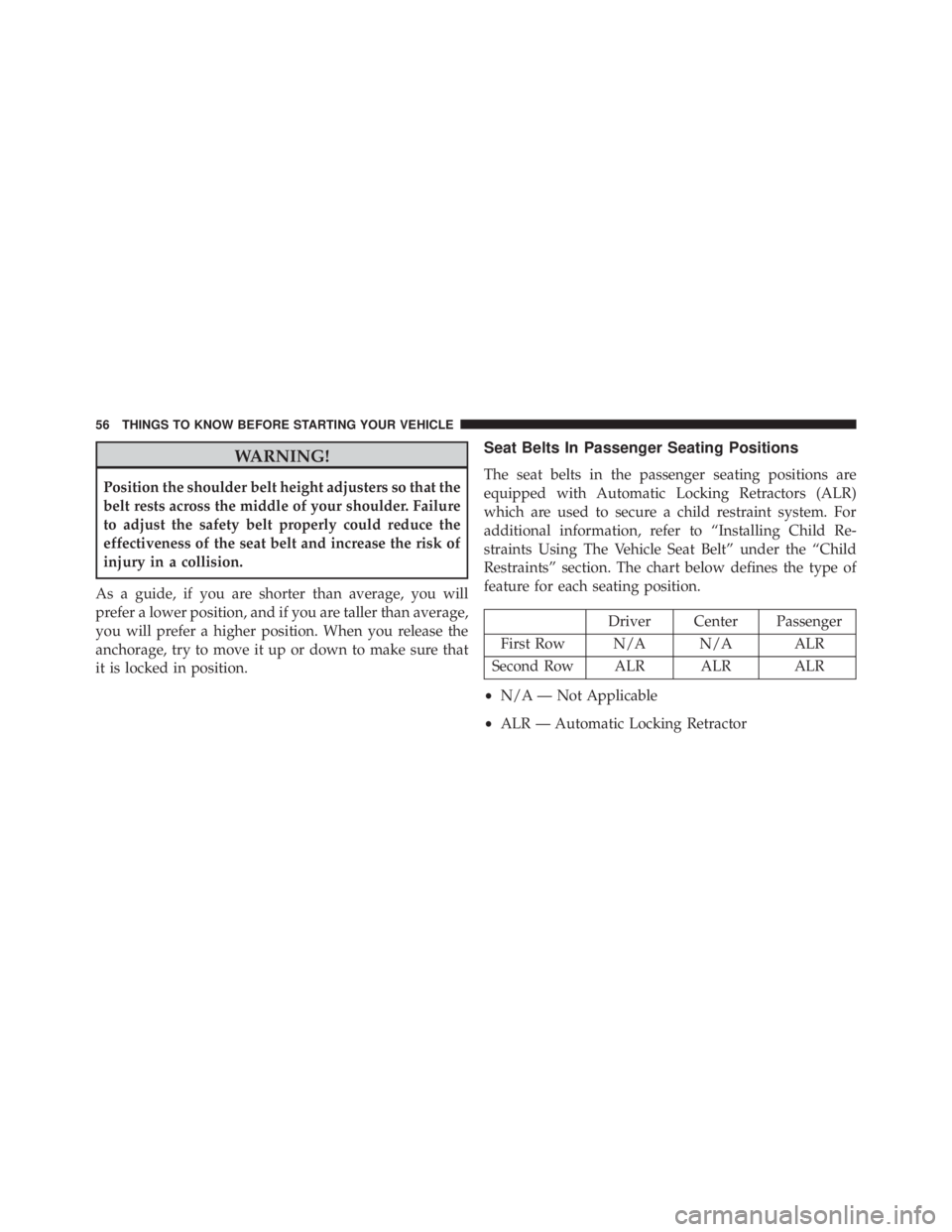
WARNING!Position the shoulder belt height adjusters so that the
belt rests across the middle of your shoulder. Failure
to adjust the safety belt properly could reduce the
effectiveness of the seat belt and increase the risk of
injury in a collision.
As a guide, if you are shorter than average, you will
prefer a lower position, and if you are taller than average,
you will prefer a higher position. When you release the
anchorage, try to move it up or down to make sure that
it is locked in position. Seat Belts In Passenger Seating Positions
The seat belts in the passenger seating positions are
equipped with Automatic Locking Retractors (ALR)
which are used to secure a child restraint system. For
additional information, refer to “Installing Child Re-
straints Using The Vehicle Seat Belt” under the “Child
Restraints” section. The chart below defines the type of
feature for each seating position.
Driver Center Passenger
First Row N/A N/A ALR
Second Row ALR ALR ALR
• N/A — Not Applicable
• ALR — Automatic Locking Retractor56 THINGS TO KNOW BEFORE STARTING YOUR VEHICLE
Page 60 of 655
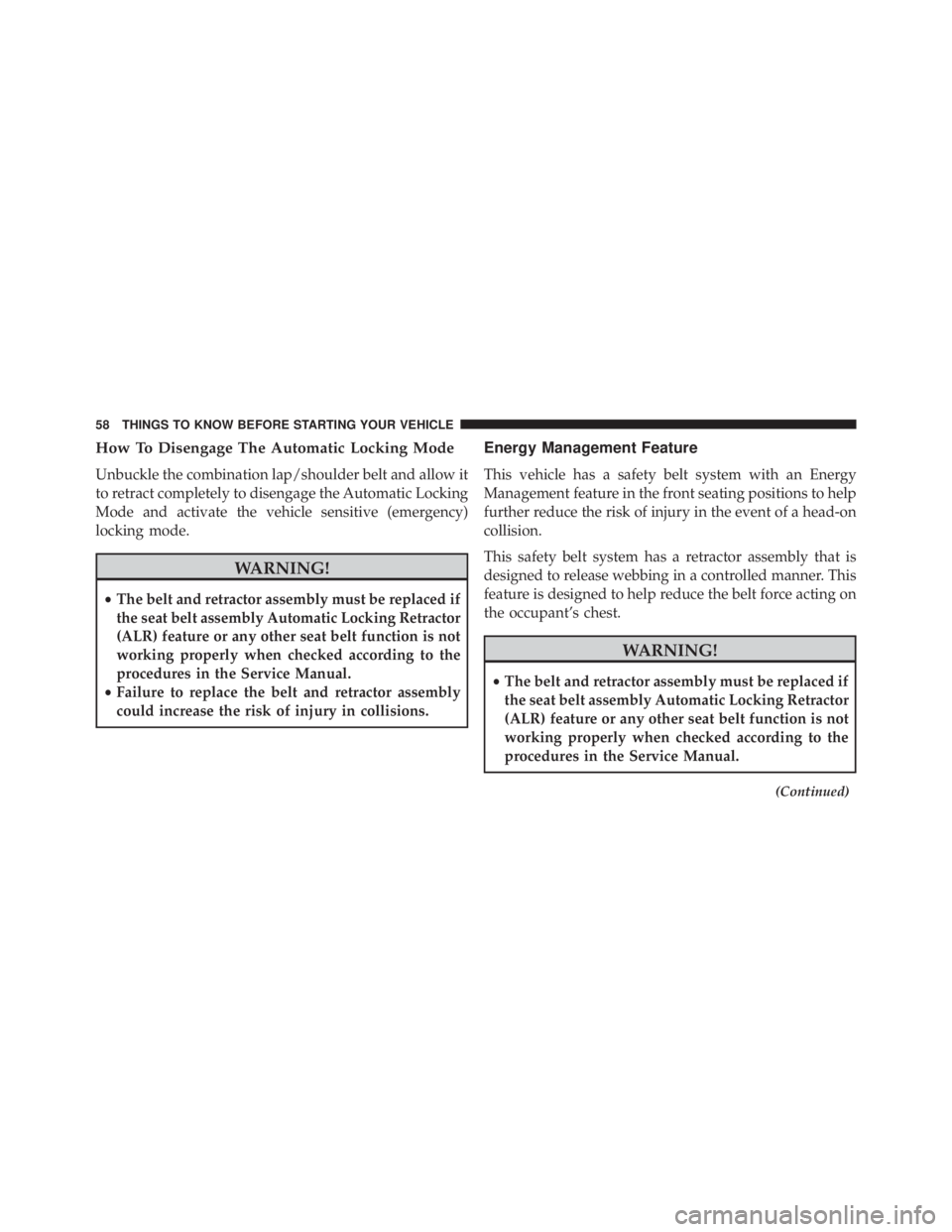
How To Disengage The Automatic Locking Mode
Unbuckle the combination lap/shoulder belt and allow it
to retract completely to disengage the Automatic Locking
Mode and activate the vehicle sensitive (emergency)
locking mode.
WARNING!• The belt and retractor assembly must be replaced if
the seat belt assembly Automatic Locking Retractor
(ALR) feature or any other seat belt function is not
working properly when checked according to the
procedures in the Service Manual.
• Failure to replace the belt and retractor assembly
could increase the risk of injury in collisions. Energy Management Feature
This vehicle has a safety belt system with an Energy
Management feature in the front seating positions to help
further reduce the risk of injury in the event of a head-on
collision.
This safety belt system has a retractor assembly that is
designed to release webbing in a controlled manner. This
feature is designed to help reduce the belt force acting on
the occupant’s chest.
WARNING!• The belt and retractor assembly must be replaced if
the seat belt assembly Automatic Locking Retractor
(ALR) feature or any other seat belt function is not
working properly when checked according to the
procedures in the Service Manual. (Continued)58 THINGS TO KNOW BEFORE STARTING YOUR VEHICLE
Page 61 of 655
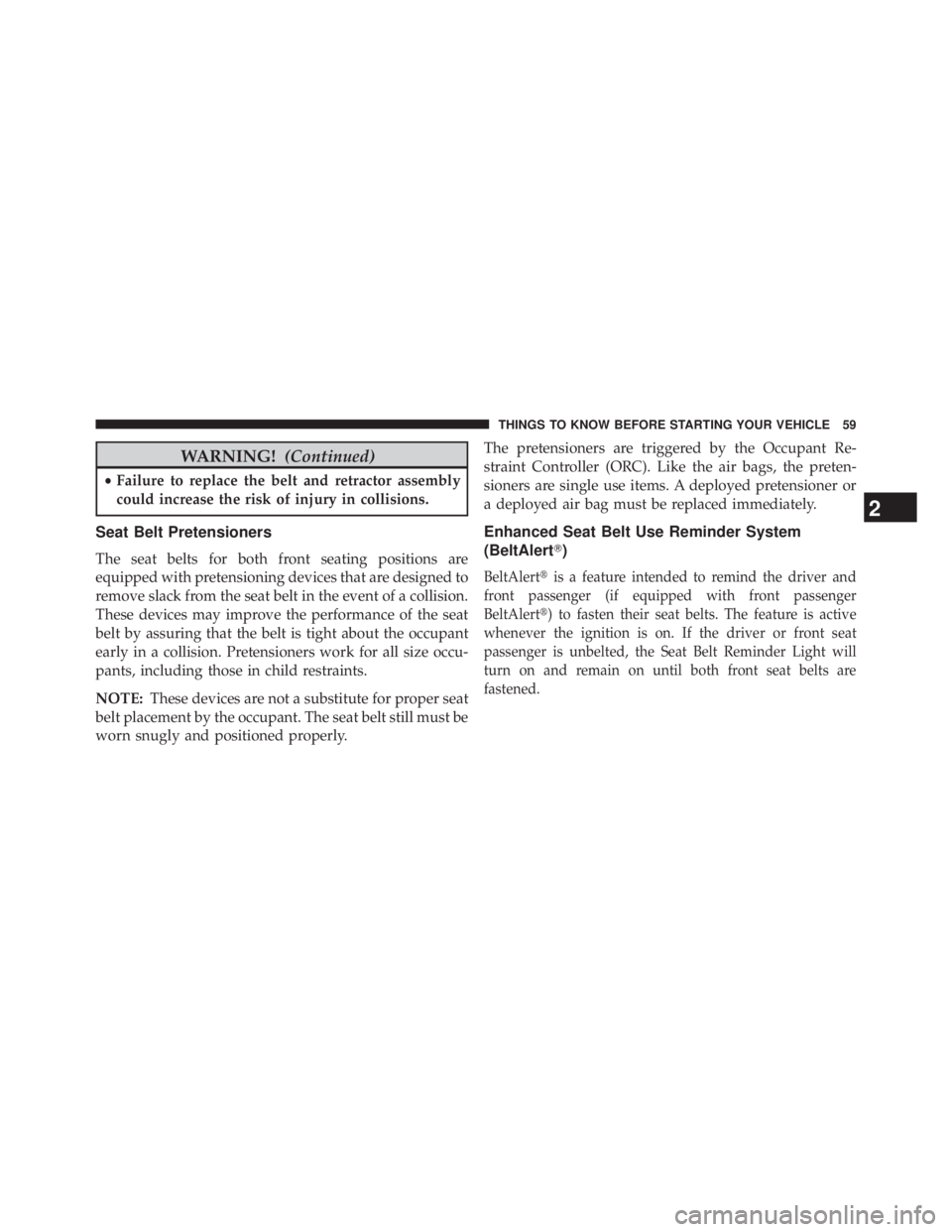
WARNING! (Continued)• Failure to replace the belt and retractor assembly
could increase the risk of injury in collisions.
Seat Belt Pretensioners
The seat belts for both front seating positions are
equipped with pretensioning devices that are designed to
remove slack from the seat belt in the event of a collision.
These devices may improve the performance of the seat
belt by assuring that the belt is tight about the occupant
early in a collision. Pretensioners work for all size occu-
pants, including those in child restraints.
NOTE: These devices are not a substitute for proper seat
belt placement by the occupant. The seat belt still must be
worn snugly and positioned properly. The pretensioners are triggered by the Occupant Re-
straint Controller (ORC). Like the air bags, the preten-
sioners are single use items. A deployed pretensioner or
a deployed air bag must be replaced immediately.
Enhanced Seat Belt Use Reminder System
(BeltAlert � )
BeltAlert � is a feature intended to remind the driver and
front passenger (if equipped with front passenger
BeltAlert � ) to fasten their seat belts. The feature is active
whenever the ignition is on. If the driver or front seat
passenger is unbelted, the Seat Belt Reminder Light will
turn on and remain on until both front seat belts are
fastened.
2 THINGS TO KNOW BEFORE STARTING YOUR VEHICLE 59
Page 62 of 655

The BeltAlert � warning sequence begins after the vehicle
speed is over 5 mph (8 km/h), by blinking the Seat Belt
Reminder Light and sounding an intermittent chime.
Once the sequence starts, it will continue for the entire
duration or until the respective seatbelts are fastened.
After the sequence completes, the Seat Belt Reminder
Light remains illuminated until the respective seat belts
are fastened. The driver should instruct all other occu-
pants to fasten their seat belts. If a front seat belt is
unbuckled while traveling at speeds greater than 5 mph
(8 km/h), BeltAlert � will provide both audio and visual
notification. The front passenger seat BeltAlert � is not active when the
front passenger seat is unoccupied. BeltAlert � may be
triggered when an animal or heavy object is on the front
passenger seat or when the seat is folded flat (if
equipped). It is recommended that pets be restrained in
the rear seat in pet harnesses or pet carriers that are
secured by seat belts, and cargo is properly stowed.
BeltAlert � can be enabled or disabled by your authorized
dealer. Chrysler Group LLC does not recommend deac-
tivating BeltAlert � .
NOTE: Although BeltAlert � has been deactivated, the
Seat Belt Reminder Light will continue to illuminate
while the driver ’s or front passenger (if equipped with
BeltAlert � ) seat belt remains unfastened.60 THINGS TO KNOW BEFORE STARTING YOUR VEHICLE
Page 63 of 655
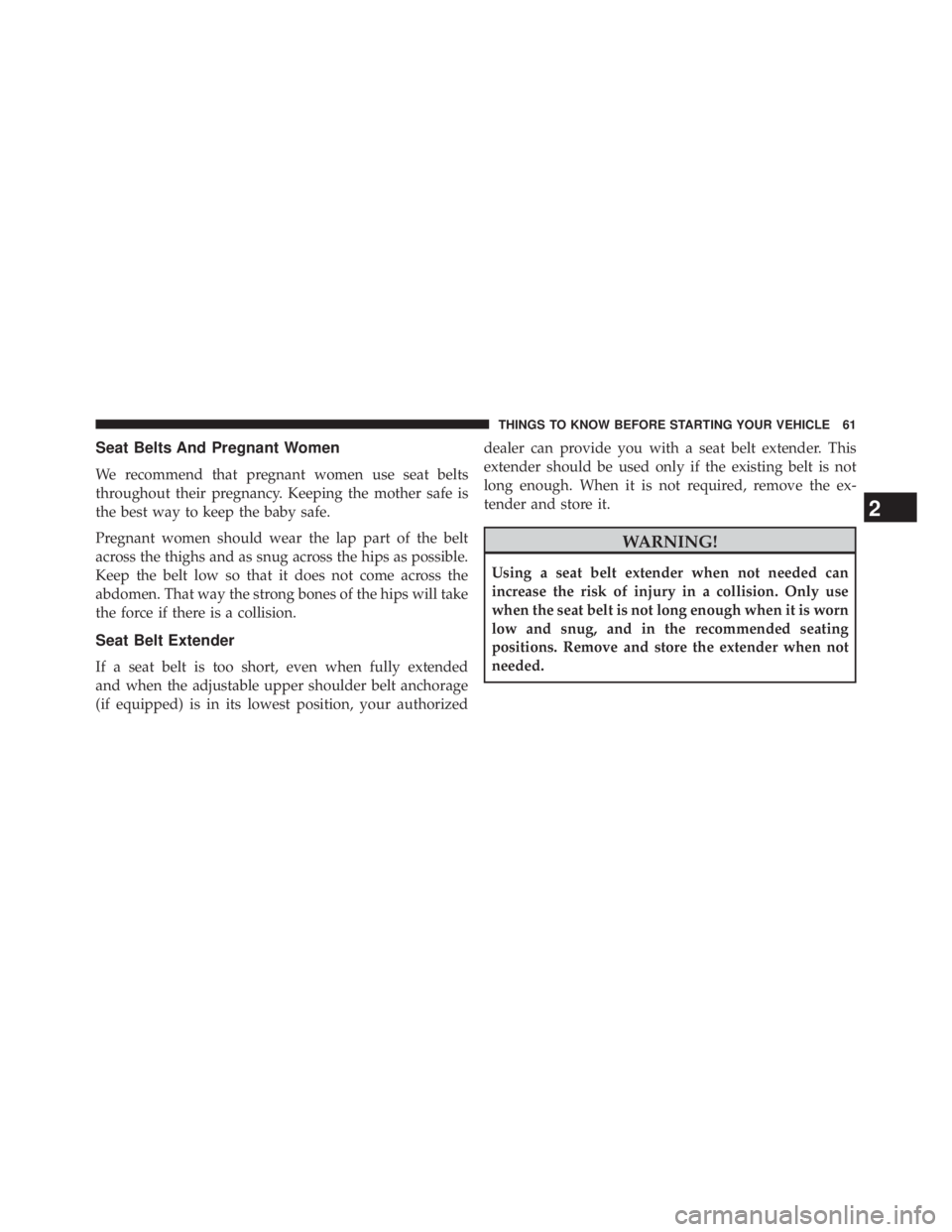
Seat Belts And Pregnant Women
We recommend that pregnant women use seat belts
throughout their pregnancy. Keeping the mother safe is
the best way to keep the baby safe.
Pregnant women should wear the lap part of the belt
across the thighs and as snug across the hips as possible.
Keep the belt low so that it does not come across the
abdomen. That way the strong bones of the hips will take
the force if there is a collision.
Seat Belt Extender
If a seat belt is too short, even when fully extended
and when the adjustable upper shoulder belt anchorage
(if equipped) is in its lowest position, your authorized dealer can provide you with a seat belt extender. This
extender should be used only if the existing belt is not
long enough. When it is not required, remove the ex-
tender and store it.
WARNING!Using a seat belt extender when not needed can
increase the risk of injury in a collision. Only use
when the seat belt is not long enough when it is worn
low and snug, and in the recommended seating
positions. Remove and store the extender when not
needed.
2 THINGS TO KNOW BEFORE STARTING YOUR VEHICLE 61
Page 66 of 655
Air Bag System Components
Your vehicle may be equipped with the following air bag
system components:
• Occupant Restraint Controller (ORC)
• Air Bag Warning Light
• Steering Wheel and Column
• Instrument Panel
• Knee Impact Bolster
• Driver Advanced Front Air Bag
• Passenger Advanced Front Air Bag
• Supplemental Seat-Mounted Side Air Bags (SAB)
• Front and Side Impact Sensors
• Front Seat Belt Pretensioners, Seat Belt Buckle Switch,
and Seat Track Position Sensors Advanced Front Air Bag Features
The Advanced Front Air Bag system has multistage
driver and front passenger air bags. This system provides
output appropriate to the severity and type of collision as
determined by the Occupant Restraint Controller (ORC),
which may receive information from the front impact
sensors.
The first stage inflator is triggered immediately during an
impact that requires air bag deployment. This low output
is used in less severe collisions. A higher energy output is
used for more severe collisions.
WARNING!• No objects should be placed over or near the air bag
on the instrument panel, because any such objects
could cause harm if the vehicle is in a collision
severe enough to cause the air bag to inflate. (Continued)64 THINGS TO KNOW BEFORE STARTING YOUR VEHICLE
Page 67 of 655
WARNING! (Continued)• Do not put anything on or around the air bag
covers or attempt to open them manually. You may
damage the air bags and you could be injured
because the air bags may no longer be functional.
The protective covers for the air bag cushions are
designed to open only when the air bags are
inflating.
• If your vehicle is equipped with Supplemental
Seat-Mounted Side Air Bags (SAB), do not use
accessory seat covers or place objects between you
and the SAB; the performance could be adversely
affected and/or objects could be pushed into you,
causing serious injury. (Continued) WARNING! (Continued)• If your vehicle is equipped with SAB, do not attach
cupholders or any other objects on or around the
door. The inflating SAB could drive the objects
into occupants, causing serious injury.
• Do not cover or place items on the air bag covers.
These items may cause serious injury during infla-
tion.
• Do not drill, cut or tamper with the knee bolster in
any way.
• Do not mount any accessories to the knee bolster
such as alarm lights, stereos, citizen band radios,
etc.
2 THINGS TO KNOW BEFORE STARTING YOUR VEHICLE 65
Page 70 of 655

The side air bags will not deploy in all side collisions.
Side air bag deployment will depend on the severity and
type of collision.
Because air bag sensors measure vehicle deceleration
over time, vehicle speed and damage by themselves are
not good indicators of whether or not an air bag should
have deployed.
Seat belts are necessary for your protection in all crashes,
and also are needed to help keep you in position, away
from an inflating air bag.
The ORC also monitors the readiness of the electronic
parts of the air bag system whenever the ignition switch
is in the START or ON/RUN positions. If the key is in the
LOCK position, in the ACC position, or not in the
ignition, the air bag system is not on and the air bags will
not inflate. The ORC contains a backup power supply system that
may deploy the air bags even if the battery loses power or
it becomes disconnected prior to deployment.
Also, the ORC turns on the Air Bag Warning
Light for four to eight seconds for a self-check
when the ignition is first turned on. After the
self-check, the Air Bag Warning Light will turn
off. If the ORC detects a malfunction in any part of the
system, it turns on the Air Bag Warning Light either
momentarily or continuously. A single chime will sound
if the light comes on again after initial startup.
It also includes diagnostics that will illuminate the instru-
ment cluster Air Bag Warning Light if a malfunction is
noted that could affect the air bag system. The diagnos-
tics also record the nature of the malfunction.68 THINGS TO KNOW BEFORE STARTING YOUR VEHICLE