Page 132 of 655
WARNING!To use your Uconnect™ Phone System in an emer-
gency, your mobile phone must be:
• turned on,
• paired to the Uconnect™ System,
• and have network coverage.
Towing Assistance
If you need towing assistance:
• Press the button to begin.
• After the “Ready” prompt and the following beep, say
“Towing Assistance”. NOTE:
•
The towing assistance number dialed is based on the
country where the vehicle is purchased (1-800-528-2069
for the U.S., 1-877-213-4525 for Canada, 55-14-3454 for
Mexico City and 1-800-712-3040 for outside Mexico City
in Mexico). Please refer to the 24-Hour Towing Assis-
tance coverage details on the DVD in the Warranty
Information Booklet and the 24-Hour Towing Assistance
references.
• If supported, this number may be programmable on
some systems. To do this, press the button and say
“Setup”, followed by “Towing Assistance”.
Paging
To learn how to page, refer to “Working with Automated
Systems”. Paging works properly except for pagers of
certain companies, which time out a little too soon to
work properly with the Uconnect™ Phone.130 UNDERSTANDING THE FEATURES OF YOUR VEHICLE
Page 148 of 655

General Information
This device complies with Part 15 of the FCC rules and
RSS 210 of Industry Canada. Operation is subject to the
following conditions:
• Changes or modifications not expressly approved by
the party responsible for compliance could void the
user’s authority to operate the equipment.
• This device may not cause harmful interference.
• This device must accept any interference received,
including interference that may cause undesired op-
eration. VOICE COMMAND — IF EQUIPPED
Voice Command System Operation
This Voice Command system allows you to
control your AM, FM radio, satellite radio, disc
player, and a memo recorder.
NOTE: Take care to speak into the Voice Interface Sys-
tem as calmly and normally as possible. The ability of the
Voice Interface System to recognize user voice commands
may be negatively affected by rapid speaking or a raised
voice level.
WARNING!Any voice commanded system should be used only
in safe driving conditions following all applicable
laws. All attention should be kept on the roadway
ahead. Failure to do so may result in a collision
causing serious injury or death.146 UNDERSTANDING THE FEATURES OF YOUR VEHICLE
Page 154 of 655
SEATS
Seats are part of the Occupant Restraint System of the
vehicle.
WARNING!• It is dangerous to ride in a cargo area, inside or
outside of a vehicle. In a collision, people riding in
these areas are more likely to be seriously injured
or killed.
• Do not allow people to ride in any area of your
vehicle that is not equipped with seats and seat
belts. In a collision, people riding in these areas are
more likely to be seriously injured or killed.
• Be sure everyone in your vehicle is in a seat and
using a seat belt properly. Front Seat Adjustment
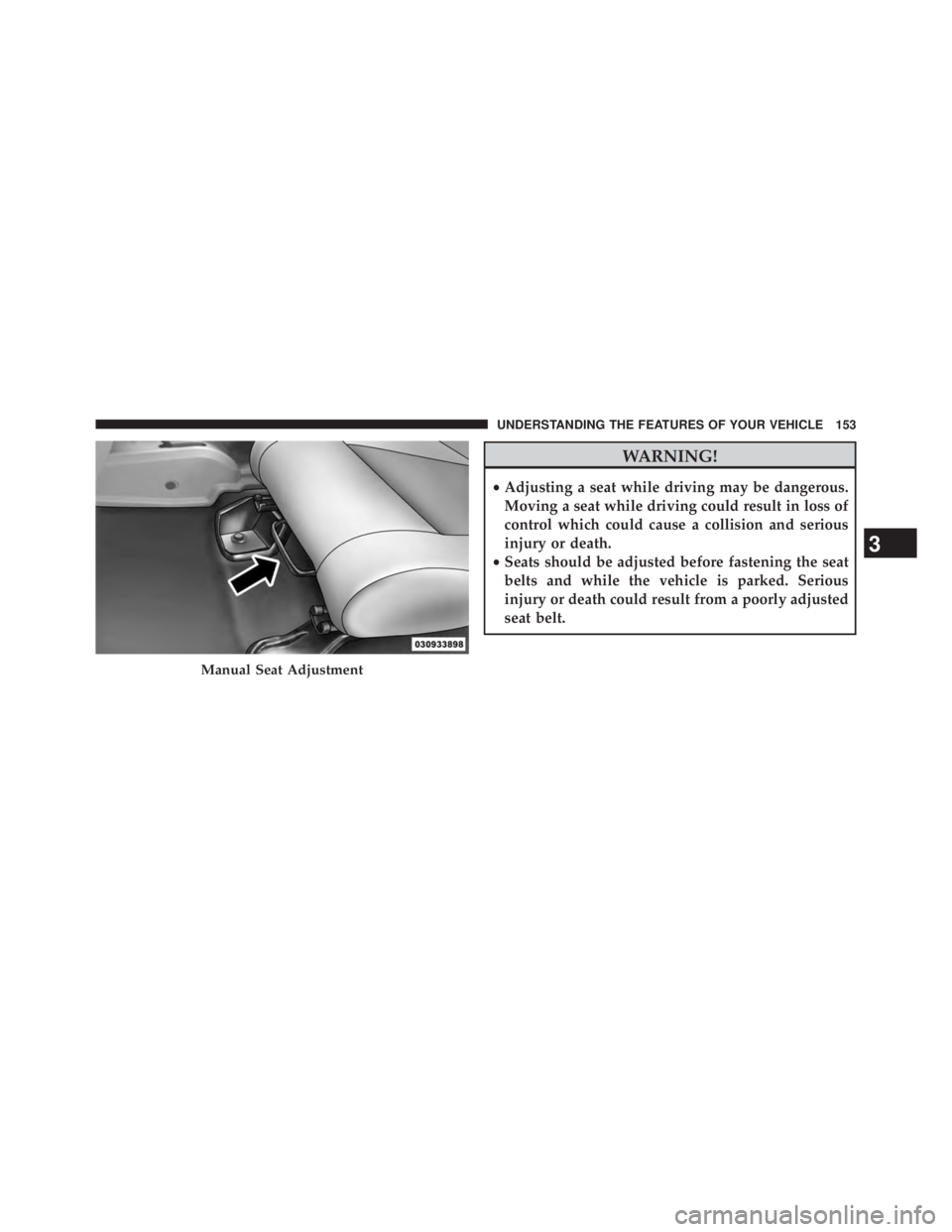
The seat can be adjusted forward or rearward by using a
bar located by the front of the seat cushion, near the floor.
While sitting in the seat, lift up on the bar located under
the seat cushion and move the seat forward or rearward.
Release the bar once you have reached the desired
position. Then, using body pressure, move forward and
rearward on the seat to be sure that the seat adjusters
have latched.152 UNDERSTANDING THE FEATURES OF YOUR VEHICLE
Page 155 of 655
WARNING!• Adjusting a seat while driving may be dangerous.
Moving a seat while driving could result in loss of
control which could cause a collision and serious
injury or death.
• Seats should be adjusted before fastening the seat
belts and while the vehicle is parked. Serious
injury or death could result from a poorly adjusted
seat belt.Manual Seat Adjustment
3 UNDERSTANDING THE FEATURES OF YOUR VEHICLE 153
Page 157 of 655
WARNING!Do not ride with the seatback reclined so that the
shoulder belt is no longer resting against your chest.
In a collision you could slide under the seat belt,
which could result in serious injury or death. Front Passenger Easy Entry Seat — Two-Door
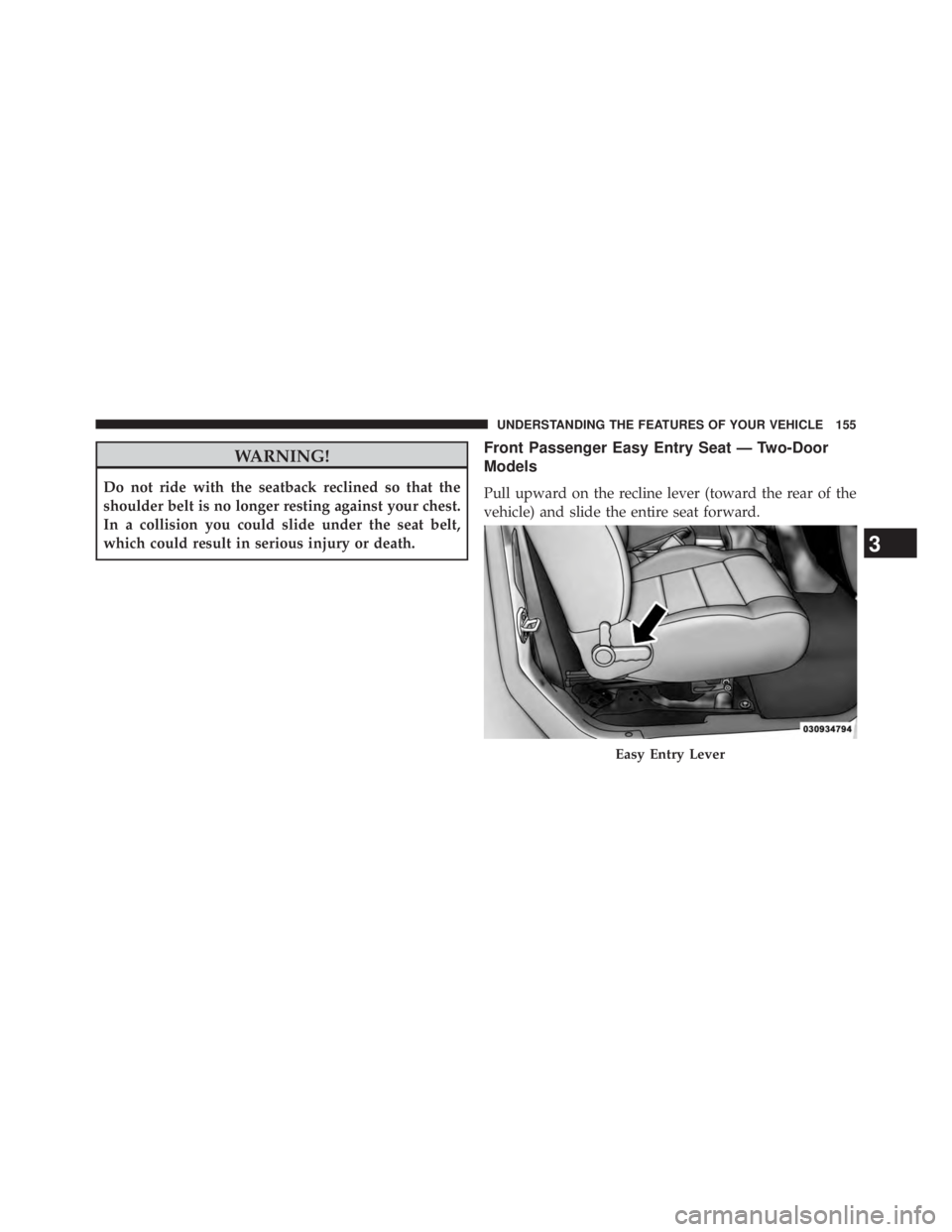
Models
Pull upward on the recline lever (toward the rear of the
vehicle) and slide the entire seat forward.
Easy Entry Lever
3 UNDERSTANDING THE FEATURES OF YOUR VEHICLE 155
Page 162 of 655

WARNING!• Persons who are unable to feel pain to the skin
because of advanced age, chronic illness, diabetes,
spinal cord injury, medication, alcohol use, exhaus-
tion or other physical condition must exercise care
when using the seat heater. It may cause burns
even at low temperatures, especially if used for
long periods of time.
• Do not place anything on the seat or seatback that
insulates against heat, such as a blanket or cushion.
This may cause the seat heater to overheat. Sitting
in a seat that has been overheated could cause
serious burns due to the increased surface tempera-
ture of the seat. Head Restraints
Head restraints are designed to reduce the risk of injury
by restricting head movement in the event of a rear
impact. Head restraints should be adjusted so that the top
of the head restraint is located above the top of your ear.
WARNING!The head restraints for all occupants must be prop-
erly adjusted prior to operating the vehicle or occu-
pying a seat. Head restraints should never be ad-
justed while the vehicle is in motion. Driving a
vehicle with the head restraints improperly adjusted
or removed could cause serious injury or death in the
event of a collision.160 UNDERSTANDING THE FEATURES OF YOUR VEHICLE
Page 165 of 655
Removing The Rear Seat — Two-Door Models
WARNING!• It is extremely dangerous to ride in a cargo area,
inside or outside of a vehicle. In a collision, people
riding in these areas are more likely to be seriously
injured or killed.
• Do not allow people to ride in any area of your
vehicle that is not equipped with seats and seat
belts.
• Be sure everyone in your vehicle is in a seat and
using a seat belt properly.
• In a collision, you or others in your vehicle could
be injured if seats are not properly latched to their
floor attachments. Always be sure that the seats are
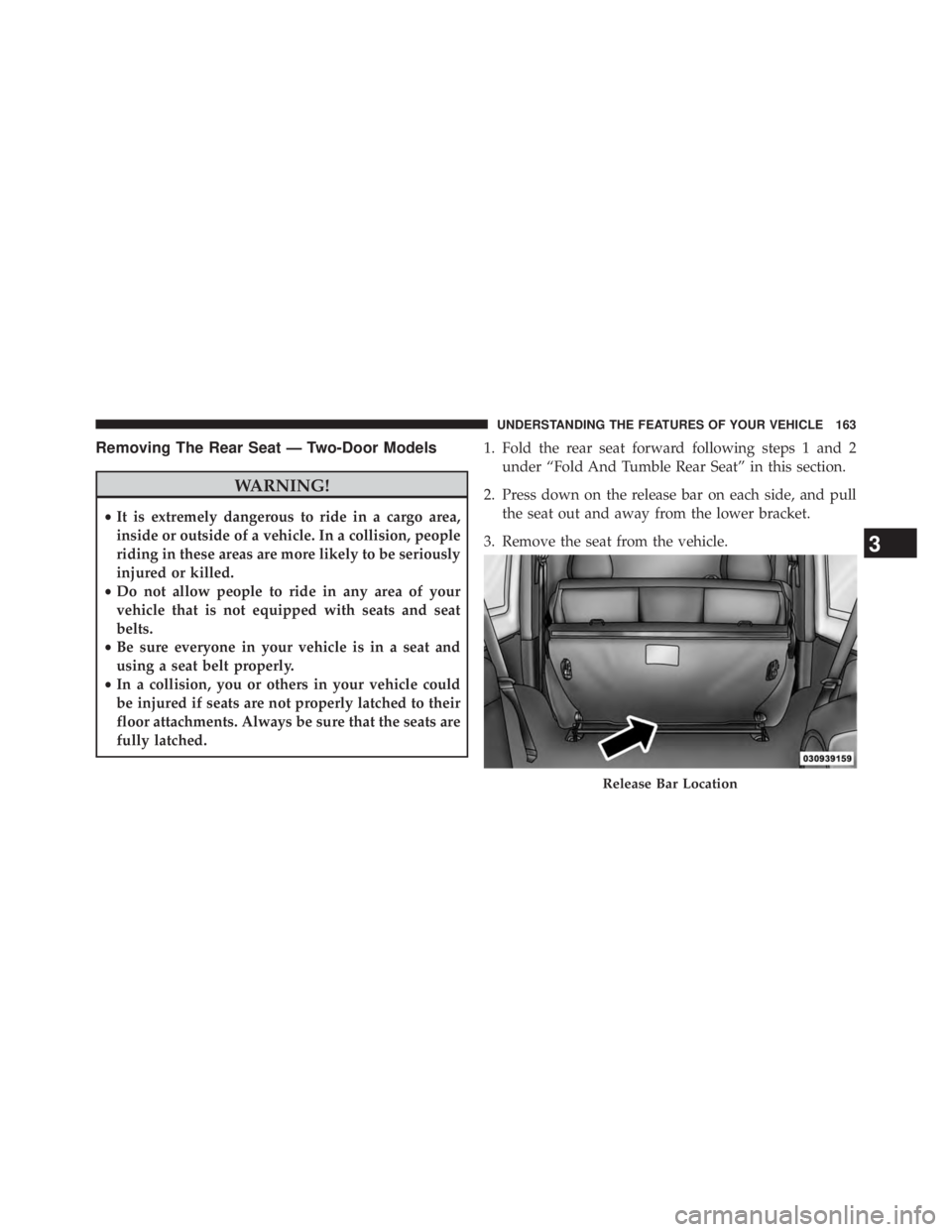
fully latched. 1. Fold the rear seat forward following steps 1 and 2
under “Fold And Tumble Rear Seat” in this section.
2. Press down on the release bar on each side, and pull
the seat out and away from the lower bracket.
3. Remove the seat from the vehicle.
Release Bar Location
3 UNDERSTANDING THE FEATURES OF YOUR VEHICLE 163
Page 166 of 655
Replacing The Rear Seat — Two-Door Models
Reverse the steps for removing the seat.
WARNING!• To help protect against personal injury, passengers
should not be seated in the rear cargo area with the
rear seat folded down or removed from the vehicle.
• The rear cargo space is intended for load carrying
purposes only, not for passengers who should sit in
seats and use seat belts.
60/40 Split Folding Rear Seat — Four-Door
Models
To provide additional storage area, each rear seat can be
folded flat to allow for extended cargo space and still
maintain some rear seating room. NOTE:
• Prior to folding the rear seat, it may be necessary to
reposition the front seat to its mid-track position.
• Be sure that the front seats are fully upright and
positioned forward. This will allow the rear seat to fold
down easily.
WARNING!• It is extremely dangerous to ride in a cargo area,
inside or outside of a vehicle. In a collision, people
riding in these areas are more likely to be seriously
injured or killed.
• Do not allow people to ride in any area of your
vehicle that is not equipped with seats and seat
belts.
• Be sure everyone in your vehicle is in a seat and
using a seat belt properly.164 UNDERSTANDING THE FEATURES OF YOUR VEHICLE