2013 FORD SUPER DUTY service
[x] Cancel search: servicePage 221 of 563
GENERAL INFORMATION
Note:Occasional brake noise is normal. If a metal-to-metal, continuous
grinding or continuous squeal sound is present, the brake linings may be
worn-out and should be inspected by an authorized dealer. If your
vehicle has continuous vibration or shudder in the steering wheel while
braking, it should be inspected by an authorized dealer.
Note:Brake dust may accumulate on the wheels, even under normal
driving conditions. Some dust is inevitable as the brakes wear and does
not contribute to brake noise. See theVehicle Carechapter for wheel
cleaning instructions.
See theInstrument Clusterchapter for information on the
brake system warning light.
Wet brakes result in reduced braking efficiency. Gently press the brake
pedal a few times when driving from a car wash or standing water to dry
the brakes.
Brake Over Accelerator
If the accelerator pedal becomes stuck or entrapped, apply steady and
firm pressure to the brake pedal to slow your vehicle and reduce engine
power. If you experience this condition, apply the brakes and bring your
vehicle to a safe stop. Turn the engine off, shift to positionPand apply
the parking brake, then inspect the accelerator pedal for any
interferences. If none are found and the condition persists, have your
vehicle towed to the nearest authorized dealer.
Brake Assist
Brake assist detects when you brake heavily by measuring the rate at
which you press the brake pedal. It provides maximum braking efficiency
as long as you press the pedal. Brake assist can reduce stopping
distances in critical situations.
Anti-Lock Brake System
This system helps you maintain steering control during emergency stops
by keeping the brakes from locking.
The anti-lock brake system lamp momentarily illuminates when
the ignition is turned on. If the light does not illuminate during
start-up, remains on or flashes, the anti-lock brake system may
be disabled and may need to be serviced.
220Brakes
2013 F-250/350/450/550(f23)
Owners Guide gf, 1st Printing
USA(fus)
Page 222 of 563
If the anti-lock brake system is disabled, normal braking is still
effective. If the brake warning lamp illuminates with the parking
brake released, have your brake system serviced immediately.
HINTS ON DRIVING WITH ANTI-LOCK BRAKES
When the system is operating, the brake pedal will pulse and may travel
further. Maintain pressure on the brake pedal. You may also hear a noise
from the system. This is normal.
The ABS will not eliminate the dangers inherent when:
•you drive too closely to the vehicle in front of you.
•your vehicle is hydroplaning.
•you take corners too fast.
•the road surface is poor.
PARKING BRAKE
WARNING:Always set the parking brake fully and make sure that
the transmission selector lever is securely latched in positionP.
To set the parking brake, press the parking brake pedal down until the
pedal stops.
The BRAKE warning lamp in the instrument cluster will illuminate and
remains illuminated until the parking brake is released.
To release, pull the brake release lever located at the lower left side of
the instrument panel.
If you are parking your vehicle on a grade or with a trailer, press and
hold the brake pedal down, then set the parking brake. There may be a
little vehicle movement as the parking brake sets to hold the vehicle’s
weight. This is normal and should be no reason for concern. If needed,
press and hold the service brake pedal down, then try reapplying the
parking brake. Chock the wheels if required. If the parking brake cannot
hold the weight of the vehicle, the parking brake may need to be
serviced or the vehicle may be overloaded.
Brakes221
2013 F-250/350/450/550(f23)
Owners Guide gf, 1st Printing
USA(fus)
Page 224 of 563
System indicator lights and messages
WARNING:If a failure has been detected within the Traction
Control System, the stability control light will illuminate steadily.
Verify that the Traction Control System was not manually disabled
using the stability control button. If the stability control light still
illuminates steadily, have the system serviced by an authorized dealer
immediately. Operating your vehicle with Traction Control disabled
could lead to an increased risk of loss of vehicle control, vehicle
rollover, personal injury and death.
The stability control light temporarily illuminates on engine
start-up and flashes when a driving condition activates the
stability system.
The stability control off light temporarily illuminates on engine
start-up and stays on when the traction control system is
turned off or if a problem occurs in the stability system.
Traction Control223
2013 F-250/350/450/550(f23)
Owners Guide gf, 1st Printing
USA(fus)
Page 237 of 563
Steering
To help prevent damage to the power steering system:
•Never hold the steering wheel at its furthest turning points (until it
stops) for more than three to five seconds when the engine is running.
•Do not operate the vehicle with a low power steering pump fluid level
(below the MIN mark on the reservoir).
•Some noise is normal during operation. If excessive, check for low
power steering pump fluid level before seeking service by your dealer.
•Heavy or uneven efforts may be caused by low power steering fluid.
Check for low power steering pump fluid level before seeking service
by your dealer.
•Do not fill the power steering pump reservoir above the MAX mark on
the reservoir, as this may result in leaks from the reservoir.
If the power steering system breaks down (or if the engine is turned
off), you can steer the vehicle manually, but it takes more effort.
If the steering wanders or pulls, check for:
•an improperly inflated tire
•uneven tire wear
•loose or worn suspension components
•loose or worn steering components
•improper steering alignment
If any steering components are serviced or replaced, install new
fasteners (many are coated with thread adhesive or have prevailing
torque features which may not be re-used). Never re-use a bolt or nut.
Torque fasteners to specifications inWorkshop Manual.
A high crown in the road or high crosswinds may also make the steering
seem to wander/pull.
236Driving Aids
2013 F-250/350/450/550(f23)
Owners Guide gf, 1st Printing
USA(fus)
Page 247 of 563
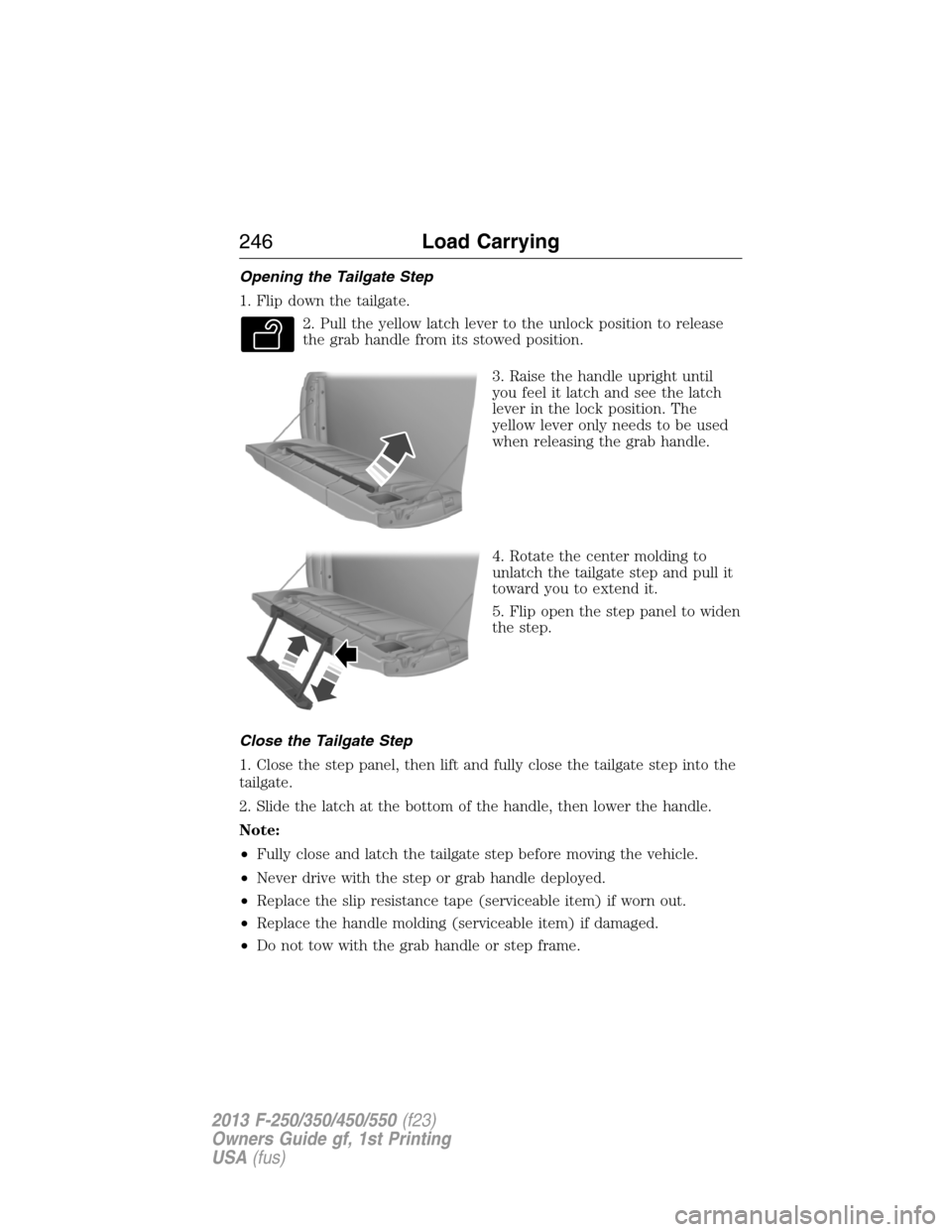
Opening the Tailgate Step
1. Flip down the tailgate.
2. Pull the yellow latch lever to the unlock position to release
the grab handle from its stowed position.
3. Raise the handle upright until
you feel it latch and see the latch
lever in the lock position. The
yellow lever only needs to be used
when releasing the grab handle.
4. Rotate the center molding to
unlatch the tailgate step and pull it
toward you to extend it.
5. Flip open the step panel to widen
the step.
Close the Tailgate Step
1. Close the step panel, then lift and fully close the tailgate step into the
tailgate.
2. Slide the latch at the bottom of the handle, then lower the handle.
Note:
•Fully close and latch the tailgate step before moving the vehicle.
•Never drive with the step or grab handle deployed.
•Replace the slip resistance tape (serviceable item) if worn out.
•Replace the handle molding (serviceable item) if damaged.
•Do not tow with the grab handle or step frame.
246Load Carrying
2013 F-250/350/450/550(f23)
Owners Guide gf, 1st Printing
USA(fus)
Page 252 of 563
•Driver weight
•Passenger(s) weight
•Payload, cargo and luggage weight
•Aftermarket equipment weight.
3. This equals the maximum loaded trailer weight (for this
combination).
Note:The trailer tongue load is considered part of the payload for your
vehicle so the total payload should be reduced by the final trailer tongue
weight.
Consult your authorized dealer to determine the maximum trailer weight
allowed for your vehicle if you are not sure.
Further trailer/hitch restrictions exist depending on the type of trailer
and hitch listed. This information follows the table listing the maximum
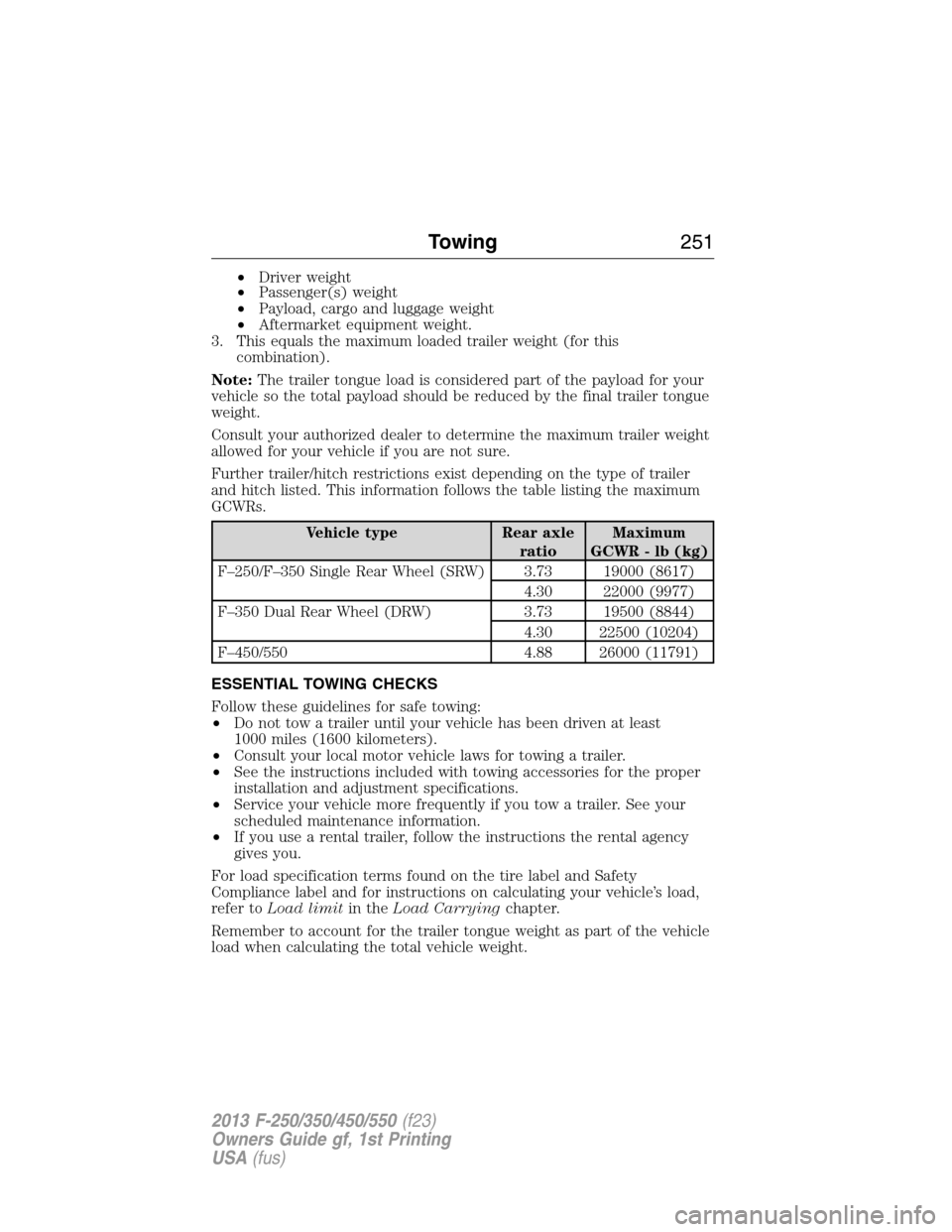
GCWRs.
Vehicle type Rear axle
ratioMaximum
GCWR - lb (kg)
F–250/F–350 Single Rear Wheel (SRW) 3.73 19000 (8617)
4.30 22000 (9977)
F–350 Dual Rear Wheel (DRW) 3.73 19500 (8844)
4.30 22500 (10204)
F–450/550 4.88 26000 (11791)
ESSENTIAL TOWING CHECKS
Follow these guidelines for safe towing:
•Do not tow a trailer until your vehicle has been driven at least
1000 miles (1600 kilometers).
•Consult your local motor vehicle laws for towing a trailer.
•See the instructions included with towing accessories for the proper
installation and adjustment specifications.
•Service your vehicle more frequently if you tow a trailer. See your
scheduled maintenance information.
•If you use a rental trailer, follow the instructions the rental agency
gives you.
For load specification terms found on the tire label and Safety
Compliance label and for instructions on calculating your vehicle’s load,
refer toLoad limitin theLoad Carryingchapter.
Remember to account for the trailer tongue weight as part of the vehicle
load when calculating the total vehicle weight.
Towing251
2013 F-250/350/450/550(f23)
Owners Guide gf, 1st Printing
USA(fus)
Page 262 of 563
•Make sure the stuck vehicle is not loaded in excess of its GVWR
specified on the certification label.
•Always align the tow vehicle and stuck vehicle in a straight line
(within 10 degrees).
•Keep bystanders to thesidesof the vehicle, at a distance of at least
twice the length of the recovery strap. This helps avoid injury from
the hazard of a recovery hook or strap breaking, or a vehicle lurching
into their path.
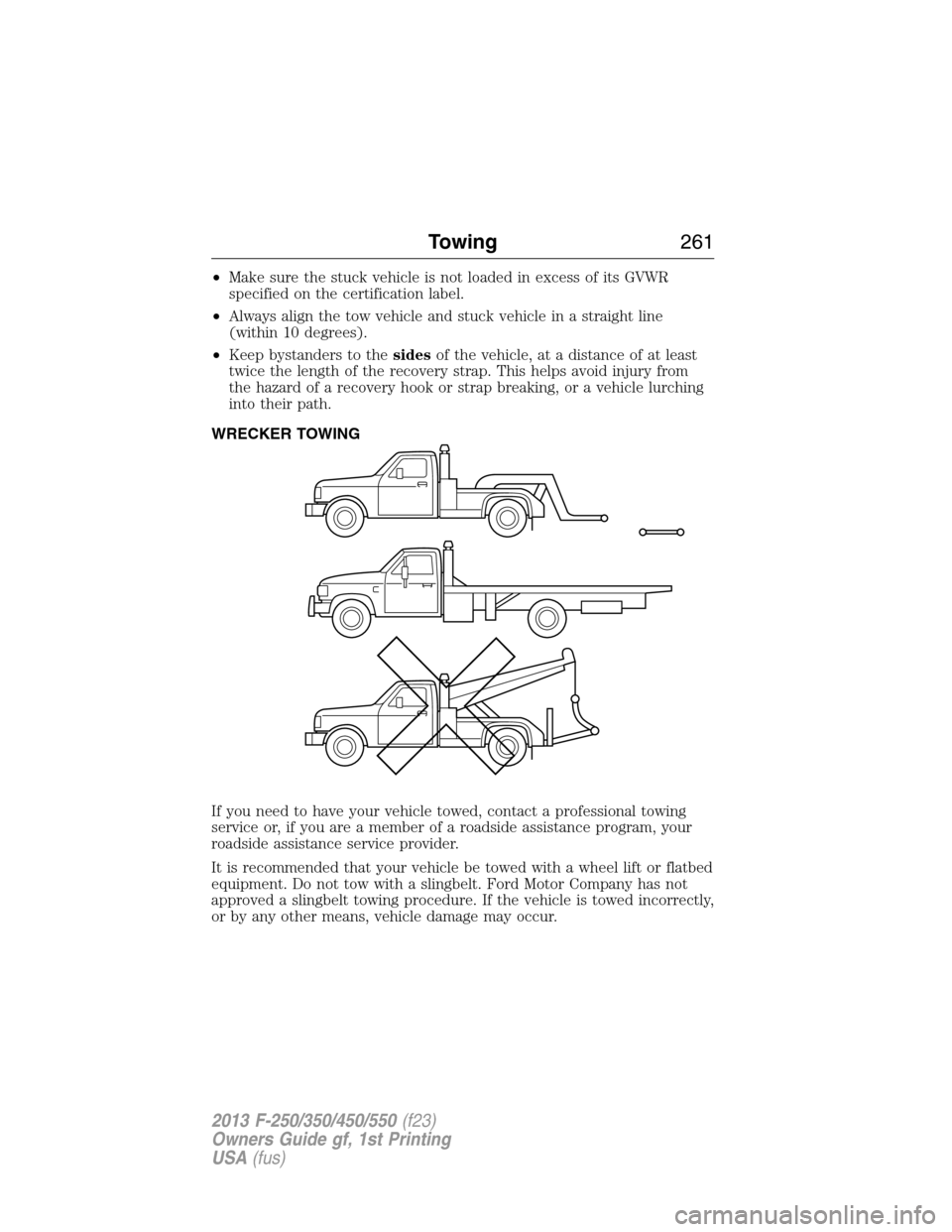
WRECKER TOWING
If you need to have your vehicle towed, contact a professional towing
service or, if you are a member of a roadside assistance program, your
roadside assistance service provider.
It is recommended that your vehicle be towed with a wheel lift or flatbed
equipment. Do not tow with a slingbelt. Ford Motor Company has not
approved a slingbelt towing procedure. If the vehicle is towed incorrectly,
or by any other means, vehicle damage may occur.
Towing261
2013 F-250/350/450/550(f23)
Owners Guide gf, 1st Printing
USA(fus)
Page 270 of 563

Snowplowing with your Air Bag Equipped Vehicle
WARNING:Do not attempt to service, repair, or modify the air
bag supplemental restraint system (SRS) or its fuses. See your
Ford or Lincoln Mercury dealer.
WARNING:Additional equipment such as snowplow equipment
may effect the performance of the air bag sensors increasing the
risk of injury. Please refer to theBody Builders Layout Bookfor
instructions about the appropriate installation of additional equipment.
WARNING:All occupants of the vehicle, including the driver,
should always properly wear their safety belts, even when an air
bag supplemental restraint system (SRS) is provided.
Your vehicle is equipped with a driver and passenger air bag
supplemental restraint system. The supplemental restrain system is
designed to activate in certain frontal and offset frontal collisions when
the vehicle sustains sufficient longitudinal deceleration.
Careless or high speed driving while plowing snow which results in
sufficient vehicle decelerations can deploy the air bag. Such driving also
increases the risk of accidents.
Never remove or defeat the tripping mechanisms designed into the snow
removal equipment by its manufacturer. Doing so may cause damage to
the vehicle and the snow removal equipment as well as possible air bag
deployment.
Engine temperature while plowing
When driving with a plow, your engine may run at a higher temperature
than normal because the attached snowplow blade will restrict airflow to
the radiator.
If you are driving more than 15 miles (24 kilometers) at temperatures
above freezing, angle the plow blade either full left or full right to
provide maximum airflow to the radiator.
If you are driving less than 15 miles (24 kilometers) at speeds up to
45 mph (72 km/h) in cold weather, you will not need to worry about
blade position to provide maximum airflow.
Driving Hints269
2013 F-250/350/450/550(f23)
Owners Guide gf, 1st Printing
USA(fus)