2013 FORD SUPER DUTY change time
[x] Cancel search: change timePage 2 of 95
Introduction
2
Instrument Cluster
6
Starting and Stopping the Engine
8
Fuel and Refueling
14
Brakes
44
Towing
45
Roadside Emergencies
46
Maintenance
48
Vehicle Care
64
Capacities and Specifications
66
Scheduled Maintenance
70
Normal scheduled maintenance and log 75
Index
93
The information contained in this publication was correct at the time of going to
print. In the interest of continuous development, we reserve the right to change
specifications, design or equipment at any time without notice or obligation. No
part of this publication may be reproduced, transmitted, stored in a retrieval
system or translated into any language in any form by any means without our
written permission. Errors and omissions excepted.
© Ford Motor Company 2012
Table of Contents
1
2013 Diesel(67l)
Supplement, 1st Printing
USA(fus)
Page 6 of 95
The glow plug system is
electronically controlled by the PCM
and GPCM. The GPCM energizes the
glow plugs immediately after the ignition is turned on and kept on as
determined by the GPCM using the ECT, BARO and environmental
temperature sensor. The required time for the glow plugs to be
energized decreases as the coolant temperature, barometric pressure and
environmental temperature increase.
Engine and secondary cooling system
The cooling system contains an engine cooling loop to cool the engine
and a secondary cooling loop to cool the transmission, exhaust gas
recirculation (EGR), charge air and fuel. The coolant serves three
primary purposes: to provide heat transfer, freeze point protection, and
corrosion protection using additives.
Vehicles with diesel engines typically are used to carry heavy loads and
accumulate mileage rapidly. These two factors may cause the additives in
the coolant to “wear out” in a shorter time. Refer to theSpecial
operating conditionssection for more information about coolant
additives and coolant change intervals. Operating the engine with
insufficient coolant and/or coolant additive can cause severe engine
damage.
Selective catalytic reduction (SCR) system
Your vehicle is equipped with a selective catalytic reduction (SCR)
system to help reduce emission levels of oxides of nitrogen from the
exhaust of the diesel engine. This system relies on the use of diesel
exhaust fluid (DEF) which must be replenished at certain intervals.
Failure to maintain proper DEF levels or if the DEF becomes
contaminated will result in vehicle speed limitations and/or result in the
vehicle entering an idle-only mode. SeeSelective catalytic reduction
(SCR) systemin theFuel and Refuelingchapter for more information.
Speed control (if equipped)
If vehicle speed goes outside a predetermined range from the set speed,
the RES (Resume) function will not reset vehicle speed. Vehicle speed
will need to be reset with the SET +/- button after reaching desired
speed using accelerator pedal.
Introduction
5
2013 Diesel(67l)
Supplement, 1st Printing
USA(fus)
Page 12 of 95
In cold weather below 32°F (0°C), the engine may slowly increase to a
higher idle speed if left idling in P (Park). As the engine warms-up, the
engine sound level decreases due to the activation of PCM-controlled
sound reduction features.
If your vehicle is operated in a heavy snow storm or blowing snow
conditions, the engine air induction may become partially clogged with
snow and/or ice. If this occurs, the engine may experience a significant
reduction in power output. At the earliest opportunity, clear all the snow
and/or ice away from inside the air filter assembly. Remove the air
cleaner cover and the pleated paper filter, leaving the foam filter in and
remove any snow or ice. Make sure the foam filter is installed correctly
in place. Remove any debris, snow and/or ice on the foam filter by
brushing the surface with soft brush. Do not use water, solvents, or a
hard brush for cleaning the foam filter.
In order to operate the engine in temperatures of 32°F (0°C) or lower,
read the following instructions:
•Make sure that the batteries are of sufficient size and are fully
charged. Check other electrical components to make sure they are in
optimum condition.
•Use the proper coolant solution at the concentration recommended to
protect the engine against damage from freezing.
•Try to keep the fuel tank full as much as possible at the end of
operation to prevent condensation in the fuel system.
•Make sure you use proper cold weather engine oil and that it is at its
proper level. Also, if necessary, make sure to follow the engine oil and
filter change schedule found under theSpecial operating conditions
section listed in thescheduled maintenance information.
•At temperatures of -10°F (-23°C) or below, it is recommended that
you use an engine block heater to improve cold engine starting.
•If operating in arctic temperatures of -20°F (-29°C) or lower, consult
your truck dealer for information about special cold weather
equipment and precautions.
The following cold weather idling guidelines are recommended:
•Motorcraft® cetane improvers or non-alcohol-based cetane improvers
from a reputable manufacturer may be used as needed.
•Maintain the engine cooling system properly.
•Avoid shutting the engine down after an extensive idling period. Drive
the vehicle for several miles with the engine at normal operating
temperatures under a moderate load.
•Consider using an engine block heater.
•For extended idle times use an approved idle speed increase device.
Starting and Stopping the Engine
11
2013 Diesel(67l)
Supplement, 1st Printing
USA(fus)
Page 18 of 95
DIESEL FUEL ADDITIVES
It should not be necessary to add any aftermarket additives to your fuel
tank if you use a properly formulated diesel fuel. Aftermarket additives
can damage the injector system or engine.
Use Motorcraft® cetane booster or an equivalent cetane booster additive
if you suspect fuel has low cetane. Use Motorcraft® anti-gel &
performance improver or an equivalent additive if there is fuel gelling.
Do not use alcohol based additives to improve cetane quality, to prevent
fuel gelling or any other use. The use of alcohol additives may result in
damage to the fuel injectors/system. refer to theTechnical
specificationssection in theCapacities and Specificationschapter for
more information.
Repairs to correct the effects of using an aftermarket product that does
not meet Ford specifications in your fuel may not be covered by your
warranty.
Note:Ultra Low Sulfur Diesel fuel is designed to meet the emissions
standards for the 6.7L engine and is backward compatible as well (i.e.,
can be used in Ford 7.3L, 6.9L, 6.4L and 6.0L diesel engines in Ford
vehicles).
FUELING TIPS
WARNING:Do not use starting fluid such as ether or gasoline
in the diesel air intake system. Such fluids can cause immediate
explosive damage to the engine and possible personal injury.
Truck stops have pumps and nozzles designed for larger, heavy-duty
trucks. When refueling at truck stops: if the nozzle shuts off repeatedly
when refueling, wait 5–10 seconds; then use a slower rate of flow (don’t
depress the nozzle trigger as far).
If air is allowed to enter the fuel system (during fuel filter change or if
you run out of fuel) the engine will purge the trapped air as it runs. To
purge the air sooner: prior to engine start, prime the system by turning
the key to on for 30 seconds then to off. Repeat this several times. The
engine may run rough and produce white smoke while air is in the
system. This is normal and should correct itself in a short time.
An engine that suddenly becomes noisy or operates poorly after a fuel fill
could be using substandard fuel (i.e., high water content, low cetane
rating or gasoline in the fuel). Diesel fuel should be purchased from a
reputable station which sells a large amount of diesel fuel.
Fuel and Refueling
17
2013 Diesel(67l)
Supplement, 1st Printing
USA(fus)
Page 33 of 95
•Normal operation: If the message appears during normal operation
when the vehicle / engine is fully warm, and fuel level is not low, the
fuel filters must be changed regardless of the maintenance schedule
interval.
•If replacement of the fuel filter does not remedy the low fuel pressure
message during normal operation as defined above, take the vehicle to
your authorized dealer.
CHANGING THE ENGINE-MOUNTED AND DFCM FUEL FILTERS
Your vehicle is equipped with two fuel filters; one is mounted on top of
the driver’s side of the engine and the second filter, inside the DFCM, is
mounted on the frame rail under the driver-side floorboard near the
transmission. Both filters should be replaced at the same time. Regular
fuel filter changes are an important part of engine maintenance; failing to
keep with the scheduled maintenance could lead to engine performance
issues and/or fuel injection system damage. Refer to thescheduled
maintenance informationof this supplement for more information.
Refer toMotorcraft part numbersin theMaintenancechapter for the
fuel filter replacement part number. This part number includes filters
and seals for both the engine-mounted and frame-mounted filters.
Removal - DFCM filter
The DFCM filter is located in the lower portion of the DFCM housing.
1. Drain the DFCM. SeeFuel filter/water separatorin theFuel and
Refuelingchapter.
To install the new DFCM filter, seeInstallation – DFCM filterin the
Fuel and Refuelingchapter.
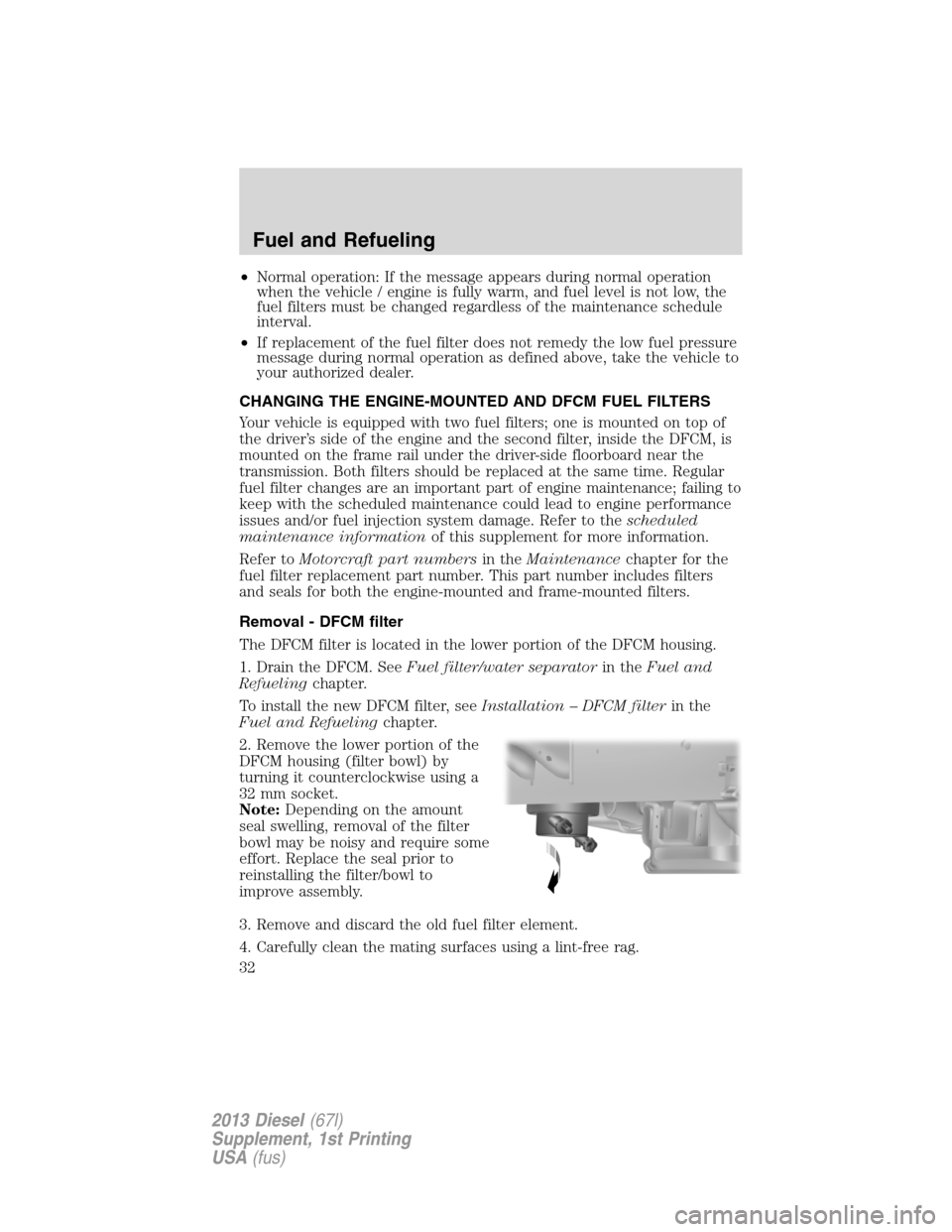
2. Remove the lower portion of the
DFCM housing (filter bowl) by
turning it counterclockwise using a
32 mm socket.
Note:Depending on the amount
seal swelling, removal of the filter
bowl may be noisy and require some
effort. Replace the seal prior to
reinstalling the filter/bowl to
improve assembly.
3. Remove and discard the old fuel filter element.
4. Carefully clean the mating surfaces using a lint-free rag.
Fuel and Refueling
32
2013 Diesel(67l)
Supplement, 1st Printing
USA(fus)
Page 36 of 95
from the tailpipe. As soot gathers in the system it begins to restrict the
filter. The soot gathered inside the filter needs to be periodically cleaned.
The soot can be cleaned in two different ways; passive regeneration and
active regeneration. Both methods occur automatically and require no
actions from the driver/operator. During either one of these regeneration
methods you may notice an increase/change in exhaust noise/tone. At
certain times, the message center will display various messages related
to the DPF. See theInformation Displayschapter in theOwner Guide
for more information.
Passive regeneration
In passive regeneration, the exhaust constituents / temperature are at an
appropriate level where some soot can be reduced or oxidized (burned)
thus cleaning the filter. This method occurs naturally as a result of
normal engine operating conditions (at varying levels due to drive
patterns).
Active regeneration
Note:Do not disregard theDRIVE TO CLEAN EXHAUST FILTERor
Drive to Clean Exhaust Systemmaintenance message for extended
periods of time. Failure to perform active or operator commanded
regeneration (OCR) (if equipped) when instructed may result in a
clogged DPF. If your DPF fills beyond what can be safely regenerated,
active regeneration and OCR will be disabled. This could cause
irreversible damage to the DPF, requiring service and possible
replacement that may not be covered by your warranty.
Once the DPF is full of exhaust particles, the engine control module will
command the exhaust system to clean the DPF through a process called
active regeneration. Active regeneration requires the engine computer to
raise the exhaust temperature to eliminate the particles. During cleaning,
the particles are converted to harmless gasses, and the DPF will then be
clean and ready to continue trapping exhaust particles.
The regeneration process operates more efficiently when the vehicle is
safely operated at least 30 mph (48 km/h) with a steady pedal for
approximately 20 minutes to complete the process. The frequency and
duration of regeneration will fluctuate as both are determined by how
you drive your vehicle, outside air temperature, and altitude. For most
driving, regeneration frequency will vary from 100 - 500 miles (161 -
805 km) between occurrences and each occurrence will last from 9 -
20 minutes. The duration of regeneration is usually reduced if a constant
speed above 30 mph (48 km/h) is maintained.
Fuel and Refueling
35
2013 Diesel(67l)
Supplement, 1st Printing
USA(fus)
Page 39 of 95
Base information display procedure
1. Start with the vehicle engine fully warmed.
2. Press the Info button on the steering wheel until the information
display reads one of the following choices:
•If the DPF needs cleaning and the vehicle is warmed up, a message
requesting permission to initiate filter cleaning will be displayed
EXHST XX% FULL CLEAN Y/NorEXHAUST FILTER FULL.
Answer yes to this prompt and then follow the prompts regarding
exhaust position as needed to initiate OCR. Be sure to understand
each prompt. If you are not sure what is being asked by each prompt,
contact your authorized dealer. The display will confirm the operation
has started and when it has finished.
•If the vehicle is warmed up, the
powertrain fault indicator will
illuminate and messages
requesting permission to initiate filter cleaning will be displayed
DRIVE TO CLEAN EXHAUST FILTER+EXH OVERLOADED
CLEAN? Y/N. Answer yes to this prompt and then follow the
prompts regarding exhaust position as needed to initiate OCR. Be sure
to understand each prompt. If you are not sure what is being asked by
each prompt, contact your authorized dealer. The display will confirm
the operation has started and when it has finished. You can also drive
to clean the filter. SeeActive regenerationearlier in this chapter.
•The service engine soon light will
illuminate and the following
messagesEXH OVERLOADED
CLEAN? Y/N+REDUCED ENGINE POWERwill appear when the
system is at the point of oversaturation you will not be able to allow
cleaning . The vehicle must be serviced by an authorized dealer.
3. Once OCR starts, the engine’s rpm will rise to approximately 2,000 -
2,400 rpm and the cooling fan will increase speed; you will hear a change
in audible sound due to the fan and engine speed increase.
It is not necessary to open the hood on the engine compartment. Once
OCR is complete, the engine rpm and fan will return to normal idling.
The exhaust system will remain very hot for several minutes even after
regeneration is complete. Do not reposition the vehicle over materials
that could burn until the exhaust system has had sufficient time to
cool. Depending on the amount of soot collected by the DPF, ambient
temperature, and altitude, OCR may last from 10 to 25 minutes.
Fuel and Refueling
38
2013 Diesel(67l)
Supplement, 1st Printing
USA(fus)
Page 40 of 95
Optional information display procedure
1. Start with the vehicle engine fully warmed.
2. From the main menu, select Gauge Mode and scroll through until one
of the following options appear:
•If the DPF needs cleaning and the vehicle is warmed up, you will be
prompted to hold OK to cleanExhaust xx% FullorExhaust Filter
Full. Press OK and then follow the prompts regarding exhaust
position as needed to initiate OCR. Be sure to understand each
prompt. If you are not sure what is being asked by each prompt,
contact your authorized dealer. The display will confirm the operation
has started and when it has finished.
•When the exhaust system is
overloaded cleaning will be
allowed until a certain saturation
level. If the vehicle is warmed up and ready the powertrain fault
indicator will illuminate and you will be prompted to hold OK to clean
Drive to Clean Exhaust System+Exhaust Filter Overloaded.
Press OK and then follow the prompts regarding exhaust position as
needed to initiate OCR. Be sure to understand each prompt. If you are
not sure what is being asked by each prompt, contact your authorized
dealer. The display will confirm the operation has started and when it
has finished. You can also drive to clean the filter. SeeActive
regenerationearlier in this chapter.
•The service engine soon light will
illuminate and the following
messagesExhaust Filter
Overloaded+Reduced Engine PowerorReduced Engine Power
will appear when the system is at the point of oversaturation you will
not be able to allow cleaning . The vehicle must be serviced by an
authorized dealer.
3. Once OCR starts, the engine’s rpm will rise to approximately 2,000 -
2,400 rpm and the cooling fan will increase speed; you will hear a change
in audible sound due to the fan and engine speed increase.
It is not necessary to open the hood on the engine compartment. Once
OCR is complete, the engine rpm and fan will return to normal idling.
The exhaust system will remain very hot for several minutes even after
regeneration is complete. Do not reposition the vehicle over materials
that could burn until the exhaust system has had sufficient time to
cool. Depending on the amount of soot collected by the DPF, ambient
temperature, and altitude, OCR may last from 10 to 25 minutes.
Fuel and Refueling
39
2013 Diesel(67l)
Supplement, 1st Printing
USA(fus)