2013 FORD SUPER DUTY air condition
[x] Cancel search: air conditionPage 6 of 95
The glow plug system is
electronically controlled by the PCM
and GPCM. The GPCM energizes the
glow plugs immediately after the ignition is turned on and kept on as
determined by the GPCM using the ECT, BARO and environmental
temperature sensor. The required time for the glow plugs to be
energized decreases as the coolant temperature, barometric pressure and
environmental temperature increase.
Engine and secondary cooling system
The cooling system contains an engine cooling loop to cool the engine
and a secondary cooling loop to cool the transmission, exhaust gas
recirculation (EGR), charge air and fuel. The coolant serves three
primary purposes: to provide heat transfer, freeze point protection, and
corrosion protection using additives.
Vehicles with diesel engines typically are used to carry heavy loads and
accumulate mileage rapidly. These two factors may cause the additives in
the coolant to “wear out” in a shorter time. Refer to theSpecial
operating conditionssection for more information about coolant
additives and coolant change intervals. Operating the engine with
insufficient coolant and/or coolant additive can cause severe engine
damage.
Selective catalytic reduction (SCR) system
Your vehicle is equipped with a selective catalytic reduction (SCR)
system to help reduce emission levels of oxides of nitrogen from the
exhaust of the diesel engine. This system relies on the use of diesel
exhaust fluid (DEF) which must be replenished at certain intervals.
Failure to maintain proper DEF levels or if the DEF becomes
contaminated will result in vehicle speed limitations and/or result in the
vehicle entering an idle-only mode. SeeSelective catalytic reduction
(SCR) systemin theFuel and Refuelingchapter for more information.
Speed control (if equipped)
If vehicle speed goes outside a predetermined range from the set speed,
the RES (Resume) function will not reset vehicle speed. Vehicle speed
will need to be reset with the SET +/- button after reaching desired
speed using accelerator pedal.
Introduction
5
2013 Diesel(67l)
Supplement, 1st Printing
USA(fus)
Page 7 of 95
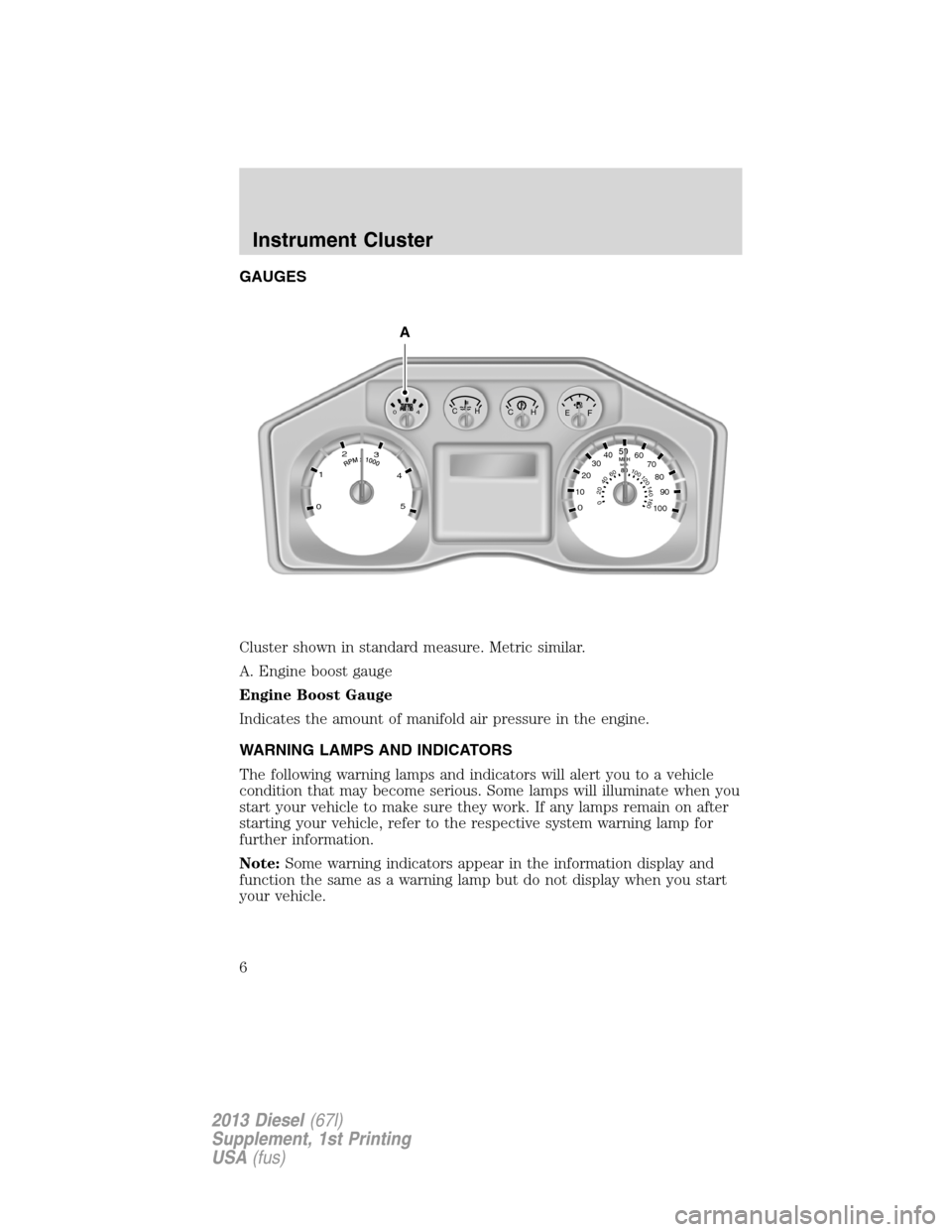
GAUGES
Cluster shown in standard measure. Metric similar.
A. Engine boost gauge
Engine Boost Gauge
Indicates the amount of manifold air pressure in the engine.
WARNING LAMPS AND INDICATORS
The following warning lamps and indicators will alert you to a vehicle
condition that may become serious. Some lamps will illuminate when you
start your vehicle to make sure they work. If any lamps remain on after
starting your vehicle, refer to the respective system warning lamp for
further information.
Note:Some warning indicators appear in the information display and
function the same as a warning lamp but do not display when you start
your vehicle.
A
60
70
80
90
100
02
0406
01001201401600
10203040012
3
4
5
CH04CHEF
Instrument Cluster
6
2013 Diesel(67l)
Supplement, 1st Printing
USA(fus)
Page 11 of 95
STOPPING THE ENGINE
Turn the ignition to the off position.
To prolong engine life (especially after extended high speed, high
ambient temperature, or high GVW/GCW operation, such as heavy loads
and/or heavy trailers), it is recommended that a hot engine be idled for
3-5 minutes. This allows the turbocharged engine to cool down. For more
information on GVW/GCW, see theLoad Carryingchapter in your
Owner’s Manual.
COLD WEATHER OPERATION
Note:Idling in cold weather does not heat the engine to its normal
operating temperature. Long periods of idling, especially in cold weather,
can cause a buildup of deposits which can cause engine damage.
Changing to a lighter grade engine oil also makes starting easier under
these conditions. Refer toEngine oil specificationsin theMaintenance
chapter of this supplement.
Diesel fuel is adjusted seasonally for cold temperatures. Diesel fuel which
has not been properly formulated for the ambient conditions may gel
which can clog the fuel filters. One indication that the fuel filter(s) may
be clogged is if the engine starts, stalls after a short time, and then does
not restart. If you have been using biodiesel, you may need to use a fuel
with lower biodiesel content, try another brand, or discontinue using
biodiesel. Do not use alcohol based additives to correct fuel gelling. This
may result in damage to the fuel injectors/system. Use the proper
anti-gel & performance improver product as listed in theTechnical
Specificationssection in theCapacities and Specificationschapter.
Your vehicle is equipped with a diesel fuel conditioner module (DFCM)
which recirculates fuel from the engine to help prevent fuel filter
clogging. To avoid engine fuel starvation during cold weather operation
of 32°F (0°C) or below, it is recommended that the fuel level in your
tank should not be allowed to drop below
14full. This helps prevent air
from entering the fuel system and stalling the engine.
Your vehicle is equipped with a an SCR system which uses diesel exhaust
fluid (DEF) to operate properly. DEF must be replenished at certain
intervals. When filling the vehicle’s DEF tank in cold weather, special
care must be taken to prevent damage to the DEF tank. For proper cold
weather fill procedure, seeSelective Catalytic Reduction (SCR) System
in theFuel and Refuelingchapter.
Starting and Stopping the Engine
10
2013 Diesel(67l)
Supplement, 1st Printing
USA(fus)
Page 12 of 95
In cold weather below 32°F (0°C), the engine may slowly increase to a
higher idle speed if left idling in P (Park). As the engine warms-up, the
engine sound level decreases due to the activation of PCM-controlled
sound reduction features.
If your vehicle is operated in a heavy snow storm or blowing snow
conditions, the engine air induction may become partially clogged with
snow and/or ice. If this occurs, the engine may experience a significant
reduction in power output. At the earliest opportunity, clear all the snow
and/or ice away from inside the air filter assembly. Remove the air
cleaner cover and the pleated paper filter, leaving the foam filter in and
remove any snow or ice. Make sure the foam filter is installed correctly
in place. Remove any debris, snow and/or ice on the foam filter by
brushing the surface with soft brush. Do not use water, solvents, or a
hard brush for cleaning the foam filter.
In order to operate the engine in temperatures of 32°F (0°C) or lower,
read the following instructions:
•Make sure that the batteries are of sufficient size and are fully
charged. Check other electrical components to make sure they are in
optimum condition.
•Use the proper coolant solution at the concentration recommended to
protect the engine against damage from freezing.
•Try to keep the fuel tank full as much as possible at the end of
operation to prevent condensation in the fuel system.
•Make sure you use proper cold weather engine oil and that it is at its
proper level. Also, if necessary, make sure to follow the engine oil and
filter change schedule found under theSpecial operating conditions
section listed in thescheduled maintenance information.
•At temperatures of -10°F (-23°C) or below, it is recommended that
you use an engine block heater to improve cold engine starting.
•If operating in arctic temperatures of -20°F (-29°C) or lower, consult
your truck dealer for information about special cold weather
equipment and precautions.
The following cold weather idling guidelines are recommended:
•Motorcraft® cetane improvers or non-alcohol-based cetane improvers
from a reputable manufacturer may be used as needed.
•Maintain the engine cooling system properly.
•Avoid shutting the engine down after an extensive idling period. Drive
the vehicle for several miles with the engine at normal operating
temperatures under a moderate load.
•Consider using an engine block heater.
•For extended idle times use an approved idle speed increase device.
Starting and Stopping the Engine
11
2013 Diesel(67l)
Supplement, 1st Printing
USA(fus)
Page 13 of 95
Winter Operating Tips for Arctic Operation -20°F (-29°C) and Below
The following information is provided as a guideline only, and is not
intended to be the only source of possible solutions in resolving extreme
cold temperature issues.
Starting Aids:
WARNING:Do not use starting fluid, such as ether, in the air
intake system (see air filter decal). Such fluid could cause
immediate explosive damage to the engine and possible personal injury.
The use of the factory engine block heater assists in engine starting in
extreme cold ambient temperatures. Refer toEngine block heaterin the
Starting and Stopping the Enginechapter of yourOwner’s Manual.
Idle Control:
•Your vehicle may have a factory option for a stationary elevated idle
control (SEIC) through dash-mounted upfitter switches which allows
the operator to elevate the idle rpm for extended idle periods, as well
as aftermarket equipment such as PTO operation. This feature must
be configured even if ordered from the factory. See your authorized
dealer for required upfitting.
Operation in Snow and Rain
Vehicle operation in heavy snowfall or extreme rain conditions may feed
excessive amounts of snow/water into the air intake system. This could
plug/soak the air filter with snow and may cause the engine to lose
power and possibly shut down.
The following actions are recommended after operating the vehicle up to
200 miles (320 kilometers) in snowfall or extreme rain:
•Snow:At the earliest opportunity, open the hood and clear all the
snow and ice from the air filter housing inlet (do not remove the
foam filter) and reset the air filter restriction gauge.Note:Removal
of the foam filter degrades vehicle performance during snow and hot
weather conditions.
•Extreme rain:The air filter dries after about 15–30 minutes at
highway speeds. At the earliest opportunity, open the hood and reset
the air filter restriction gauge.
Refer toAir filter and restriction gaugein theMaintenancechapter of
this supplement for more information.
Starting and Stopping the Engine
12
2013 Diesel(67l)
Supplement, 1st Printing
USA(fus)
Page 21 of 95
Your vehicle’s message center will display a series of messages regarding
the amount of DEF available. A systems check will display messages
indicating the amount of DEF available (OK or under
12full) or will
produce a warning message that displays the mileage (kilometers)
remaining as the fluid in the DEF tank nears empty. For more
information on warning messages, see theInformation Displayschapter
of yourOwner’s Manual.
As the DEF level nears empty, the
DEF warning symbol will be
displayed and chimes will sound
with the messages starting at 500 miles (805 km) remaining before DEF
is depleted. The warning symbol and messages will continue until the
DEF tank is refilled.
Continued driving without refilling will result in the following actions as
required by the California Air Resources Board (CARB) and /or U.S.
Environmental Protection Agency (EPA):
•Within a certain number of miles (kilometers) to empty, speed will be
limited upon vehicle restart. Prior to this occurring a message will
appear in the message center.
•Further vehicle operation without refilling your DEF tank will cause
the engine to enter an idle-only condition. This will only occur upon
vehicle refueling or extended idle and will be indicated by a message
in the message center indicating required actions to resume normal
operation. It is required to add a minimum of 0.5 gallons (1.9L) of
DEF to the tank to exit the idle-only condition, but the vehicle will
still be in the speed limiting mode until the tank is refilled completely.
For either vehicle speed limiting or idle-only condition, normal vehicle
operation will resume when the DEF tank is refilled.
Note:When filling the DEF tank from empty, there may be a short delay
before detecting the increased level of DEF. This must occur before full
power is returned.
Fuel and Refueling
20
2013 Diesel(67l)
Supplement, 1st Printing
USA(fus)
Page 28 of 95
To prevent overfilling of the DEF tank when filling with a bottle, Ford
recommends using Motorcraft® DEF. Additionally, if the information
display indicatesEXHAUST FLUID UNDER 1/2 FULL, you should only
add a MAXIMUM of 2 gallons (6.7L) of DEF to the tank to prevent
freeze damage due to overfilling. If the information display indicates
EXHAUST FLUID LEVEL OK, do not add DEF.
Contaminated DEF or inoperative SCR system
SCR systems are sensitive to
contamination of the DEF. USE
ONLY API or ISO 22241 CERTIFIED
DIESEL EXHAUST FLUID. If the SCR becomes contaminated or
inoperative, the DEF light will illuminate and exhaust fluid system fault
messages will appear in the information display.
Continued driving without replacing DEF or having the SCR system
repaired will result in the following actions as required by the California
Air Resources Board (CARB) and /or U.S. Environmental Protection
Agency (EPA):
•Within a certain number of miles (kilometers) to empty, speed will be
limited upon restart. Prior to this occurring a message will appear in
the message center.
•
Further vehicle operation without replacing contaminated DEF will cause
the engine to enter an idle-only condition. This will only occur upon
vehicle refueling, vehicle idling in park for 1 hour, or engine shutdown for
10 minutes or more and will be indicated by a message in the message
center indicating required actions to resume normal operation.
For either vehicle speed limiting or idle-only condition, normal vehicle
operation will resume when the contaminated system is repaired.To
service a contaminated or inoperative system, see your
authorized dealer.
DEF guidelines and information
•Use only DEF that carries the trademark: American Petroleum
Institute (API) certified DEF or ISO 22241.
•Do not put DEF in the diesel fuel tank.
•Do not overfill the DEF tank.
•Do not re-use the DEF container once it is emptied.
•
Avoid spilling DEF on painted surfaces, carpeting or plastic components.
Immediately wipe away any DEF that has spilled with a damp cloth and
water. If it has already crystallized, use warm water and a sponge.
Fuel and Refueling
27
2013 Diesel(67l)
Supplement, 1st Printing
USA(fus)
Page 31 of 95
FUEL FILTER/WATER SEPARATOR
Diesel Fuel Conditioner Module (DFCM)
The vehicle is equipped with a diesel fuel conditioning module (DFCM)
located on the frame-rail under the driver-side floorboard near the
transmission
Water should be drained from the
module assembly whenever the
warning light comes on and the
message center directs you to drain the water separator. This will occur
when approximately 0.32 pints (150 ml) of water accumulates in the
module. If water level is allowed to exceed this level, the water may be
passed through to the engine and may cause fuel injection equipment
damage.
Draining the DFCM
WARNING:The vehicle must be stopped with the engine off
when draining the DFCM. Fuel may ignite if the separator is
drained while the engine is running or vehicle is moving.
Note:Air will enter into the fuel system if the DFCM is drained while
the system is running. The engine will not operate properly if air enters
the system.
Note:With fuel tank levels above
34tank it may be necessary to loosen
the bowl 3 turns before opening the drain. This will actuate an
anti-siphon valve at the DFCM inlet and prevent the fuel from siphoning
out of the tank.
Note:A loose drain valve can allow air to enter the fuel system and
cause drivetrain issues. The engine will not operate properly. Be sure
that the drain valve is fully tightened.
1. Stop the vehicle andshut offthe engine.
2. Locate the DFCM and place an appropriate container under the drain
port (see illustration).
Fuel and Refueling
30
2013 Diesel(67l)
Supplement, 1st Printing
USA(fus)