2013 FORD SUPER DUTY light
[x] Cancel search: lightPage 4 of 95
BREAKING-IN YOUR VEHICLE
Your vehicle does not need an extensive break-in. Try not to drive
continuously at the same speed for the first 1,000 miles
(1,600 kilometers) of new vehicle operation. Vary your speed to allow
parts to adjust themselves to other parts.
Drive your new vehicle at least 500 miles (800 kilometers) before towing
a trailer. Make sure you use the specified engine oil by checking the
engine oil specification chart underEngine oilin theMaintenance
chapter.
Do not add friction modifier compounds or special break-in oils during
the first few thousand miles (kilometers) of operation, since these
additives may prevent piston ring seating. SeeEngine oilin the
Maintenancechapter of this supplement for more information on oil
usage.
DIESEL ENGINE INFORMATION
The diesel engine fuel system is a pressurized two-stage filtration system
and consists of:
•a frame-mounted diesel fuel conditioner module (DFCM) / primary
filter with an electric fuel pump and water drain,
•an engine-mounted secondary fuel filter,
•a fuel injector for each cylinder (8 total),
•a high-pressure fuel pump,
•a high-pressure fuel rail for each cylinder bank (2 total) and
•numerous high-pressure pipes from the high-pressure pump to the
rails, and rails to the injectors.
The DFCM acts as a primary fuel filter/water separator which removes
both water and impurities from the fuel. The engine mounted filter filters
finer impurities from the diesel fuel. The engine-mounted fuel filter and
the DFCM filter should be changed at the recommended service interval
or when indicated by the information displayLOW FUEL PRESSURE
message. Refer to thescheduled maintenance informationin this
supplement for more information.
The DFCM should be drained at regular intervals (recommended at
every oil change) or when indicated by the information display and water
in fuel indicator light. SeeFuel filter/water separatorin theFuel and
refuelingchapter.
Introduction
3
2013 Diesel(67l)
Supplement, 1st Printing
USA(fus)
Page 5 of 95
The fuel injection system is controlled through the Powertrain Control
Module (PCM).
Fuel is drawn from the fuel tank by a frame-mounted electric fuel pump
located inside the DFCM and provides pressurized fuel to the engine.
The fuel pump contains a pressure relief valve for overpressure
protection in the event of restricted flow.
Engine protection mode
Ford diesel engines are equipped with engine protection and emission
control systems. These systems monitor critical temperatures and
pressures, and modify engine operation accordingly. These features are
intended to modify engine performance characteristics.
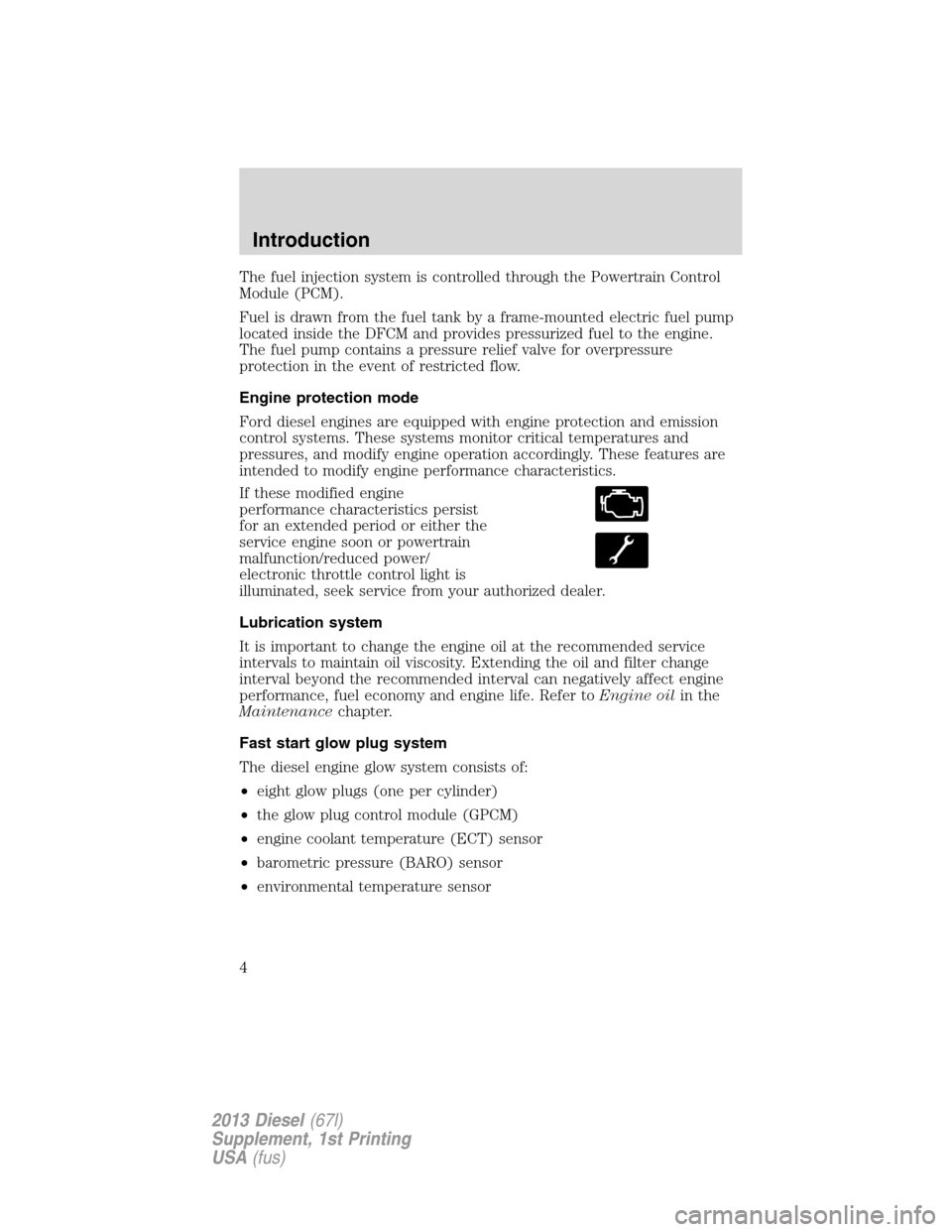
If these modified engine
performance characteristics persist
for an extended period or either the
service engine soon or powertrain
malfunction/reduced power/
electronic throttle control light is
illuminated, seek service from your authorized dealer.
Lubrication system
It is important to change the engine oil at the recommended service
intervals to maintain oil viscosity. Extending the oil and filter change
interval beyond the recommended interval can negatively affect engine
performance, fuel economy and engine life. Refer toEngine oilin the
Maintenancechapter.
Fast start glow plug system
The diesel engine glow system consists of:
•eight glow plugs (one per cylinder)
•the glow plug control module (GPCM)
•engine coolant temperature (ECT) sensor
•barometric pressure (BARO) sensor
•environmental temperature sensor
Introduction
4
2013 Diesel(67l)
Supplement, 1st Printing
USA(fus)
Page 8 of 95
Diesel Exhaust Fluid
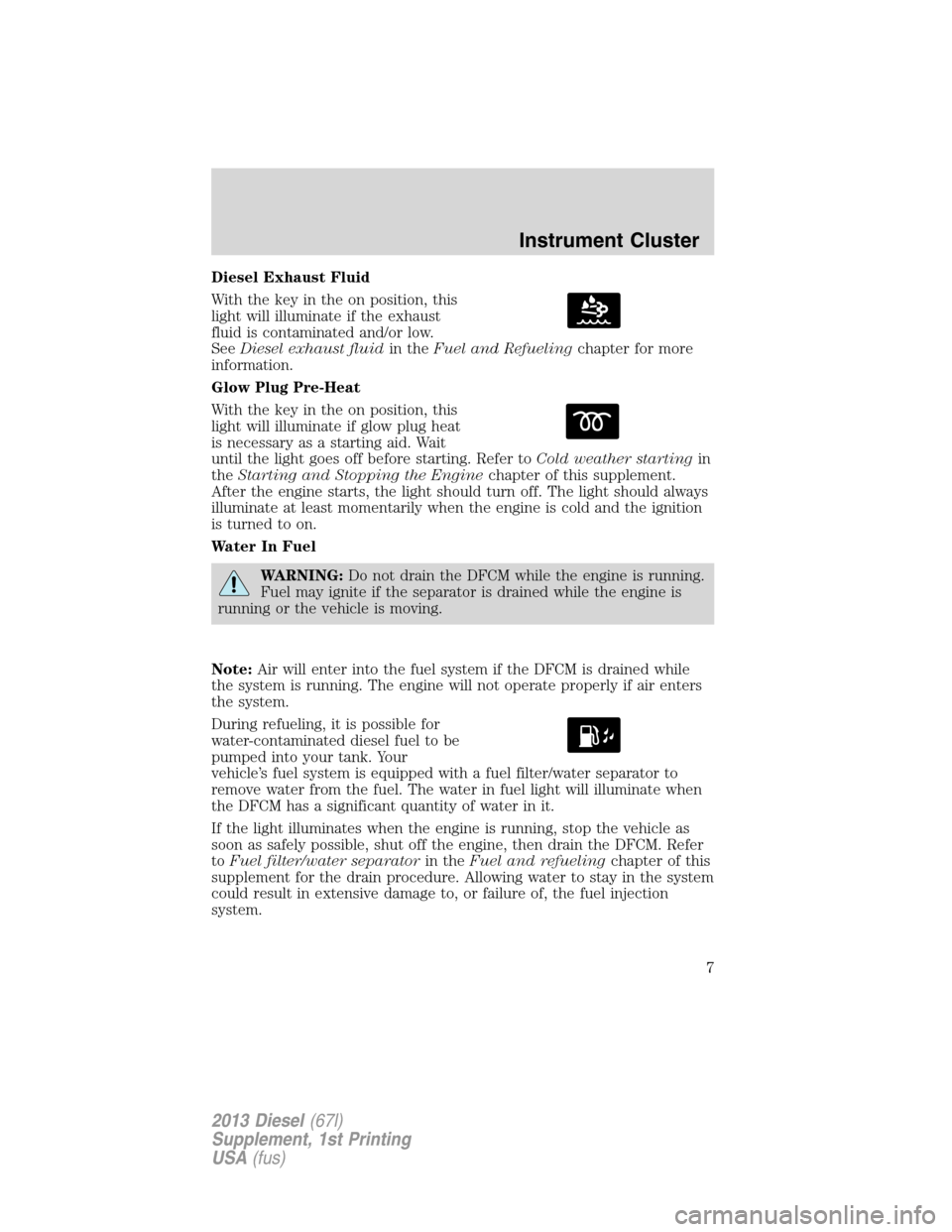
With the key in the on position, this
light will illuminate if the exhaust
fluid is contaminated and/or low.
SeeDiesel exhaust fluidin theFuel and Refuelingchapter for more
information.
Glow Plug Pre-Heat
With the key in the on position, this
light will illuminate if glow plug heat
is necessary as a starting aid. Wait
until the light goes off before starting. Refer toCold weather startingin
theStarting and Stopping the Enginechapter of this supplement.
After the engine starts, the light should turn off. The light should always
illuminate at least momentarily when the engine is cold and the ignition
is turned to on.
Water In Fuel
WARNING:Do not drain the DFCM while the engine is running.
Fuel may ignite if the separator is drained while the engine is
running or the vehicle is moving.
Note:Air will enter into the fuel system if the DFCM is drained while
the system is running. The engine will not operate properly if air enters
the system.
During refueling, it is possible for
water-contaminated diesel fuel to be
pumped into your tank. Your
vehicle’s fuel system is equipped with a fuel filter/water separator to
remove water from the fuel. The water in fuel light will illuminate when
the DFCM has a significant quantity of water in it.
If the light illuminates when the engine is running, stop the vehicle as
soon as safely possible, shut off the engine, then drain the DFCM. Refer
toFuel filter/water separatorin theFuel and refuelingchapter of this
supplement for the drain procedure. Allowing water to stay in the system
could result in extensive damage to, or failure of, the fuel injection
system.
Instrument Cluster
7
2013 Diesel(67l)
Supplement, 1st Printing
USA(fus)
Page 11 of 95
STOPPING THE ENGINE
Turn the ignition to the off position.
To prolong engine life (especially after extended high speed, high
ambient temperature, or high GVW/GCW operation, such as heavy loads
and/or heavy trailers), it is recommended that a hot engine be idled for
3-5 minutes. This allows the turbocharged engine to cool down. For more
information on GVW/GCW, see theLoad Carryingchapter in your
Owner’s Manual.
COLD WEATHER OPERATION
Note:Idling in cold weather does not heat the engine to its normal
operating temperature. Long periods of idling, especially in cold weather,
can cause a buildup of deposits which can cause engine damage.
Changing to a lighter grade engine oil also makes starting easier under
these conditions. Refer toEngine oil specificationsin theMaintenance
chapter of this supplement.
Diesel fuel is adjusted seasonally for cold temperatures. Diesel fuel which
has not been properly formulated for the ambient conditions may gel
which can clog the fuel filters. One indication that the fuel filter(s) may
be clogged is if the engine starts, stalls after a short time, and then does
not restart. If you have been using biodiesel, you may need to use a fuel
with lower biodiesel content, try another brand, or discontinue using
biodiesel. Do not use alcohol based additives to correct fuel gelling. This
may result in damage to the fuel injectors/system. Use the proper
anti-gel & performance improver product as listed in theTechnical
Specificationssection in theCapacities and Specificationschapter.
Your vehicle is equipped with a diesel fuel conditioner module (DFCM)
which recirculates fuel from the engine to help prevent fuel filter
clogging. To avoid engine fuel starvation during cold weather operation
of 32°F (0°C) or below, it is recommended that the fuel level in your
tank should not be allowed to drop below
14full. This helps prevent air
from entering the fuel system and stalling the engine.
Your vehicle is equipped with a an SCR system which uses diesel exhaust
fluid (DEF) to operate properly. DEF must be replenished at certain
intervals. When filling the vehicle’s DEF tank in cold weather, special
care must be taken to prevent damage to the DEF tank. For proper cold
weather fill procedure, seeSelective Catalytic Reduction (SCR) System
in theFuel and Refuelingchapter.
Starting and Stopping the Engine
10
2013 Diesel(67l)
Supplement, 1st Printing
USA(fus)
Page 15 of 95
FUEL REQUIREMENTS - CHOOSING THE RIGHT FUEL: VEHICLES
OPERATED WHERE ULTRA LOW SULFUR DIESEL FUEL IS
REQUIRED (UNITED STATES/CANADA/PUERTO RICO/U.S. VIRGIN
ISLANDS AND OTHER LOCALES)
Note:Damage caused by using the improper type of fuel or fuel additive
is not covered under your warranty.
Note:Do not blend used engine oil with diesel fuel under any
circumstances. Blending used oil with the fuel will significantly increase
your vehicle’s exhaust emissions and reduce engine life due to increased
internal wear.
Ultra-Low Sulfur Diesel fuel (also known as ULSD) designated as number
1-D or 2-D with a maximum of 15 ppm sulfur should be used in your
diesel vehicle. This vehicle may be operated on diesel fuels containing up
to 20% biodiesel, also known as B20. These fuels should meet either the
ASTM D975 diesel or the ASTM D7467 B6-B20 biodiesel industry
specifications should be used. Outside of North America, use fuels
meeting EN590 or equivalent local market standard.
Using low sulfur diesel fuel
(16-500 ppm) or high sulfur diesel
fuel (greater than 500 ppm) in the
6.7L diesel engine will cause certain emission components to malfunction
which may also cause the service engine soon light to illuminate
indicating an emissions-related concern.
Diesel fuel is adjusted seasonally for cold temperature. For best results at
temperatures below 20°F (-7°C), it is recommended to use a diesel fuel
which has been seasonally adjusted for the ambient conditions. SeeCold
weather operationin theFuel and Refuelingchapter of this supplement.
Fuel and Refueling
14
2013 Diesel(67l)
Supplement, 1st Printing
USA(fus)
Page 27 of 95
5. Once the level in the DEF bottle
has stopped dropping, return the
container to the vertical position
slightly below the DEF filler port
and let any DEF drain out of the
spout. DO NOT try to continue to
add DEF to the tank by shaking or
repositioning the container to
induce flow. This may cause spilling
and overfill the tank. Overfilling the
DEF tank can cause damage to the
tank.
6. Once the spout has drained, remove the spout from the DEF filler
port and install the blue cap on the DEF filler port.
7. Remove the spout from the DEF container and install the cap back on
the bottle.
8. If the container is empty, discard the empty container, or recycle if
possible. If there is DEF left in the container, retain it for later use. The
spout is re-useable; after use, rinse it with clean water and store the
spout to ensure it is kept clean. Do not use the DEF spout with any
other chemicals.
9. Wipe away any DEF that has spilled on painted surfaces with water
and a damp cloth.
•DEF filling station nozzle fill:
Filling the DEF tank using a nozzle is similar to a normal fuel fill. The
nozzle will shut off automatically when the tank is full. Do not continue
to fill the tank as this may cause spilling and overfill the tank which can
cause damage.
Note:Some filling station nozzles may prevent filling of your DEF tank
due to a magnetic mechanism in the nozzle. This is not a problem with
your vehicle. To refill your tank either locate another filling station or
use a bottle to refill the tank.
Filling the DEF tank in cold climates
DEF will freeze below 12°F (-11°C); however, your vehicle is equipped
with an automatic preheating system which allows the DEF system to
operate below 12°F (-11°C). When the vehicle is not in operation for an
extended period of time with temperatures at or below 12°F (-11°C), the
DEF tank could freeze. If the tank is OVERFILLED and freezes, it could
be damaged, therefore DO NOT OVERFILL.
Fuel and Refueling
26
2013 Diesel(67l)
Supplement, 1st Printing
USA(fus)
Page 28 of 95
To prevent overfilling of the DEF tank when filling with a bottle, Ford
recommends using Motorcraft® DEF. Additionally, if the information
display indicatesEXHAUST FLUID UNDER 1/2 FULL, you should only
add a MAXIMUM of 2 gallons (6.7L) of DEF to the tank to prevent
freeze damage due to overfilling. If the information display indicates
EXHAUST FLUID LEVEL OK, do not add DEF.
Contaminated DEF or inoperative SCR system
SCR systems are sensitive to
contamination of the DEF. USE
ONLY API or ISO 22241 CERTIFIED
DIESEL EXHAUST FLUID. If the SCR becomes contaminated or
inoperative, the DEF light will illuminate and exhaust fluid system fault
messages will appear in the information display.
Continued driving without replacing DEF or having the SCR system
repaired will result in the following actions as required by the California
Air Resources Board (CARB) and /or U.S. Environmental Protection
Agency (EPA):
•Within a certain number of miles (kilometers) to empty, speed will be
limited upon restart. Prior to this occurring a message will appear in
the message center.
•
Further vehicle operation without replacing contaminated DEF will cause
the engine to enter an idle-only condition. This will only occur upon
vehicle refueling, vehicle idling in park for 1 hour, or engine shutdown for
10 minutes or more and will be indicated by a message in the message
center indicating required actions to resume normal operation.
For either vehicle speed limiting or idle-only condition, normal vehicle
operation will resume when the contaminated system is repaired.To
service a contaminated or inoperative system, see your
authorized dealer.
DEF guidelines and information
•Use only DEF that carries the trademark: American Petroleum
Institute (API) certified DEF or ISO 22241.
•Do not put DEF in the diesel fuel tank.
•Do not overfill the DEF tank.
•Do not re-use the DEF container once it is emptied.
•
Avoid spilling DEF on painted surfaces, carpeting or plastic components.
Immediately wipe away any DEF that has spilled with a damp cloth and
water. If it has already crystallized, use warm water and a sponge.
Fuel and Refueling
27
2013 Diesel(67l)
Supplement, 1st Printing
USA(fus)
Page 29 of 95
•Store DEF out of direct sunlight and in temperatures between 23°F
(-5°C) — 68°F (20°C).
•DEF will freeze below 12°F (-11°C).
•Do not store DEF bottle in vehicle. If it leaks it could cause damage to
interior components or release an ammonia odor inside the vehicle.
•DEF is non-flammable, non-toxic, colorless and water-soluble liquid.
•Do not dilute DEF with water or any other liquid.
•An ammonia odor may be smelled when the cap is removed or during
refill. Refill DEF in a well ventilated area.
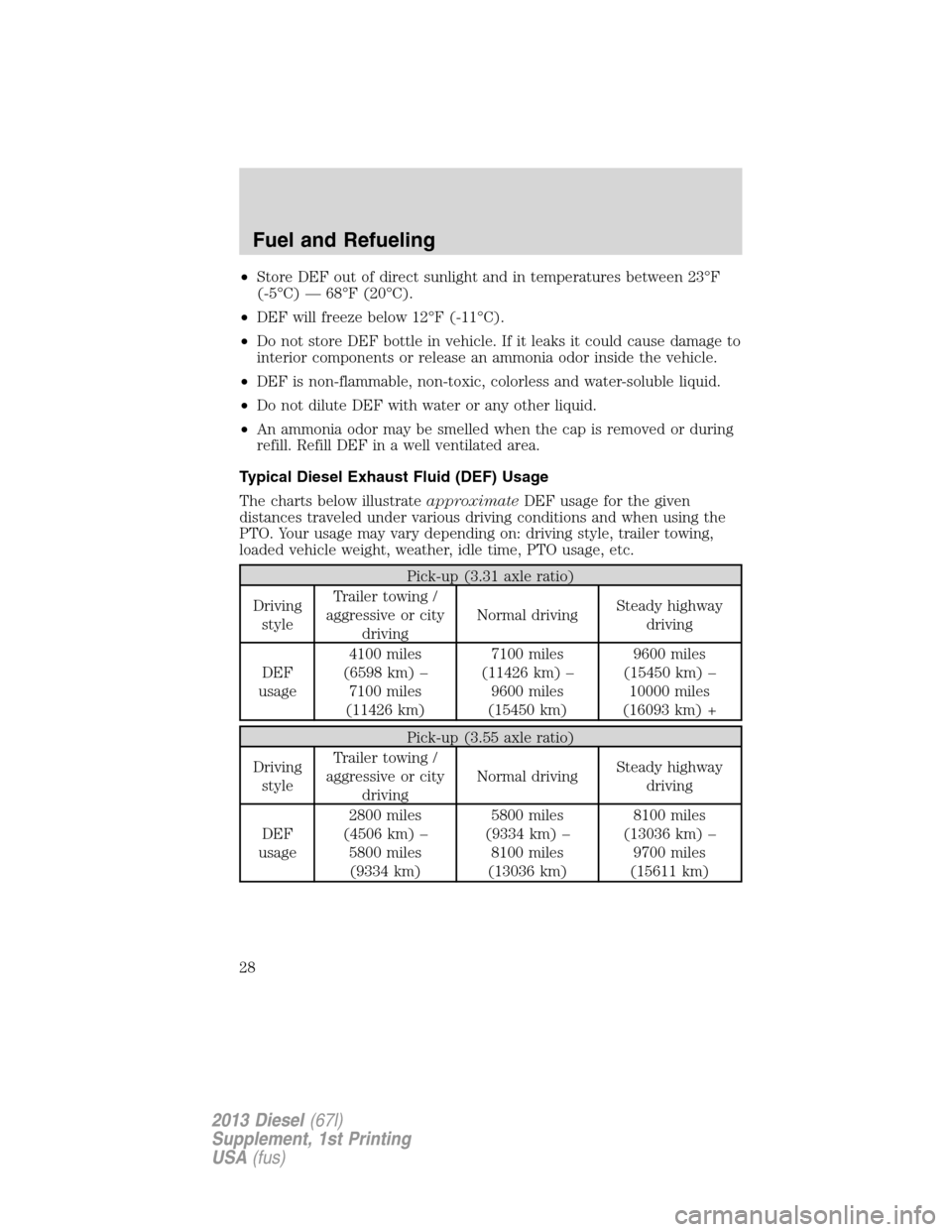
Typical Diesel Exhaust Fluid (DEF) Usage
The charts below illustrateapproximateDEF usage for the given
distances traveled under various driving conditions and when using the
PTO. Your usage may vary depending on: driving style, trailer towing,
loaded vehicle weight, weather, idle time, PTO usage, etc.
Pick-up (3.31 axle ratio)
Driving
styleTrailer towing /
aggressive or city
drivingNormal drivingSteady highway
driving
DEF
usage4100 miles
(6598 km) –
7100 miles
(11426 km)7100 miles
(11426 km) –
9600 miles
(15450 km)9600 miles
(15450 km) –
10000 miles
(16093 km) +
Pick-up (3.55 axle ratio)
Driving
styleTrailer towing /
aggressive or city
drivingNormal drivingSteady highway
driving
DEF
usage2800 miles
(4506 km) –
5800 miles
(9334 km)5800 miles
(9334 km) –
8100 miles
(13036 km)8100 miles
(13036 km) –
9700 miles
(15611 km)
Fuel and Refueling
28
2013 Diesel(67l)
Supplement, 1st Printing
USA(fus)