Page 49 of 95
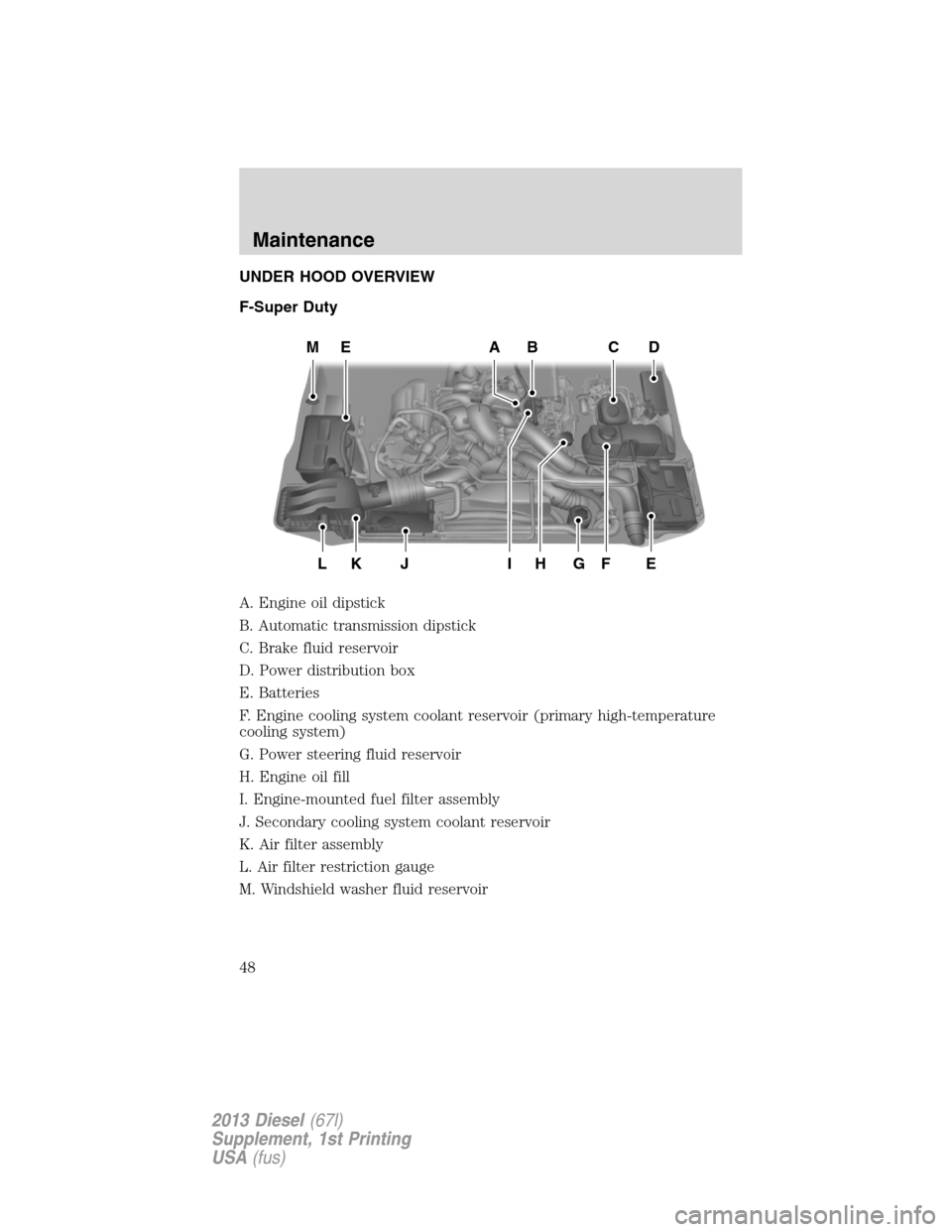
UNDER HOOD OVERVIEW
F-Super Duty
A. Engine oil dipstick
B. Automatic transmission dipstick
C. Brake fluid reservoir
D. Power distribution box
E. Batteries
F. Engine cooling system coolant reservoir (primary high-temperature
cooling system)
G. Power steering fluid reservoir
H. Engine oil fill
I. Engine-mounted fuel filter assembly
J. Secondary cooling system coolant reservoir
K. Air filter assembly
L. Air filter restriction gauge
M. Windshield washer fluid reservoir
MEBC
EGJKLF
DA
HI
Maintenance
48
2013 Diesel(67l)
Supplement, 1st Printing
USA(fus)
Page 53 of 95
•frequent low-speed operation, consistent heavy traffic less than
25 mph (40 km/h)
•operating in severe dust conditions
•operating the vehicle off road
•towing a trailer over 1,000 miles (1,600 km)
•sustained, high-speed driving at Gross Vehicle Weight Rating
(maximum loaded weight for vehicle operation)
•
use of fuels with sulfur content other than ultra-low sulfur diesel (ULSD)
•use of high-sulfur diesel fuel
ENGINE AND SECONDARY COOLING SYSTEM COOLANT
Checking the engine coolant
The concentration, additive strength and level of coolant should be
checked at the mileage intervals listed in thescheduled maintenance
information.Be sure to read and understandPrecautions when
servicing your vehiclein yourOwner’s Manual.
When the engine is cold, check the level of coolant in the reservoirs. See
Under Hood Overviewfor the location of the engine and secondary
cooling system reservoirs. If the coolant has not been checked at the
recommended interval, the engine or secondary coolant reservoir may
become low or empty. If either reservoir is low or empty, add coolant to
the reservoir(s). Refer toEngine and secondary cooling system refill
procedurein this chapter.
Note:The engine coolant should be between the MIN and MAX marks
(within the COLD FILL RANGE), as listed on the engine coolant reservoirs.
Note:Coolant expands when it is hot. The level may extend beyond the
MAX mark.
If the level is below the MIN mark, add engine coolant immediately see
Adding coolantin this chapter.
Note:For best results, coolant concentration should be tested with a
refractometer such as Rotunda tool 300– ROB75240 available from your
dealer. Ford does not recommend the use of hydrometers or coolant test
strips for measuring coolant concentrations.
The coolant concentration should be maintained within 48% to 50%,
which equates to a freeze point between -30 °F and -34 °F.
Note:Automotive fluids are not interchangeable; do not use engine
coolant/antifreeze or windshield washer fluid outside of its specified
function and vehicle location.
Maintenance
52
2013 Diesel(67l)
Supplement, 1st Printing
USA(fus)
Page 54 of 95
Adding engine coolant
WARNING:Do not add coolant when the engine is hot. Steam and
scalding liquids released from a hot cooling system can burn you
badly. Also, you can be burned if you spill coolant on hot engine parts.
WARNING:Do not put coolant in the windshield washer fluid
container. If sprayed on the windshield, coolant could make it
difficult to see through the windshield.
WARNING:To reduce the risk of personal injury, make sure the
engine is cool before unscrewing the coolant pressure relief cap.
The cooling system(s) are under pressure; steam and hot liquid can
come out forcefully when the cap is loosened slightly.
WARNING:Do not add coolant further than the MAX mark.
Note:Do not use stop leak pellets, cooling system sealants or unapproved
additives as they can cause damage to the engine cooling and/or heating
systems. This damage would not be covered under your vehicle’s warranty.
Note:During normal vehicle operation, the engine coolant may change
color from orange to pink or light red. If the engine coolant is clear and
uncontaminated, this color change does not indicate the engine coolant
has degraded nor does it require the engine coolant to be drained, the
system to be flushed, or the engine coolant to be replaced.
•DO NOT MIX different colors or types of coolant in your vehicle. Only
use prediluted engine coolant that meets Ford specification . Mixing of
engine coolants may harm your engine’s cooling system. The use of an
improper coolant may harm engine and cooling system components
and may void the warranty.
•In case of emergency, a large amount of water without engine coolant
may be added in order to reach a vehicle service location. In this
instance, the cooling system must be drained, chemically cleaned, and
refilled with engine coolant as soon as possible per the instructions in
the Workshop Manual. Water alone (without engine coolant) can cause
engine damage from corrosion, overheating or freezing.DO NOTuse
this method for the secondary cooling system. The secondary cooling
system operates close to ambient temperature, and is susceptible to
freezing in any subfreezing environment, in the absence of coolant.
Maintenance
53
2013 Diesel(67l)
Supplement, 1st Printing
USA(fus)
Page 65 of 95
ENGINE
Engines are more efficient when they are clean because grease and dirt
buildup keep the engine warmer than normal. When washing:
•Take care when using a power washer to clean the engine. The
high-pressure fluid could penetrate the sealed parts and cause
damage.
•Do not spray a hot engine with cold water to avoid cracking the
engine block or other engine components.
•Spray Motorcraft® Engine Shampoo and Degreaser (ZC-20) on all
parts that require cleaning and pressure rinse clean.
•Never wash or rinse the engine while it is running; water in the
running engine may cause internal damage.
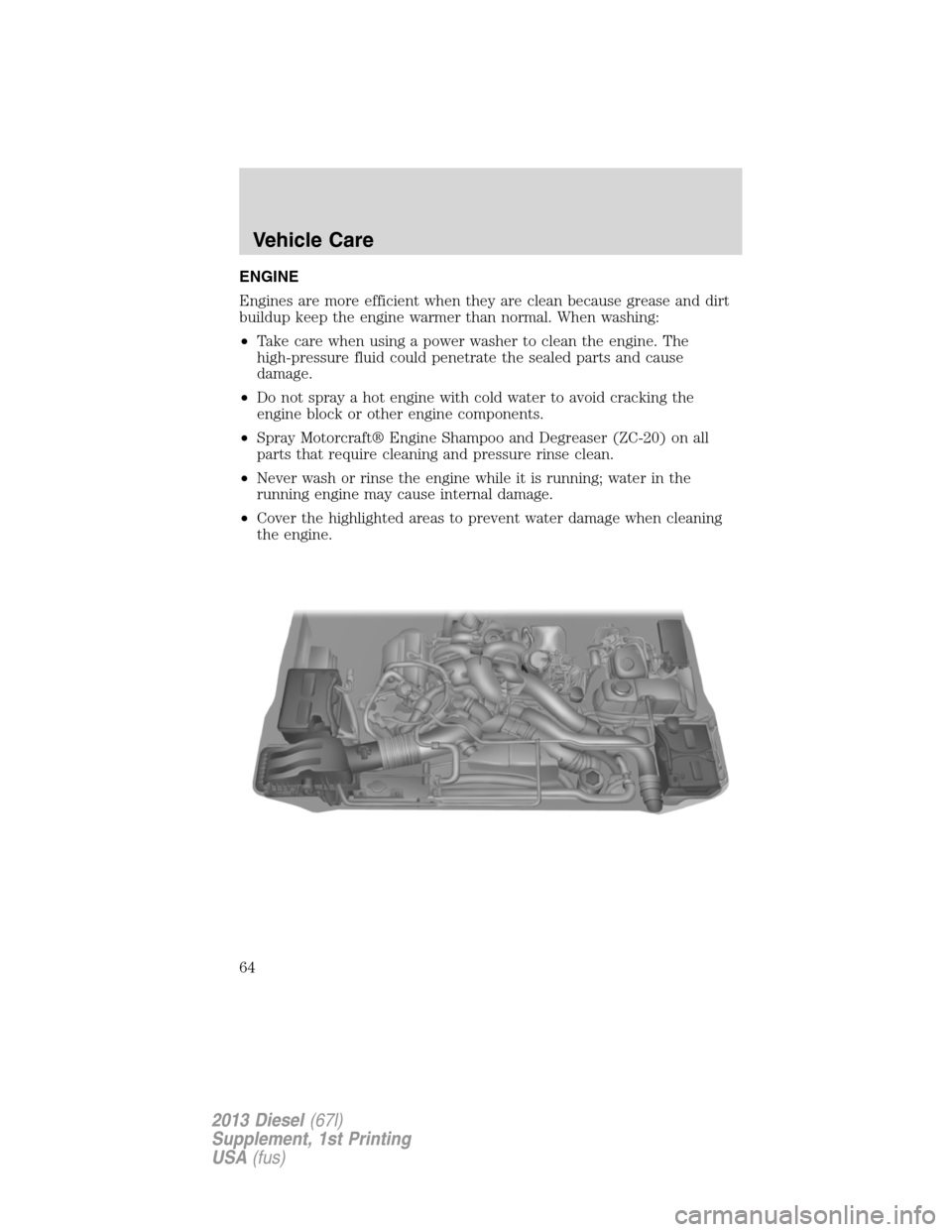
•Cover the highlighted areas to prevent water damage when cleaning
the engine.
Vehicle Care
64
2013 Diesel(67l)
Supplement, 1st Printing
USA(fus)
Page 74 of 95
Multi-point Inspection
In order to keep your vehicle running right, it is important to have the
systems on your vehicle checked regularly. This can help identify
potential issues and prevent major problems. Ford Motor Company
recommends the following multi-point inspection be performed at every
scheduled maintenance interval to help make sure your vehicle keeps
running great.
Multi-point Inspection
Accessory drive belt(s) Horn operation
Battery performance Radiator, cooler, heater and A/C hoses
Engine air filter Suspension component for leaks or
damage
Exhaust system Steering and linkage
Exterior lamps and hazard
warning system operationTires (including spare) for wear and
proper pressure
**
Fluid levels*; fill if necessary Windshield for cracks, chips or pits
For oil and fluid leaks Washer spray and wiper operation
*Brake, coolant recovery reservoir, automatic transmission, power
steering and window washer.
**If your vehicle is equipped with a temporary mobility kit, check the tire
sealant expiration Use By date on the canister. Replace as needed.
Be sure to ask your dealership service advisor or technician about the
multi-point vehicle inspection. It is a comprehensive way to perform a
thorough inspection of your vehicle. It is your checklist that gives you
immediate feedback on the overall condition of your vehicle. You will
know what has been checked, what is okay, as well as those things that
may require future or immediate attention. The multi-point vehicle
inspection is one more way to keep your vehicle running great!
Scheduled Maintenance
73
2013 Diesel(67l)
Supplement, 1st Printing
USA(fus)