2013 FORD SUPER DUTY wheel
[x] Cancel search: wheelPage 39 of 95
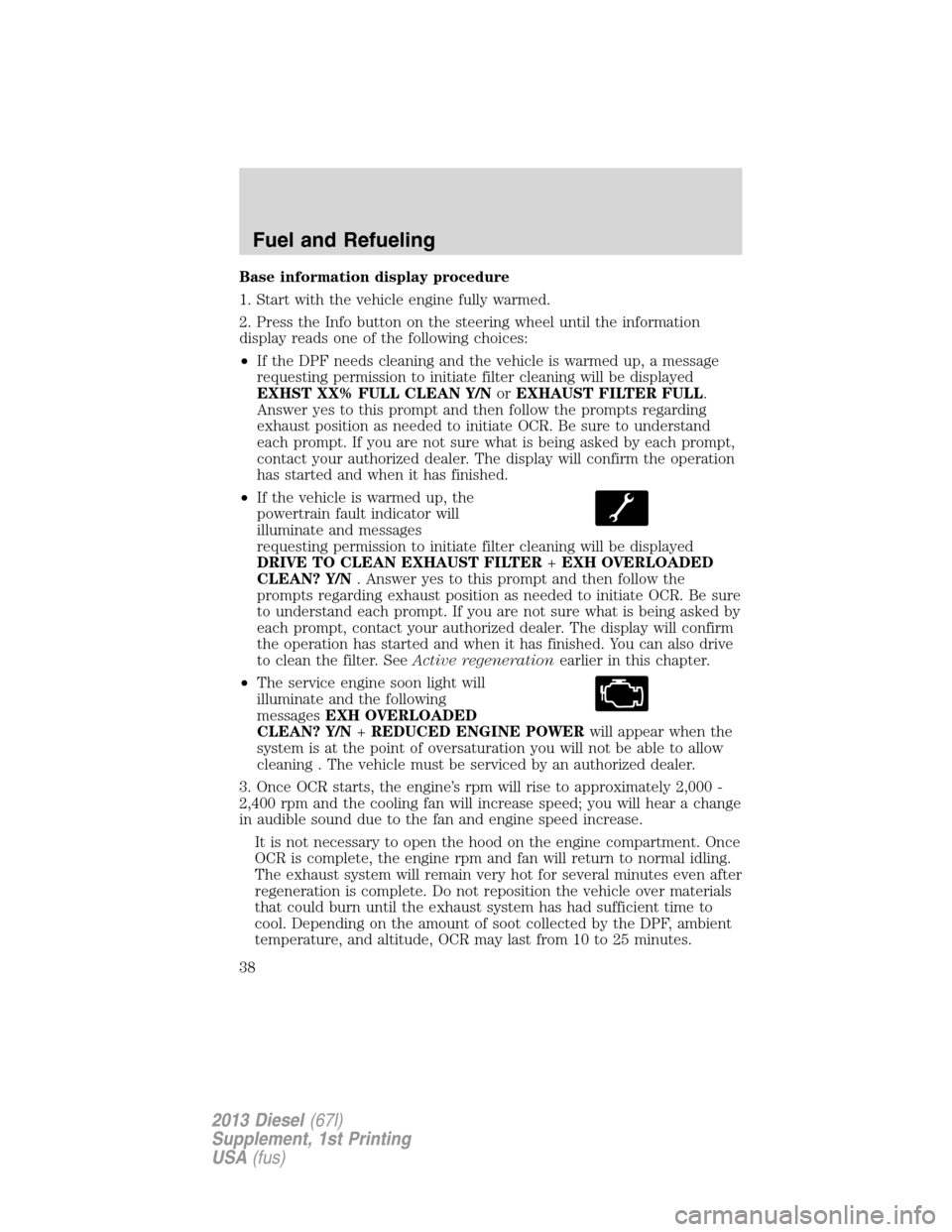
Base information display procedure
1. Start with the vehicle engine fully warmed.
2. Press the Info button on the steering wheel until the information
display reads one of the following choices:
•If the DPF needs cleaning and the vehicle is warmed up, a message
requesting permission to initiate filter cleaning will be displayed
EXHST XX% FULL CLEAN Y/NorEXHAUST FILTER FULL.
Answer yes to this prompt and then follow the prompts regarding
exhaust position as needed to initiate OCR. Be sure to understand
each prompt. If you are not sure what is being asked by each prompt,
contact your authorized dealer. The display will confirm the operation
has started and when it has finished.
•If the vehicle is warmed up, the
powertrain fault indicator will
illuminate and messages
requesting permission to initiate filter cleaning will be displayed
DRIVE TO CLEAN EXHAUST FILTER+EXH OVERLOADED
CLEAN? Y/N. Answer yes to this prompt and then follow the
prompts regarding exhaust position as needed to initiate OCR. Be sure
to understand each prompt. If you are not sure what is being asked by
each prompt, contact your authorized dealer. The display will confirm
the operation has started and when it has finished. You can also drive
to clean the filter. SeeActive regenerationearlier in this chapter.
•The service engine soon light will
illuminate and the following
messagesEXH OVERLOADED
CLEAN? Y/N+REDUCED ENGINE POWERwill appear when the
system is at the point of oversaturation you will not be able to allow
cleaning . The vehicle must be serviced by an authorized dealer.
3. Once OCR starts, the engine’s rpm will rise to approximately 2,000 -
2,400 rpm and the cooling fan will increase speed; you will hear a change
in audible sound due to the fan and engine speed increase.
It is not necessary to open the hood on the engine compartment. Once
OCR is complete, the engine rpm and fan will return to normal idling.
The exhaust system will remain very hot for several minutes even after
regeneration is complete. Do not reposition the vehicle over materials
that could burn until the exhaust system has had sufficient time to
cool. Depending on the amount of soot collected by the DPF, ambient
temperature, and altitude, OCR may last from 10 to 25 minutes.
Fuel and Refueling
38
2013 Diesel(67l)
Supplement, 1st Printing
USA(fus)
Page 44 of 95
Among those acts which the U.S. Environmental Protection Agency may
presume to constitute tampering are the acts listed below:
•Removal of hood blanket, fender apron absorbers, fender apron
barriers, underbody noise shields or acoustically absorptive material.
•Tampering or rendering inoperative the engine speed governor, so as
to allow engine speed to exceed manufacturer’s specifications.
The complexity of the diesel engine makes it so the owner is discouraged
from attempting to perform maintenance other than the services
described in this supplement.
If you experience difficult starting, rough idling, excessive exhaust
smoke, a decrease in engine performance or excess fuel consumption,
perform the following checks:
•a plugged or disconnected air inlet system or engine air filter element.
•water in the fuel filter/water separator.
•a clogged fuel filter.
•contaminated fuel.
•air in the fuel system, due to loose connections.
•an open or pinched sensor hose.
•check engine oil level.
•wrong fuel or oil viscosity for climactic conditions.
If these checks do not help you correct the engine performance problem
you are experiencing, consult an authorized dealer.
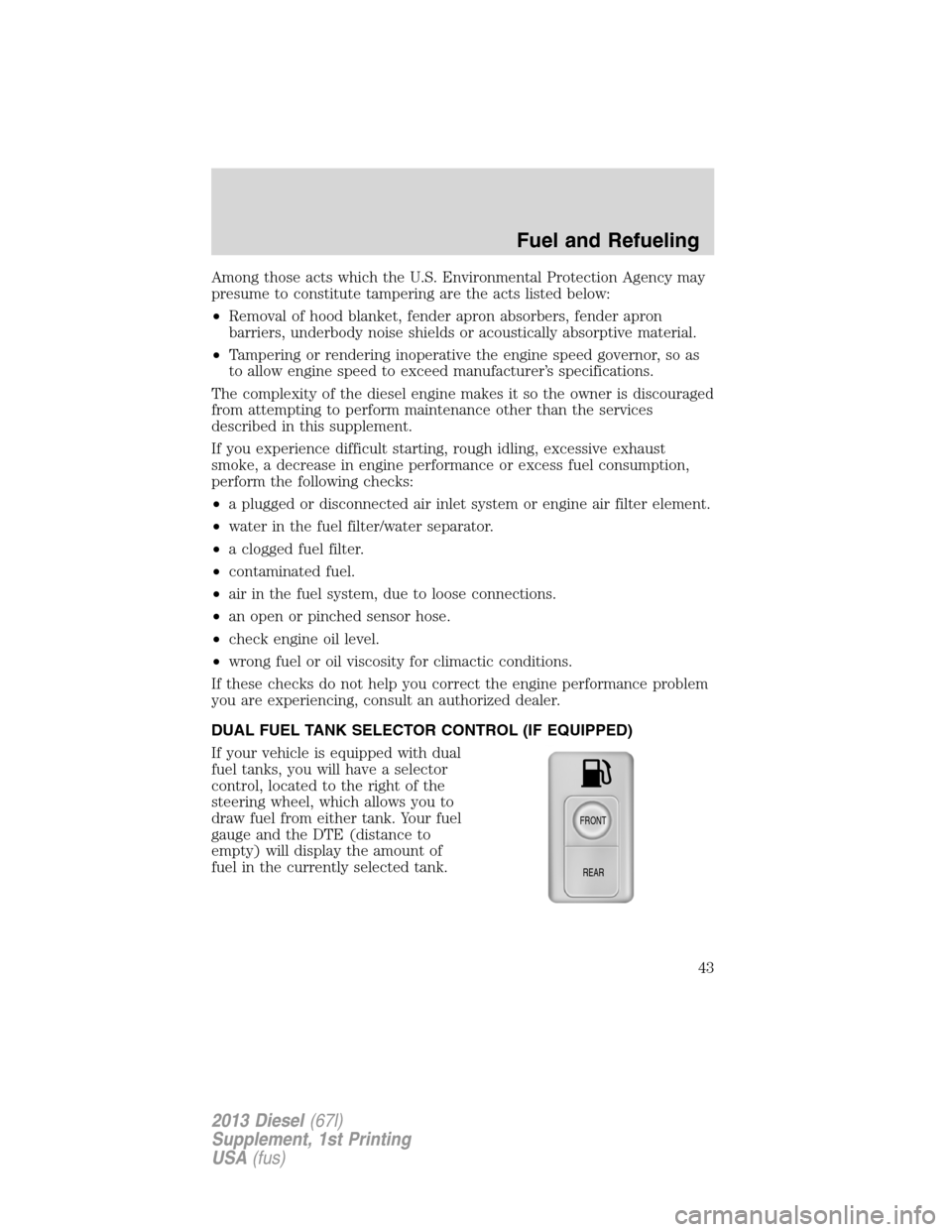
DUAL FUEL TANK SELECTOR CONTROL (IF EQUIPPED)
If your vehicle is equipped with dual
fuel tanks, you will have a selector
control, located to the right of the
steering wheel, which allows you to
draw fuel from either tank. Your fuel
gauge and the DTE (distance to
empty) will display the amount of
fuel in the currently selected tank.
FRONT
REAR
Fuel and Refueling
43
2013 Diesel(67l)
Supplement, 1st Printing
USA(fus)
Page 46 of 95
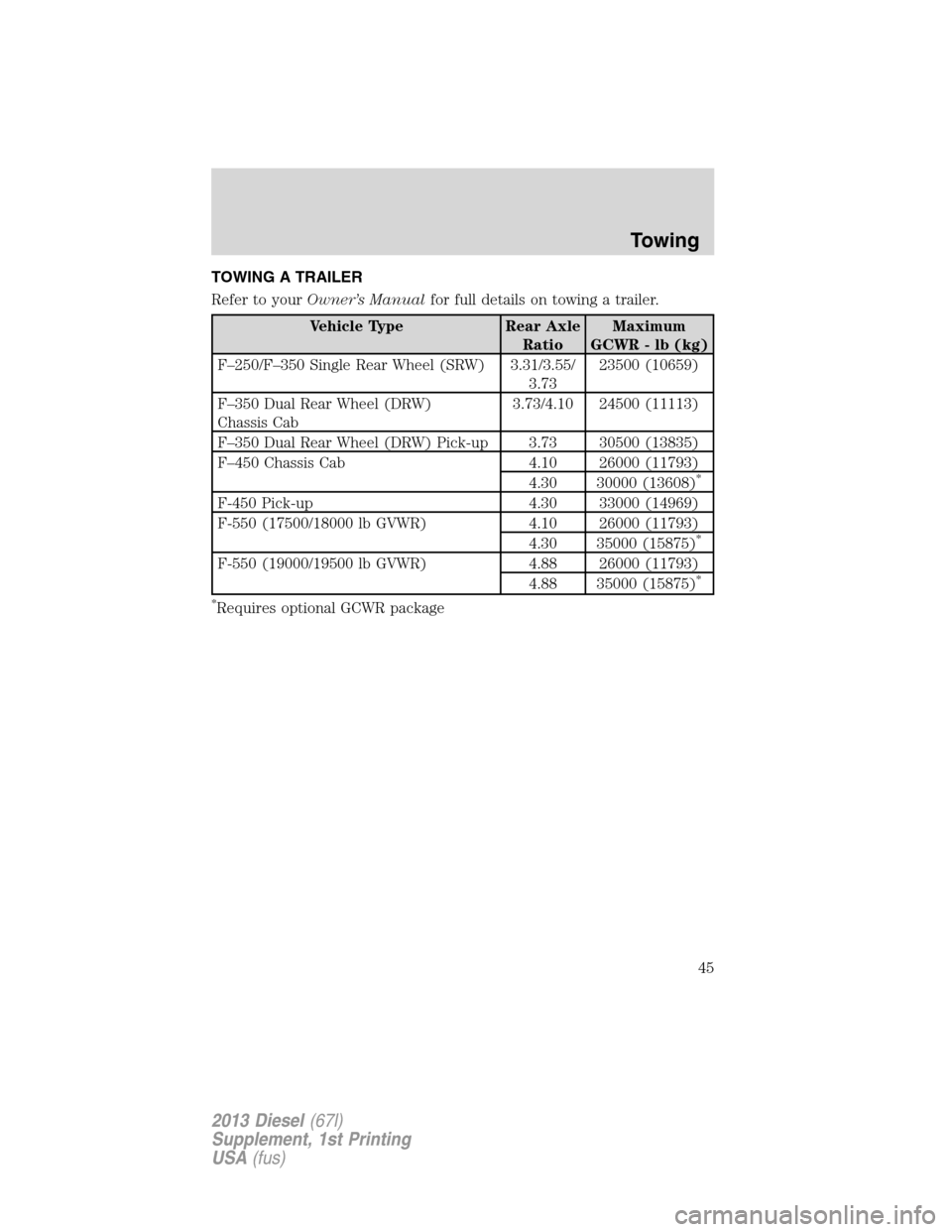
TOWING A TRAILER
Refer to yourOwner’s Manualfor full details on towing a trailer.
Vehicle Type Rear Axle
RatioMaximum
GCWR - lb (kg)
F–250/F–350 Single Rear Wheel (SRW) 3.31/3.55/
3.7323500 (10659)
F–350 Dual Rear Wheel (DRW)
Chassis Cab3.73/4.10 24500 (11113)
F–350 Dual Rear Wheel (DRW) Pick-up 3.73 30500 (13835)
F–450 Chassis Cab 4.10 26000 (11793)
4.30 30000 (13608)
*
F-450 Pick-up 4.30 33000 (14969)
F-550 (17500/18000 lb GVWR) 4.10 26000 (11793)
4.30 35000 (15875)
*
F-550 (19000/19500 lb GVWR) 4.88 26000 (11793)
4.88 35000 (15875)*
*
Requires optional GCWR package
Towing
45
2013 Diesel(67l)
Supplement, 1st Printing
USA(fus)
Page 73 of 95
Oils, Fluids and Flushing
In many cases, fluid discoloration is a normal operating characteristic
and, by itself, does not necessarily indicate a concern or that the fluid
needs to be changed. However, discolored fluids that also show signs of
overheating and foreign material contamination should be inspected
immediately by a qualified expert, such as the factory-trained technicians
at your dealership. Your vehicle’s oils and fluids should be changed at the
specified intervals or in conjunction with a repair. Flushing is a viable
way to change fluid for many vehicle sub-systems during scheduled
maintenance. It is critical that systems are flushed only with new fluid
that is the same as that required to fill and operate the system, or using
a Ford-approved flushing chemical.
Owner Checks and Services
Certain basic maintenance checks and inspections should be performed by
the owner or a service technician at the intervals indicated. Service
information and supporting specifications are provided in theOwner’s Guide.
Any adverse condition should be brought to the attention of your dealer
or qualified service technician as soon as possible for the proper service
advice. The owner maintenance service checks are generally not covered
by warranties so you may be charged for labor, parts or fluids used.
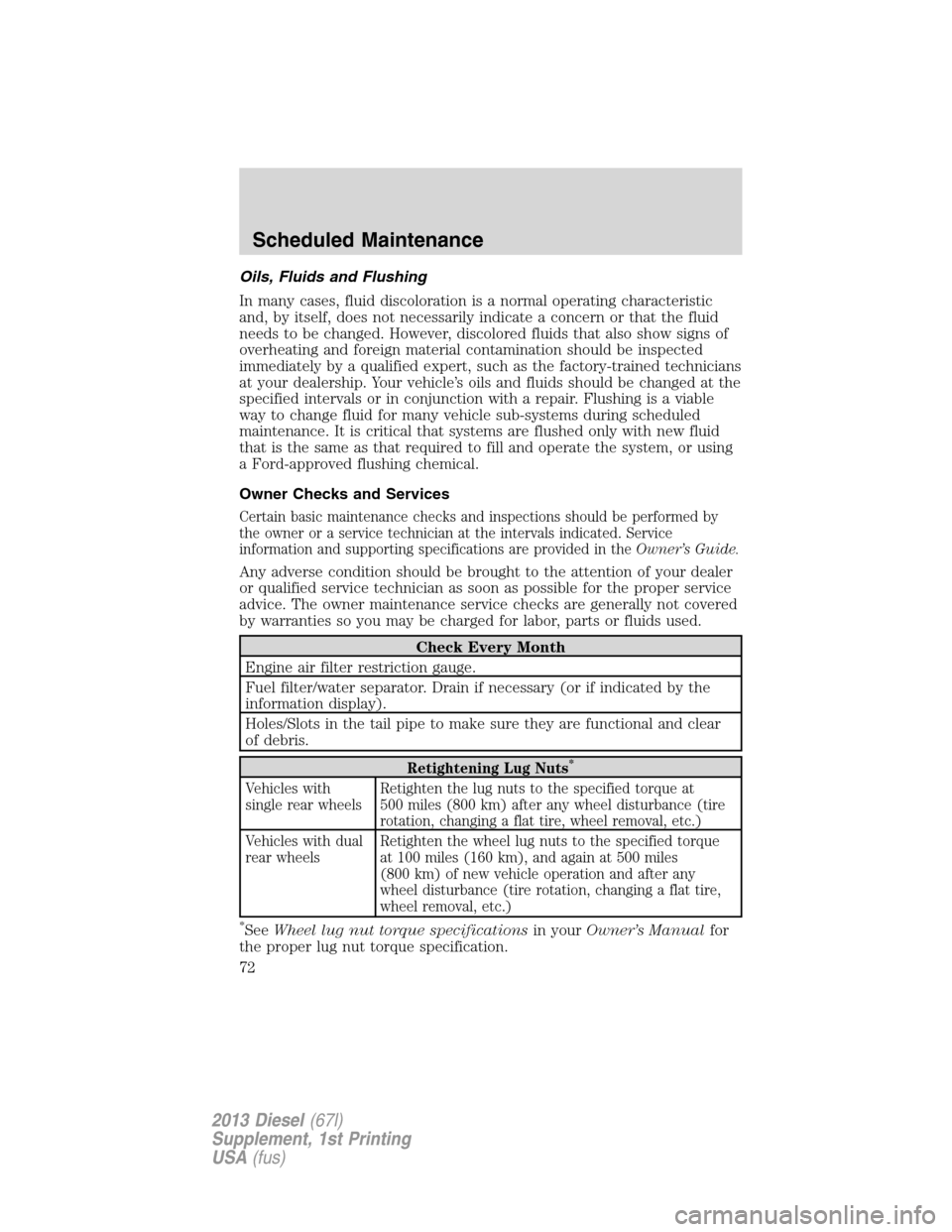
Check Every Month
Engine air filter restriction gauge.
Fuel filter/water separator. Drain if necessary (or if indicated by the
information display).
Holes/Slots in the tail pipe to make sure they are functional and clear
of debris.
Retightening Lug Nuts*
Vehicles with
single rear wheelsRetighten the lug nuts to the specified torque at
500 miles (800 km) after any wheel disturbance (tire
rotation, changing a flat tire, wheel removal, etc.)
Vehicles with dual
rear wheelsRetighten the wheel lug nuts to the specified torque
at 100 miles (160 km), and again at 500 miles
(800 km) of new vehicle operation and after any
wheel disturbance (tire rotation, changing a flat tire,
wheel removal, etc.)
*SeeWheel lug nut torque specificationsin yourOwner’s Manualfor
the proper lug nut torque specification.
Scheduled Maintenance
72
2013 Diesel(67l)
Supplement, 1st Printing
USA(fus)
Page 77 of 95
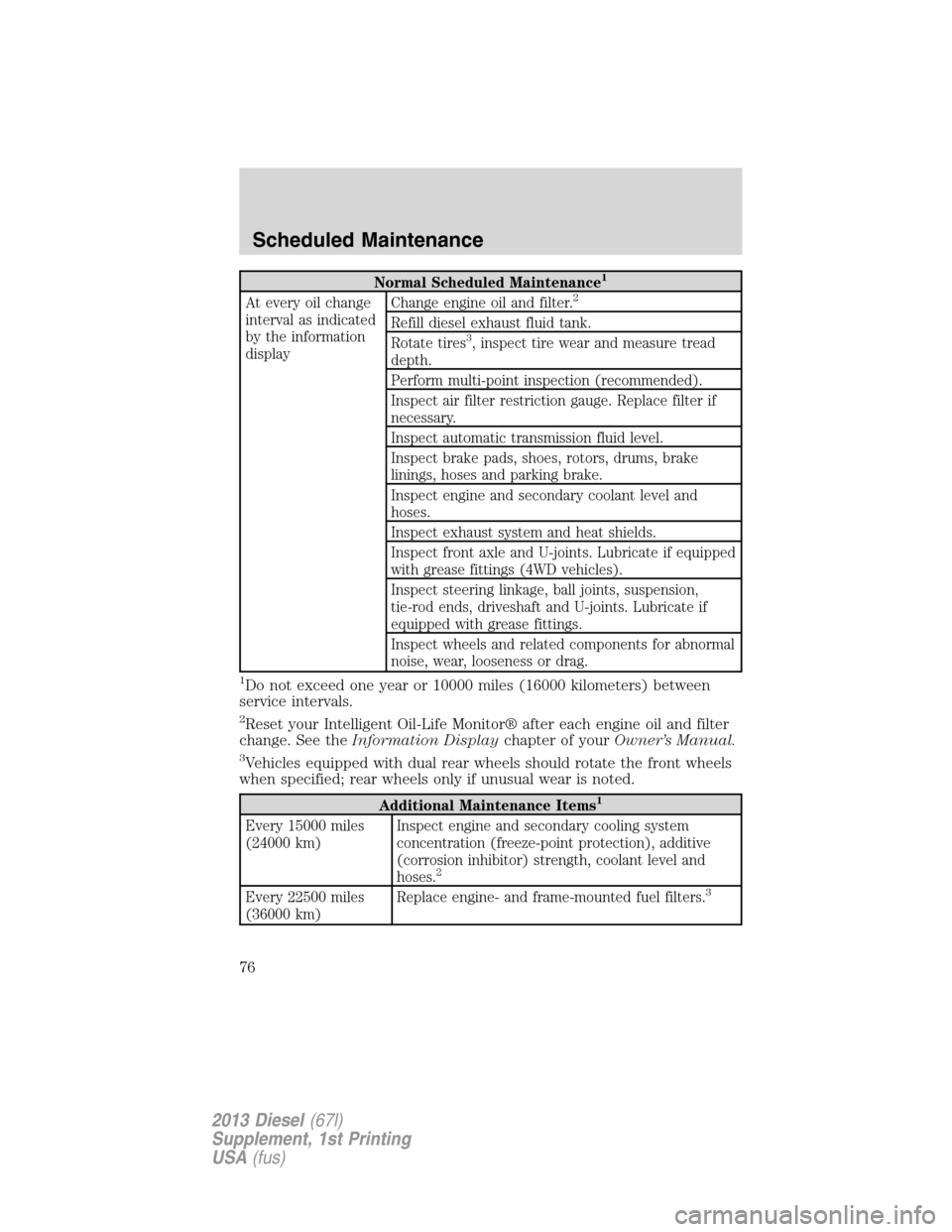
Normal Scheduled Maintenance1
At every oil change
interval as indicated
by the information
displayChange engine oil and filter.2
Refill diesel exhaust fluid tank.
Rotate tires3, inspect tire wear and measure tread
depth.
Perform multi-point inspection (recommended).
Inspect air filter restriction gauge. Replace filter if
necessary.
Inspect automatic transmission fluid level.
Inspect brake pads, shoes, rotors, drums, brake
linings, hoses and parking brake.
Inspect engine and secondary coolant level and
hoses.
Inspect exhaust system and heat shields.
Inspect front axle and U-joints. Lubricate if equipped
with grease fittings (4WD vehicles).
Inspect steering linkage, ball joints, suspension,
tie-rod ends, driveshaft and U-joints. Lubricate if
equipped with grease fittings.
Inspect wheels and related components for abnormal
noise, wear, looseness or drag.
1Do not exceed one year or 10000 miles (16000 kilometers) between
service intervals.
2Reset your Intelligent Oil-Life Monitor® after each engine oil and filter
change. See theInformation Displaychapter of yourOwner’s Manual.
3Vehicles equipped with dual rear wheels should rotate the front wheels
when specified; rear wheels only if unusual wear is noted.
Additional Maintenance Items1
Every 15000 miles
(24000 km)Inspect engine and secondary cooling system
concentration (freeze-point protection), additive
(corrosion inhibitor) strength, coolant level and
hoses.
2
Every 22500 miles
(36000 km)Replace engine- and frame-mounted fuel filters.3
Scheduled Maintenance
76
2013 Diesel(67l)
Supplement, 1st Printing
USA(fus)
Page 78 of 95
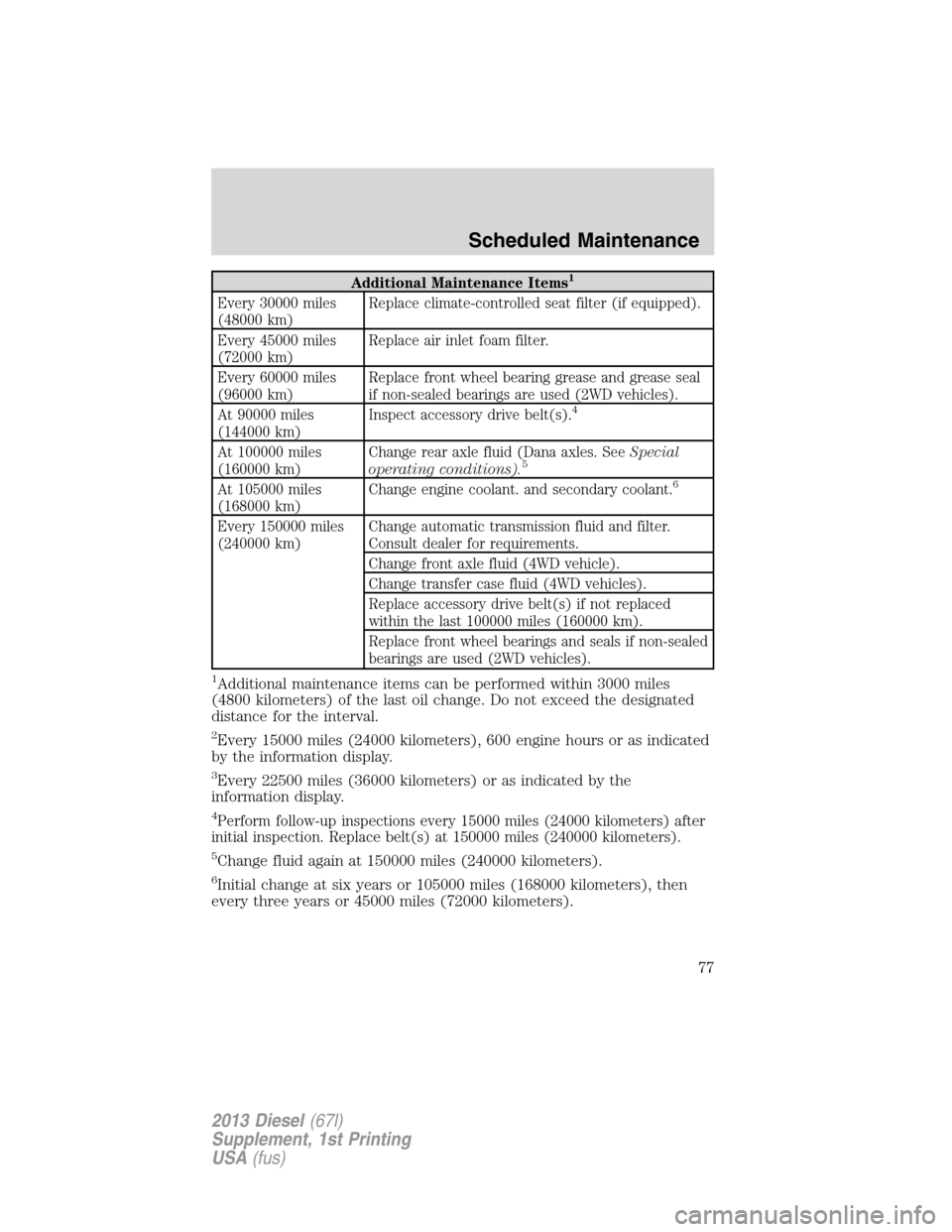
Additional Maintenance Items1
Every 30000 miles
(48000 km)Replace climate-controlled seat filter (if equipped).
Every 45000 miles
(72000 km)Replace air inlet foam filter.
Every 60000 miles
(96000 km)Replace front wheel bearing grease and grease seal
if non-sealed bearings are used (2WD vehicles).
At 90000 miles
(144000 km)Inspect accessory drive belt(s).
4
At 100000 miles
(160000 km)Change rear axle fluid (Dana axles. SeeSpecial
operating conditions).5
At 105000 miles
(168000 km)Change engine coolant. and secondary coolant.6
Every 150000 miles
(240000 km)Change automatic transmission fluid and filter.
Consult dealer for requirements.
Change front axle fluid (4WD vehicle).
Change transfer case fluid (4WD vehicles).
Replace accessory drive belt(s) if not replaced
within the last 100000 miles (160000 km).
Replace front wheel bearings and seals if non-sealed
bearings are used (2WD vehicles).
1Additional maintenance items can be performed within 3000 miles
(4800 kilometers) of the last oil change. Do not exceed the designated
distance for the interval.
2Every 15000 miles (24000 kilometers), 600 engine hours or as indicated
by the information display.
3Every 22500 miles (36000 kilometers) or as indicated by the
information display.
4Perform follow-up inspections every 15000 miles (24000 kilometers) after
initial inspection. Replace belt(s) at 150000 miles (240000 kilometers).
5Change fluid again at 150000 miles (240000 kilometers).
6Initial change at six years or 105000 miles (168000 kilometers), then
every three years or 45000 miles (72000 kilometers).
Scheduled Maintenance
77
2013 Diesel(67l)
Supplement, 1st Printing
USA(fus)
Page 84 of 95
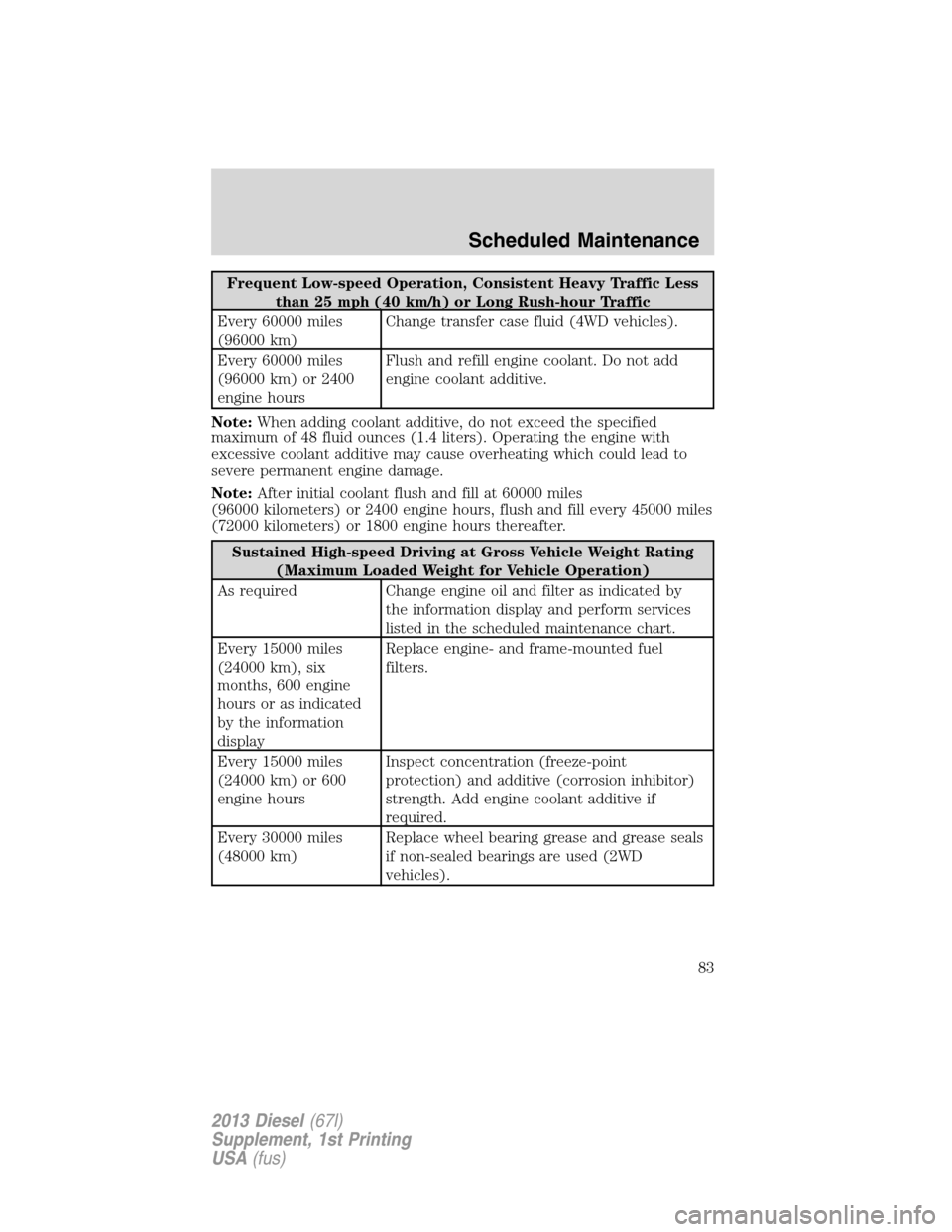
Frequent Low-speed Operation, Consistent Heavy Traffic Less
than 25 mph (40 km/h) or Long Rush-hour Traffic
Every 60000 miles
(96000 km)Change transfer case fluid (4WD vehicles).
Every 60000 miles
(96000 km) or 2400
engine hoursFlush and refill engine coolant. Do not add
engine coolant additive.
Note:When adding coolant additive, do not exceed the specified
maximum of 48 fluid ounces (1.4 liters). Operating the engine with
excessive coolant additive may cause overheating which could lead to
severe permanent engine damage.
Note:After initial coolant flush and fill at 60000 miles
(96000 kilometers) or 2400 engine hours, flush and fill every 45000 miles
(72000 kilometers) or 1800 engine hours thereafter.
Sustained High-speed Driving at Gross Vehicle Weight Rating
(Maximum Loaded Weight for Vehicle Operation)
As required Change engine oil and filter as indicated by
the information display and perform services
listed in the scheduled maintenance chart.
Every 15000 miles
(24000 km), six
months, 600 engine
hours or as indicated
by the information
displayReplace engine- and frame-mounted fuel
filters.
Every 15000 miles
(24000 km) or 600
engine hoursInspect concentration (freeze-point
protection) and additive (corrosion inhibitor)
strength. Add engine coolant additive if
required.
Every 30000 miles
(48000 km)Replace wheel bearing grease and grease seals
if non-sealed bearings are used (2WD
vehicles).
Scheduled Maintenance
83
2013 Diesel(67l)
Supplement, 1st Printing
USA(fus)
Page 85 of 95
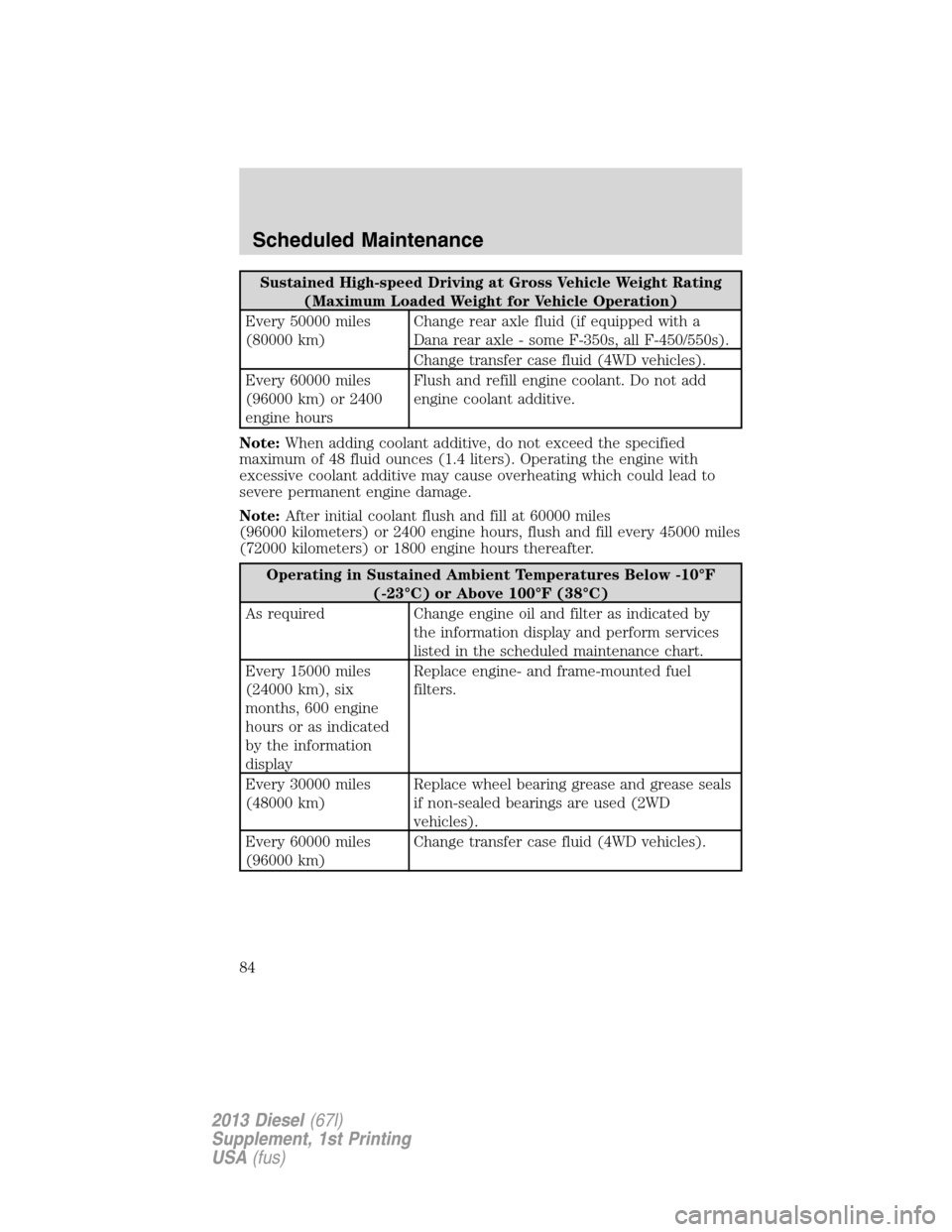
Sustained High-speed Driving at Gross Vehicle Weight Rating
(Maximum Loaded Weight for Vehicle Operation)
Every 50000 miles
(80000 km)Change rear axle fluid (if equipped with a
Dana rear axle - some F-350s, all F-450/550s).
Change transfer case fluid (4WD vehicles).
Every 60000 miles
(96000 km) or 2400
engine hoursFlush and refill engine coolant. Do not add
engine coolant additive.
Note:When adding coolant additive, do not exceed the specified
maximum of 48 fluid ounces (1.4 liters). Operating the engine with
excessive coolant additive may cause overheating which could lead to
severe permanent engine damage.
Note:After initial coolant flush and fill at 60000 miles
(96000 kilometers) or 2400 engine hours, flush and fill every 45000 miles
(72000 kilometers) or 1800 engine hours thereafter.
Operating in Sustained Ambient Temperatures Below -10°F
(-23°C) or Above 100°F (38°C)
As required Change engine oil and filter as indicated by
the information display and perform services
listed in the scheduled maintenance chart.
Every 15000 miles
(24000 km), six
months, 600 engine
hours or as indicated
by the information
displayReplace engine- and frame-mounted fuel
filters.
Every 30000 miles
(48000 km)Replace wheel bearing grease and grease seals
if non-sealed bearings are used (2WD
vehicles).
Every 60000 miles
(96000 km)Change transfer case fluid (4WD vehicles).
Scheduled Maintenance
84
2013 Diesel(67l)
Supplement, 1st Printing
USA(fus)