2013 FORD SUPER DUTY service
[x] Cancel search: servicePage 3 of 95
POWER STROKE DIESEL ENGINE
Note:Your vehicle’s powertrain control systems can detect and store
information about vehicle modifications that increase horsepower and
torque output such as whether or not performance-enhancing powertrain
components commonly referred to as “performance chips” have been
used. This information cannot be erased and will stay in the system’s
memory even if the modification is removed. The information can be
retrieved by Ford Motor Company, Ford of Canada, and service and
repair facilities when servicing your vehicle. This information may be
used to determine if repairs will be covered by warranty.
Note:Some aftermarket products may cause severe engine/transmission
and/or exhaust system damage; refer to your warranty information for
more information.
Your new diesel engine will feel, drive and function somewhat differently
than a gasoline engine. Therefore it is very important that you read and
thoroughly familiarize yourself and others operating the vehicle with this
guide. A special procedure for turning off the diesel engine is in the
Starting and Stopping the Enginechapter.It is important to read
and understand this material in order to maintain the best
service life for your engine.
This supplement will acquaint you with the Power Stroke diesel engine.
It provides recommendations on engine care and operating procedures.
For complete vehicle information, also refer to yourOwner’s Manual
included with the vehicle. It also describes equipment and gives
specifications for equipment that was in effect when this guide was
approved for printing, and should be considered a permanent part of the
vehicle.
Ford may discontinue models or change specifications without any notice
and without incurring obligations.
WARNINGS
Throughout this guide, you will find warnings identified by the warning
symbol. Warnings remind you to be especially careful to reduce the risk
of personal injury.
Introduction
2
2013 Diesel(67l)
Supplement, 1st Printing
USA(fus)
Page 4 of 95
BREAKING-IN YOUR VEHICLE
Your vehicle does not need an extensive break-in. Try not to drive
continuously at the same speed for the first 1,000 miles
(1,600 kilometers) of new vehicle operation. Vary your speed to allow
parts to adjust themselves to other parts.
Drive your new vehicle at least 500 miles (800 kilometers) before towing
a trailer. Make sure you use the specified engine oil by checking the
engine oil specification chart underEngine oilin theMaintenance
chapter.
Do not add friction modifier compounds or special break-in oils during
the first few thousand miles (kilometers) of operation, since these
additives may prevent piston ring seating. SeeEngine oilin the
Maintenancechapter of this supplement for more information on oil
usage.
DIESEL ENGINE INFORMATION
The diesel engine fuel system is a pressurized two-stage filtration system
and consists of:
•a frame-mounted diesel fuel conditioner module (DFCM) / primary
filter with an electric fuel pump and water drain,
•an engine-mounted secondary fuel filter,
•a fuel injector for each cylinder (8 total),
•a high-pressure fuel pump,
•a high-pressure fuel rail for each cylinder bank (2 total) and
•numerous high-pressure pipes from the high-pressure pump to the
rails, and rails to the injectors.
The DFCM acts as a primary fuel filter/water separator which removes
both water and impurities from the fuel. The engine mounted filter filters
finer impurities from the diesel fuel. The engine-mounted fuel filter and
the DFCM filter should be changed at the recommended service interval
or when indicated by the information displayLOW FUEL PRESSURE
message. Refer to thescheduled maintenance informationin this
supplement for more information.
The DFCM should be drained at regular intervals (recommended at
every oil change) or when indicated by the information display and water
in fuel indicator light. SeeFuel filter/water separatorin theFuel and
refuelingchapter.
Introduction
3
2013 Diesel(67l)
Supplement, 1st Printing
USA(fus)
Page 5 of 95
The fuel injection system is controlled through the Powertrain Control
Module (PCM).
Fuel is drawn from the fuel tank by a frame-mounted electric fuel pump
located inside the DFCM and provides pressurized fuel to the engine.
The fuel pump contains a pressure relief valve for overpressure
protection in the event of restricted flow.
Engine protection mode
Ford diesel engines are equipped with engine protection and emission
control systems. These systems monitor critical temperatures and
pressures, and modify engine operation accordingly. These features are
intended to modify engine performance characteristics.
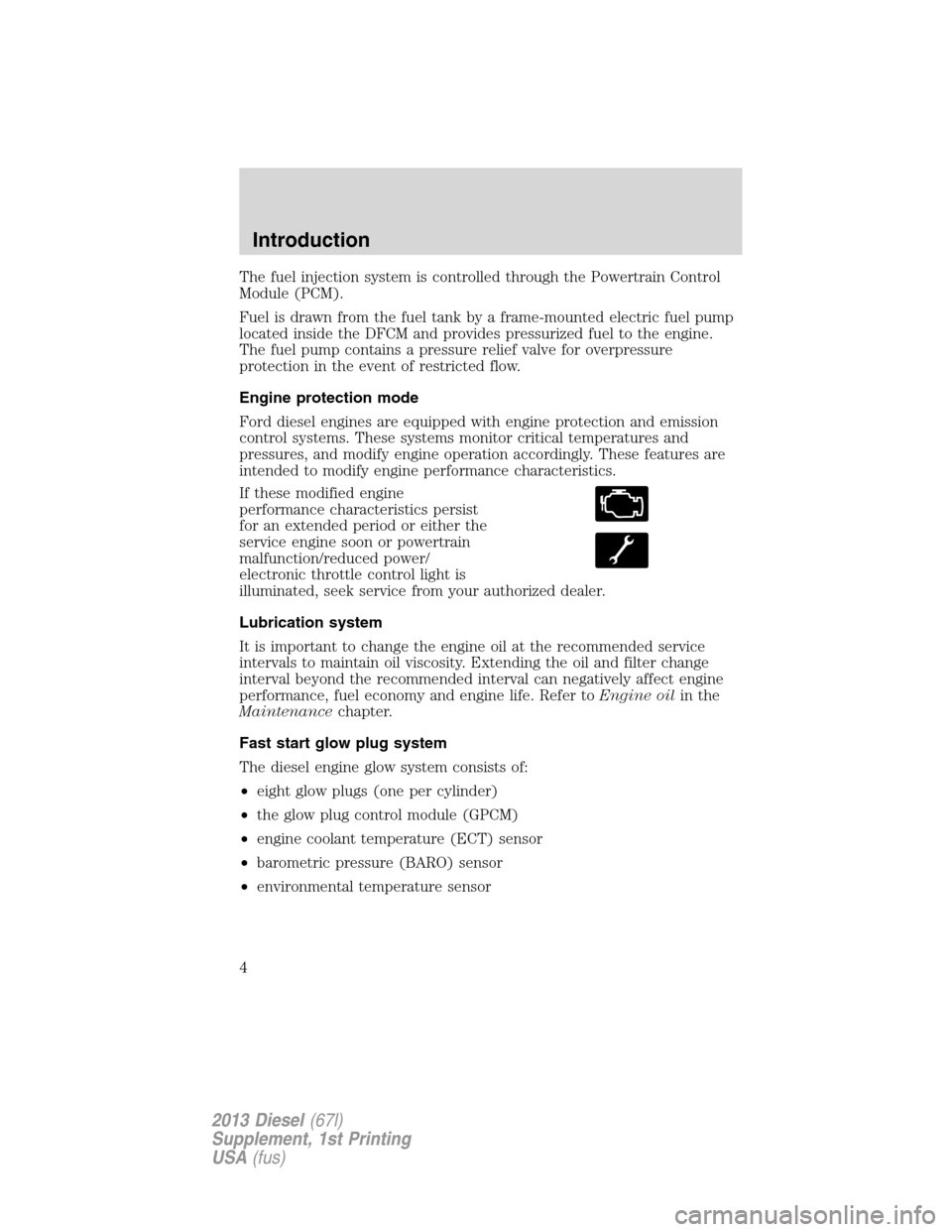
If these modified engine
performance characteristics persist
for an extended period or either the
service engine soon or powertrain
malfunction/reduced power/
electronic throttle control light is
illuminated, seek service from your authorized dealer.
Lubrication system
It is important to change the engine oil at the recommended service
intervals to maintain oil viscosity. Extending the oil and filter change
interval beyond the recommended interval can negatively affect engine
performance, fuel economy and engine life. Refer toEngine oilin the
Maintenancechapter.
Fast start glow plug system
The diesel engine glow system consists of:
•eight glow plugs (one per cylinder)
•the glow plug control module (GPCM)
•engine coolant temperature (ECT) sensor
•barometric pressure (BARO) sensor
•environmental temperature sensor
Introduction
4
2013 Diesel(67l)
Supplement, 1st Printing
USA(fus)
Page 14 of 95
Operation in Standing Water
Ingestion of water into the diesel engine can result in immediate and
severe damage to the engine. If driving through water, slow down to
avoid splashing water into the intake. If the engine stalls, and ingestion
of water into the engine is suspected, do not try to restart the engine.
Consult your dealer for service immediately.
The fuel tank is vented to atmosphere by valves on top of the tank and
through the fuel cap. If water reaches this level water may be pulled into
the fuel tank. Water in the fuel can cause performance issues and
damage the fuel injection system.
Engine Block Heater (If Equipped)
Refer to theStarting and Stopping the Enginechapter in your
Owner’s Manual.
Rapid Heat Supplemental Heating System (If Equipped)
Note:Additional aftermarket electrical loads operated during engine
warm up may impact the performance of the rapid heat supplemental
heater.
The optional rapid heat feature is an electrically powered device that is
designed to provide supplemental heat during engine warm up. For
maximum effectiveness mid to low blower speed is recommended during
initial warm up. When operating in automatic mode (when equipped) the
climate control unit determines the appropriate blower speed for existing
conditions.
Starting and Stopping the Engine
13
2013 Diesel(67l)
Supplement, 1st Printing
USA(fus)
Page 15 of 95
FUEL REQUIREMENTS - CHOOSING THE RIGHT FUEL: VEHICLES
OPERATED WHERE ULTRA LOW SULFUR DIESEL FUEL IS
REQUIRED (UNITED STATES/CANADA/PUERTO RICO/U.S. VIRGIN
ISLANDS AND OTHER LOCALES)
Note:Damage caused by using the improper type of fuel or fuel additive
is not covered under your warranty.
Note:Do not blend used engine oil with diesel fuel under any
circumstances. Blending used oil with the fuel will significantly increase
your vehicle’s exhaust emissions and reduce engine life due to increased
internal wear.
Ultra-Low Sulfur Diesel fuel (also known as ULSD) designated as number
1-D or 2-D with a maximum of 15 ppm sulfur should be used in your
diesel vehicle. This vehicle may be operated on diesel fuels containing up
to 20% biodiesel, also known as B20. These fuels should meet either the
ASTM D975 diesel or the ASTM D7467 B6-B20 biodiesel industry
specifications should be used. Outside of North America, use fuels
meeting EN590 or equivalent local market standard.
Using low sulfur diesel fuel
(16-500 ppm) or high sulfur diesel
fuel (greater than 500 ppm) in the
6.7L diesel engine will cause certain emission components to malfunction
which may also cause the service engine soon light to illuminate
indicating an emissions-related concern.
Diesel fuel is adjusted seasonally for cold temperature. For best results at
temperatures below 20°F (-7°C), it is recommended to use a diesel fuel
which has been seasonally adjusted for the ambient conditions. SeeCold
weather operationin theFuel and Refuelingchapter of this supplement.
Fuel and Refueling
14
2013 Diesel(67l)
Supplement, 1st Printing
USA(fus)
Page 16 of 95
FUEL REQUIREMENTS - CHOOSING THE RIGHT FUEL: VEHICLES
OPERATED WHERE ULTRA LOW SULFUR DIESEL FUEL IS NOT
REQUIRED
For the engine to operate reliably on low-sulfur or high-sulfur diesel fuel,
the engine must be a factory built high-sulfur engine (available as a
dealer order option for select markets) or a ULSD (ultra low sulfur
diesel) fuel configured engine that has been retrofitted for high-sulfur
diesel fuel using Ford Motor Company dealer service parts. Failure to use
retrofit components other than those available through your authorized
dealer will result in engine coolant system damage, engine overheating,
SCR and/or DPF damage and possible base engine damage.
Use only a diesel engine that has been configured for use with high
sulfur diesel fuel in markets with diesel fuel that has sulfur content
greater than 15 ppm. Using low sulfur diesel fuel (16–500 ppm) or
high sulfur diesel fuel (greater than 500 ppm) in a diesel engine
designed to use only Ultra Low Sulfur Diesel fuel may result in
damage to engine emission control devices and the aftertreatment
system, potentially rendering the vehicle inoperable.
Vehicles with engines configured for use with high sulfur diesel fuel will
only be made available for sale in countries where ULSD fuel is generally
not available or mandated by the government. Vehicles originally sold in
a ULSD fuel market that are subsequently exported to non-ULSD fuel
markets will need to be retrofitted (at the customer’s expense using Ford
authorized dealer service parts) in order to be reliably operated on
non-ULSD fuel.
BIODIESEL
WARNING:Do not use home heating oil, agricultural fuel, raw
fats and oils, waste cooking greases, biodiesel fuels greater than
20% or any diesel fuel not intended for highway use. Damage to the
fuel injection system, engine and exhaust catalyst can occur if an
improper fuel is used. Do not add gasoline, gasohol or alcohol to diesel
fuel. This practice creates a serious fire hazard and engine
performance problems.
This vehicle may be operated on diesel fuels containing up to 20%
biodiesel, also known as B20.
Biodiesel fuel is a product that has been chemically converted from
renewable fuel sources, such as vegetable oils, animal fats and waste
cooking greases.
Fuel and Refueling
15
2013 Diesel(67l)
Supplement, 1st Printing
USA(fus)
Page 17 of 95
To help achieve acceptable engine performance and durability when
using biodiesel in your vehicle:
•Confirm the biodiesel content of the fuel to be B20 (20% biodiesel) or
less.
•Only use biodiesel fuel of good quality that complies with industry
standards.
•Follow the recommended service maintenance intervals section in the
Schedule Maintenancechapter.
•Do not store biodiesel fuel in the fuel tank for more than 1 month.
•Consider changing brands or reducing biodiesel content if you have
cold temperature fuel gelling issues or a frequentLOW FUEL
PRESSUREmessage appearing.
•Do NOT use raw oils, fats or waste cooking greases.
Use of biodiesel in concentrations greater than 20% may cause damage
to your vehicle, including engine and/or exhaust after-treatment
hardware (exhaust catalyst and particulate filter) failures. Concentrations
greater than 20% can also cause fuel filter restrictions that may result in
a lack of power and / or damage to fuel system components, including
fuel pump and fuel injector failures.
SAE 5W-40 or SAE 15W-40 oil is recommended for fuels with greater than
5% biodiesel (B5). Refer to theSpecial operating conditionssection
under theSchedule Maintenancechapter for more information about oil
change intervals and other maintenance when operating on biodiesel.
Look for a label on the fuel pump to confirm the amount of biodiesel
contained in a diesel fuel. Biodiesel content is often indicated with the
letter “B” followed by the percent of biodiesel in the fuel. For example,
B20 indicates a fuel containing 20% biodiesel. Ask the service station
attendant to confirm the biodiesel content of a diesel fuel if you do not
see a label on the fuel pump.
Biodiesel fuels degrade more easily than diesel fuels not containing
biodiesel and should not be stored in the fuel tank for more than 1 month.
If your vehicle will be parked or stored for more than 1 month, then your
vehicle fuel tank should be emptied of biodiesel fuel, filled with a pure
petroleum-based diesel fuel, and run for a minimum of 30 minutes.
Note:Degraded or oxidized biodiesel can damage fuel system seals and
plastics and corrode steel parts.
During cold weather, if you have problems operating on biodiesel, you
may need to use a diesel fuel with lower biodiesel content, try another
brand, or discontinue the use of biodiesel.
Fuel and Refueling
16
2013 Diesel(67l)
Supplement, 1st Printing
USA(fus)
Page 20 of 95
SELECTIVE CATALYTIC REDUCTION (SCR) SYSTEM
Your vehicle is equipped with a selective catalytic reduction (SCR)
system to help reduce emission levels of oxides of nitrogen from the
exhaust of the diesel engine. The system automatically injects diesel
exhaust fluid (DEF) into the exhaust system to enable proper SCR
function.
Importance of maintaining the DEF level
In order for the SCR system to operate properly, the DEF level must be
maintained. Generally, the DEF tank should be filled during the oil
change service interval. See thescheduled maintenance informationin
this supplement for more information. However, certain conditions or
driving styles, such as trailer towing or fast rates of acceleration, will
require the refilling of the DEF tank more often.
The engine control unit will monitor the amount of fluid available in the
DEF tank. Running a system check in the message center will indicate
whether the DEF level is ok or if it is less than 1/2 full. A message will
automatically be displayed in the message center when the DEF level is
low and needs to be refilled. When you see this message you should refill
your tank. See theInformation displayschapter of yourOwner’s
Manualfor information display functions. For instructions on refilling
your DEF tank, seeFilling the DEF tankin theFuel and Refueling
chapter.
DEF warning messages and vehicle operations
WARNING:Diesel Exhaust Fluid (DEF) must be refilled when
low or replaced when contaminated or the vehicle speed will be
speed limited to 50 mph (80 km/h). In these conditions, drive with
caution and refill DEF immediately. If the DEF becomes empty or
contaminated fluid is not replaced, the vehicle will become limited to
idle speed only once stopped. In these conditions, be cautious where
you stop the vehicle because you may not be able to drive long
distances and will not be able to maintain highway speeds until DEF is
refilled or replaced.
WARNING:Tampering or disabling your vehicle’s exhaust
aftertreatment system will result in severe vehicle performance
limitation including eventual speed limiting to 5 mph.
Fuel and Refueling
19
2013 Diesel(67l)
Supplement, 1st Printing
USA(fus)