2013 FORD SUPER DUTY service
[x] Cancel search: servicePage 43 of 95
EMISSION CONTROL SYSTEM(S) LAWS
WARNING:Do not remove or alter the original equipment floor
covering or insulation between it and the metal floor of the
vehicle. The floor covering and insulation protect occupants of the
vehicle from the engine and exhaust system heat and noise. On
vehicles with no original equipment floor covering insulation, do not
carry passengers in a manner that permits prolonged skin contact with
the metal floor. Provide adequate insulation. Failure to follow these
instructions may result in fire or personal injury.
In the U.S. federal law and certain state laws prohibit removing or
rendering inoperative emission control system(s). Similar federal or
provincial laws may apply in Canada. Ford recommends against any
vehicle modification without determining applicable law.
Tampering with emissions control
systems (including related sensors
and the diesel exhaust fluid (DEF)
injection system) can result in reduced engine power and the
illumination of the service engine soon light.
NOISE EMISSIONS WARRANTY, PROHIBITED TAMPERING ACTS
AND MAINTENANCE
On January 1, 1978, Federal regulation became effective governing the
noise emission on trucks over 10,000 lbs. (4,536 kg) GVWR (Gross
Vehicle Weight Rating). The following statements concerning prohibited
tampering acts and maintenance, and the noise warranty found in the
Warranty Guide, are applicable to complete chassis cabs over
10,000 lbs. (4,536 kg) GVWR.
Tampering with noise control system prohibited
Federal law prohibits the following acts or the causing thereof: (1) The
removal or rendering inoperative by any person other than for purposes
of maintenance, repair or replacement of any device or element of design
incorporated into any new vehicle for the purpose of noise control prior
to its sale or delivery to the ultimate purchaser or while it is in use, or
(2) the use of the vehicle after such device or element of design has
been removed or rendered inoperative by any person.
Fuel and Refueling
42
2013 Diesel(67l)
Supplement, 1st Printing
USA(fus)
Page 44 of 95
Among those acts which the U.S. Environmental Protection Agency may
presume to constitute tampering are the acts listed below:
•Removal of hood blanket, fender apron absorbers, fender apron
barriers, underbody noise shields or acoustically absorptive material.
•Tampering or rendering inoperative the engine speed governor, so as
to allow engine speed to exceed manufacturer’s specifications.
The complexity of the diesel engine makes it so the owner is discouraged
from attempting to perform maintenance other than the services
described in this supplement.
If you experience difficult starting, rough idling, excessive exhaust
smoke, a decrease in engine performance or excess fuel consumption,
perform the following checks:
•a plugged or disconnected air inlet system or engine air filter element.
•water in the fuel filter/water separator.
•a clogged fuel filter.
•contaminated fuel.
•air in the fuel system, due to loose connections.
•an open or pinched sensor hose.
•check engine oil level.
•wrong fuel or oil viscosity for climactic conditions.
If these checks do not help you correct the engine performance problem
you are experiencing, consult an authorized dealer.
DUAL FUEL TANK SELECTOR CONTROL (IF EQUIPPED)
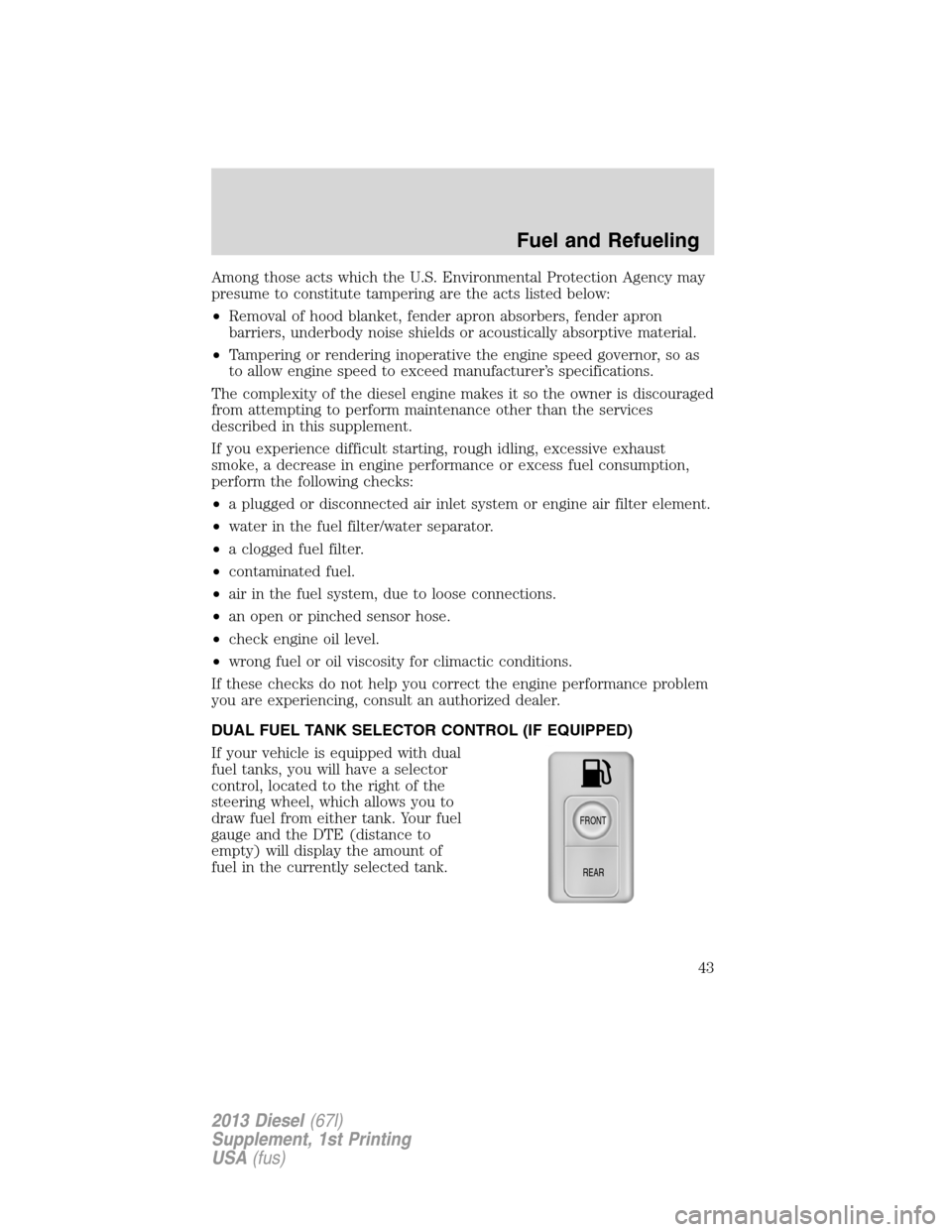
If your vehicle is equipped with dual
fuel tanks, you will have a selector
control, located to the right of the
steering wheel, which allows you to
draw fuel from either tank. Your fuel
gauge and the DTE (distance to
empty) will display the amount of
fuel in the currently selected tank.
FRONT
REAR
Fuel and Refueling
43
2013 Diesel(67l)
Supplement, 1st Printing
USA(fus)
Page 50 of 95
SCHEDULED MAINTENANCE
The scheduled maintenance services in thescheduled maintenance
informationof this supplement are required because they are
considered essential to the life and performance of your vehicle.
Use only recommended fuel, lubricants, fluids and service parts
conforming to Ford specifications. Motorcraft® parts are designed and
built for best performance in your vehicle.
ENGINE OIL
Checking the engine oil level
Because it is normal to add some oil between oil changes, check your
engine oil level each time you stop for fuel. To check the engine oil level
consistently and accurately, the following procedure is recommended:
1. Have engine at normal operating temperature (at least into the
NORMAL range on the engine coolant temperature gauge).
2. Park the vehicle on a level surface, then turn off the engine and open
the hood.
3. Allow at least20 minutesafter engine shutdown to ensure that the oil
contained in the upper parts of the engine has returned to the oil pan.
4. Protecting yourself from engine heat, pull out the dipstick, wipe it
clean and reinsert fully.
5. Read oil level on both sides of dipstick and use highest level (reading)
for the actual engine oil level.
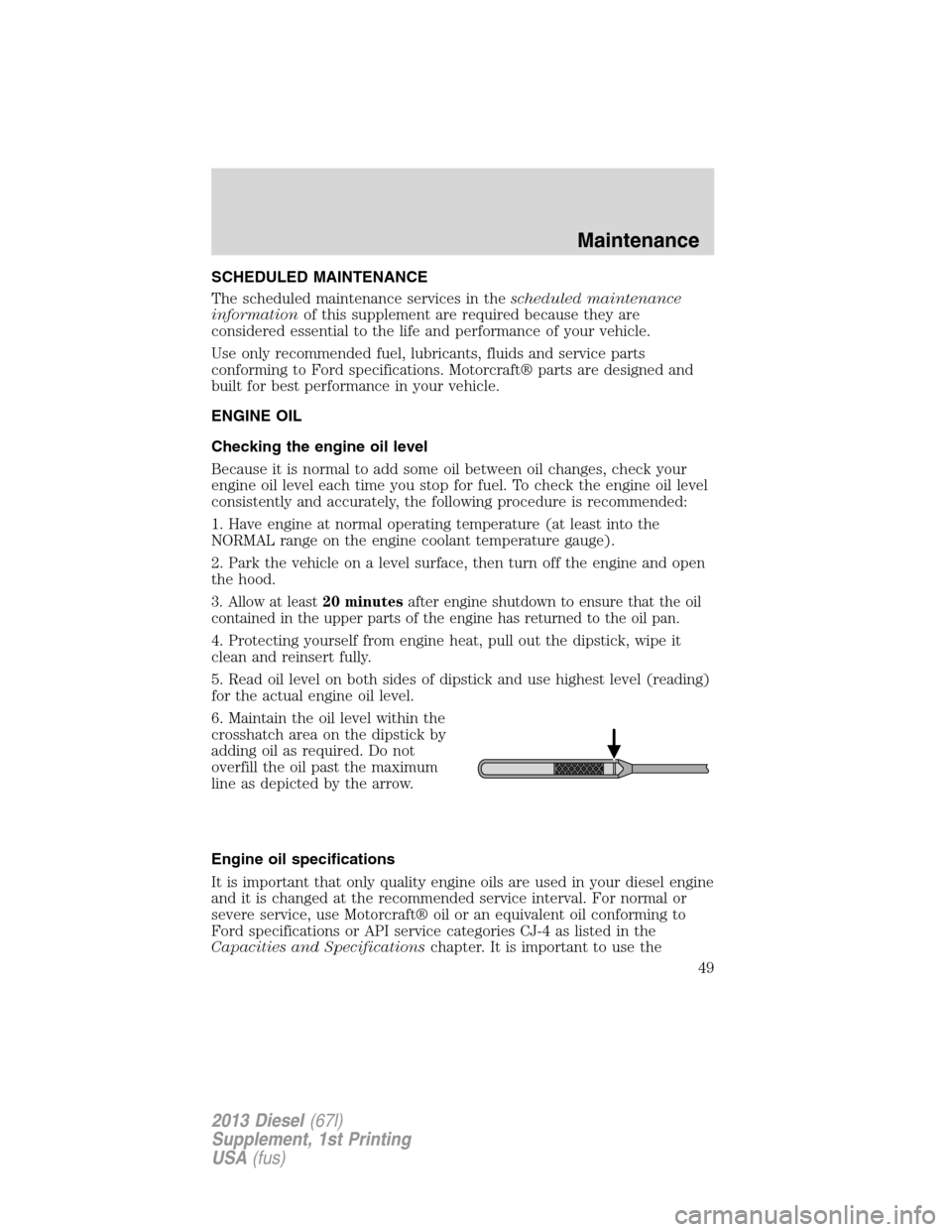
6. Maintain the oil level within the
crosshatch area on the dipstick by
adding oil as required. Do not
overfill the oil past the maximum
line as depicted by the arrow.
Engine oil specifications
It is important that only quality engine oils are used in your diesel engine
and it is changed at the recommended service interval. For normal or
severe service, use Motorcraft® oil or an equivalent oil conforming to
Ford specifications or API service categories CJ-4 as listed in the
Capacities and Specificationschapter. It is important to use the
Maintenance
49
2013 Diesel(67l)
Supplement, 1st Printing
USA(fus)
Page 51 of 95
recommended oils because they will provide acceptable engine
performance and durability. These oils are also compatible with the
emission control equipment of your vehicle to meet the more stringent
emission standards.
The use of correct oil viscosities for diesel engines is important for
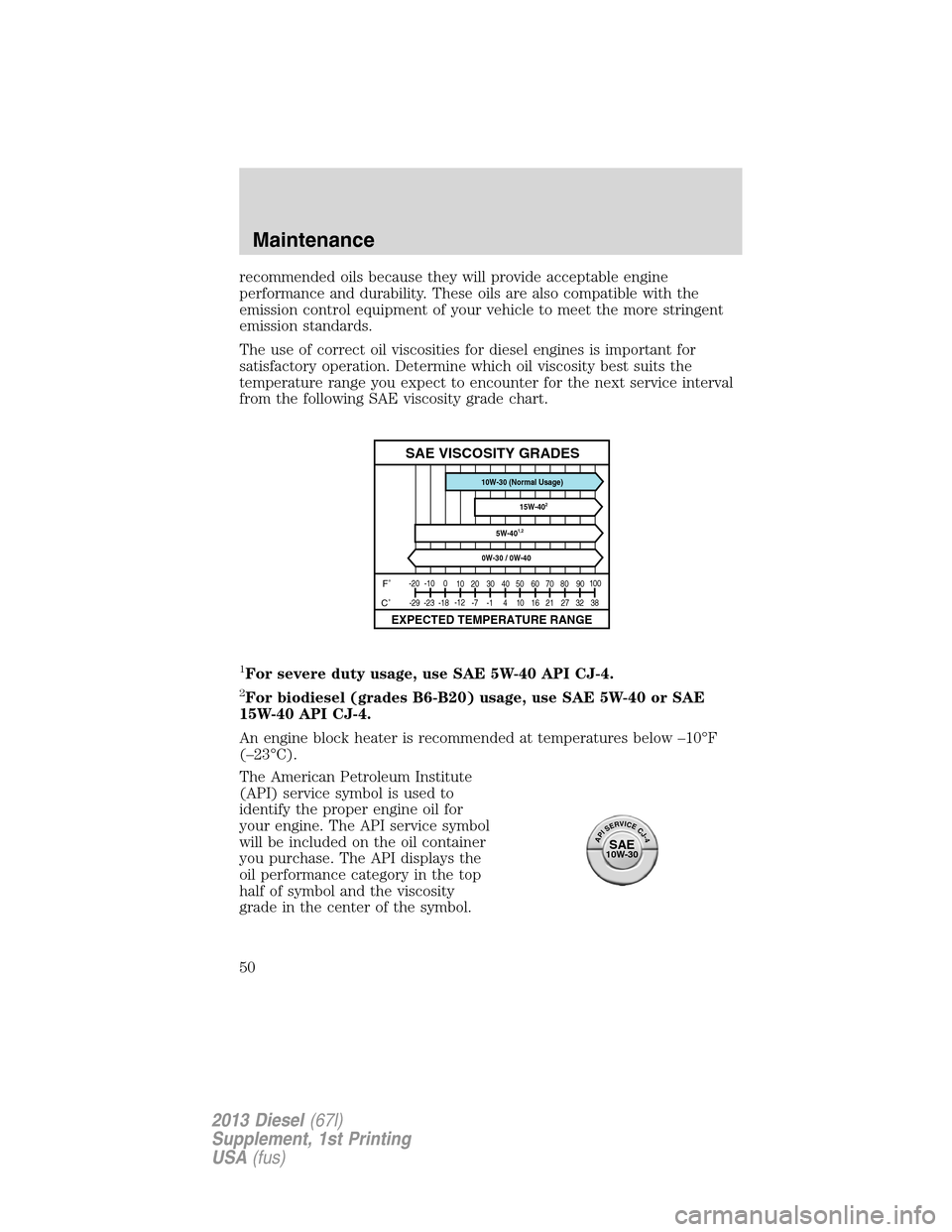
satisfactory operation. Determine which oil viscosity best suits the
temperature range you expect to encounter for the next service interval
from the following SAE viscosity grade chart.
1For severe duty usage, use SAE 5W-40 API CJ-4.
2For biodiesel (grades B6-B20) usage, use SAE 5W-40 or SAE
15W-40 API CJ-4.
An engine block heater is recommended at temperatures below –10°F
(–23°C).
The American Petroleum Institute
(API) service symbol is used to
identify the proper engine oil for
your engine. The API service symbol
will be included on the oil container
you purchase. The API displays the
oil performance category in the top
half of symbol and the viscosity
grade in the center of the symbol.
-20
-100
10 20 30
40
38 32 27 21 16 10 4 -1 -7 -12
-18 -23 -2950 60
7080 9010 0
SAE VISCOSITY GRADES
EXPECTED TEMPERATURE RANGE
F˚
C˚
5W-401,2
0W-30 / 0W-4015W-40
2
10W-30 (Normal Usage)
API SERVICE CJ-4
SAE10W-30
Maintenance
50
2013 Diesel(67l)
Supplement, 1st Printing
USA(fus)
Page 52 of 95
Changing the engine oil and oil filter
WARNING:Do not handle a hot oil filter with bare hands.
WARNING:Continuous contact with used motor oil has caused
cancer in laboratory mice. Protect your skin by washing with
soap and water.
Your vehicle is equipped with an Intelligent Oil Life Monitor™ that
calculates the proper oil change service interval. When the information
display indicates:OIL CHANGE REQUIRED, change the engine oil and
oil filter. See theInformation Displayschapter in theOwner Manual
for more information.
Refer toMotorcraft part numberstheCapacities and Specifications
chapter for the engine oil filter part number. This filter protects your
engine by filtering harmful, abrasive or sludge particles and particles
significantly smaller than most available “will-fit” filters.
To change the engine oil and oil filter:
1. Unscrew the oil filter and oil pan drain plug and wait for the oil to drain.
Note:The oil pan drain plug only requires 1/4 turn to removal/install. A
3/8 inch socket drive may be used to assist with removal/installation, but be
careful not to over-tighten the plug during installation.
2. Replace the filter.
3. Reinstall the oil pan drain plug.
4. Refill the engine with new oil. For the proper capacity, seeCapacities
and Specificationschapter.
5. Reset the Intelligent Oil Life Monitor™. See theInformation Displays
chapter in theOwner Manualfor more information.
Engine lubrication for severe service operation
The following conditions define severe operation for which engine
operation with SAE 5W-40 API CJ-4 is recommended. Oil and oil filter
change intervals will be determined by the Intelligent Oil Life Monitor™
as noted previously.
•
frequent or extended idling (over 10 minutes per hour of normal driving)
•low-speed operation/stationary use
•if vehicle is operated in sustained ambient temperatures below -10°F
(-23°C) or above 100°F (38°C)
Maintenance
51
2013 Diesel(67l)
Supplement, 1st Printing
USA(fus)
Page 54 of 95
Adding engine coolant
WARNING:Do not add coolant when the engine is hot. Steam and
scalding liquids released from a hot cooling system can burn you
badly. Also, you can be burned if you spill coolant on hot engine parts.
WARNING:Do not put coolant in the windshield washer fluid
container. If sprayed on the windshield, coolant could make it
difficult to see through the windshield.
WARNING:To reduce the risk of personal injury, make sure the
engine is cool before unscrewing the coolant pressure relief cap.
The cooling system(s) are under pressure; steam and hot liquid can
come out forcefully when the cap is loosened slightly.
WARNING:Do not add coolant further than the MAX mark.
Note:Do not use stop leak pellets, cooling system sealants or unapproved
additives as they can cause damage to the engine cooling and/or heating
systems. This damage would not be covered under your vehicle’s warranty.
Note:During normal vehicle operation, the engine coolant may change
color from orange to pink or light red. If the engine coolant is clear and
uncontaminated, this color change does not indicate the engine coolant
has degraded nor does it require the engine coolant to be drained, the
system to be flushed, or the engine coolant to be replaced.
•DO NOT MIX different colors or types of coolant in your vehicle. Only
use prediluted engine coolant that meets Ford specification . Mixing of
engine coolants may harm your engine’s cooling system. The use of an
improper coolant may harm engine and cooling system components
and may void the warranty.
•In case of emergency, a large amount of water without engine coolant
may be added in order to reach a vehicle service location. In this
instance, the cooling system must be drained, chemically cleaned, and
refilled with engine coolant as soon as possible per the instructions in
the Workshop Manual. Water alone (without engine coolant) can cause
engine damage from corrosion, overheating or freezing.DO NOTuse
this method for the secondary cooling system. The secondary cooling
system operates close to ambient temperature, and is susceptible to
freezing in any subfreezing environment, in the absence of coolant.
Maintenance
53
2013 Diesel(67l)
Supplement, 1st Printing
USA(fus)
Page 62 of 95
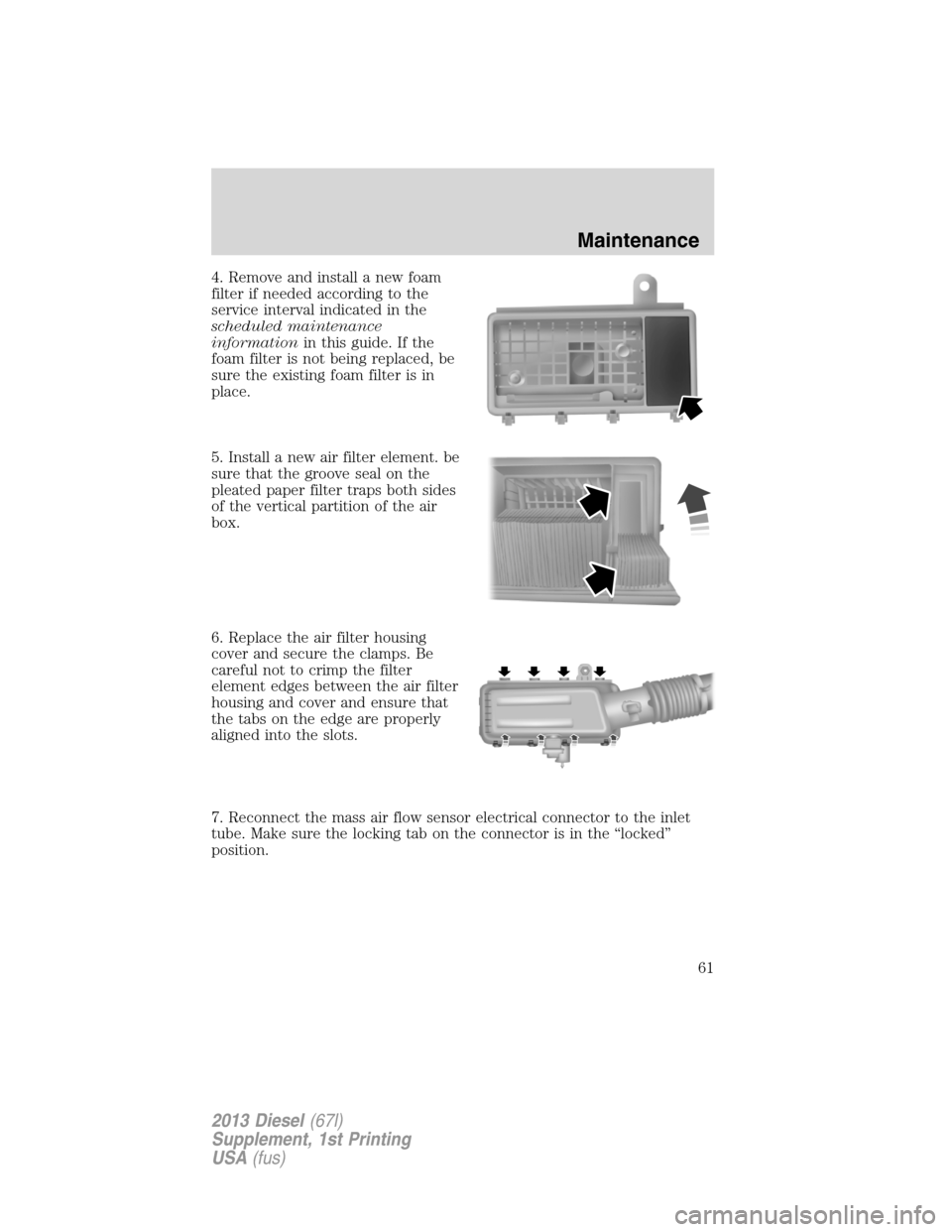
4. Remove and install a new foam
filter if needed according to the
service interval indicated in the
scheduled maintenance
informationin this guide. If the
foam filter is not being replaced, be
sure the existing foam filter is in
place.
5. Install a new air filter element. be
sure that the groove seal on the
pleated paper filter traps both sides
of the vertical partition of the air
box.
6. Replace the air filter housing
cover and secure the clamps. Be
careful not to crimp the filter
element edges between the air filter
housing and cover and ensure that
the tabs on the edge are properly
aligned into the slots.
7. Reconnect the mass air flow sensor electrical connector to the inlet
tube. Make sure the locking tab on the connector is in the “locked”
position.
Maintenance
61
2013 Diesel(67l)
Supplement, 1st Printing
USA(fus)
Page 71 of 95
GENERAL MAINTENANCE INFORMATION
Why Maintain Your Vehicle?
Carefully following the maintenance schedule helps protect against major
repair expenses resulting from neglect or inadequate maintenance and
may also help to increase the value of your vehicle when you sell or
trade it. Keep all receipts for completed maintenance with the vehicle.
Regular maintenance intervals for your vehicle have been established
based upon rigorous testing. It is important that you have your vehicle
serviced at the proper times. These intervals serve two purposes; one is
to maintain the reliability of your vehicle and the second is to keep your
cost of owning the vehicle down.
It is your responsibility to see that all scheduled maintenance is
performed and that the materials used meet the specifications identified
in theCapacities and Specificationschapter. Failure to perform
scheduled maintenance invalidates warranty coverage on parts affected
by the lack of maintenance.
Why Maintain Your Vehicle at Your Dealership?
Factory-Trained Technicians
Service technicians participate in extensive factory-sponsored
certification training to help them become experts on the operation of
your vehicle. Ask your dealership about the training and certification
their technicians have received.
Genuine Ford and Motorcraft® Replacement Parts
Dealerships stock Ford, Motorcraft® and Ford-authorized branded
remanufactured replacement parts. These parts meet or exceed Ford
Motor Company’s specifications. Parts installed at your dealership carry a
nationwide, 12 month/12000 mile (20000 kilometer) parts and labor
limited warranty. If you do not use Ford authorized parts, they may not
meet Ford specifications and, depending on the part, it could affect
emissions compliance.
Convenience
Many dealerships have extended evening and Saturday hours to make
your service visit more convenient and they offer one stop shopping.
They can perform any services that are required on your vehicle, from
general maintenance to collision repairs.
Note:Not all dealers have extended hours or bodyshops. Please contact
your dealer for details.
Scheduled Maintenance
70
2013 Diesel(67l)
Supplement, 1st Printing
USA(fus)