2013 FORD SUPER DUTY check engine light
[x] Cancel search: check engine lightPage 4 of 95
BREAKING-IN YOUR VEHICLE
Your vehicle does not need an extensive break-in. Try not to drive
continuously at the same speed for the first 1,000 miles
(1,600 kilometers) of new vehicle operation. Vary your speed to allow
parts to adjust themselves to other parts.
Drive your new vehicle at least 500 miles (800 kilometers) before towing
a trailer. Make sure you use the specified engine oil by checking the
engine oil specification chart underEngine oilin theMaintenance
chapter.
Do not add friction modifier compounds or special break-in oils during
the first few thousand miles (kilometers) of operation, since these
additives may prevent piston ring seating. SeeEngine oilin the
Maintenancechapter of this supplement for more information on oil
usage.
DIESEL ENGINE INFORMATION
The diesel engine fuel system is a pressurized two-stage filtration system
and consists of:
•a frame-mounted diesel fuel conditioner module (DFCM) / primary
filter with an electric fuel pump and water drain,
•an engine-mounted secondary fuel filter,
•a fuel injector for each cylinder (8 total),
•a high-pressure fuel pump,
•a high-pressure fuel rail for each cylinder bank (2 total) and
•numerous high-pressure pipes from the high-pressure pump to the
rails, and rails to the injectors.
The DFCM acts as a primary fuel filter/water separator which removes
both water and impurities from the fuel. The engine mounted filter filters
finer impurities from the diesel fuel. The engine-mounted fuel filter and
the DFCM filter should be changed at the recommended service interval
or when indicated by the information displayLOW FUEL PRESSURE
message. Refer to thescheduled maintenance informationin this
supplement for more information.
The DFCM should be drained at regular intervals (recommended at
every oil change) or when indicated by the information display and water
in fuel indicator light. SeeFuel filter/water separatorin theFuel and
refuelingchapter.
Introduction
3
2013 Diesel(67l)
Supplement, 1st Printing
USA(fus)
Page 32 of 95
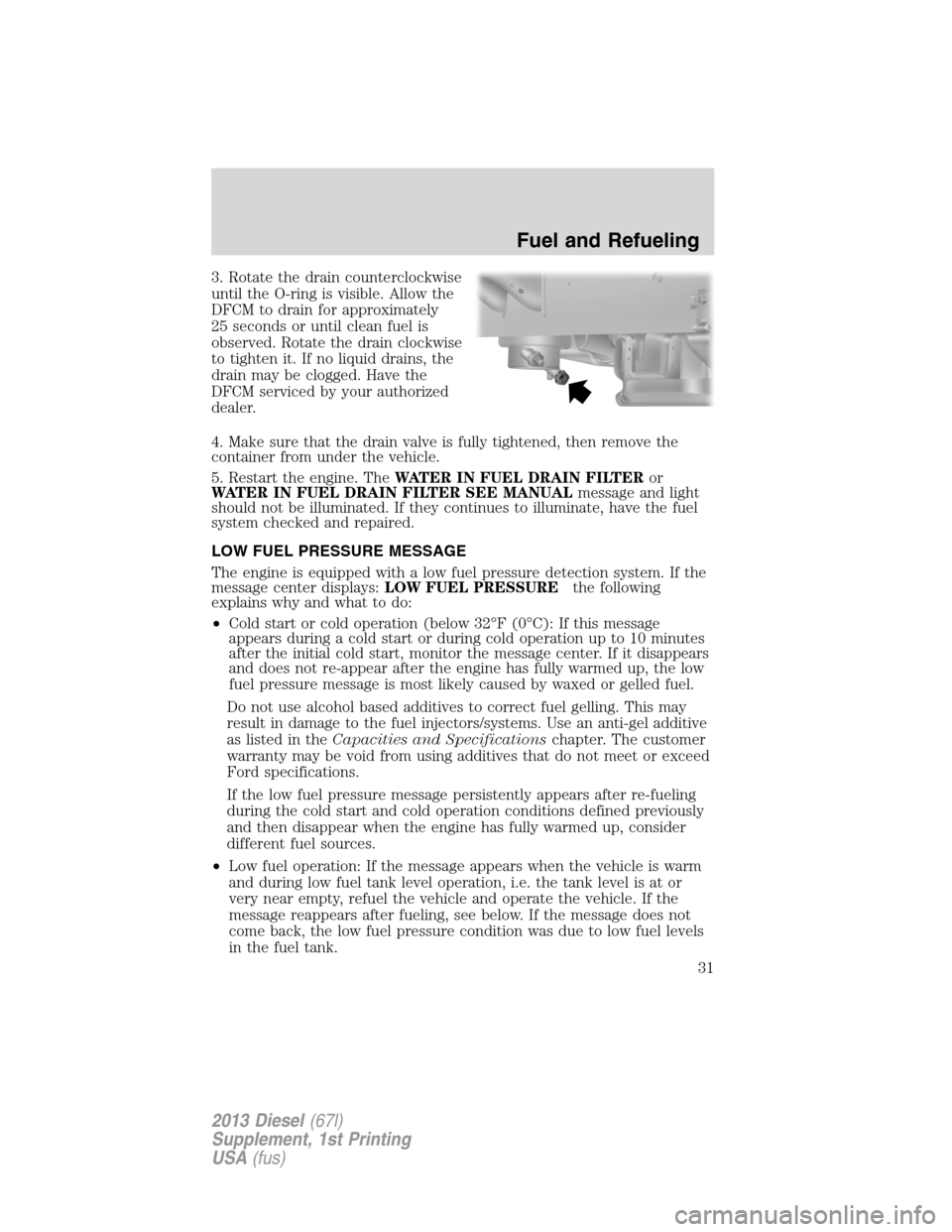
3. Rotate the drain counterclockwise
until the O-ring is visible. Allow the
DFCM to drain for approximately
25 seconds or until clean fuel is
observed. Rotate the drain clockwise
to tighten it. If no liquid drains, the
drain may be clogged. Have the
DFCM serviced by your authorized
dealer.
4. Make sure that the drain valve is fully tightened, then remove the
container from under the vehicle.
5. Restart the engine. TheWATER IN FUEL DRAIN FILTERor
WATER IN FUEL DRAIN FILTER SEE MANUALmessage and light
should not be illuminated. If they continues to illuminate, have the fuel
system checked and repaired.
LOW FUEL PRESSURE MESSAGE
The engine is equipped with a low fuel pressure detection system. If the
message center displays:LOW FUEL PRESSUREthe following
explains why and what to do:
•Cold start or cold operation (below 32°F (0°C): If this message
appears during a cold start or during cold operation up to 10 minutes
after the initial cold start, monitor the message center. If it disappears
and does not re-appear after the engine has fully warmed up, the low
fuel pressure message is most likely caused by waxed or gelled fuel.
Do not use alcohol based additives to correct fuel gelling. This may
result in damage to the fuel injectors/systems. Use an anti-gel additive
as listed in theCapacities and Specificationschapter. The customer
warranty may be void from using additives that do not meet or exceed
Ford specifications.
If the low fuel pressure message persistently appears after re-fueling
during the cold start and cold operation conditions defined previously
and then disappear when the engine has fully warmed up, consider
different fuel sources.
•Low fuel operation: If the message appears when the vehicle is warm
and during low fuel tank level operation, i.e. the tank level is at or
very near empty, refuel the vehicle and operate the vehicle. If the
message reappears after fueling, see below. If the message does not
come back, the low fuel pressure condition was due to low fuel levels
in the fuel tank.
Fuel and Refueling
31
2013 Diesel(67l)
Supplement, 1st Printing
USA(fus)
Page 63 of 95
MINOR TROUBLESHOOTING GUIDE
Air purge procedure
Turn the key on for 30 seconds, then turn off. Repeat the procedure six
times.
If the engine won’t crank
WARNING:Battery posts, terminals and related accessories
contain lead and lead compounds.Wash hands after handling.
Turn on the headlights. If the lights are dim, do not go on at all or when
the ignition is turned to START the lights become dim or go out, the
battery connections may be loose or corroded, or the battery may be
discharged. If there is a clicking or stuttering sound coming from the
engine compartment when you turn the key to START, this may also
indicate a loose or corroded battery connection.
Check the battery connections at the battery posts, cable connection to
the engine grounding point and at the starter connection.
If a discharged battery is suspected, have it checked and corrected.
•The gearshift lever must be in P (Park) or N (Neutral) in order for
the starter to operate.
•Try operating the starter switch several times. Should the switch be
corroded, this operation may clean the contacts or make the switch
temporarily operable until you can reach the dealer.
•If all electrical connections are tight and you need assistance to start,
refer toJump startingin theRoadside Emergencieschapter of your
Owner’s Manual.
If engine cranks but won’t start
Prolonged starter cranking (in excess of 10 seconds) could cause
damage to the starter motor.
•
Check the fuel gauge. You may be out of fuel. If the gauge shows that
there is fuel in the tank, the trouble may be in the electrical system or
the fuel system. If equipped with an auxiliary tank, be sure that the tank
control switch is set for the tank with fuel and not on an empty tank.
•Leaving the ignition key turned to on for over two minutes without
starting may make starting difficult because the glow plugs will cease
activation. Reset the system by turning the ignition key to off and
then back to on again.
Maintenance
62
2013 Diesel(67l)
Supplement, 1st Printing
USA(fus)
Page 92 of 95
EXCEPTIONS
In addition, there are several exceptions to the Normal Schedule. They
are listed below:
Normal vehicle axle maintenance:Rear axles and power take-off
(PTO) units with synthetic fluid and light-duty trucks equipped with
Ford-design axles are lubricated for life; do not check or change fluid
unless a leak is suspected, service is required or the assembly has been
submerged in water. During long periods of trailer towing with outside
temperatures above 70°F (21°C) and at wide-open throttle for long
periods above 45 mph (72 km/h), non-synthetic rear axle fluids should
be changed every 3000 miles (4800 kilometers) or three months,
whichever comes first. This interval can be waived if the axle is filled
with 75W140 synthetic gear fluid meeting Ford specification
WSL-M2C192-A, part number F1TZ-19580-B or equivalent. Add friction
modifier XL-3 (EST-M2C118-A) or equivalent for complete refill of
Traction-Lok rear axles (refer toTechnical specificationsin the
Maintenancechapter for details).
F-450 and F-550 axle maintenance:Change rear axle fluid every
100000 miles (160000 kilometers) under normal driving conditions on all
commercial applications. For trucks operated at or near maximum Gross
Vehicle Weights, the rear axle fluid should be changed every 50000 miles
(80000 kilometers). In addition, this 50000 mile (80000 kilometer)
schedule should be observed when the vehicles are operated under the
special operating conditions, where noted.
Diesel Particulate Filter (DPF):The DPF may need to be removed
for ash cleaning at approximately 120000 miles (192000 kilometers) or
greater (actual mileage can vary greatly depending upon engine/vehicle
operating conditions) and replaced with a new or remanufactured (ash
cleaned) part. The filter may need to be replaced at approximately
250000 miles (400000 kilometers) depending upon engine/vehicle
operating conditions. In both cases the engine control system will set a
service light (
) to inform you to bring the vehicle to the dealer for
service. If there are any issues with the oxidation catalyst/DPF system a
service light (
or) will be set by the engine control system to
inform you to bring the vehicle into a dealership for service.
Scheduled Maintenance
91
2013 Diesel(67l)
Supplement, 1st Printing
USA(fus)