2013 FORD SUPER DUTY service
[x] Cancel search: servicePage 28 of 95
To prevent overfilling of the DEF tank when filling with a bottle, Ford
recommends using Motorcraft® DEF. Additionally, if the information
display indicatesEXHAUST FLUID UNDER 1/2 FULL, you should only
add a MAXIMUM of 2 gallons (6.7L) of DEF to the tank to prevent
freeze damage due to overfilling. If the information display indicates
EXHAUST FLUID LEVEL OK, do not add DEF.
Contaminated DEF or inoperative SCR system
SCR systems are sensitive to
contamination of the DEF. USE
ONLY API or ISO 22241 CERTIFIED
DIESEL EXHAUST FLUID. If the SCR becomes contaminated or
inoperative, the DEF light will illuminate and exhaust fluid system fault
messages will appear in the information display.
Continued driving without replacing DEF or having the SCR system
repaired will result in the following actions as required by the California
Air Resources Board (CARB) and /or U.S. Environmental Protection
Agency (EPA):
•Within a certain number of miles (kilometers) to empty, speed will be
limited upon restart. Prior to this occurring a message will appear in
the message center.
•
Further vehicle operation without replacing contaminated DEF will cause
the engine to enter an idle-only condition. This will only occur upon
vehicle refueling, vehicle idling in park for 1 hour, or engine shutdown for
10 minutes or more and will be indicated by a message in the message
center indicating required actions to resume normal operation.
For either vehicle speed limiting or idle-only condition, normal vehicle
operation will resume when the contaminated system is repaired.To
service a contaminated or inoperative system, see your
authorized dealer.
DEF guidelines and information
•Use only DEF that carries the trademark: American Petroleum
Institute (API) certified DEF or ISO 22241.
•Do not put DEF in the diesel fuel tank.
•Do not overfill the DEF tank.
•Do not re-use the DEF container once it is emptied.
•
Avoid spilling DEF on painted surfaces, carpeting or plastic components.
Immediately wipe away any DEF that has spilled with a damp cloth and
water. If it has already crystallized, use warm water and a sponge.
Fuel and Refueling
27
2013 Diesel(67l)
Supplement, 1st Printing
USA(fus)
Page 32 of 95
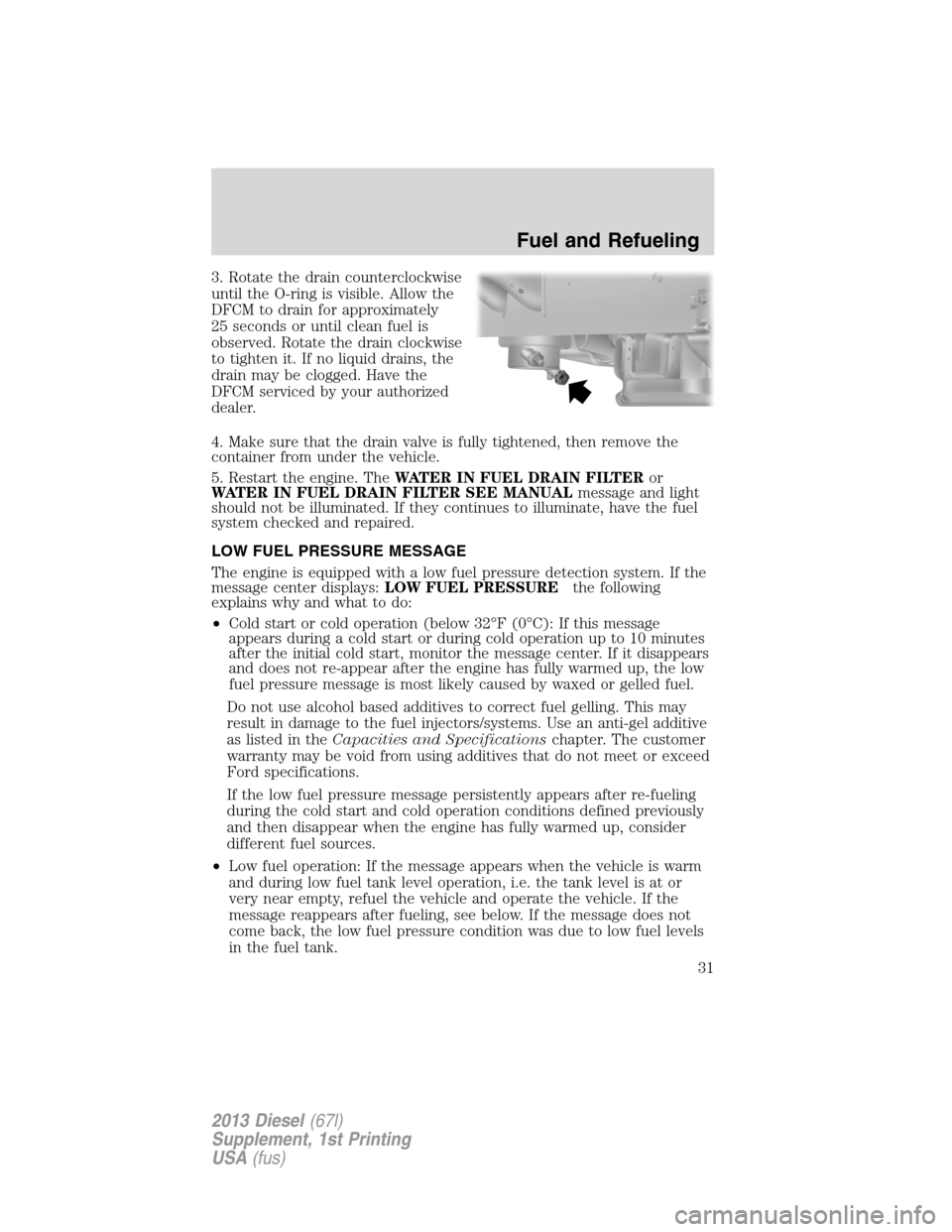
3. Rotate the drain counterclockwise
until the O-ring is visible. Allow the
DFCM to drain for approximately
25 seconds or until clean fuel is
observed. Rotate the drain clockwise
to tighten it. If no liquid drains, the
drain may be clogged. Have the
DFCM serviced by your authorized
dealer.
4. Make sure that the drain valve is fully tightened, then remove the
container from under the vehicle.
5. Restart the engine. TheWATER IN FUEL DRAIN FILTERor
WATER IN FUEL DRAIN FILTER SEE MANUALmessage and light
should not be illuminated. If they continues to illuminate, have the fuel
system checked and repaired.
LOW FUEL PRESSURE MESSAGE
The engine is equipped with a low fuel pressure detection system. If the
message center displays:LOW FUEL PRESSUREthe following
explains why and what to do:
•Cold start or cold operation (below 32°F (0°C): If this message
appears during a cold start or during cold operation up to 10 minutes
after the initial cold start, monitor the message center. If it disappears
and does not re-appear after the engine has fully warmed up, the low
fuel pressure message is most likely caused by waxed or gelled fuel.
Do not use alcohol based additives to correct fuel gelling. This may
result in damage to the fuel injectors/systems. Use an anti-gel additive
as listed in theCapacities and Specificationschapter. The customer
warranty may be void from using additives that do not meet or exceed
Ford specifications.
If the low fuel pressure message persistently appears after re-fueling
during the cold start and cold operation conditions defined previously
and then disappear when the engine has fully warmed up, consider
different fuel sources.
•Low fuel operation: If the message appears when the vehicle is warm
and during low fuel tank level operation, i.e. the tank level is at or
very near empty, refuel the vehicle and operate the vehicle. If the
message reappears after fueling, see below. If the message does not
come back, the low fuel pressure condition was due to low fuel levels
in the fuel tank.
Fuel and Refueling
31
2013 Diesel(67l)
Supplement, 1st Printing
USA(fus)
Page 35 of 95
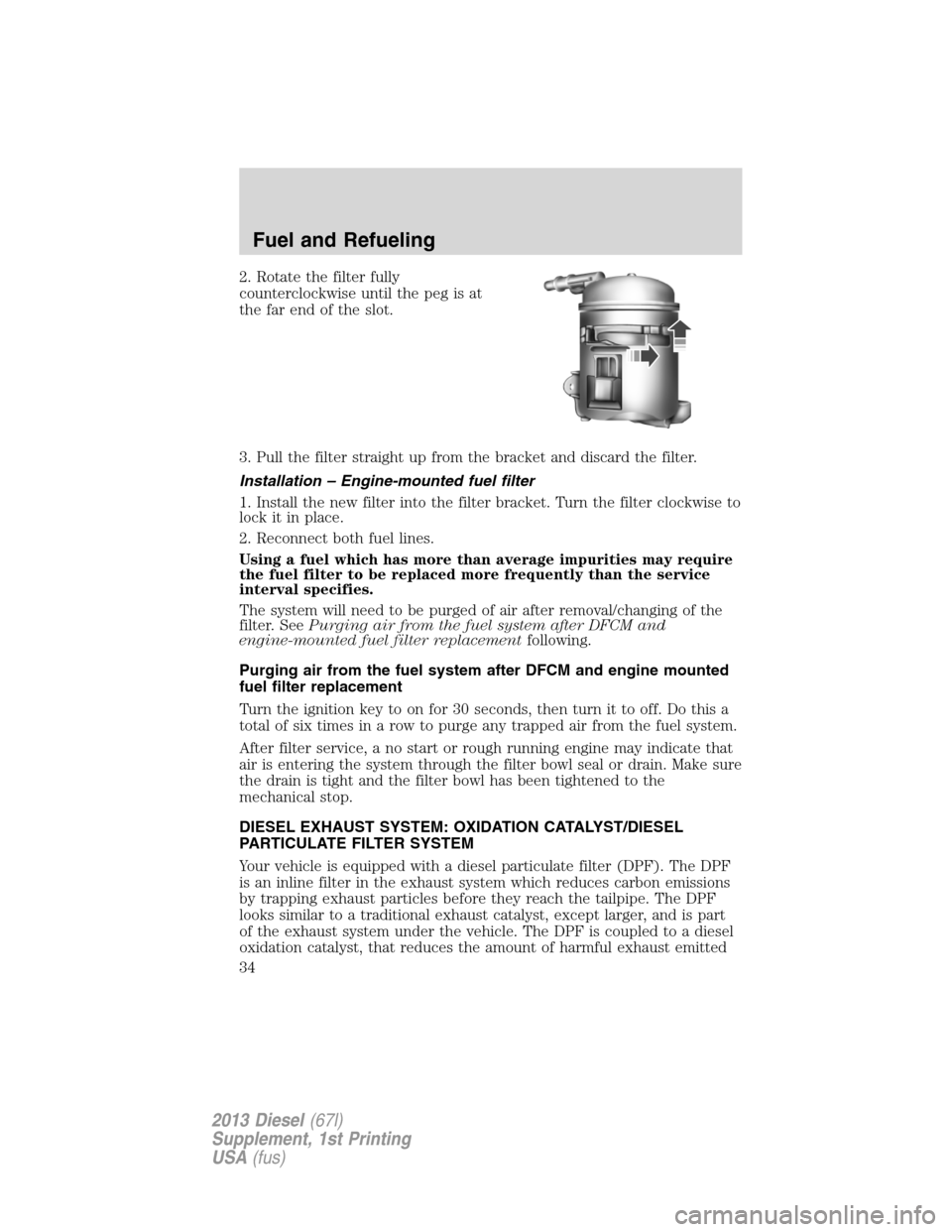
2. Rotate the filter fully
counterclockwise until the peg is at
the far end of the slot.
3. Pull the filter straight up from the bracket and discard the filter.
Installation – Engine-mounted fuel filter
1. Install the new filter into the filter bracket. Turn the filter clockwise to
lock it in place.
2. Reconnect both fuel lines.
Using a fuel which has more than average impurities may require
the fuel filter to be replaced more frequently than the service
interval specifies.
The system will need to be purged of air after removal/changing of the
filter. SeePurging air from the fuel system after DFCM and
engine-mounted fuel filter replacementfollowing.
Purging air from the fuel system after DFCM and engine mounted
fuel filter replacement
Turn the ignition key to on for 30 seconds, then turn it to off. Do this a
total of six times in a row to purge any trapped air from the fuel system.
After filter service, a no start or rough running engine may indicate that
air is entering the system through the filter bowl seal or drain. Make sure
the drain is tight and the filter bowl has been tightened to the
mechanical stop.
DIESEL EXHAUST SYSTEM: OXIDATION CATALYST/DIESEL
PARTICULATE FILTER SYSTEM
Your vehicle is equipped with a diesel particulate filter (DPF). The DPF
is an inline filter in the exhaust system which reduces carbon emissions
by trapping exhaust particles before they reach the tailpipe. The DPF
looks similar to a traditional exhaust catalyst, except larger, and is part
of the exhaust system under the vehicle. The DPF is coupled to a diesel
oxidation catalyst, that reduces the amount of harmful exhaust emitted
Fuel and Refueling
34
2013 Diesel(67l)
Supplement, 1st Printing
USA(fus)
Page 36 of 95
from the tailpipe. As soot gathers in the system it begins to restrict the
filter. The soot gathered inside the filter needs to be periodically cleaned.
The soot can be cleaned in two different ways; passive regeneration and
active regeneration. Both methods occur automatically and require no
actions from the driver/operator. During either one of these regeneration
methods you may notice an increase/change in exhaust noise/tone. At
certain times, the message center will display various messages related
to the DPF. See theInformation Displayschapter in theOwner Guide
for more information.
Passive regeneration
In passive regeneration, the exhaust constituents / temperature are at an
appropriate level where some soot can be reduced or oxidized (burned)
thus cleaning the filter. This method occurs naturally as a result of
normal engine operating conditions (at varying levels due to drive
patterns).
Active regeneration
Note:Do not disregard theDRIVE TO CLEAN EXHAUST FILTERor
Drive to Clean Exhaust Systemmaintenance message for extended
periods of time. Failure to perform active or operator commanded
regeneration (OCR) (if equipped) when instructed may result in a
clogged DPF. If your DPF fills beyond what can be safely regenerated,
active regeneration and OCR will be disabled. This could cause
irreversible damage to the DPF, requiring service and possible
replacement that may not be covered by your warranty.
Once the DPF is full of exhaust particles, the engine control module will
command the exhaust system to clean the DPF through a process called
active regeneration. Active regeneration requires the engine computer to
raise the exhaust temperature to eliminate the particles. During cleaning,
the particles are converted to harmless gasses, and the DPF will then be
clean and ready to continue trapping exhaust particles.
The regeneration process operates more efficiently when the vehicle is
safely operated at least 30 mph (48 km/h) with a steady pedal for
approximately 20 minutes to complete the process. The frequency and
duration of regeneration will fluctuate as both are determined by how
you drive your vehicle, outside air temperature, and altitude. For most
driving, regeneration frequency will vary from 100 - 500 miles (161 -
805 km) between occurrences and each occurrence will last from 9 -
20 minutes. The duration of regeneration is usually reduced if a constant
speed above 30 mph (48 km/h) is maintained.
Fuel and Refueling
35
2013 Diesel(67l)
Supplement, 1st Printing
USA(fus)
Page 38 of 95
OCR precautions and safe exhaust position
WARNING:Failure to comply with the following instructions for
operator commanded regeneration (OCR) may result in fire,
serious injury, death and/or property damage.
Before you start OCR, observe/do the following:
•Place the vehicle in P (Park) with the parking brake set on stable,
level ground.
•The vehicle must not be parked in a structure.
•The vehicle must be 10 – 15 feet (3 – 5 meters) away from any
obstructions,
•and must be away from materials that can easily combust or melt such
as: paper, leaves, petroleum products, fuels, plastics and other dry
organic material, such as grass.
•Make sure there is a minimum of 1/8 tank of fuel.
•Make sure all fluids are at proper levels.
Make sure that the louvers (holes) located at the tip of the exhaust are
also clear of any obstructions as they are used to introduce fresh air into
the tailpipe to cool the exhaust gas as it leaves. SeeExhaustunder the
Cleaningchapter for more information.
How to start operator commanded regeneration (OCR)
WARNING:Stay clear of exhaust tip during regeneration. You or
others can be burned.
Note:OCR will not be allowed until DPF load percentage has reached
100% (Full). The DPF load percentage will fluctuate up and down when
driving your vehicle due to active and passive regenerations.
Note:During the use of OCR, you may observe a light amount of white
smoke. This is normal.
OCR will not be allowed to operate
if the service engine soon light is
illuminated
Fuel and Refueling
37
2013 Diesel(67l)
Supplement, 1st Printing
USA(fus)
Page 39 of 95
Base information display procedure
1. Start with the vehicle engine fully warmed.
2. Press the Info button on the steering wheel until the information
display reads one of the following choices:
•If the DPF needs cleaning and the vehicle is warmed up, a message
requesting permission to initiate filter cleaning will be displayed
EXHST XX% FULL CLEAN Y/NorEXHAUST FILTER FULL.
Answer yes to this prompt and then follow the prompts regarding
exhaust position as needed to initiate OCR. Be sure to understand
each prompt. If you are not sure what is being asked by each prompt,
contact your authorized dealer. The display will confirm the operation
has started and when it has finished.
•If the vehicle is warmed up, the
powertrain fault indicator will
illuminate and messages
requesting permission to initiate filter cleaning will be displayed
DRIVE TO CLEAN EXHAUST FILTER+EXH OVERLOADED
CLEAN? Y/N. Answer yes to this prompt and then follow the
prompts regarding exhaust position as needed to initiate OCR. Be sure
to understand each prompt. If you are not sure what is being asked by
each prompt, contact your authorized dealer. The display will confirm
the operation has started and when it has finished. You can also drive
to clean the filter. SeeActive regenerationearlier in this chapter.
•The service engine soon light will
illuminate and the following
messagesEXH OVERLOADED
CLEAN? Y/N+REDUCED ENGINE POWERwill appear when the
system is at the point of oversaturation you will not be able to allow
cleaning . The vehicle must be serviced by an authorized dealer.
3. Once OCR starts, the engine’s rpm will rise to approximately 2,000 -
2,400 rpm and the cooling fan will increase speed; you will hear a change
in audible sound due to the fan and engine speed increase.
It is not necessary to open the hood on the engine compartment. Once
OCR is complete, the engine rpm and fan will return to normal idling.
The exhaust system will remain very hot for several minutes even after
regeneration is complete. Do not reposition the vehicle over materials
that could burn until the exhaust system has had sufficient time to
cool. Depending on the amount of soot collected by the DPF, ambient
temperature, and altitude, OCR may last from 10 to 25 minutes.
Fuel and Refueling
38
2013 Diesel(67l)
Supplement, 1st Printing
USA(fus)
Page 40 of 95
Optional information display procedure
1. Start with the vehicle engine fully warmed.
2. From the main menu, select Gauge Mode and scroll through until one
of the following options appear:
•If the DPF needs cleaning and the vehicle is warmed up, you will be
prompted to hold OK to cleanExhaust xx% FullorExhaust Filter
Full. Press OK and then follow the prompts regarding exhaust
position as needed to initiate OCR. Be sure to understand each
prompt. If you are not sure what is being asked by each prompt,
contact your authorized dealer. The display will confirm the operation
has started and when it has finished.
•When the exhaust system is
overloaded cleaning will be
allowed until a certain saturation
level. If the vehicle is warmed up and ready the powertrain fault
indicator will illuminate and you will be prompted to hold OK to clean
Drive to Clean Exhaust System+Exhaust Filter Overloaded.
Press OK and then follow the prompts regarding exhaust position as
needed to initiate OCR. Be sure to understand each prompt. If you are
not sure what is being asked by each prompt, contact your authorized
dealer. The display will confirm the operation has started and when it
has finished. You can also drive to clean the filter. SeeActive
regenerationearlier in this chapter.
•The service engine soon light will
illuminate and the following
messagesExhaust Filter
Overloaded+Reduced Engine PowerorReduced Engine Power
will appear when the system is at the point of oversaturation you will
not be able to allow cleaning . The vehicle must be serviced by an
authorized dealer.
3. Once OCR starts, the engine’s rpm will rise to approximately 2,000 -
2,400 rpm and the cooling fan will increase speed; you will hear a change
in audible sound due to the fan and engine speed increase.
It is not necessary to open the hood on the engine compartment. Once
OCR is complete, the engine rpm and fan will return to normal idling.
The exhaust system will remain very hot for several minutes even after
regeneration is complete. Do not reposition the vehicle over materials
that could burn until the exhaust system has had sufficient time to
cool. Depending on the amount of soot collected by the DPF, ambient
temperature, and altitude, OCR may last from 10 to 25 minutes.
Fuel and Refueling
39
2013 Diesel(67l)
Supplement, 1st Printing
USA(fus)
Page 41 of 95
How to interrupt/cancel OCR
If OCR needs to be cancelled, pressing the brake, accelerator, or shutting
off the vehicle will stop OCR. Depending on the amount of time OCR was
allowed to operate, soot may not have had sufficient time to be
eliminated, but the exhaust system and exhaust gas may still be hot. If
the vehicle is shut off during OCR, you will notice turbo flutter. This is a
normal consequence caused by shutting off a diesel engine during
boosted operation and is considered normal.
Filter service/maintenance
Over time a slight amount of ash will build up in the DPF which is not
removed during the regeneration process. The DPF may need to be
removed for ash cleaning at approximately 120,000 miles (193,000 km)
or greater (actual mileage can vary greatly depending upon
engine/vehicle operating conditions) and replaced with a new or
remanufactured (ash cleaned) part. The filter may need to be replaced
at approximately 250,000 miles (400,000 km) depending upon
engine/vehicle operating conditions.
In both cases the engine control
system will set a service light to
inform you to bring the vehicle to
the dealer for service.
If there are any issues with the
oxidation catalyst/DPF system a
service light will be set by the
engine control system to inform you
to bring the vehicle into your
authorized dealer for service.
Fuel and Refueling
40
2013 Diesel(67l)
Supplement, 1st Printing
USA(fus)