Page 38 of 157
Do not make any unauthorized changes to your vehicle or engine. By
law, vehicle owners and anyone who manufactures, repairs, services,
sells, leases, trades vehicles, or supervises a fleet of vehicles are not
permitted to intentionally remove an emission control device or prevent
it from working. Information about your vehicle’s emission system is on
the Vehicle Emission Control Information Decal located on or near the
engine. This decal also lists engine displacement.
Please consult yourWarranty Guidefor complete emission warranty
information.
On-board diagnostics (OBD-II)
Your vehicle is equipped with a computer that monitors the engine’s
emission control system. This system is commonly known as the
on-board diagnostics system (OBD-II). The OBD-II system protects the
environment by ensuring that your vehicle continues to meet
government emission standards. The OBD-II system also assists your
authorized dealer in properly servicing your vehicle.
When the service engine soon indicator illuminates, the OBD-II
system has detected a malfunction. Temporary malfunctions
may cause the service engine soon indicator to illuminate.
Examples are:
1. The vehicle has run out of fuel—the engine may misfire or run poorly.
2. Poor fuel quality or water in the fuel—the engine may misfire or run
poorly.
3. The fuel cap may not have been securely tightened.
4. Driving through deep water—the electrical system may be wet.
These temporary malfunctions can be corrected by filling the fuel tank
with good quality fuel, properly tightening the fuel cap or letting the
electrical system dry out. After three driving cycles without these or any
other temporary malfunctions present, the service engine soon indicator
should stay off the next time the engine is started. A driving cycle
consists of a cold engine startup followed by mixed city/highway driving.
No additional vehicle service is required.
If the service engine soon indicator remains on, have your vehicle
serviced at the first available opportunity. Although some malfunctions
detected by the OBD-II may not have symptoms that are apparent,
continued driving with the service engine soon indicator on can result in
increased emissions, lower fuel economy, reduced engine and
transmission smoothness, and lead to more costly repairs.
Fuel and Refueling37
2013 Motorhome(mot)
Owners Guide gf, 1st Printing
USA(fus)
Page 49 of 157
LOAD LIMIT
Vehicle Loading – With and Without a Trailer
This section will guide you in the proper loading of your vehicle and/or
trailer, to keep your loaded vehicle weight within its design rating
capability, with or without a trailer. Properly loading your vehicle will
provide maximum return of vehicle design performance. Before loading
your vehicle, familiarize yourself with the following terms for determining
your vehicle’s weight ratings, with or without a trailer, from the vehicle’s
Safety Compliance Certification Label:
Base Curb Weight– is the weight of the vehicle including a full tank of
fuel and all standard equipment. It does not include passengers, cargo, or
optional equipment.
Vehicle Curb Weight– is the weight of your new vehicle when you picked
it up from your authorized dealer plus any aftermarket equipment.
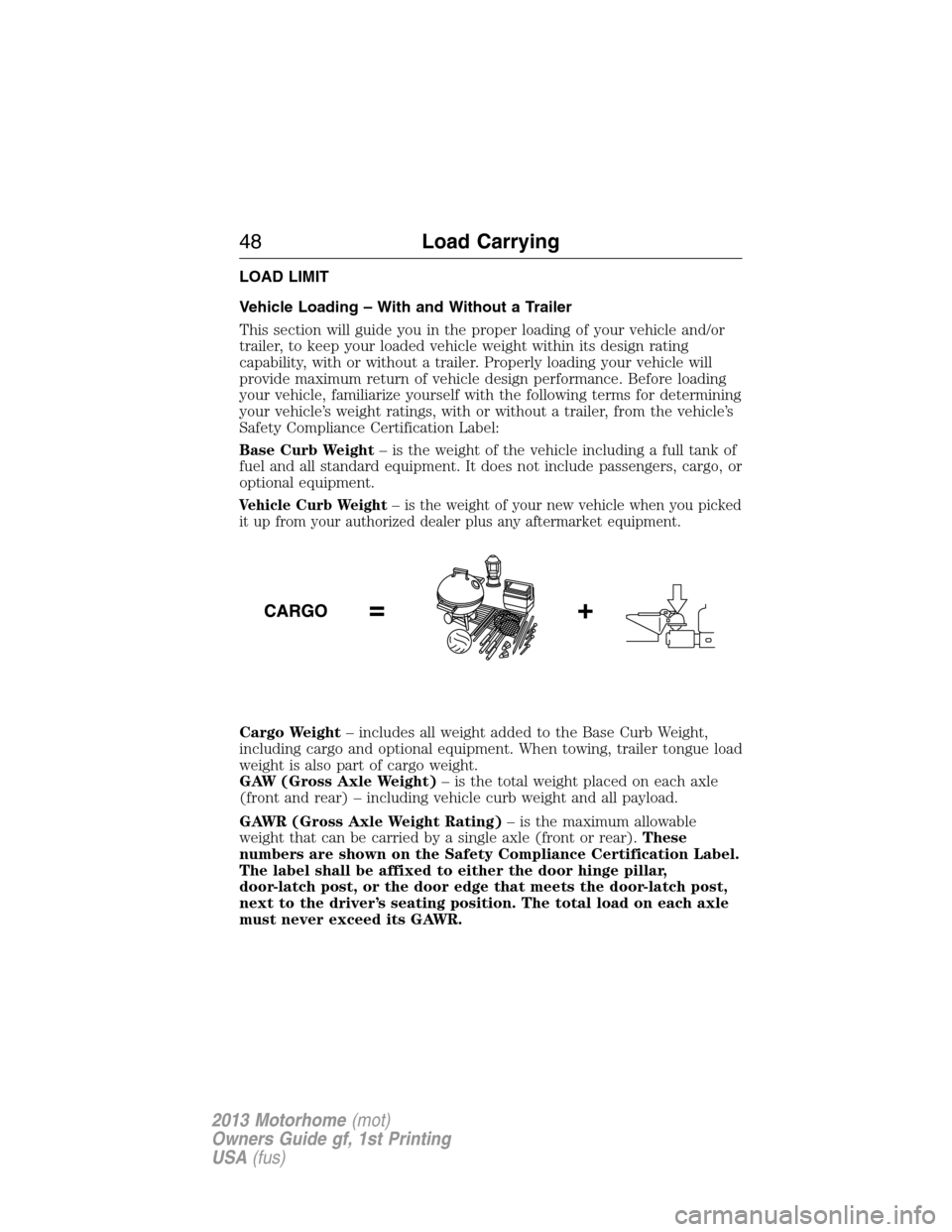
Cargo Weight– includes all weight added to the Base Curb Weight,
including cargo and optional equipment. When towing, trailer tongue load
weight is also part of cargo weight.
GAW (Gross Axle Weight)– is the total weight placed on each axle
(front and rear) – including vehicle curb weight and all payload.
GAWR (Gross Axle Weight Rating)– is the maximum allowable
weight that can be carried by a single axle (front or rear).These
numbers are shown on the Safety Compliance Certification Label.
The label shall be affixed to either the door hinge pillar,
door-latch post, or the door edge that meets the door-latch post,
next to the driver’s seating position. The total load on each axle
must never exceed its GAWR.
48Load Carrying
2013 Motorhome(mot)
Owners Guide gf, 1st Printing
USA(fus)
Page 72 of 157
The use of leaded fuel in your vehicle without proper conversion may
damage the effectiveness of your emission control system and may cause
engine knocking or serious engine damage. Ford Motor Company/Ford of
Canada is not responsible for any damage caused by use of improper
fuel. Using leaded fuel may also result in difficulty importing your vehicle
back into the U.S.
If your vehicle must be serviced while you are traveling or living in
Asia-Pacific Region, Sub-Saharan Africa, U.S. Virgin Islands, Central
America, the Caribbean, and Israel, contact the nearest authorized
dealer. If the authorized dealer cannot help you, contact:
FORD MOTOR COMPANY
FORD EXPORT OPERATIONS & GLOBAL INITIATIVES
1555 Fairlane Drive
Fairlane Business Park #3
Allen Park, Michigan 48101
U.S.A.
Telephone: (313) 594-4857
For customers in Guam, the Commonwealth of the Northern Mariana
Islands (CNMI), America Samoa, and the U.S. Virgin Islands, please feel
free to call our Toll-Free Number: (800) 841-FORD (3673).
FAX: (313) 390-0804
Email: [email protected]
If your vehicle must be serviced while you are traveling or living in
Puerto Rico, contact the nearest authorized dealer. If the authorized
dealer cannot help you, contact:
Ford International Business Development Inc.
Customer Relationship Center
P.O. Box 11957
Caparra Heights Station
San Juan, Puerto Rico 00922-1957
Telephone: (800) 841-FORD (3673)
FAX: (313) 390-0804
Email: [email protected]
www.ford.com.pr
Customer Assistance71
2013 Motorhome(mot)
Owners Guide gf, 1st Printing
USA(fus)
Page 77 of 157

The high-current fuses are coded as follows:
Fuse/Relay
LocationFuse Amp
RatingProtected Components
1 5A* Power brake assist module –
Hydromax
2 10A* A/C compressor clutch
3 20A* A/C clutch relay coil, Mass air
flow sensor with intake air
temperature, Vapor management
valve, Engine heated exhaust gas
oxygen sensor #11 and #21,
Catalyst monitor sensor
4 5A* Powertrain control module
memory
5 20A* Powertrain control module power
6 20A* Park lamp feeds, Instrument panel
fuse #41, Warning chime module,
Trailer tow running lamp relay
coil, Instrument panel dimmer
module
7 20A* Ignition coils, Radio capacitors
8 30A* Hydromax – Anti-lock brake
system module
9 10A* Starter main relay coil, Starter
ground relay coil
10 20A* Daytime running lamps
11 20A* Fuel pump relay coil, Powertrain
control module power
12 25A* Trailer tow back-up lamps feed,
Instrument panel - backup lamp
feed
13 30A** Trailer tow electric brake
controller feed
14 60A** Instrument panel battery feed
(fuse #9, 15, 21)
15 20A** Trailer tow park lamps
76Fuses
2013 Motorhome(mot)
Owners Guide gf, 1st Printing
USA(fus)
Page 87 of 157
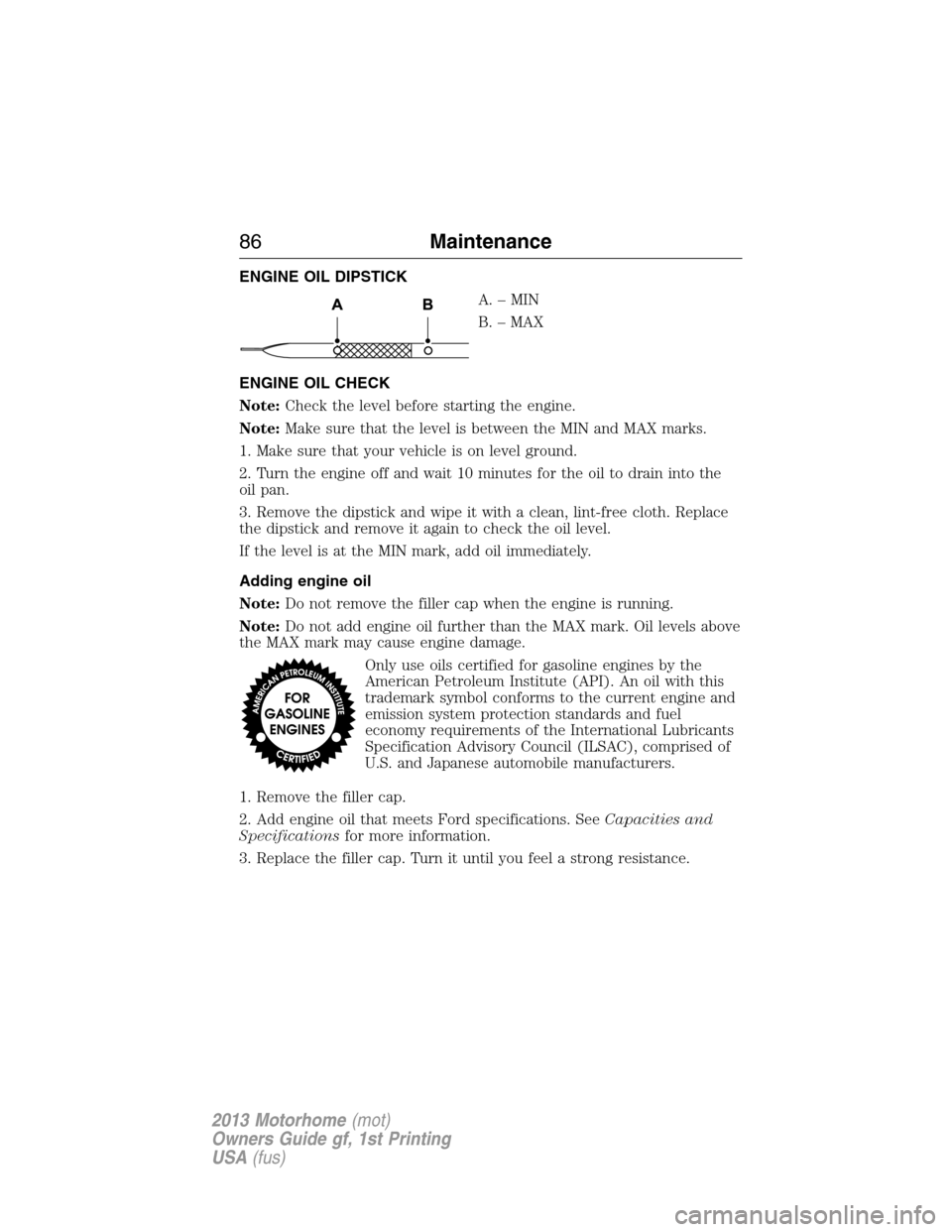
ENGINE OIL DIPSTICK
A.–MIN
B. – MAX
ENGINE OIL CHECK
Note:Check the level before starting the engine.
Note:Make sure that the level is between the MIN and MAX marks.
1. Make sure that your vehicle is on level ground.
2. Turn the engine off and wait 10 minutes for the oil to drain into the
oil pan.
3. Remove the dipstick and wipe it with a clean, lint-free cloth. Replace
the dipstick and remove it again to check the oil level.
If the level is at the MIN mark, add oil immediately.
Adding engine oil
Note:Do not remove the filler cap when the engine is running.
Note:Do not add engine oil further than the MAX mark. Oil levels above
the MAX mark may cause engine damage.
Only use oils certified for gasoline engines by the
American Petroleum Institute (API). An oil with this
trademark symbol conforms to the current engine and
emission system protection standards and fuel
economy requirements of the International Lubricants
Specification Advisory Council (ILSAC), comprised of
U.S. and Japanese automobile manufacturers.
1. Remove the filler cap.
2. Add engine oil that meets Ford specifications. SeeCapacities and
Specificationsfor more information.
3. Replace the filler cap. Turn it until you feel a strong resistance.
86Maintenance
2013 Motorhome(mot)
Owners Guide gf, 1st Printing
USA(fus)
Page 98 of 157
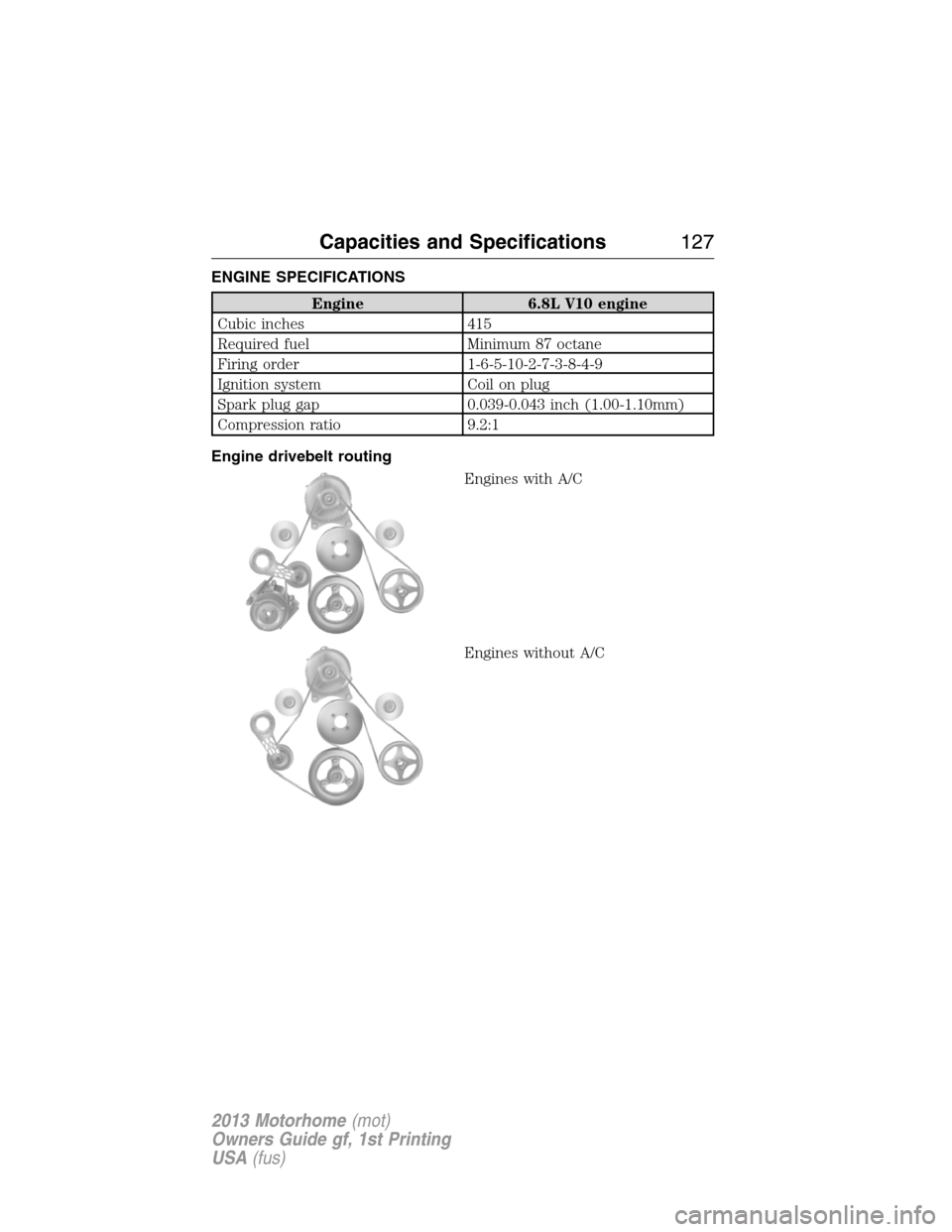
4. Check the fluid level on the
dipstick. It should be between the
arrows in the FULL range on the
side of the dipstick with the words
MAX. HOT at the top. Do not add
fluid if the level is within this range.
5. If the fluid is low, add fluid in
small amounts, continuously
checking the level until it reaches
the FULL range. Be sure to put the
dipstick back in the reservoir.
Refer toMaintenance product specifications and capacitiesin this
chapter for the proper fluid type.
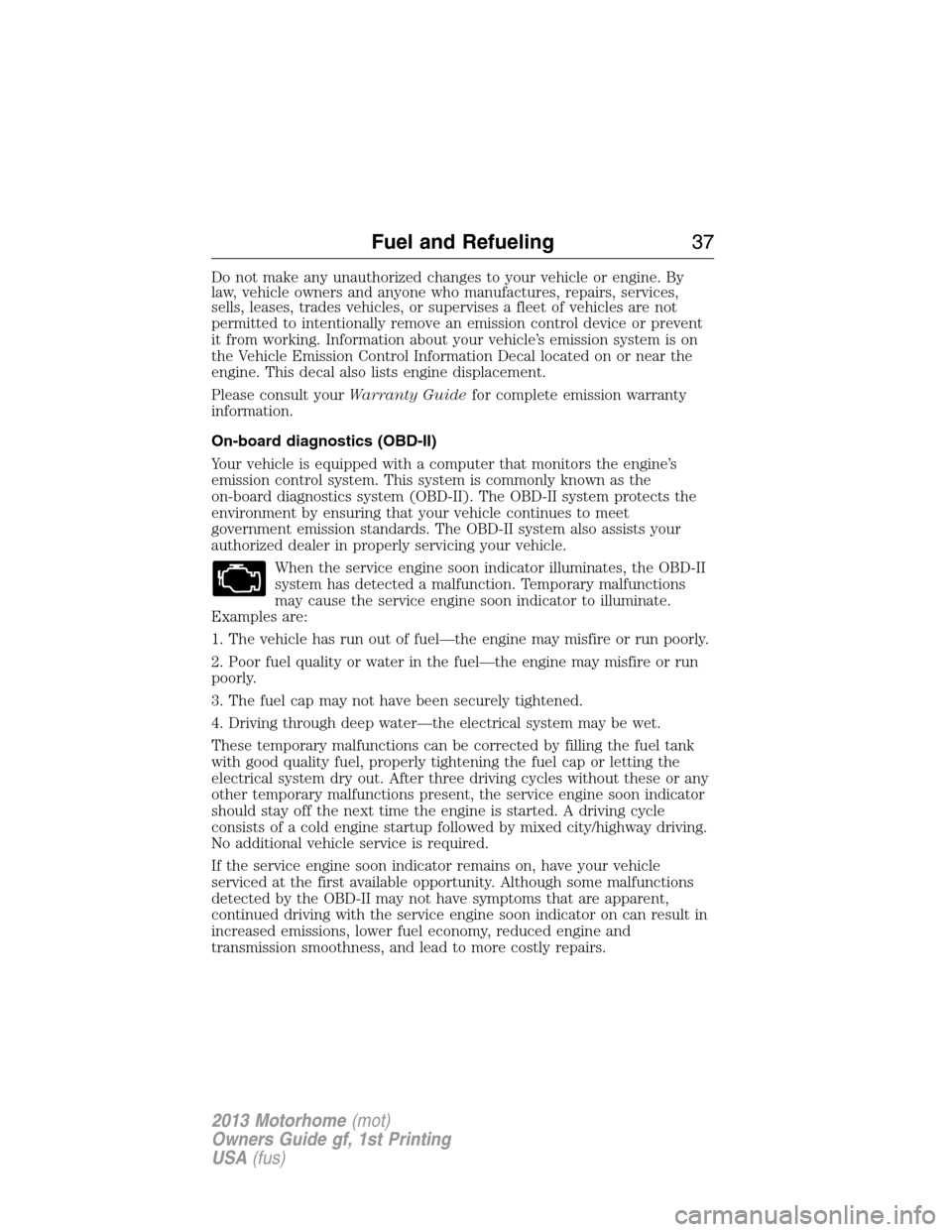
Steering linkage lubrication points
There are nine lubrication points on the steering linkage shown as “A”.
Refer toTechnical specificationsin theCapacities and Specifications
chapter for lubricant type to use.
FUEL FILTER
Your vehicle is equipped with a lifetime fuel filter that is integrated with
the fuel tank. Regular maintenance or replacement is not needed.
ADD MAX. HOTFULL
A
AA
A
A
A
A
A
Maintenance97
2013 Motorhome(mot)
Owners Guide gf, 1st Printing
USA(fus)
Page 128 of 157
ENGINE SPECIFICATIONS
Engine 6.8L V10 engine
Cubic inches 415
Required fuel Minimum 87 octane
Firing order 1-6-5-10-2-7-3-8-4-9
Ignition system Coil on plug
Spark plug gap 0.039-0.043 inch (1.00-1.10mm)
Compression ratio 9.2:1
Engine drivebelt routing
Engines with A/C
Engines without A/C
Capacities and Specifications127
2013 Motorhome(mot)
Owners Guide gf, 1st Printing
USA(fus)
Page 131 of 157
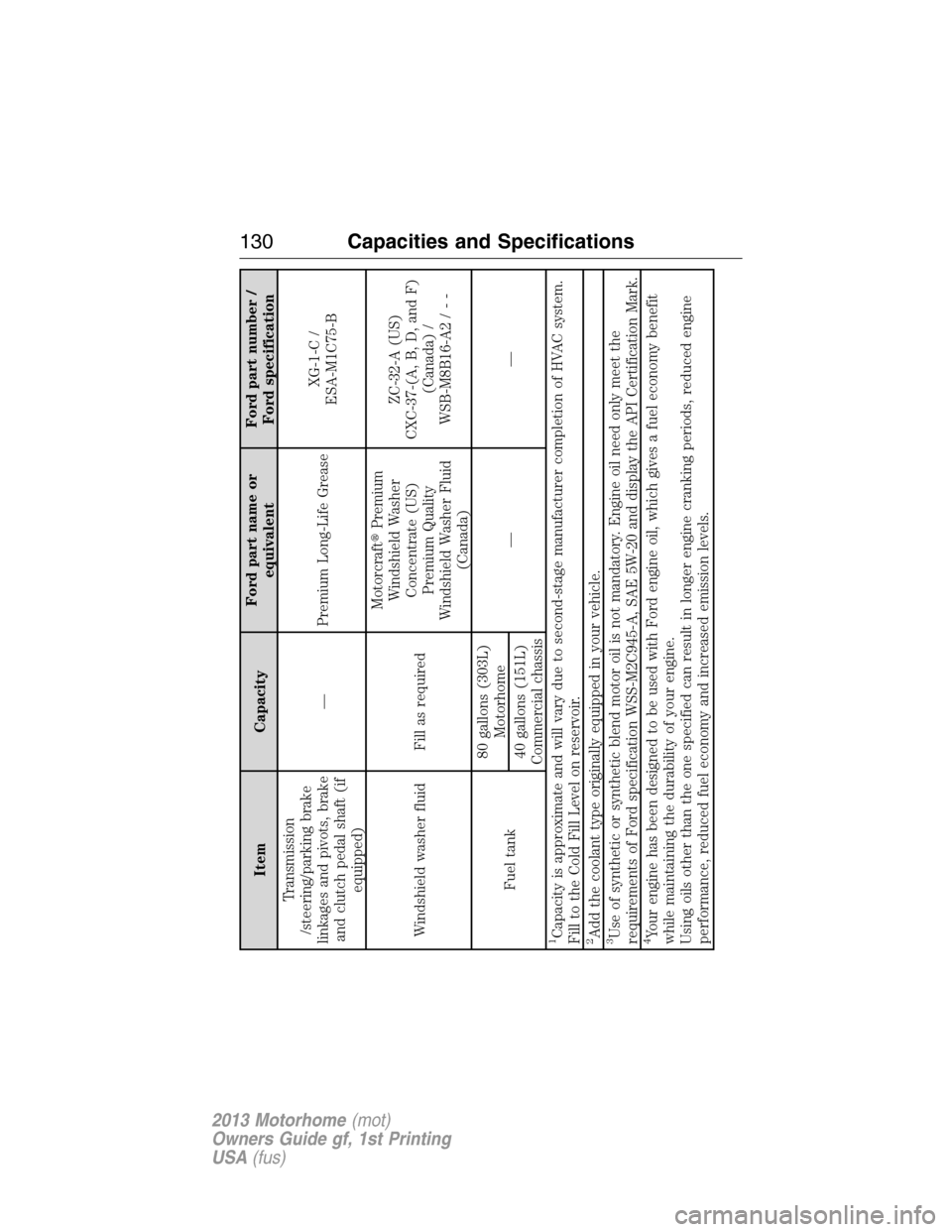
Item CapacityFord part name or
equivalentFord part number /
Ford specification
Transmission
/steering/parking brake
linkages and pivots, brake
and clutch pedal shaft (if
equipped)— Premium Long-Life GreaseXG-1-C /
ESA-M1C75-B
Windshield washer fluid Fill as requiredMotorcraft�Premium
Windshield Washer
Concentrate (US)
Premium Quality
Windshield Washer Fluid
(Canada)ZC-32-A (US)
CXC-37-(A, B, D, and F)
(Canada) /
WSB-M8B16-A2 / - -
Fuel tank80 gallons (303L)
Motorhome
——
40 gallons (151L)
Commercial chassis
1Capacity is approximate and will vary due to second-stage manufacturer completion of HVAC system.
Fill to the Cold Fill Level on reservoir.2Add the coolant type originally equipped in your vehicle.3Use of synthetic or synthetic blend motor oil is not mandatory. Engine oil need only meet the
requirements of Ford specification WSS-M2C945-A, SAE 5W-20 and display the API Certification Mark.4Your engine has been designed to be used with Ford engine oil, which gives a fuel economy benefit
while maintaining the durability of your engine.
Using oils other than the one specified can result in longer engine cranking periods, reduced engine
performance, reduced fuel economy and increased emission levels.
130Capacities and Specifications
2013 Motorhome(mot)
Owners Guide gf, 1st Printing
USA(fus)