2013 AUDI A5 CABRIOLET oil
[x] Cancel search: oilPage 221 of 290

Engine cooling system
Coolant
The engine coolant performs two functions: it
keeps the engine from overheating and it pro
te cts the engine from freezing in the winter .
The cooling system is sealed and generally re
qu ires little attention .
The cooling system has been filled at the fac
tory with a permanent coolant which does not need to be changed. The coolant consists of a
mixture of water and the manufacturer's gly
col-based coolant additive G 13 antifreeze with
anticor ros ion add itives (50% for USA mode ls;
60% for Canadian mode ls). This mixtu re both
assures the ne cessa ry frost prote cti on and
p rotec ts metal components in the engine's
coo ling system from cor ros io n an d scaling. It
a lso raises the boiling point of the coolant.
D o not red uce the con cent ration o f th e coo l
ant in the summe r by adding plain water .
The
proportion of coolant additive must be at least 50% but not more than 60%
to ma in
tain antifreeze protection and cooling efficien
cy. If the coolant frost protect ion is too low,
the coolant cou ld freeze and damage the veh i
cle heating and eng ine cooling system .
For yea r-round driving, antifreeze is added at
the factory for temperatures down to:
- -3 1 °F (-35°C)USA
- -4 0 ° F ( - 40 °C) Canada.
A WARNING
Before yo u check any thing in the engine
compartment, always read and hee d all
W AR NIN GS
¢ .&. in Working in the engine
compartment on page 212.
(D Note
- Before win ter se ts in, have the coolan t
checked to see if t he coolant ad dit ive i n
your vehicle is suffic ient to meet the cli
mate cond itions . T hi s is especially imp or
tant if you live in a regi on whe re the w in
te r is e xtremely cold. If necessary, in -
Checking and fillin g 219
crease the propo rtion of coo lant add itive
to 60%.
- When adding coolant additive to yo ur
coolin g system , remembe r:
- We reco mmend us ing o nly coola nt ad
d itive G12++ or G13 for your vehicle .
This coolan t ad ditive is availab le at a u
thor ized Audi dealers. O ther types of
ant ifree ze can s ignific antly red uce cor
rosion pro tec tion . The result ing corro
sion can ca use a loss o f coolan t and se
rio us en gine damage.
- D o not add any ty pe of rad iator leak seal
ant to yo ur vehicle 's engine coolan t.
Adding radiator repair fl uid may adverse
ly affect the function and performance of
your cooling system and co uld resu lt in
damage not covered by you r New Ve hicle
Limited War ran ty.
Checking the engine coolant level
The engine coolant level can be checked with
a quick glance.
Fig . 1 78 Eng in e co mpa rtm ent : Cover o n the coo la nt
expans io n t an k
-... ;;; ,; a, m
.. Before yo u check anything in the engine
compartment,
always read and heed all
WARNINGS ¢ & in Working in the engine
compartment on page 212 .
"' Park yo ur vehicle on a lev el su rface .
"' Turn off the ignition .
"' Read t he e ngine coolant level from the
coo lant expan sio n ta nk ¢
fig. 178 ,
¢ fig. 175. With a cold engine, the coolant
level sho uld be between the "MIN " and
"MAX" markings . When the engine is warm,
the level may be slightly above the "MAX"
marking.
Iii>
Page 222 of 290

220 Check ing and filling
The location of the coolant expansion tank
can be seen in the engine compartment illus
tration ¢
page 214 .
To obtain an accurate read ing, the eng ine
must be switched off .
The expans io n tank in you r vehicle is equipped
with an e lectr ic cool ant level sensor.
When the coolant level is too low, the warning light in the A uto-Check System ¢
page 18 will
b link until you add coo lant and the level has
been restored to no rm al. Even though the re is
an e lec tric coolant level sensor, we s till rec
ommend you check the coolant leve l from
time to time.
Coolant loss
Coolant loss may indicate a leak in the cooling
system. In the event of coolan t loss, the cool
i ng system should be inspected immedia tely
by your authorized A udi dealer. It is not
enough merely to add coolant.
I n a
s e aled system, losses can occur only if
the boiling poin t of the coolant is excee ded as
a result of overheating.
A WARNING
The cooling system is unde r pressure and
can get ve ry hot. Reduce the risk of sca ld
ing from hot coolant by following these
steps.
- Turn off the engine and allow it to cool
down.
- Protect yo ur face, hands and arms from
escaping fluid and steam by covering the
cap with a large, thick rag.
- Turn the cap slowly and ve ry carefu lly in
a counter-clockwise direction wh ile ap
plying light, downward pressure on the
top of the cap .
- To avoid being b urned, do not spill ant i
freeze or coolant on t he exhaust system
or hot eng ine parts. Unde r certain condi
tions, t he ethy lene g lycol in engine cool
an t can ca tch fire.
(D Note
Do not ad d any type of radiator leak sea l
ant to your veh icle's engine coo lant. Add
i ng radiator repa ir fluid may adverse ly af
fect the funct ion and performance of your
cooling system and could result in damage not cove red by your New Veh icle L imited
War ran ty .
Adding coolant
Be very careful when adding engine coolant.
Before you check anyth ing in the eng ine com
partment,
always read and heed all WARN
INGS c> &. in Working in the engine compart
ment on page 212.
.. Turn off the engine.
.. Let the engine cool down.
.. Place a thick rag over the coolant expansion
tank ¢
fig. 178 and carefully turn the cap
co unter-clo ckwise ¢,&. .
.,. Add coo lant.
.. Twis t the cap on aga in
t ightly.
Replacement engine coo lant must confo rm to
exact spec ificat ions
¢ page 219, Coolant. We
re commend using on ly coo la nt additive G 12+
+ , G 13 or in an eme rgen cy G12+. Do
not use a
different additive. In an emergency use plain
water until yo u can get the correct additive
and can restore the correct ratio . This shou ld
be done as soon as possible .
If you have los t a cons iderab le amount o f
coolant , then you sho uld ad d cold antifreeze
and cold wate r on ly w hen the engine is cold.
Always use
new engine coo lant when refilling.
Do not f ill coo lant abov e the "MAX" mark . Ex
cess coo la nt w ill be fo rced o ut thro ugh the
pressure relief valve in t he cap w hen the en
gine becomes hot.
A WARNING
-= -
-The cooling system is under pressure and
can get very hot. Reduce the risk of ..,.
Page 230 of 290
228 Tire s and wheel s
-Never mount used tires on yo ur vehicle if
you are not sure of their "previous histo
ry." Old used tires may have been dam
aged even though the damage cannot be
seen that can lead to sudden t ire failure
and loss of vehicle control.
- If you notice unusual vibration or if the
vehicle pulls to one side when driving, al
ways stop as soon as it is safe to do so
and check the wheels and tires for dam
age.
(D Note
Please note that summer and winter tires
are designed for the cond itions that are
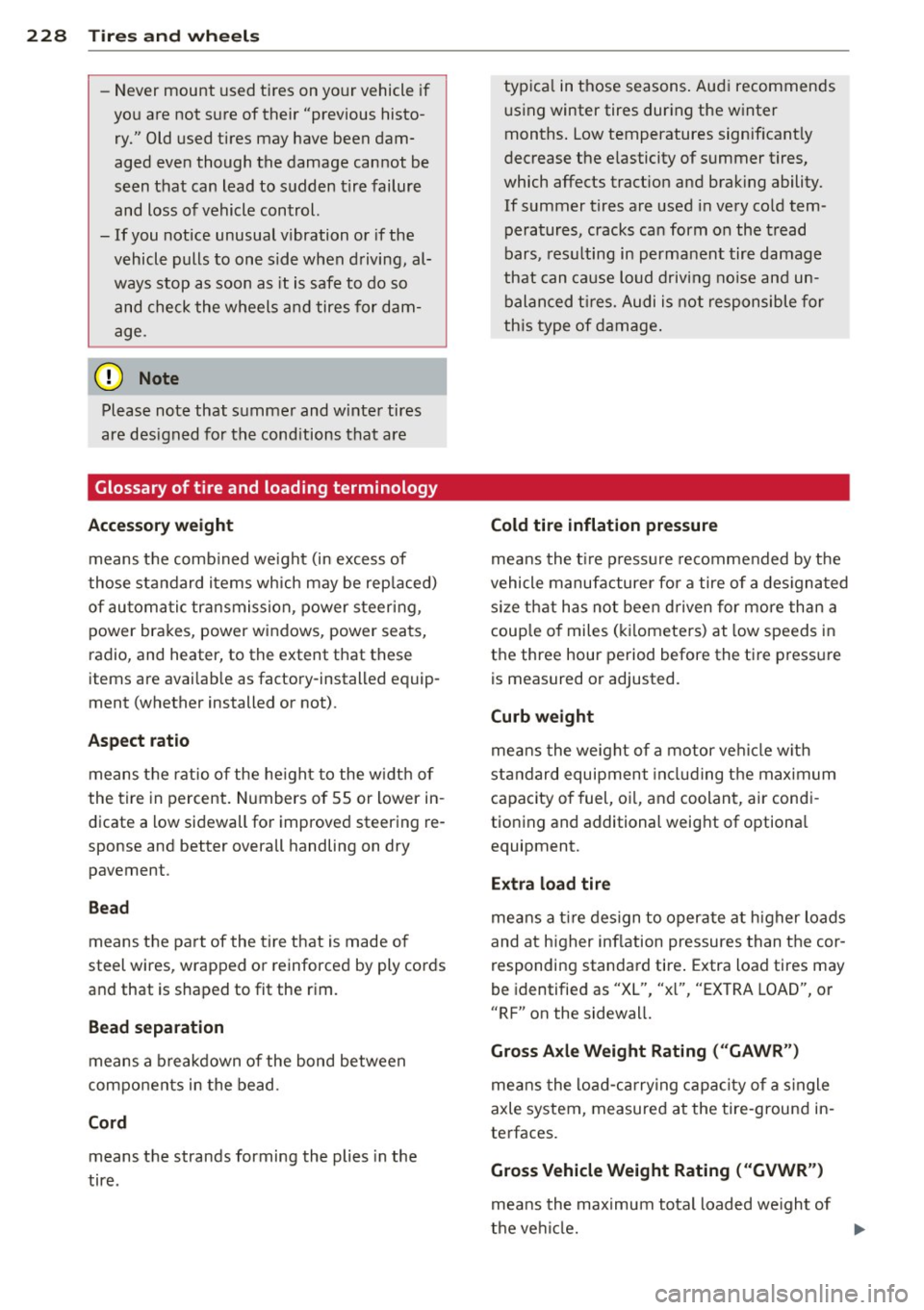
Glossary of tire and loading terminology
Accessory weight
means t he comb ined we ight (in excess of
those sta ndard items which may be rep laced)
of au toma tic tra nsmission, power steer ing,
power brakes, power windows, power seats,
radio, and heater, to the extent that th ese
items are availab le as factory -installed equip
ment (whether installed or not) .
Aspect ratio
means t he ratio of the he ight to the w idth of
the tire in percent . Numbers of 55 or lower in
dicate a low sidewall for improved steering re
sponse and better overall handling on dry pavement .
Bead
means the part of the ti re that is made of
steel wires, wrapped or reinforced by ply cords
and that is shaped to fit the rim.
Bead separation
means a b reakdown of the bond between
components in the bead.
Cord
means the strands forming the plies in the
tire . typ
ica l in those seasons . Audi recommends
using winter tires during the winter
months . Low temperatures signif icant ly
decrease the e lasticity of summer tires,
which affects tract ion and brak ing ability.
If summer tires are used in very co ld tem
peratures, cracks ca n form on the tread
bars, res ulting in permanent tire damage
that can cause loud driving no ise and un
balan ced t ires. Audi is not responsible for
th is type of damage .
Cold tire inflation pressure
means the tire p ressu re recommended by t he
vehicle manufacturer fo r a tire of a des igna ted
s iz e that has not bee n driven for more than a
coup le of miles (k ilometers) at low speeds in
t h e three hour period before the tire pressure
is measured or adjusted.
Curb weight
mea ns the we ight of a motor ve hicl e w ith
standard equipment including the max imum
capacity of fuel, oil, and coolant, air condi
tioning and additional weight of optiona l
equipment.
Extra load tire
me ans a t ire design to operate at higher loads
and at h igher inflation pressures than the cor
responding standard tire . Extra load tires may
be identified as "XL", "x l" , "EXTRA LOAD", or
"RF" on the sidewall.
Gross A xle Weight Rating ("GAWR ")
means the lo ad -c a rry ing c apac ity of a s ingle
axle system , measured a t the tire-ground in
terfaces.
Gross Vehicle Weight Rating ("GVWR ")
mea ns the maximum total loaded we ight of
t h e ve hicl e. .,.
Page 240 of 290

238 Tires and w hee ls
wheel alignment checked by an authorized
Audi dealer or qualified workshop.
All wheel dri ve
Vehicles w ith quattro ® must always have tires
of the same size, construction and tread type. F or detai ls see
¢ page 184 .
.8, WARNING
Sudden tire failure can lead to loss of con
trol, a crash and serious personal injury!
- Never drive a veh icle when the tread on
any tire is worn down to the wear indica
tors.
- Worn tires are a safety hazard, they do not grip well on wet roads and increase
your risk of "hydrop lan ing" and loss of
control.
- Always keep chemicals that can cause
tire damage, such as grease, oil, gasoline
and brake fluid away from tires.
- Tires age even if they are not being used
and can fail suddenly, especially at high
speeds. Tires that are more than 6 years
old can only be used in an emergency
and then with special care and at lower
speeds.
- Never mount used tires on your vehicle if
you are not sure of their "previous histo
ry." Old used tires may have been dam
aged even though the damage cannot be
seen that can lead to s udden tire failure
and loss of vehicle control.
New tires and replacing tires and wheels
New tires and wheels have to be broken in .
Fig. 186 Tir e specificat ion c odes on t he s idewall o f a
t ire
N o. Descri ption
(!) Passenger car tire (where applicable)
@ Nom inal width of tire in millimeters
@ Ratio of height to width (aspect ratio)
© Radial
® Rim diameter code
@ L oad index and speed rating
(J) U.S. DOT tire identification number
@ Audi Orig inal tire
@ Sever snow conditions
@ Tire ply compos ition and mate rials
used
Maximum load rating
Treadwear, traction and temperature
grades
Maximum permissible inflation pres
sure
T he t ires and rims are essential parts of the
vehicle 's design . The tires and rims approved
by Audi are spec ially matched to the charac
teristics of the vehicle and can make a major .,..
Page 246 of 290

24 4 T ire s and wheel s
Wheel bolts
Wheel bolts must always be tightened to the
correct torque .
The design of wheel bolts is matched to the
factory installed rims. If differen t rims are fit
ted, the correct wheel bolts with the r ight
length and correctly shaped bolt heads must
be used. This ensures that wheels are fitted
secure ly and that the brake system funct ions
correctly .
In ce rtain circumstances, you may not use
wheel bolts from a different vehicle -even if it
i s the same model~
page 2 71.
_& WARNING
Improperly tig htened o r maintained whee l
bolts can become loose ca using loss of
contro l, a co llision and serious persona l in
jury.
- Always keep the wheel bolts and the
threads in the wheel hubs clean so the
wheel bolts can turn easily and be prop
erly t ightened.
- Never grease or oil the wheel bo lts and
the threads in the wheel hubs. They can
become loose while driving if greased or
oiled, even if tightened to the specif ied
torque .
- Only use wheel bolts that belong to the
rim being installed .
- Never use different wheels bolts on your
vehicle .
-Always maintain the correct tighten ing
torque for the wheel bo lts to reduce the
risk of a wheel loss. If the tightening tor
que of the wheel bolts is too low, they
can loosen and com e out when the veh i
cl e is moving. If the tightening torque is
too high, the whee l bolts and threads
can be damaged and the wheel can be
come loose.
@ Note
The spec ified torq ue fo r the wheel bo lts is
90 ft lbs. (120 Nm) wi th a toler ance of
± 7,4 ft lbs. (± 10 Nm). Torque wheel bo lts diagonally. After changing a wheel, the
torque m
ust be checked as soon as possi
ble with a torque wrench -preferably by an
a uthori zed Audi dea ler or q ua lified work
shop .
Low aspect ratio tires
Your Audi is factory -equ ipped w ith low aspect
ratio tires . T hese tires have been thoroughly
tested and been se lected specifically fo r your
model for their superb perfo rmance, road fee l
and hand ling under a variety o f driv ing condi
t ions . As k your authorized A udi dealer for
more details .
T he low aspect ratio of these tires is ind icated
by a numera l of
55 or l ess in the tire's s ize
designation. The numeral represents the ratio
of the tire's sidewa ll height in relation to its
tread width exp ressed in percentage . Conven
tiona l tires have a he ight/w idth ratio of 60 or
more .
The performance of low-a spect-r atio tire s is
pa rt icul arly s ens itive to imp ro per i nfl ation
pressure. It is therefore import ant that low
aspect ratio tires are inflated to the specified pre ssure and that the inflation pressure is
r e gularly checked and maintained . Tire pres
sur es should be checked at l east once a
month and always before a long trip
~ page 233, Checking tire pressure.
What you can do to avoid tire and rim
damage
Low aspect ratio tires can be damaged mo re
easily by impact w it h potholes, c urbs, g ull ies
o r ridges on the road, pa rticul arly if the tire is
u nderinfla ted .
In orde r to minimize the occurrence of impact
damage to t he tires of your vehi cle, we recom
mend tha t you observe the following preca u
tions:
- Always ma inta in recommended inflation
pressu res. Check your tire pressure eve ry
2 ,000 miles (3,000 km) and add air if neces -
sary. ..,.
Page 259 of 290

No.
9 Supplementary heater
Fuse panel B (brown)
1 CD/DVD player
2
3 MMI/Radio
4 Instrument cluster
5 Gateway (instrument cluster
control module)
6 Ignition lock
7 Light switch
8
Climate control system
blower
9 Steering column lock
10 Climate control system
11 Terminal
30 diagnostic con-
nector
12 Steering column switch
module
Right luggage compartment fuse
assignment
5
5
5/20 5
5
5
5
40
5
10
10
5
Fig. 200 Rig ht luggage compartment: fu se panel wi th
pl ast ic d ip
Fuses and bulbs 257
No. Consumer
Fuse panel @ (black)
1
Luggage compartment lid
control module (allroad) / Power top control module
(Cabriolet)
2
Trailer control module or re
tractable rear spoiler (RS 5
Coupe)
3
4
5
6
7
8
9
Trailer control module
Trailer control module
Electromechanical parking
brake
Electronic damping control
Electromechanical parking
brake
Rear exterior lighting
quattro sport
10 Rear exterior lighting
Vehicle electrical system
11 control module
12 Terminal 30
Fuse panel © (brown)
1
2
3
Luggage compartment lid
control module (allroad)
12-volt socket, cigarette
lighter
DCDC converter path 1
--·--
-
4
DCDC converter path 2, DSP
6
7
9
amplifier, radio
Right upper cabin heating
(Cabriolet)
Electromechanical parking
brake
Rig ht front door (window
regulator, central locking,
mirror, switch, lighting)
Left upper cabin heating
10 (Cabriolet)
Two-door models : rear right
window regulator, Four-door
11 models: rear right door (window regulator, central
locking, switch, lighting)
Amps
30/10
15
20
20
5
15
30
30
35
30
20
5
30
20
40
30
30
30
30
30
30
.
Page 266 of 290
264 Emergency situations
fall from a lift if there is a change in ve
hicle weight distribution and balance.
This might happen, for example, when
heavy components such as the engine
block or transmission are removed .
- When removing heavy components like
these, anchor vehicle to hoist or add cor
responding weights to maintain the cen
ter of gravity. Otherwise, the vehicle
might tilt or slip off the hoist, causing
serious personal injury.
(D Note
- Be aware of the following points before
lifting the vehicle:
-The vehicle should never be lifted or
jacked up from underneath the engine
oil pan, the transmission housing, the
front or rear axle or the body side
members. This could lead to serious
damage.
- To avoid damage to the underbody or
chassis frame, a rubber pad must be
inserted between the floor jack and
the lift points.
- Before driving over a workshop hoist,
check that the vehicle weight does not
exceed the permissible lifting capacity
of the hoist.
- Before driving over a workshop hoist,
ensure that there is sufficient clear
ance between the hoist and low parts
of the vehicle.
Page 269 of 290
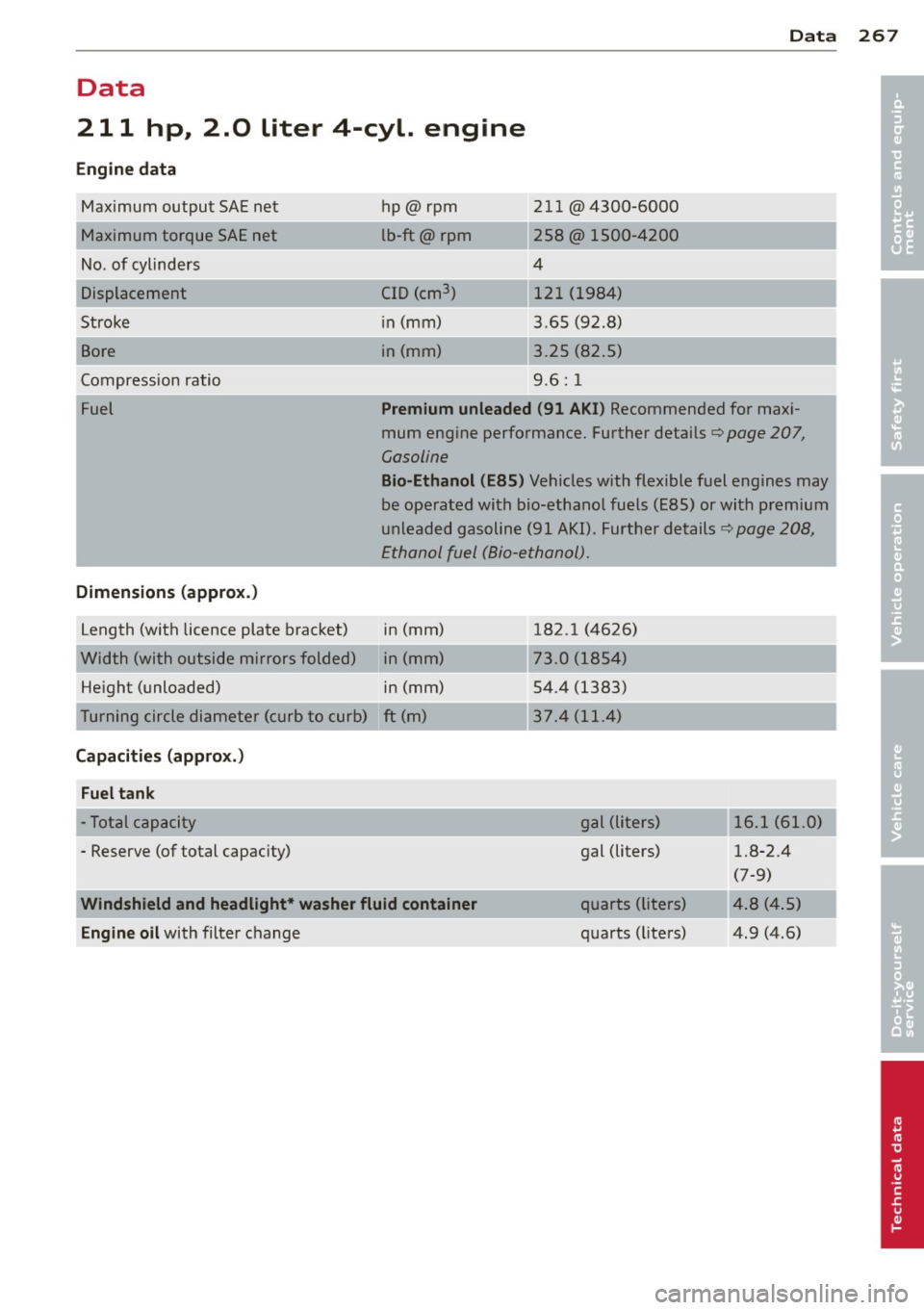
Data
211 hp, 2.0 liter 4-cyl. engine
Engine data
211 @4300-6000
Maximum output SAE net
Maximum torque SAE net
No. of cylinders
Displacement hp@rpm
lb-ft@ rpm
-·--
Stroke
Bore
Compression ratio CID (cm
3
)
in (mm)
in (mm)
__ .. ,
258@ 1500-4200
4
121 (1984)
3 .65 (92.8)
3.25 (82 .5)
9 .6: 1
Data
Fuel Premium unleaded (91 AKI) Recommended for maxi
mum engine performance. Further details¢ page 207,
Gasoline
Bio-Ethanol (E85) Vehicles with flexible fuel engines may
be operated with bio-ethanol fuels (E85) or with premium
unleaded gasoline (91
AKI) . Further details¢ page 208,
E thanol fuel (Bio-ethanol).
Dimensions (approx .)
Length (with licence plate bracket) in (mm)
Width (with outside mirrors folded) in (mm) He ight (unloaded) in (mm)
T urning circle diameter (curb to curb) ft (m)
Capacities (approx.)
Fuel tank
- Total capacity
- Reserve (of total capacity)
--.. ,
--.. ,
Windshield and headlight* washer fluid container Engine oil
with filter change 182
.1 (4626)
73.0 ( 1854)
54.4 (1383)
37 . 4 (1 1.4)
gal (liters)
gal (liters)
quarts (liters)
quarts (liters) 1.8-2.4
(7-9)
4 .9 (4 .6)
267
•
•