2013 AUDI A5 CABRIOLET service
[x] Cancel search: servicePage 210 of 290

208 Fuel supply and filling your fuel tank
-Anti -knock index must be 87 AKI or higher.
- Blend must contain not more than 15%
MTBE .
Seasonally adjusted gasoline
Many gasoline grades are blended to perform
especially well for winter or summer driving .
During seasonal change-over, we suggest that
you fill up at busy gas stat ions where the sea
sonal adjustment is more likely to be made in
time.
CD Note
- Fuels containing a high percentage of
ethanol such as ESO and E85 may only
be used in vehicles with flex ible fuel en
gines. Using high ethano l fuel in vehicles
not equipped with flexib le fue l eng ines
can cause severe engine damage.
- Methanol fuels which do not mee t these
requirements may cause corrosion and
damage to plastic and rubber compo
nents in the fuel system.
- Do not use fuels that fail to meet the
specified criteria in this chapter.
- If you are unable to determine whether
or not a particular fuel blend meets the
specifications, ask your service station or
its fuel supplier.
- Do not use fuel for which the contents
cannot be identif ied.
- Fuel system damage and performance
problems resulting from the use of fuels
different from those specified are not
the respons ibility of Audi and are not
covered under the New Vehicle or the
Emission Control System Warranties .
- If you experience a loss of fuel economy
or driveab ility and performance prob
le ms due to the use of one of these fuel
blends, we recommend that you switch
to unblended fuel.
Ethanol fuel (B io-ethanol)
App lies to veh icles : w ith flex ible fue l en g in e
You can recognize vehicles with a flexible fuel
engine by looking at the label on the inside of
the fuel filler flap.
Vehicles with flexible fuel engines may be op
erated with bio -ethanol fuels such as E85
(85% ethanol and 15% gasoline) or with un
leaded gasoline (91 AKI/ROZ 95) . The vehicle
may also be operated with a mixture of these
fuels.
Your fuel consumption w ill increase when us
ing bio-ethanol fue ls due to the lower amount
of energy contained per unit volume in etha
nol.
Warming up the flexible fuel engine in
low temperatures
Due to the chemical composition of b io-etha
nol , a certain amount of fuel ends up in the
engine oil when driving short distances in very
low temperatures. This fue l evaporates again
when the engine is warmed up.
II Please warm up engine.
If the driver message appears in the instru
ment cluster display, drive with a warm en
gine to reduce the o il level.
CD Note
- Never fill with methanol o r with a higher
percentage of b io-ethanol than 85%
(E85). A higher percentage of bio-etha
nol in the fuel can cause damage to the
engine or to the fue l system.
- If you use only E85, it is recommended
to fill the fuel tank complete ly with un
leaded premium grade gaso line every
5,000 miles.
- If you experience starting, rough id le or
hesitation driveability problems, fill the
fue l tank comp letely with unleaded pre
m ium grade gasoline and dr ive it nor
mally until the gasoline is used. See your
authorized Audi dealer if the problem
persists .
Page 218 of 290

216 Check ing and filling
temperatures stay below freezing point for
long periods.
Detergent addit ives in the o il w il l make fresh
oil look dark after the eng ine has been run
ning for a short time . This is norma l and is not
a reason to change the oi l more often than
recommended.
D am age or m alfunc tions du e to lack of
m ainten ance
It
is essential that you change your oil at the
recommended in tervals using only engine o il
that complies with Audi oi l standard
VW 502 00. Your Limited New Vehicle War
ranty does not cover damage or malfunctions
due to fail ure to fo llow recommended mainte
nance and use requ irements as set forth in
the Audi Owner's Manual and Warranty
&
Maintenance book let . Your dealer will have to
deny warranty coverage unless you present to
the dea ler proof in the form of Service or Re
pa ir Orders that all scheduled ma intenance
was performed in a t imely manner.
Eng ine oil consumption
The engine in your vehicle depends on an ade
quate amount of oil to lubricate and cool all
of its moving parts.
In order to provide effective lubrication and
cool ing of internal engine components, a ll in
ternal combustion eng ines consume a certa in
amount of oil. O il consumption varies from
engine to engine and may change significantly
over the life of the engine. Typica lly, engines
with a specif ied break-in period (see
¢
page 187) consume more oil during the
break-in period than they consume after oil
consumption has stabilized.
Under norma l conditions, the rate of oil con
sumption depends on the quality and viscosity
of the oil, the RPM (revolutions per minute) at
which the engine is operated, the ambient
temperature and road condit ions . Further fac
tors are the amount of oil d ilution from water
condensat ion or fuel residue and the ox ida
tion level of the oi l. As any engine is subject to wear as mi
leage builds up, the oil consump
tion may increase over time until replacement
of worn components may become necessary.
With a ll these variab les coming into play, no
standard rate of oil consumption can be es
tablished or specified. There is no alternative
to regu lar and frequent check ing of the o il lev
el, see
Note .
If
the yellow engine oil leve l warning symbo l
I! in the instrument cluster lights up, you
shou ld check the oil leve l as soon as possib le
¢
page 217. Top off the oil at your earliest
convenience ¢
page 217.
A WARNING '"---
Before you check anythi ng in the engine
compartment, always read and heed all
WARNINGS¢
A in Working in the engine
compartment on page 212.
(D Note
Driving w ith an insufficient o il level is like
ly to cause severe damage to the engine .
(D Tips
-The oil pressu re warn ing display . is
not an indic ator of the oil l evel. Do not
r el y on it . In stea d, check th e oil l eve l in
y our engin e at regular inter val s, pref
erably ea ch time you r efu el, and alwa ys
before go ing on a long trip .
-If you have t he impression yo ur engine
consumes excessive amoun ts of o il, we
recommend that you consu lt an author
ized Aud i dea ler to have the cause of
your concern properly diagnosed. Keep in m ind that the accurate measu rement of
oil consumption requ ires great care and
may take some time. An authorized Aud i
dealer has instructions about how to
measu re oil consumption accurately.
-
Page 220 of 290

218 Check ing and filling
@ For the sake of the environment
- Under no circumstances can the oil come
in contact with the sewage network or
the soil.
- Observe and follow legal regu lations
when disposing of empty oil containers.
Changing the engine oil
We recommend thot hove your oil changed by
an authorized Audi dealer or a qualified serv
ice station.
Before you check anything in the engine com
partment,
a lways r ea d and heed all WARN
ING S ¢ & in Working in the engine compart
ment on page 212.
The engine oil must be changed according to
the intervals specified in your Warranty
&
Maintenance book let. This is very important
because the lubricating properties of oil di
minish gradually during normal vehicle use .
Under some circ umstances the engine oi l
should be changed more frequently . Change
oil more often if you drive mostly short dis
tances, operate the vehicle in dusty areas or under predominantly stop-and -go traffic con
d itions, or have your veh icle where tempera
tures remain below freez ing fo r extended pe
riods.
Detergent addit ives in the o il w ill make fresh
oil look dark after the eng ine has been run
n ing fo r a short time. This is norma l and is not
a reason to change the oil mo re often than
recommended.
Because of the problem of proper disposal ,
a long w ith the special tools and necessary ex
pertise required, we strong ly recommend that
you have your o il changed by an authorized
Audi de ale r or a qualified service station.
If you cho ose t o c han ge your oil yours elf ,
please note the following important informa
tion :
A WARNING
To reduce the risk of personal injury if you
must change the eng ine oil in your vehicle
yourself:
- Wear eye protect ion.
- To reduce the risk of burns from hot en- gine oil, let the engine cool down to the
touch.
- When removing the o il dra in plug with
your fingers, stay as far away as possible. Always keep your forearm parallel to the
ground to help prevent hot oil from run
n ing down you r arm.
- Dra in the oil into a container designed
for this purpose, one large enough to hold at least the tota l amount of oil in
your engine.
- Engine oil is poisonous. Keep it we ll out
of the rea ch of childre n.
- Continuous contact with used eng ine o il
is harmfu l to your sk in. Always protect
your skin by washing oil off tho ro ughly
with soap and wate r.
@ Note
Neve r mix oil additives with your engine
oi l. These additives can damage your en
g ine and adversely affec t you r A ud i L imit
ed New Veh icle War ranty.
@ For the sake of the environment
- Before changing your oil, first make su re
you know where you can prope rly dispose
o f the used oil.
- Always dispose of used eng ine oi l proper
ly. Do not dump it on garden soil, wood
ed areas, into open streams o r down
sewage drains.
- Recycle used engi ne oil by taking it to a
used engine oil collection facility in you r
area, or contact a service station.
Page 225 of 290

Have the battery checked when you take your
vehicle in for service. Yo u are well advised to
replace a battery that is older than 5 years.
W ith certa in types o f airbag deployment, the
battery is disconnec ted from the vehicle elec
trica l system for safety reasons
c::> &. in Re
pair, care and disposal of the airbags on
page 154.
Di sconn ecting the battery t erminal s
Some vehicle functions (power w indow regu
l ators, for example) are lost if the battery ter
minals are disconnected . These functions have
to be re learned after the battery terminals are
connec ted again. To prevent this, the battery
should only be disconnected from the vehicle
e lectrical system when absolutely necessary
for repairs .
Vehicl es not driven for long p eriod s
If you do not drive your vehicle over a period
of several days or weeks, electrical compo
nents are gradually cu t back or switched off .
This reduces energy consumption and main
tains starting capability over a longer per iod
c::> page 185.
Some of the conven ience functions may not
operate, such as the inter ior lights or the
power seat adjustment. The conven ience
functions will be ava ilable again whe n you
turn on the ignition and sta rt the eng ine.
Winter operation
During the winter months, battery capacity
tends to decrease as temperatures drop . This
i s because more powe r is also consumed while
start ing , and the head lights, rea r window de
fogger, etc., are used more often .
Avo id unnecessary power consumption, par
ticularly in c ity t raffic or when t rave ling on ly
short d istances. Let you r authorized Audi
dea le r che ck t he capacity of the vehicle bat
t ery before w inte r sets in
c::> page 225. A well
cha rged batte ry w ill no t only p revent sta rting
p rob lems when the weathe r is cold, b ut will
a lso last longer.
Checkin g and fillin g 223
(D Tips
If your vehicle is left standing for seve ral
weeks at extremely low temperatures, the
vehicle battery shou ld be removed and
stored where it w ill not freeze. This will
prevent it from be ing damaged and having
to be replaced .
Working on the battery
Be especially careful when working on or near
the battery.
The battery is located in the l uggage compart
ment under the floor. Before you check any
th ing in the luggage compartment,
read and
h eed all WARNINGS
c::> &_ .
Always heed the safety warnings , when work
ing on the vehicle battery or the vehicle e lec
trical system to prevent injury.
The following WARNINGS are very
important when working on the battery:
Al ways heed the follo wing WARNING SYM
BOLS and safety precautions when working on the battery.
® Always wear eye protection .
/).. Batte ry acid contains sulfuric acid . Al
~ ways w ear glov es and ey e protection .
IC No
\!!51 -sparks
-flames
- smoking.
A Wh en a battery i s charged , it produces
~ hydrogen g as which i s explosive and
could cau se per sonal injur y.
~ Always keep the battery well out of
'if!:11 reach of children .
_&. WARNING
Whenever working on t he battery o r on
the electrical system, there is the risk of
injury, accident and even fire . Read and
heed the following WARNINGS:
-
•
•
Page 239 of 290

and luggag e load c apaci ty of
y our vehicle.
.,. Check the tire sidewall
(c:::> fig . 18 6) to d etermine th e
de sign ated load rating f or a
s p ecific tir e.
Tire service life
The service life of tires depends on a lot of
different things including proper installation
and balan cing , correc t tire pressure and driv
ing style.
Fi g. 1 84 Tire t rea d: tread we ar ind ic a tors (TWI)
.__ __ __,, ,.)
Fig . 185 Rotat ing t ires for more eve n wea r
Tread Wear Indicator (TWI)
The origina l tires on your vehicle have
1/16 inch (1.6 mm) high "wear indicators"
<=> fig. 184 running across the tread. Depend
ing on the make, there will be six to eight of
t hem evenly p laced around the t ire. Marks on
the t ire s idewall (for example ''TWI " or other
symbols) indicate the positions of the tread
wear ind icators . Worn t ires m ust be replaced.
D ifferen t fig ures may apply in o ther co untries
¢ ,& .
Tires and wheels 23 7
Tire pressure
Incorrect tire press ure c auses prema ture wear
and can cause sudden tire blow-out . For this
reason , tire pressure must be checked at least
once a month
r:!) page 233.
Driving style
Driving fast around c urves, heavy acce le ra ti on
and har d brak ing inc rease tire wear .
Rotating tires for more even w ear
For all four tires on your vehicle to have the
same service life , we recommend that the
front and rear t ires a re rotated a ccording to
the tire man ufactur er's suggested tire ro ta
tion intervals . Please remember the follow
ing:
- Tire rotation in tervals may differ from the
veh icle servi ce inte rv al s o utli ned in your
Ma intenance and Warranty Boo klet.
- The longer one tire is used in one lo cation
on t he veh icle, the more it wears a t cer tain
points ; the re fore, we recommend that you
follow the tire man ufact urer's suggested
tire rotation intervals .
- Vehi cles w ith front-wheel dr ive experience
more tread wear on the front wheels com
pared to a ll wheel drive (quattro ®).
- Please rotate tires as shown¢
fig. 185 .
-Extra care mus t be taken when ro ta ti ng di -
rection -specific tires
q page 2 54.
Wheel balancing
T he w heels on new ve hicles are balanced .
Howeve r, various s ituations duri ng eve ryday
driv ing ca n ca use t hem to become unba l
anced, resulting in vib rat ions you ca n usually
feel through the steer ing whee l.
Un balanced wheels must be rebalanced to
avo id excessive wear on steering, s uspension
and t ires. A whee l m ust also be reba lanced
when a new tire is insta lled .
Incorrect wheel alignment
Incor rect wheel alignment can cause exc es
s ive tire wear, impa iring the safe ty of the vehi-
cle. If tires show excessive wear, have the
)I>-
Page 262 of 290

260 Emergency situations
@ Tips
The discharged battery must be properly
connected to the vehicle's electrical sys
tem. When jump starting or charging the
battery, never connect the negative
ground cable to the battery negative post
because the batte ry manager system must
be able to detect the battery 's state of
charge. Always connect the negative
ground cab le to the negative ground post
of the battery manager control unit.
Use of jumper cables
Make sure to connect the jumper cable
clamps in exactly the order described below!
Fig. 201 Engine compartment: Connecto rs fo r jum per
cables and charger
Fig. 202 Jump sta rting wi th the battery of anot her ve ·
h ide :@ booster battery, @ disc harged vehicle battery
The procedure described below for connecting
jumper cables is intended to provide a jump
start for your vehicle .
Vehicle with discharged battery:
.. Turn off lights and accessories, move lever
of automatic transmission to N (Neutral) or
P (Park) and set parking brake .
Connect POSITIVE(+) to POSITIVE(+)
(red)
.. Remove the cover above the jump start con
nection .
.. Open the
cover on the positive pole
¢fig. 201.
1. Connect one end of the red positive cable
on the
jump start bolt c::> fig. 202 @
(Bolts under cover= "positive") of the ve
hicle to be started @.
2. Connect the other end to the positive ter-
mina l@ of the booster battery@.
Connect NEGATIVE (-) to NEGATIVE (-)
(black)
3. Connect one end of the b lack negative ca
ble to the negative terminal @of the
booster battery @.
4. Connect the other end to the
jump start
bolt @
(Bolts with hex head= "negative")
of the vehicle to be started @.
Starting the engine
.. Sta rt the engine of the vehicle with the
booster battery@. Run the engine at a
moderate speed.
.. Start engine with discharged vehicle battery
@ in the usual manner .
.. If the eng ine fails to start: do not keep the
starter cranking for longer than 10 seconds .
Wait for about 30 seconds and then try
again .
.. With engine running, remove jumper cables
from both vehicles in the exact
reverse or
der .
.. Close the
cover on the positive pole .
T he battery is vented to the outside to prevent
gases from entering the vehicle interior . Make
sure that the jumper clamps are well connect
ed with their
metal parts in full contact with
the battery terminals.
A WARNING
--
To avoid serious personal injury and dam
age to the veh icle, heed all warnings and
i nstructions of the jumper cable manufac-
turer . If in doubt, call for road service . ..,.
Page 271 of 290

Consumer Information
Warranty coverages
Your Audi is covered by the following war
ranties :
- New Vehicle Limited Warranty
- Limited Warranty Against Corrosion Perfo-
ration
- Emissions Control System Warranty
- Emissions Performance Warranty
- California Emissions Con trol Warranty (USA
vehicles only)
- California Emissions Performance Warranty
(USA vehicles only)
Detailed information regarding your warran
ties can be found in your
Warranty & Mainte
nance booklet .
Operating your vehicle
outside the U.S.A. or
Canada
Government regulations in the United States
and Canada require that automobiles meet
specific emission regulations and safety
standards. Therefore, veh icles built for the
U.S.A. and Canada differ from vehicles sold in
other countries .
If you p lan to take your vehicle outside the
continental limits of the United States or Can
ada, there is the possibility that:
- unleaded fuels for vehicles with cata lytic
converter may not be available;
- fuel may have a considerably lower octane
rating . Improper fuel may cause engine
damage ;
- service may be inadequate due to lack of
proper service facilities, tools or testing
equipment ;
- replacement parts may not be readily availa
ble.
- Navigation systems for vehicles built for the
U.S.A. and Canada will not necessari ly work
in Europe, and may not work in other coun
tries outside of North America.
Consumer Information 269
@ Note
Audi cannot be responsible for mechanical
damage that could result from inadequate
fuel, service or parts availability.
Audi Service Repair Manuals and Literature
Audi Offic ial Factory Service Manuals and Lit
erature are published as soon as possible after
model introduction. Service manuals and lit
erature are available to order from the Audi
T echnical Literature Ordering Center at:
www.audi.techliterature.com
Maintenance
' General
Your vehicle has been designed to help keep
maintenance requirements to a minimum.
However, a certain amount of regular mainte
nance is still necessary to assure your vehicle's
safety, economy and reliability . For detailed
vehicle maintenance consult your Warranty
&
Maintenance booklet.
Under difficult operating conditions , for ex
ample at extremely low outside temperatures ,
in very dusty regions, when towing a tra iler
very frequently, etc., some serv ice work
shou ld be performed between the intervals
specified. This applies particularly to:
- oil changes, and
- cleaning or replacing the air filter .
® For the sake of the environment
By regularly maintaining your vehicle, you
help make sure that emission standards
are maintained, thus min imizi ng adverse
effects on the environment .
Important considerations for you and
your vehicle
The increasing use of electronics , sophisticat
ed fuel injection and emission control sys-
tems, and the genera lly increasing technica l ..,_
•
•
Page 285 of 290
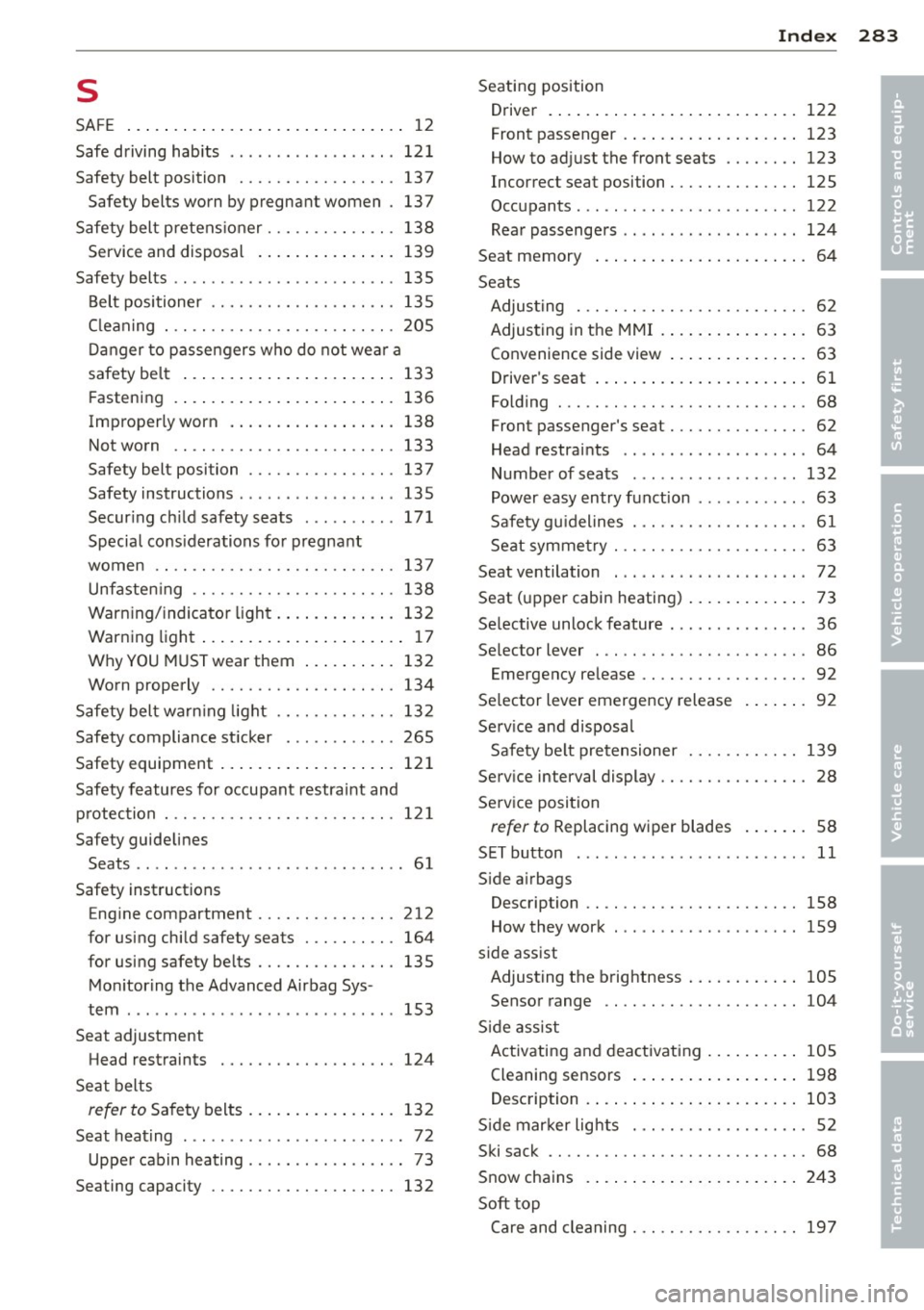
s
SAFE
Safe driving hab its ... ...... .. .. .. .. .
Safety belt position ........ .. .. .. .. .
Safety belts worn by pregnant women .
Safety belt p retens ioner ..... .. .. .. .. .
Service and disposal ... ... .. .. .. .. .
Safety belts ............ ...... .... . . 12
121
137
137
138
139
135
Belt positioner ........... .. .. .. .. . 135
C leaning . .. .... ......... .... .. .. . 205
D anger to passengers w ho do not wea r a
safety belt ... .. .. .... ... .. .. .. ... 133
F astening .. .. ... ..... ... .. .. .. ... 136
Improperly worn . . . . . . . . . . . . . . . . . . 138
Not worn .. ............. .... .. ... 133
Safety belt position ....... .. .. .. .. . 13 7
Safety instructions .. ...... .. .. .. .. . 135
Secur ing ch ild safety seats ..... ... .. 17 1
Specia l cons iderations fo r pregnant
women .. .. ............. .... .. .. . 137
Unfasten ing .... ......... .... .. .. . 138
Warn ing/ indicato r light .. .. .. ...... . 132
Warning light ... .. .... ... .. .. .. .... 1 7
Why YOU MUST wear them ... .. .. .. . 132
Worn properly ........... .. .. .. .. . 134
Safety bel t warn ing light .... .. .. .. .. . 13 2
Safety compliance st icker . ...... ... .. 265
Safety equipment ... .... ... .. .. .. .. . 12 1
Safety features for occupant restra int and
p rotec tion . . . . . . . . . . . . . . . . . . . . . . . . . 121
Safety guidelines Seats .. .. .. .. ..... ...... .. .. .. .. .. 61
Safety instructions Eng ine compartment ...... .. .. .. .. . 212
for using chi ld safety seats . .. .. .. .. . 164
for using safety be lts ...... .. .. .. .. . 135
Mon itoring the Advanced Airbag Sys-
tem ...... ... ................ .... 153
Seat adjustment Head restraints . . . . . . . . . . . . . . . . . . . 124
Seat belts
refer to Sa fety belts .... ... .. .. .. .. . 132
Seat heating . . . . . . . . . . . . . . . . . . . . . . . . 72
Uppe r cabin heating ....... .. .. .. .. .. 73
Seating capacity ........... .. .. .. .. . 132
Inde x 283
Seating position
Driver . ... .. .. .... . ... ...... ... .. 122
Front passenger . ... . .. ... .. ... .. .. 123
How to ad just the front seats ...... .. 123
Incorrect seat position . ............. 125
Occupants ....... .. ............... 122
Rea r passengers .. .. . .. .... ... ... .. 124
Seat memory . . . . . . . . . . . . . . . . . . . . . . . 64
Seats Adjus ting . . . . . . . . . . . . . . . . . . . . . . . . . 62
Adjus ting in the MMI . .. .. ... ... .. .. . 63
Convenience side view . . . . . . . . . . . . . . . 63
Drive r's seat . . . . . . . . . . . . . . . . . . . . . . . 61
Folding ... .. .. .. ... ............ .. . 68
Front passenger's seat . . . . . . . . . . . . . . . 62
Head restra ints .. .. ... ....... .... .. 64
N umber of seats . .. ... ....... .... . 132
Power easy entry f unction .......... .. 63
Safety gu idelines . .... ......... .. .. . 61
Seat symme try . . . . . . . . . . . . . . . . . . . . . 63
Seat ventilation . . . . . . . . . . . . . . . . . . . . . 72
Seat ( upper cabin heating) ..... ... .. .. . 73
Se lective unlock feature . . . . . . . . . . . . . . . 36
Se lector lever . . . . . . . . . . . . . . . . . . . . . . . 86
Emergency re lease ................. . 92
Se lector lever emergency release . ... ... 92
Se rv ice and d isposa l
Safety be lt pretensioner ........ .. .. 139
Serv ice interval display . . . . . . . . . . . . . . . . 28
Serv ice position
refer to Replacing wiper blades . ... ... 58
S ET button . . . . . . . . . . . . . . . . . . . . . . . . . 11
S ide a irbags
Description . . . . . . . . . . . . . . . . . . . . . . . 158
How they work ... .. ... ....... .... . 159
s ide assist
Adjust ing the b rig htness ..... ... .. .. 105
Sensor range .. .. ................. 104
S id e assist
Activating and deactivating ... ... .. .. 105
Cleaning sensors ... . .. .. ... ... .. .. 198
Description . ... .. .. .. ... ..... ... .. 103
S ide mar ker lig hts . ............. .... . 52
Ski sack .... .. .. .. .. . .............. . 68
Snow cha ins .. .... .. . .. .. ..... ... .. 243
Soft top Care and cleaning . .... ......... .. .. 19 7
•
•