Page 504 of 636

504 4-3. Do-it-yourself maintenance
23 EPS80 A Electric power steering
24 ST 30 A Starting system
25 CRT 10 ARear seat entertainment system,
audio system
26 RADIO NO.1 20 A Audio system
27 ECU-B NO.1 10 A Steering sensor, gauges and
meters, clock, main body ECU,
wireless remote control, smart key
system, power back door, multi-
information display, front passen-
ger occupant classification system
28 DOME 10 AVanity lights, personal lights, inte-
rior light, gauges and meters,
engine switch light, door courtesy
lights
29 TOWING 30 A Trailer lights
30 STR LOCK 20 A Steering lock system
31 EFI MAIN 25 AMultiport fuel injection system/
sequential multiport fuel injection
system, EFI NO.2, EFI NO.3
32 HAZ 15 A Turn signal lights
33 IG2 25 AINJ NO.1, INJ NO.2, IGN, GAUGE
NO.2
34 AMP 15 A Audio system
35 RR FOG 7.5 A No circuit
36 DEICER 15 A Windshield wiper de-icer
37 G/H 10 AGlass hatch, multiplex communica-
tion system, outer foot lights
38 ALT-S 7.5 A Charging system
39 AM2 7.5 A Multiplex communication system
40 H-LP LH HI 15 A Left-hand headlight (high beam)
FuseAmpereCircuit
Page 507 of 636
507
4-3. Do-it-yourself maintenance
4
Maintenance and care
9 DOOR NO.2 25 A Power windows
10 AM1 7.5 A Starting system 11 P/SEAT (PS) 30 A Power seat
12 A/C NO.1 10 A Air conditioning system
13 FUEL OPN 7.5 A No circuit
14 S/ROOF 20 A Electric moon roof
15 TAIL 15 A Parking lights, tail lights, license
plate lights, fog lights, trailer lights
16 PANEL 7.5 A Glove box light, instrument panel
lights, switch illumination
17 ECU IG NO.1 10 A Multiplex communication system,
electric moon roof, electronically
controlled automatic transmission
system, power back door, seat
heaters, tire pressure warning sys-
tem, electric power steering, anti-
glare inside rear view mirror, shift
lock system, tire pressure warning
system
18 ECU IG NO.2 7.5 A Enhanced vehicle stability control
system
19 A/C NO.2 10 A Air conditioning system
20 WASH 20 A Windshield and rear window
washer
21 S-HTR 20 A Seat heaters
FuseAmpereCircuit
Page 508 of 636
508 4-3. Do-it-yourself maintenance
22 GAUGE NO.1 10 AAudio system, back-up lights,
charging system, emergency flash-
ers, traction control system, wind-
shield wiper de-icer, air
conditioning system, charging sys-
tem, rear view monitor system,
trailer lights, multiport fuel injection
system/sequential multiport fuel
injection system
23 FR WIP 30 A Windshield wipers and washer
24 RR WIP 15 A Rear window wiper and washer
25 IGN 10 A Multiport fuel injection system/
sequential multiport fuel injection
system, steering lock system,
smart key system, SRS airbag sys-
tem
26 GAUGE NO.2 7.5 A Gauges and meters, rear view
monitor system
27 ECU-ACC 7.5 A Outside rear view mirrors, shift lock
system, smart key system, multi-
plex communication system
28 ACC SOCK
NO.1 15 A Power outlet
29 ACC SOCK
NO.2 15 A Power outlet
30 RADIO NO.2 7.5 A Audio system, clock, rear seat
entertainment system, interior
lights, personal lights
FuseAmpereCircuit
Page 520 of 636
520 5-1. Essential information
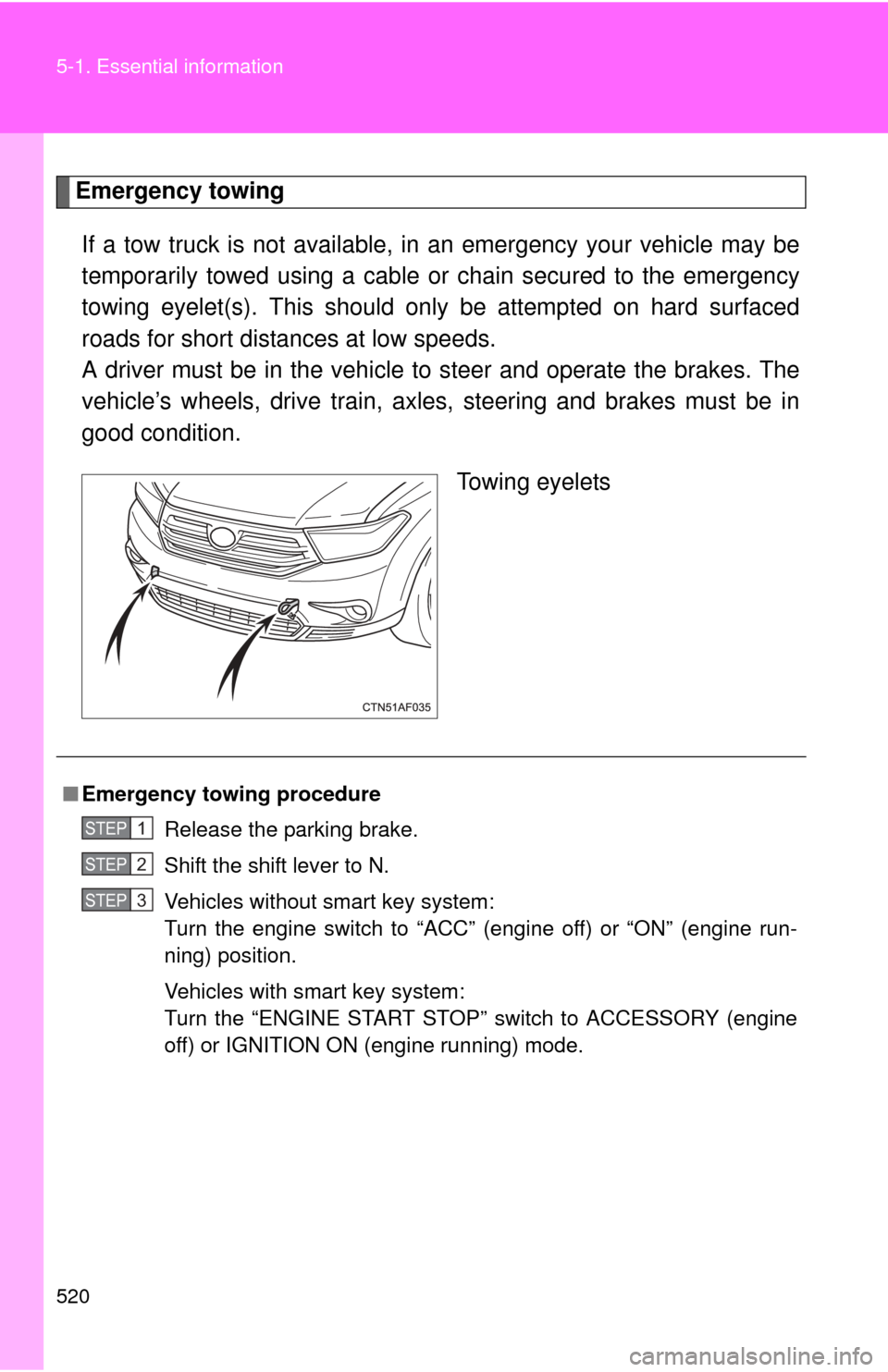
Emergency towingIf a tow truck is not available, in an emergency your vehicle may be
temporarily towed using a cable or chain secured to the emergency
towing eyelet(s). This should only be attempted on hard surfaced
roads for short distances at low speeds.
A driver must be in the vehicle to steer and operate the brakes. The
vehicle’s wheels, drive train, axles, steering and brakes must be in
good condition.
Towing eyelets
■Emergency towin g procedure
Release the parking brake.
Shift the shift lever to N.
Vehicles without smart key system:
Turn the engine switch to “ACC” (engine off) or “ON” (engine run-
ning) position.
Vehicles with smart key system:
Turn the “ENGINE START STOP” switch to ACCESSORY (engine
off) or IGNITION ON (engine running) mode.
STEP1
STEP2
STEP3
Page 521 of 636
5
When trouble arises
521
5-1. Essential information
Installing a towing eyelet
Remove the eyelet cover using a
flathead screwdriver.
To protect the bodywork, place a
rag between the screwdriver and
the vehicle body, as shown in the
illustration.
Insert the towing eyelet into the
hole and tighten partially by
hand.
CAUTION
■Caution while towing
●Use extreme caution when towing the vehicle.
Avoid sudden starts or erratic driving maneuvers which place excessive
stress on the emergency towing eyelets and the cables or chains. Always
be cautious of the surroundings and other vehicles while towing.
● If the engine is not running, the power assist for the brakes and steering
will not function, making steering and braking more difficult.
NOTICE
■To prevent causing serious dama ge to the transmission
Never tow this vehicle from the rear with the front wheels on the ground.
This may cause serious damage to the transmission.
STEP1
STEP2
Page 530 of 636
530 5-2. Steps to take in an emergency
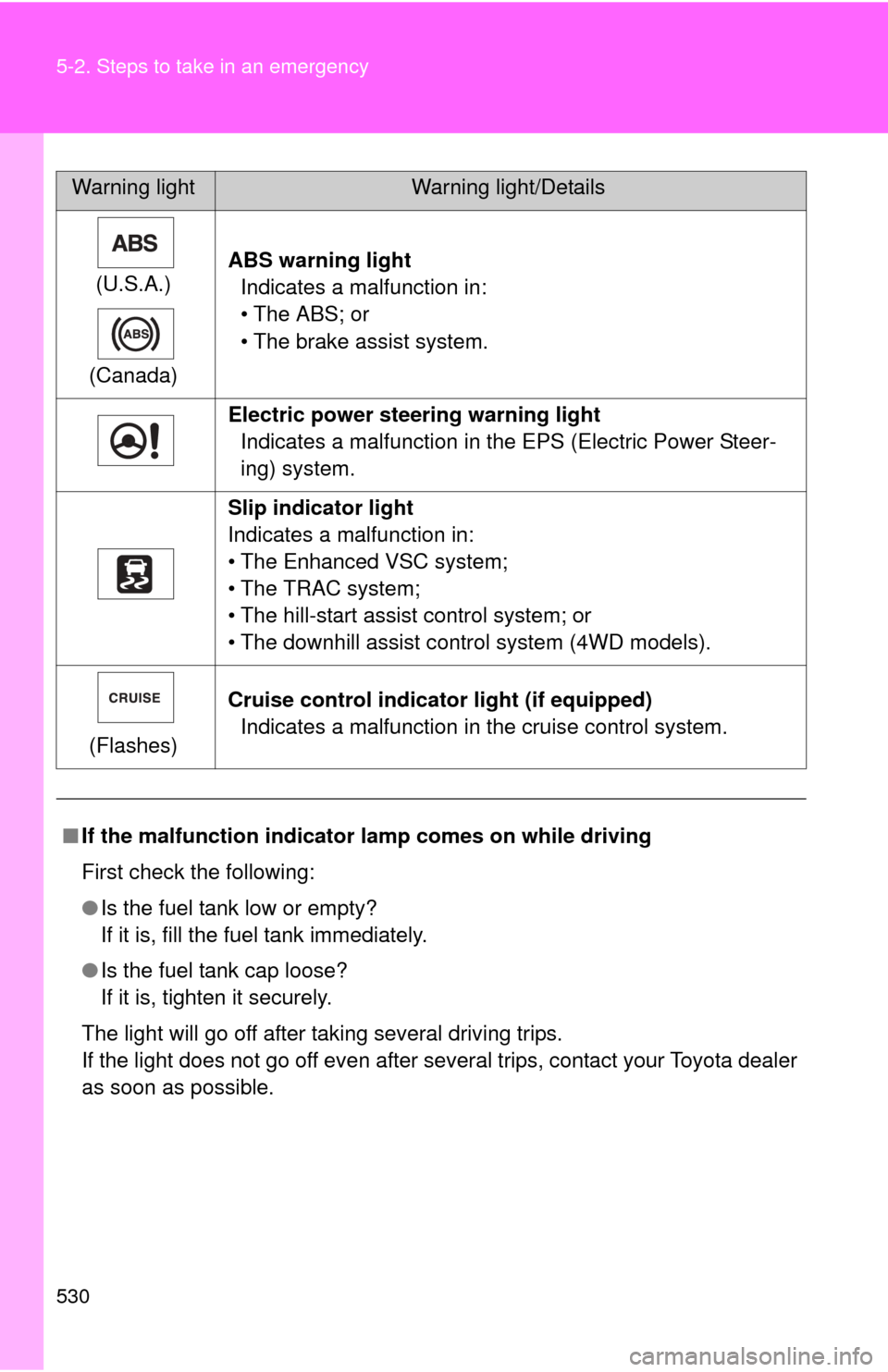
(U.S.A.)
(Canada) ABS warning light
Indicates a malfunction in:
• The ABS; or
• The brake assist system.
Electric power steering warning light Indicates a malfunction in the EPS (Electric Power Steer-
ing) system.
Slip indicator light
Indicates a malfunction in:
• The Enhanced VSC system;
• The TRAC system;
• The hill-start assist control system; or
• The downhill assist control system (4WD models).
(Flashes) Cruise control indicator
light (if equipped)
Indicates a malfunction in the cruise control system.
■ If the malfunction indicator lamp comes on while driving
First check the following:
● Is the fuel tank low or empty?
If it is, fill the fuel tank immediately.
● Is the fuel tank cap loose?
If it is, tighten it securely.
The light will go off after taking several driving trips.
If the light does not go off even after several trips, contact your Toyota dealer
as soon as possible.
Warning lightWarning light/Details
Page 537 of 636

5
When trouble arises
537
5-2. Steps to take in an emergency
CAUTION
■If the tire pressure warning light comes on
Be sure to observe the following precautions. Failure to do so could
cause loss of vehicle control and result in death or serious injury.
●Stop your vehicle in a safe place as
soon as possible. Adjust the tire
inflation pressure immediately.
●If the tire pressure warning light comes on even after tire inflation pres-
sure adjustment, it is pr obable that you have a flat tire. Check the tires.
If the tire is flat, change to the spare tire and have the flat tire repaired
by the nearest Toyota dealer.
●Avoid abrupt maneuvering and braking. If the vehicle tires deteriorate,
you could lose control of the steering wheel or the brakes.
■If a blowout or sudden air leakage should occur
The tire pressure warning syste m may not activate immediately.
■Maintenance of the tires
Each tire, including the spare (if provided), should be checked monthly
when cold and inflated to the inflation pressure recommended by the
vehicle manufacturer on the vehicle placard or tire inflation pressure
label (tire and load information label). (If your vehicle has tires of a differ-
ent size than the size indicated on the vehicle placard or tire inflation
pressure label [tire and load information label], you should determine the
proper tire inflation pr essure for those tires.)
As an added safety feature, your vehicle has been equipped with a tire
pressure monitoring system (TPMS-ti re pressure warning system) that
illuminates a low tire pressure telltal e (tire pressure warning light) when
one or more of your tires is significantly under-inflated. Accordingly,
when the low tire pressure telltale (tire pre ssure warning light) illumi-
nates, you should stop and check your tires as soon as possible, and
inflate them to the proper pressure. Driving on a significantly under-
inflated tire causes the tire to overheat and can lead to tire failure.
Under-inflation also reduces fuel effi ciency and tire tread life, and may
affect the vehicle's hand ling and stopping ability.
Page 554 of 636
554
5-2. Steps to take in an emergency
If the engine will not star t
If the engine still does not start after following the correct starting
procedure (P. 170, 174) or releasing the steering lock ( P. 172,
175), confirm the fo llowing points.
■The engine will not start even when the starter motor oper-
ates normally.
One of the following may be the cause of the problem.
●There may not be sufficient fuel in the vehicle’s tank.
Refuel the vehicle.
● The engine may be flooded.
Try to restart the engine once more following correct starting
procedures. ( P. 170, 174)
● There may be a malfunction in the engine immobilizer system
(if equipped). ( P. 11 3 )
■ The starter motor turns over slowly, the interior lights and
headlights are dim, or the horn does not sound or sounds at
a low volume.
One of the following may be the cause of the problem.
●The battery may be discharged. ( P. 560)
● The battery terminal connec tions may be loose or corroded.
■ The starter motor does not turn over (vehicles with smart
key system).
The engine starting system may be malfunctioning due to an
electrical problem such as an open circuit or a blown fuse. How-
ever, an interim measure is available to start the engine.
( P. 555)