Page 579 of 700
5
When trouble arises
579
5-1. Essential information
4RUNNER_U
If your vehicle needs to be towed
Before towingThe following may indicate a problem with your transmission. Contact
your Toyota dealer before towing.
● The engine is running but the vehicle will not move.
● The vehicle makes an abnormal sound.
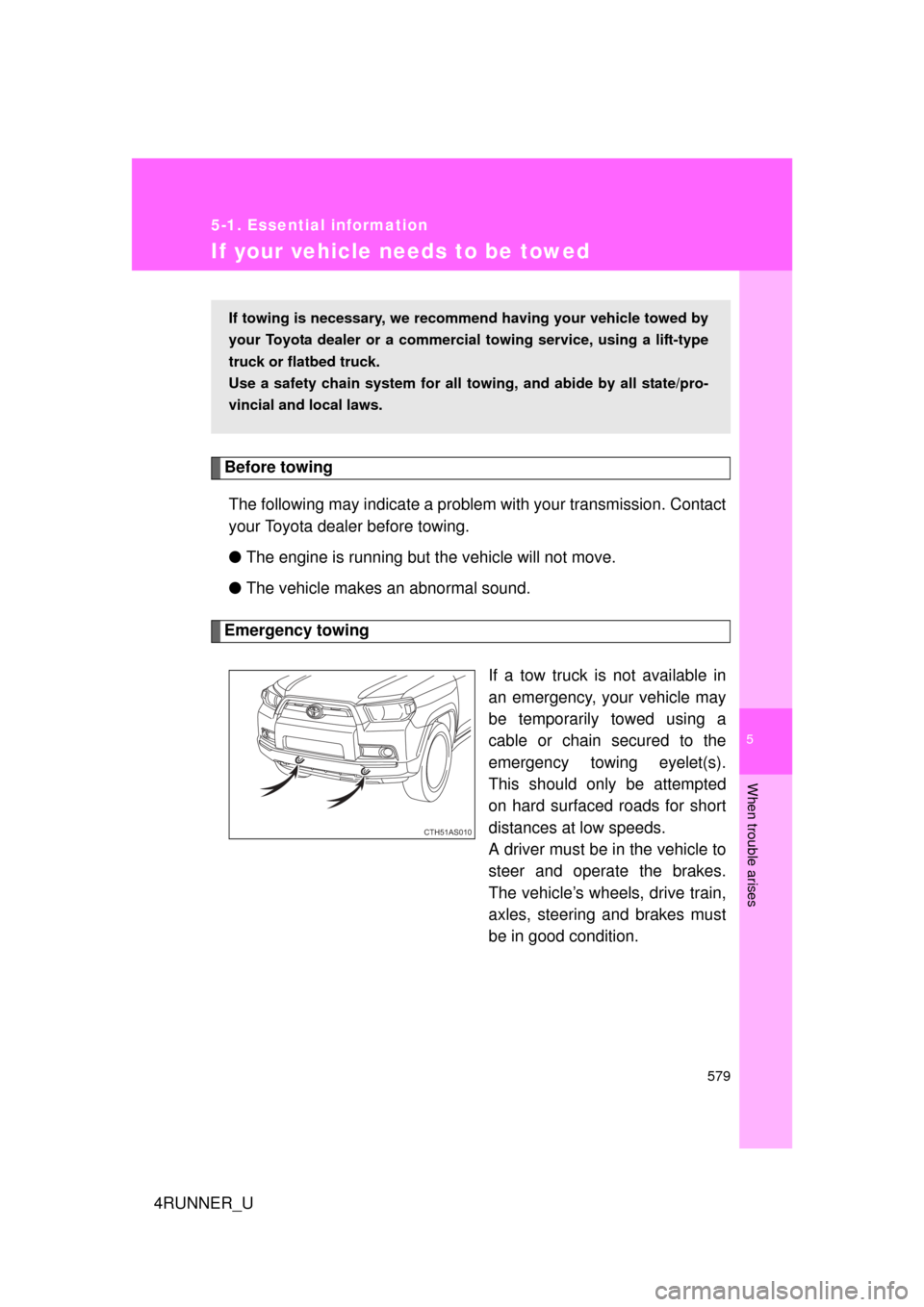
Emergency towing
If a tow truck is not available in
an emergency, your vehicle may
be temporarily towed using a
cable or chain secured to the
emergency towing eyelet(s).
This should only be attempted
on hard surfaced roads for short
distances at low speeds.
A driver must be in the vehicle to
steer and operate the brakes.
The vehicle’s wheels, drive train,
axles, steering and brakes must
be in good condition.
If towing is necessary, we recommend having your vehicle towed by
your Toyota dealer or a commerci al towing service, using a lift-type
truck or flatbed truck.
Use a safety chain system for all to wing, and abide by all state/pro-
vincial and local laws.
CTH51AS010
Page 581 of 700
5
When trouble arises
581
5-1. Essential information
4RUNNER_U
Towing with a wheel lift-type truck
From the front Use a towing dolly under the rear
wheels.
From the rear (2WD models) Vehicles without a smart key
system: Turn the engine switch
to the “ACC” position so that the
steering wheel is unlocked.
Vehicles with a smart key sys-
tem: Turn the “ENGINE START
STOP” switch to ACCESSORY
mode so that the steering wheel
is unlocked.
From the rear (4WD models) Full-time 4WD models: Use a
towing dolly under the front
wheels.
Part-time 4WD models: When
not using a towing dolly, turn the
engine switch to the “ACC” posi-
tion, shift the shift lever to N and
shift the front-wheel drive control
lever to H2.
Page 582 of 700
582 5-1. Essential information
4RUNNER_U
Using a flatbed truckIf you use chains or cables to tie
down your vehicle, the angles
shaded in black must be 45.
Do not overly tighten the tie
downs or the vehicle may be
damaged.
CTH51AS011
■ Before emergency towing
Vehicles without a smart key system: Turn the engine switch to the
“ACC” (engine off) or “ON” position.
Vehicles with a smart key system: Turn the “ENGINE START STOP” switch to ACCESSORY (engine off) or IGNITION ON mode
(engine running).
Part-time 4WD models: Shift the front-wheel drive control lever to
H2.
Full-time 4WD models: Put the four-wheel drive control switch in
H4F. (The center differential is unlocked.)
Shift the shift lever to N.
Release the parking brake.
STEP 1
STEP 2
STEP 3
STEP 4
Page 583 of 700

5
When trouble arises
583
5-1. Essential information
4RUNNER_U
CAUTION
■
Caution while towing
● Use extreme caution when towing the vehicle.
Avoid sudden starts or erratic driving maneuvers which place excessive
stress on the emergency towing eyelets and the cables or chains. Always
be cautious of the surroundings and other vehicles while towing.
● Vehicles with a smart key system: Do not turn the “ENGINE START
STOP” switch off.
Doing so will lock the steering wheel and prevent operation, possibly caus-
ing an accident and resulting in death or serious injury.
● If the engine is not running, the power assist for the brakes and steering
will not function, making steering and braking more difficult.
NOTICE
■To prevent causing serious damage to the transmission and transfer
(4WD models) when towing using a wheel-lift type truck
2WD models: Never tow this vehicle from the front with the rear wheels on
the ground.
4WD models: Never tow this vehicle with any of the wheels in contact with
the ground.
■ To prevent damage to the vehicle when towing using a wheel-lift type
truck
● 2WD models without a smart key system: Do not tow the vehicle from the
rear when the engine switch is in the “LOCK” position or the key is
removed. The steering lock mechanism is not strong enough to hold the
front wheels straight.
● 2WD models with a smart key system: Do not tow the vehicle from the rear
when the “ENGINE START STOP” switch is off. The steering lock mecha-
nism is not strong enough to hold the front wheels straight.
● When raising the vehicle, ensure adequate ground clearance for towing at
the opposite end of the raised vehicle. Without adequate clearance, the
vehicle could be damaged while being towed.
Page 584 of 700
584 5-1. Essential information
4RUNNER_U
NOTICE
■To prevent body damage when towing with a sling-type truck
Do not tow with a sling-type truck, either from the front or rear.
■ To prevent causing serious damage to the transmission and transfer
(4WD models) in emergency towing
Never tow a vehicle from the rear with four wheels on the ground. This may
cause serious damage to the transmission and transfer.
Page 589 of 700
5
When trouble arises
589
5-2. Steps to take in an emergency
4RUNNER_U
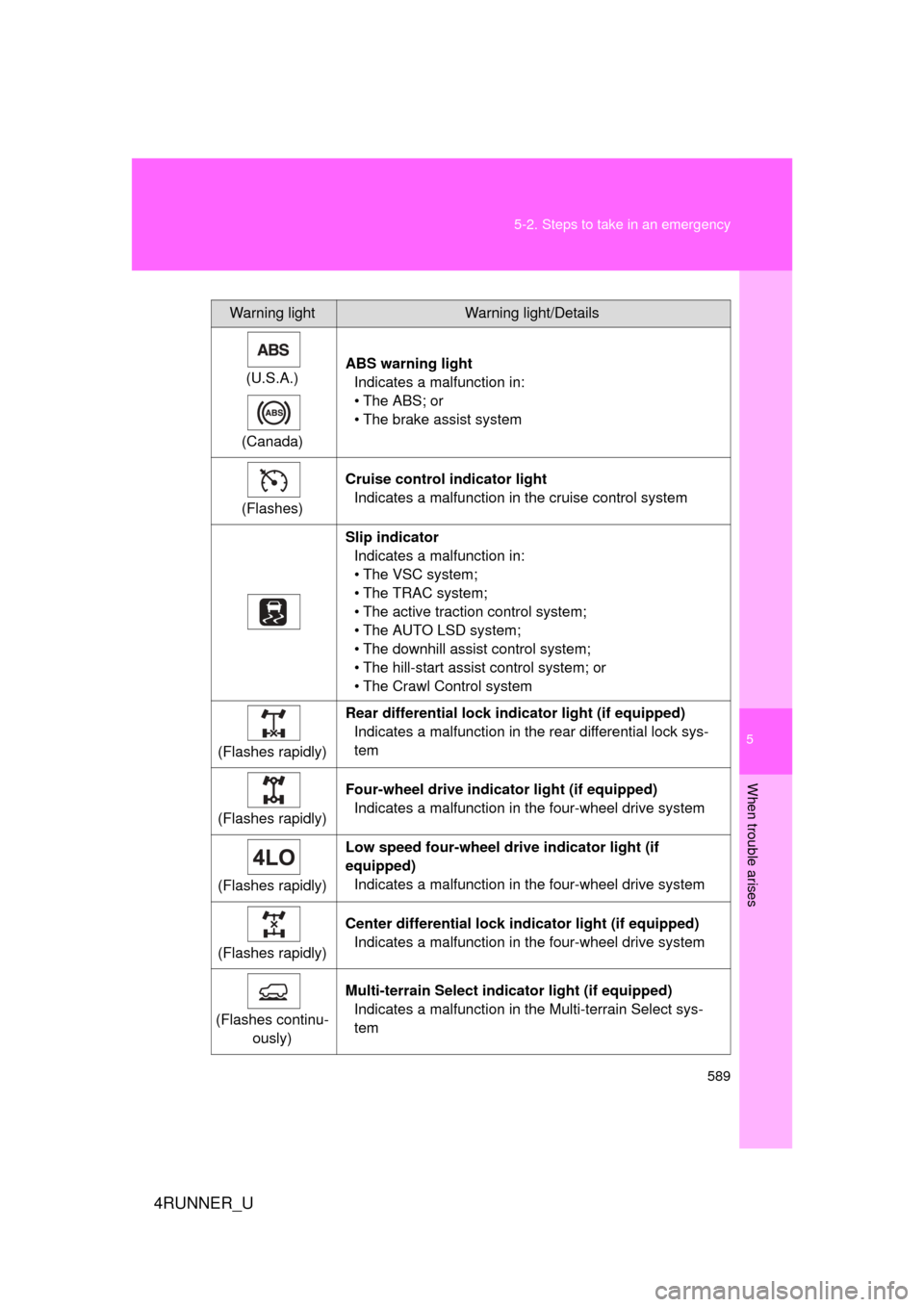
Warning lightWarning light/Details
(U.S.A.)
(Canada) ABS warning light
Indicates a malfunction in:
• The ABS; or
• The brake assist system
(Flashes) Cruise control indicator light
Indicates a malfunction in the cruise control system
Slip indicator Indicates a malfunction in:
• The VSC system;
• The TRAC system;
• The active traction control system;
• The AUTO LSD system;
• The downhill assist control system;
• The hill-start assist control system; or
• The Crawl Control system
(Flashes rapidly) Rear differential lock indicator light (if equipped)
Indicates a malfunction in the rear differential lock sys-
tem
(Flashes rapidly) Four-wheel drive indicator light (if equipped)
Indicates a malfunction in the four-wheel drive system
(Flashes rapidly) Low speed four-wheel drive indicator light (if
equipped)
Indicates a malfunction in the four-wheel drive system
(Flashes rapidly) Center differential lock indicator light (if equipped)
Indicates a malfunction in the four-wheel drive system
(Flashes continu- ously) Multi-terrain Select indicator light (if equipped)
Indicates a malfunction in the Multi-terrain Select sys-
tem
Page 599 of 700

5
When trouble arises
599
5-2. Steps to take in an emergency
4RUNNER_U
■If the tire pressure warning system is not functioning
The tire pressure warning system will be disabled in the following condi-
tions:
(When the condition be
comes normal, the system will work properly.)
●If tires not equipped with tire pressure warning valves and transmit-
ters are used
●If the ID code on the tire pressure warning valves and transmitters is
not registered in the tire pressure warning computer
●If the tire inflation pressure is 73 psi (500 kPa, 5.1 kgf/cm2 or bar) or
higher
The tire pressure warning system may be disabled in the following condi-
tions:
(When the condition be comes normal, the system will work properly.)
●If electronic devices or facilities using similar radio wave frequencies
are nearby
●If a radio set at a similar frequency is in use in the vehicle
●If a window tint that affects the radio wave signals is installed
●If there is a lot of snow or ice on the vehicle, particularly around the
wheels or wheel housings
●If non-genuine Toyota wheels are used (Even if you use Toyota
wheels, the tire pressure warning system may not work properly with
some types of tires.)
●If tire chains are used
■If the tire pressure warning light frequently comes on after blinking
for 1 minute
If the tire pressure warning light frequently comes on after blinking for 1
minute when the “ENGINE START STOP ” switch (vehicles with a smart
key system) or the engine switch (veh icles without a smart key system)
is turned on, have it che cked by your Toyota dealer.
■Customization that can be co nfigured at Toyota dealer
The vehicle speed linked seat belt reminder buzzer can be disabled.
(Customizable features P. 660) However, Toyota recommends that the
seat belt reminder buzzer be operational to alert the driver and front passen-
ger when seat belts are not fastened.
Page 600 of 700
600 5-2. Steps to take in an emergency
4RUNNER_U
CAUTION
■If the tire pressure warning light comes on
Be sure to observe the following precautions. Failure to do so could
cause a loss of vehicle control and result in death or serious injury.
●Stop your vehicle in a safe place as soon as possible. Adjust the tire
inflation pressure immediately.
●If the tire pressure warning light comes on even after tire inflation pres-
sure adjustment, it is pr obable that you have a flat tire. Check the tires.
If a tire is flat, change it with th e spare tire and have the flat tire
repaired by the nearest Toyota dealer.
●Avoid abrupt maneuvering and braking. If the vehicle tires deteriorate,
you could lose control of the steering wheel or the brakes.
■If a blowout or sudden air leakage should occur
The tire pressure warning syste m may not activate immediately.