Page 630 of 700

630
5-2. Steps to take in an emergency
4RUNNER_U
If the vehicle becomes stuck
CAUTION
■When attempting to free a stuck vehicle
If you choose to push the vehicle back and forth to free it, make sure the sur-
rounding area is clear to avoid striking other vehicles, objects or people. The
vehicle may also lunge forward or lunge back suddenly as it becomes free.
Use extreme caution.
■ When shifting the shift lever
Be careful not to shift the shift lever with the accelerator pedal depressed.
This may lead to unexpected rapid acceleration of the vehicle that may
cause an accident resulting in death or serious injury.
NOTICE
■To avoid damage to the transmission and other components
● Avoid spinning the wheels and depressing the accelerator pedal more
than necessary.
● If the vehicle remains stuck even after these procedures are performed,
the vehicle may require towing to be freed.
Carry out the following procedures if the tires spin or the vehicle
becomes stuck in mud, dirt or snow:
Stop the engine. Set the parki ng brake and shift the shift
lever to P.
Remove the mud, snow or sand from around the stuck tire.
Place wood, stones or some other material under the tires
to help provide traction.
Restart the engine.
Shift the shift lever to the D or R position and carefully apply
the accelerator to free the vehicle.
Turn off TRAC and VSC if these functions are hampering your
attempts to free the vehicle. ( P. 268)
STEP 1
STEP 2
STEP 3
STEP 4
STEP 5
Page 632 of 700
632 5-2. Steps to take in an emergency
4RUNNER_U
CAUTION
■If the engine has to be turned off while driving
● Power assist for the brakes and steering wheel will be lost, making the
brake pedal harder to depress and the steering wheel heavier to turn.
Decelerate as much as possible before turning off the engine.
● Vehicles without a smart key system: Never attempt to remove the key, as
doing so will lock the steering wheel.
Vehicles with a smart key sys-
tem: Stop the engine by press-
ing and holding the “ENGINE
START STOP” switch for 3
consecutive seconds or more.
Stop the vehicle in a safe place by the road.
Press and hold for 3 seconds or more
STEP 4
STEP 5
Page 634 of 700
634
4RUNNER_U
6-1. Specifications
Maintenance data (fuel, oil level, etc.)
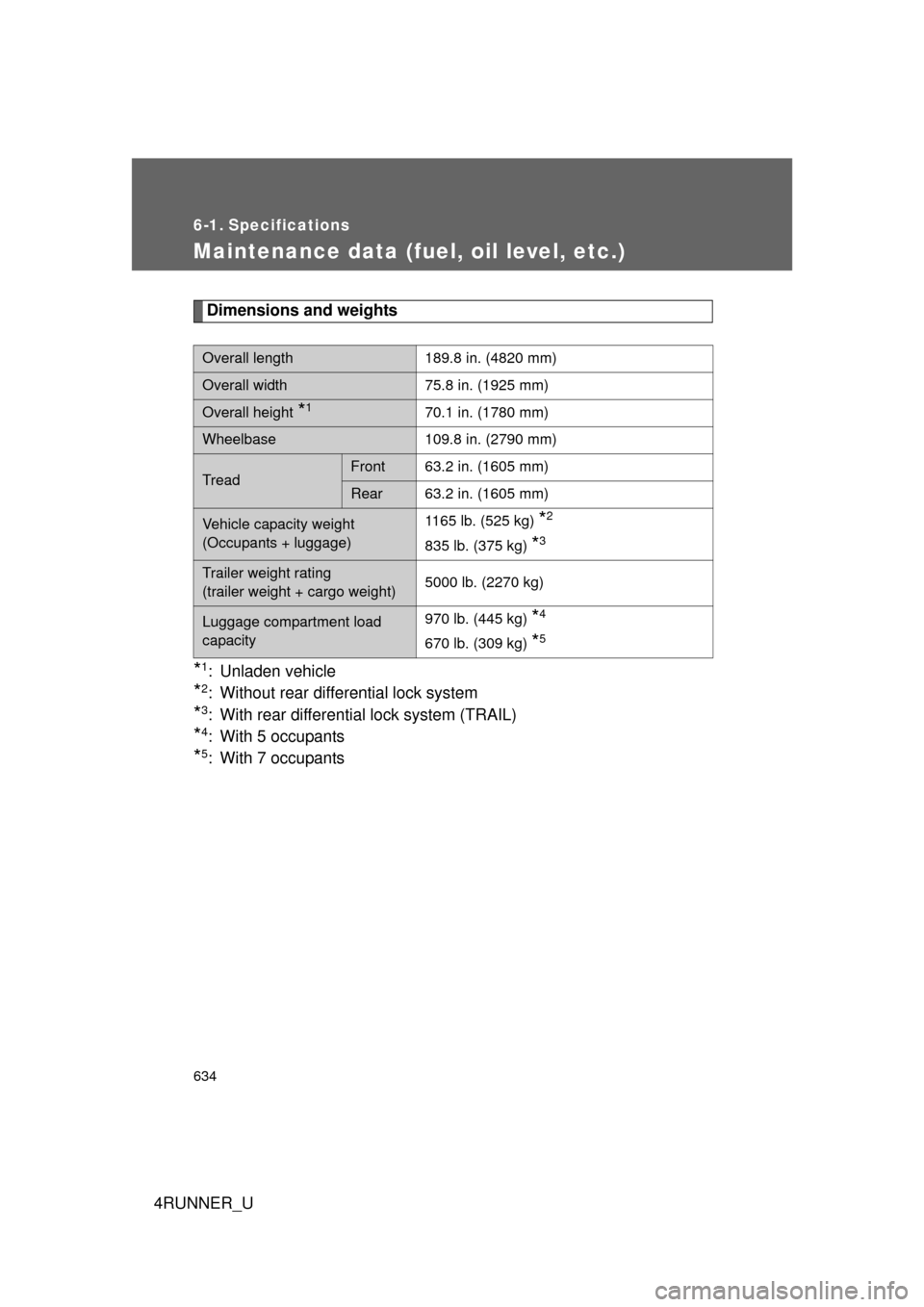
Dimensions and weights
*1: Unladen vehicle
*2: Without rear differential lock system
*3: With rear differential lock system (TRAIL)
*4: With 5 occupants
*5: With 7 occupants
Overall length189.8 in. (4820 mm)
Overall width75.8 in. (1925 mm)
Overall height *170.1 in. (1780 mm)
Wheelbase109.8 in. (2790 mm)
TreadFront63.2 in. (1605 mm)
Rear63.2 in. (1605 mm)
Vehicle capacity weight
(Occupants + luggage)1165 lb. (525 kg) *2
835 lb. (375 kg) *3
Trailer weight rating
(trailer weight + cargo weight)5000 lb. (2270 kg)
Luggage compartment load
capacity970 lb. (445 kg) *4
670 lb. (309 kg) *5
Page 643 of 700
643
6-1. Specifications
6
Vehicle specifications
4RUNNER_U
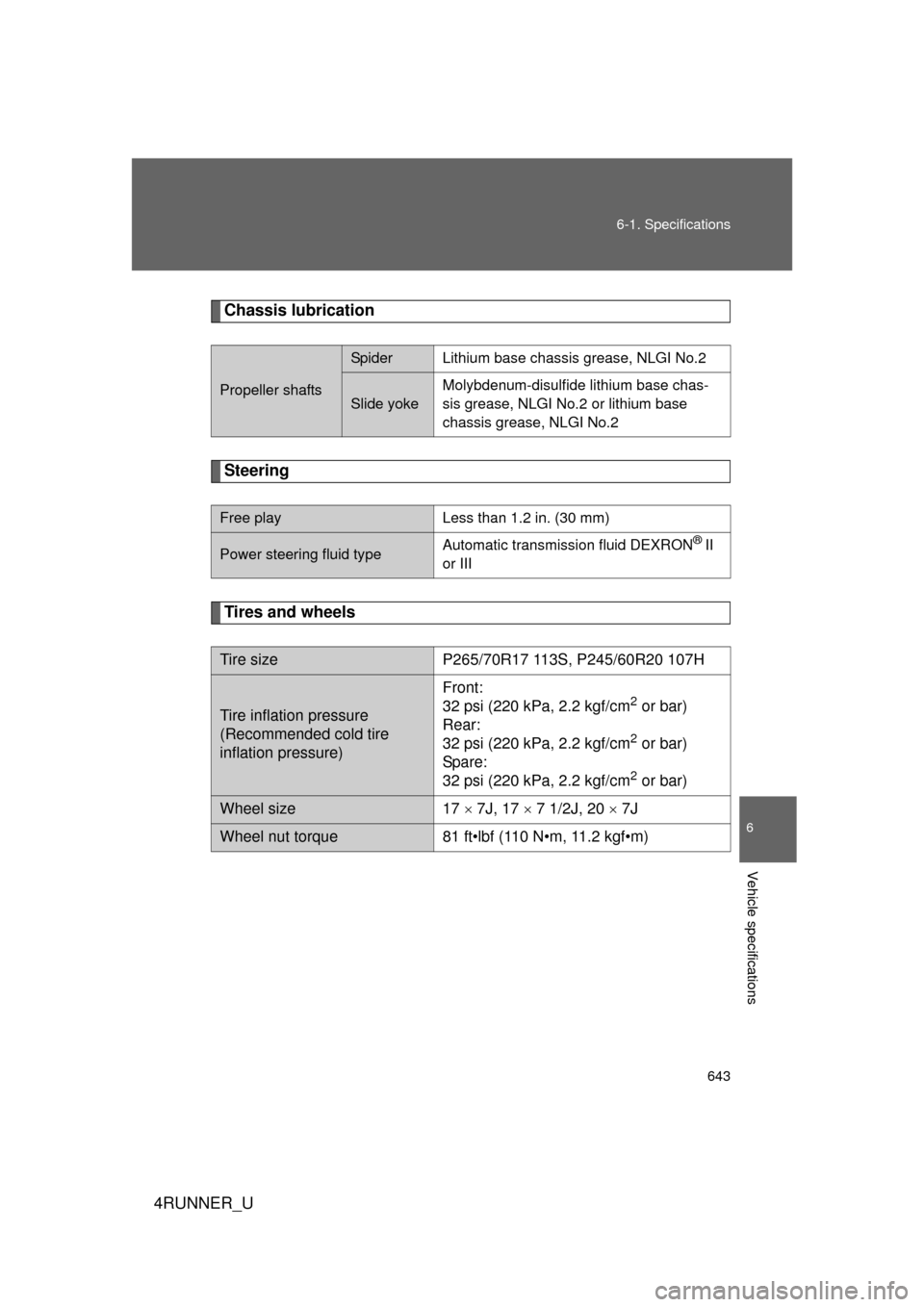
Chassis lubrication
Steering
Tires and wheels
Propeller shafts
SpiderLithium base chassis grease, NLGI No.2
Slide yoke
Molybdenum-disulfide lithium base chas-
sis grease, NLGI No.2 or lithium base
chassis grease, NLGI No.2
Free playLess than 1.2 in. (30 mm)
Power steering fluid typeAutomatic transmission fluid DEXRON® II
or III
Tire sizeP265/70R17 113S, P245/60R20 107H
Tire inflation pressure
(Recommended cold tire
inflation pressure)
Front:
32 psi (220 kPa, 2.2 kgf/cm2 or bar)
Rear:
32 psi (220 kPa, 2.2 kgf/cm
2 or bar)
Spare:
32 psi (220 kPa, 2.2 kgf/cm
2 or bar)
Wheel size17 7J, 17 7 1/2J, 20 7J
Wheel nut torque81 ft•lbf (110 N•m, 11.2 kgf•m)
Page 650 of 700
650 6-1. Specifications
4RUNNER_U
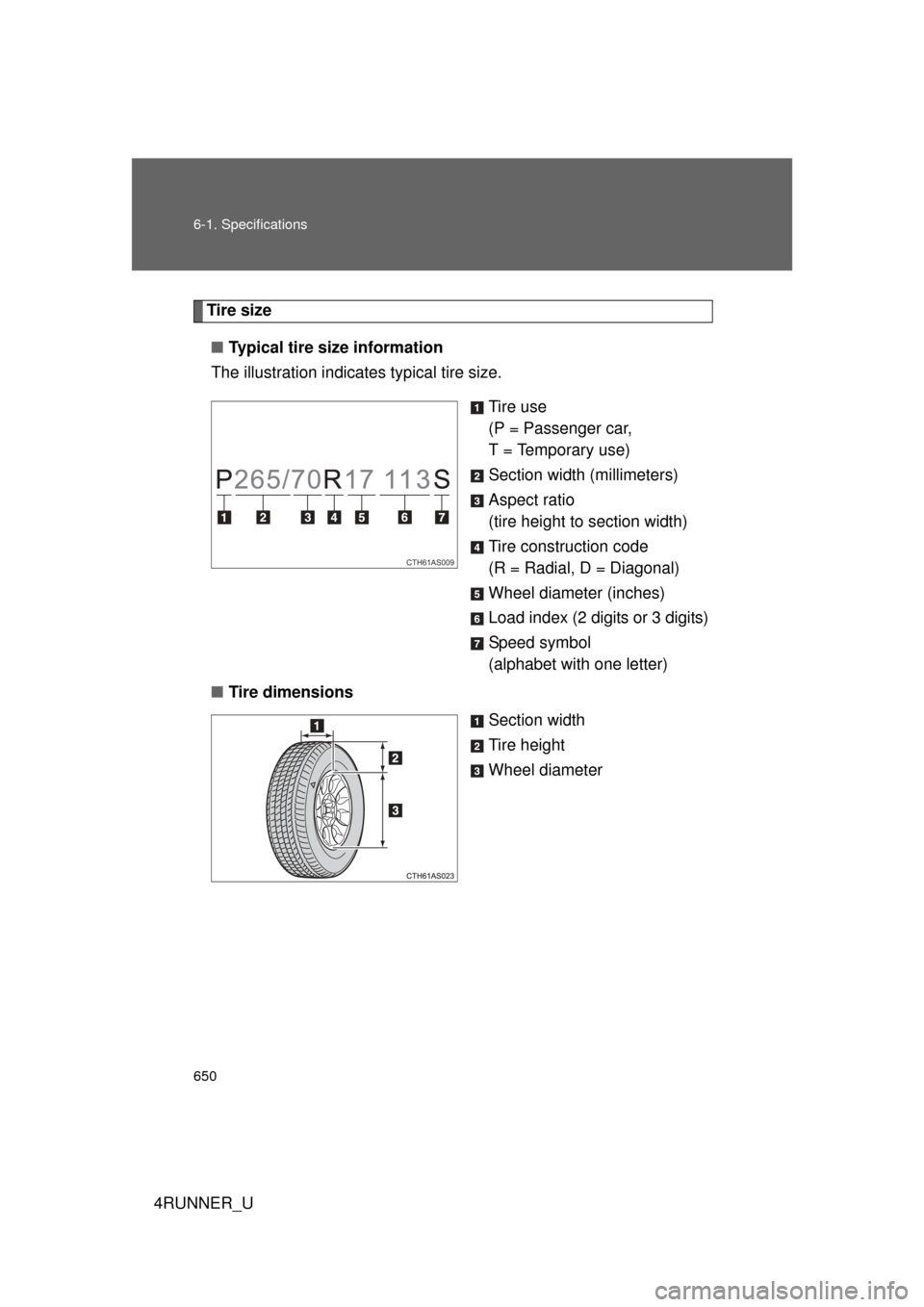
Tire size■ Typical tire size information
The illustration indicates typical tire size.
Tire use
(P = Passenger car,
T = Temporary use)
Section width (millimeters)
Aspect ratio
(tire height to section width)
Tire construction code
(R = Radial, D = Diagonal)
Wheel diameter (inches)
Load index (2 digits or 3 digits)
Speed symbol
(alphabet with one letter)
■ Tire dimensions
Section width
Tire height
Wheel diameter
CTH61AS009
Page 652 of 700

652 6-1. Specifications
4RUNNER_U■
Treadwear
The treadwear grade is a comparative rating based on the wear
rate of the tire when tested under controlled conditions on a speci-
fied government test course.
For example, a tire graded 150 would wear one and a half (1 - 1/2)
times as well on the government course as a tire graded 100.
The relative performance of tires depends upon the actual conditions
of their use. Performance may diff er significantly from the norm due
to variations in driving habits, service practices and differences in
road characteristics and climate.
■ Traction AA, A, B, C
The traction grades, from highest to lowest, are AA, A, B and C,
and they represent the tire’s ab ility to stop on wet pavement as
measured under controlled cond itions on specified government
test surfaces of asphalt and concrete.
A tire marked C may have poor traction performance.
Warning: The traction grade assigned to this tire is based on braking
(straight ahead) traction tests and does not include cornering (turn-
ing) traction.
■ Temperature A, B, C
The temperature grades are A (the highest), B, and C, represent-
ing the tire’s resistance to the generation of heat and its ability to
dissipate heat when tested under controlled conditions on a speci-
fied indoor laboratory test wheel.
Sustained high temperature can cause the material of the tire to
degenerate and reduce tire life, and excessive temperature can lead
to sudden tire failure.
Grade C corresponds to a level of performance which all passenger
car tires must meet under the Federal Motor Vehicle Safety Standard
No. 109.
Grades B and A represent higher levels of performance on the labo-
ratory test wheel than the minimum required by law.
Page 654 of 700

654 6-1. Specifications
4RUNNER_U
Tire related termMeaning
Normal occupant
weight 150 lb. (68 kg) times the number of occupants
specified in the second column of Table 1
* that
follows
Occupant distribution Distribution of occupants in a vehicle as speci-
fied in the third column of Table 1
* below
Production options
weight The combined weight of installed regular pro-
duction options weighing over 5 lb. (2.3 kg) in
excess of the standard items which they
replace, not previously considered in curb
weight or accessory weight, including heavy
duty brakes, ride levelers, roof rack, heavy duty
battery, and special trim
Rim A metal support for a tire or a tire and tube
assembly upon which the tire beads are seated
Rim diameter
(Wheel diameter) Nominal diameter of the bead seat
Rim size designation Rim diameter and width
Rim type designation The industry manufacturer’s designation for a
rim by style or code
Rim width Nominal distance between rim flanges
Vehicle capacity
weight (Total load
capacity) The rated cargo and luggage load plus 150 lb.
(68 kg) times the vehicle’s designated seating
capacity
Vehicle maximum load
on the tire The load on an individual tire that is determined
by distributing to each axle its share of the
maximum loaded vehicle weight, and dividing
by two
Page 657 of 700

657
6-1. Specifications
6
Vehicle specifications
4RUNNER_U
Tire related termMeaning
Overall width The linear distance between the exteriors of
the sidewalls of an inflated tire, including eleva-
tions due to labeling, decorations, or protective
bands or ribs
Passenger car tire A tire intended for use on passenger cars, mul-
tipurpose passenger vehicles, and trucks, that
have a gross vehicle weight rating (GVWR) of
10,000 lb. or less.
Ply A layer of rubber-coated parallel cords
Ply separation A parting of rubber compound between adja-
cent plies
Pneumatic tire A mechanical device made of rubber, chemi-
cals, fabric and steel or
other materials, that,
when mounted on an automotive wheel, pro-
vides the traction and contains the gas or fluid
that sustains the load
Radial ply tire A pneumatic tire in which the ply cords that
extend to the beads are laid at substantially 90
degrees to the centerline of the tread
Reinforced tire A tire designed to operate at higher loads and
at higher inflation pressures than the corre-
sponding standard tire
Section width The linear distance between the exteriors of
the sidewalls of an inflated tire, excluding ele-
vations due to labeling, decoration, or protec-
tive bands
Sidewall That portion of a tire between the tread and
bead
Sidewall separation The parting of the rubber compound from the
cord material in the sidewall