2012 RENAULT CLIO SPORT TOURER check engine
[x] Cancel search: check enginePage 175 of 264
JauneNoirNoir texte
4.3
ENG_UD22329_5
Capot moteur (X85 - B85 - C85 - S85 - K85 - Renault)
ENG_NU_853-8_BCSK85_Renault_4
BONNET (2/2)
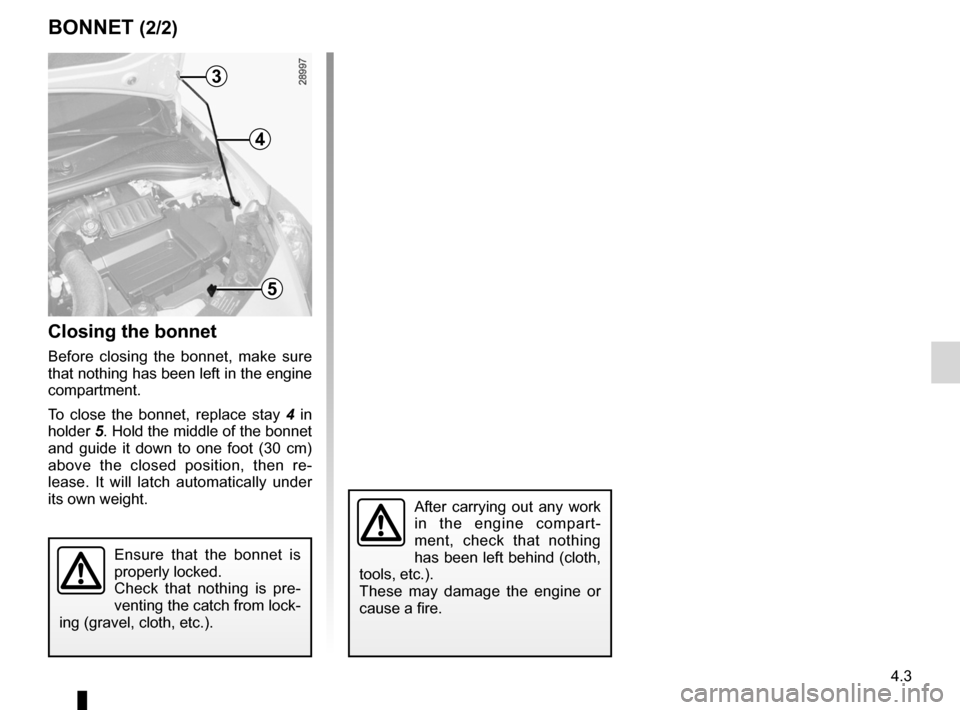
Closing the bonnet
Before closing the bonnet, make sure
that nothing has been left in the engine
compartment.
To close the bonnet, replace stay 4 in
holder 5. Hold the middle of the bonnet
and guide it down to one foot (30 cm)
above the closed position, then re -
lease. It will latch automatically under
its own weight.
Ensure that the bonnet is
properly locked.
Check that nothing is pre -
venting the catch from lock-
ing (gravel, cloth, etc.).
3
4
5
After carrying out any work
in the engine compart -
ment, check that nothing
has been left behind (cloth,
tools, etc.).
These may damage the engine or
cause a fire.
Page 176 of 264
maintenance:mechanical ...................................... (up to the end of the DU)
engine oil level ...................................... (up to the end of the DU)
engine oil .............................................. (up to the end of the DU)
4.4
ENG_UD22490_3
Niveau huile moteur : généralités (X85 - B85 - C85 - S85 - K85\
- Renault)
ENG_NU_853-8_BCSK85_Renault_4
Jaune NoirNoir texte
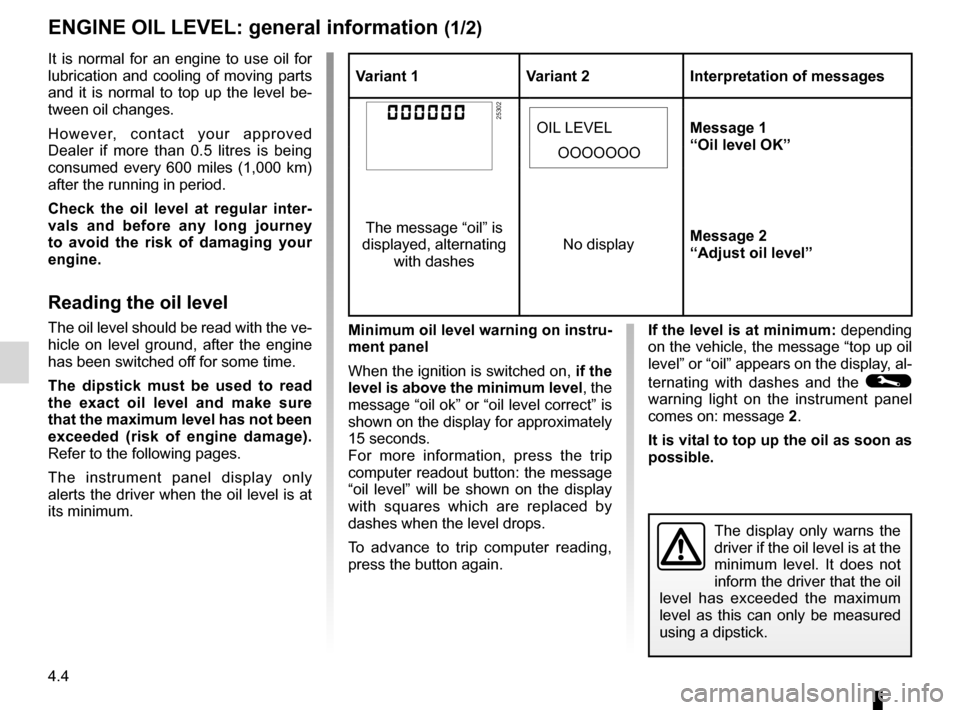
Variant 1 Variant 2Interpretation of messages
25302Message 1
“Oil level OK”
OIL LEVEL
OOOOOOO
The message “oil” is
displayed, alternating with dashes No display
Message 2
“Adjust oil level”
If the level is at minimum: depending
on the vehicle, the message “top up oil
level” or “oil” appears on the display, al-
ternating with dashes and the
©
warning light on the instrument panel
comes on: message 2.
It is vital to top up the oil as soon as
possible.
Engine oil level: general information
The display only warns the
driver if the oil level is at the
minimum level. It does not
inform the driver that the oil
level has exceeded the maximum
level as this can only be measured
using a dipstick.
Minimum oil level warning on instru-
ment panel
When the ignition is switched on, if the
level is above the minimum level, the
message “oil ok” or “oil level correct” is
shown on the display for approximately
15 seconds.
For more information, press the trip
computer readout button: the message
“oil level” will be shown on the display
with squares which are replaced by
dashes when the level drops.
To advance to trip computer reading,
press the button again.
It is normal for an engine to use oil for
lubrication and cooling of moving parts
and it is normal to top up the level be-
tween oil changes.
However, contact your approved
Dealer if more than 0.5 litres is being
consumed every 600 miles (1,000 km)
after the running in period.
Check the oil level at regular inter
-
vals and before any long journey
to avoid the risk of damaging your
engine.
Reading the oil level
The oil level should be read with the ve-
hicle on level ground, after the engine
has been switched off for some time.
The dipstick must be used to read
the exact oil level and make sure
that the maximum level has not been
exceeded (risk of engine damage).
Refer to the following pages.
The instrument panel display only
alerts the driver when the oil level is at
its minimum.
ENGINE OIL LEVEL: general information (1/2)
Page 178 of 264

ENG_NU_853-8_BCSK85_Renault_4
Jaune NoirNoir texte
Engine oil level: topping up, filling
Topping")
4.6
ENG_UD24922_4
Niveau huile moteur : appoint, remplissage (X85 - B85 - C85 - S85 - K85\
- Renault)
ENG_NU_853-8_BCSK85_Renault_4
Jaune NoirNoir texte
Engine oil level: topping up, filling
Topping up/filling
The vehicle must be parked on level
ground and the engine should be cold
(for instance, before the engine is
started up for the first time in the day). –
Unscrew cap 1;
– top up the level (as a guide, the ca-
pacity between the minimum and
maximum reading on the dipstick 2
is between 1.5 and 2 litres, depend-
ing on the engine);
– wait for approximately 10 minutes to
allow the oil to flow into the engine;
– check the level using the dipstick 2
(as described above).
Once the operation has been com -
pleted, ensure that the dipstick is
pushed in as far as it will go and that
the cap is completely screwed in.
ENGINE OIL LEVEL: topping up/filling (1/2)
1
2
Do not exceed the max level and
do not forget to refit cap 1 and dip-
stick 2.
In order to prevent splashback, it is
recommended that a funnel be used
when topping up/filling with oil.
1
2
Page 180 of 264

levels .................................................... (up to the end of the DU)
engine coolant ....................................................... (current page)
tanks and reservoirs coolant ............................................................. (current page)
levels: coolant ............................................................. (current page)
4.8
ENG_UD19908_3
Niveau / Filtres (X85 - B85 - C85 - S85 - K85 - Renault)
ENG_NU_853-8_BCSK85_Renault_4
Jaune NoirNoir texte
Frequency of checking coolant level
Check the coolant level regularly
(very severe damage is likely to be
caused to the engine if it runs out of
coolant).
If the level needs to be topped up, only
use products approved by our Technical
Department which ensure:
– protection against freezing;
– an anti-corrosion protection for the
cooling system.
Levels
engine coolant
Consult your approved dealer at
once if you notice an abnormal or
repeated drop in any of the fluid
levels.
No operations should be
carried out on the cooling
circuit when the engine is
hot.
Risk of burns.
Replacement interval
Refer to the Maintenance Service
Booklet for your vehicle.
Coolant level
With the engine switched off and on
level ground, the level when cold must
be between the MINI and MAXI marks
on reservoir 1.
Top this level up when cold before it
reaches the MINI mark.
LEVELS (1/3)
1
When working in the engine
compartment, ensure that
the windscreen wiper stalk
is in the park position.
Risk of injury.
Page 181 of 264
brake fluid .............................................................. (current page)
levels: brake fluid ........................................................ (current page)
tanks and reservoirs brake fluid ........................................................ (current page)
JauneNoirNoir texte
4.9
ENG_UD19908_3
Niveau / Filtres (X85 - B85 - C85 - S85 - K85 - Renault)
ENG_NU_853-8_BCSK85_Renault_4
brake fluid
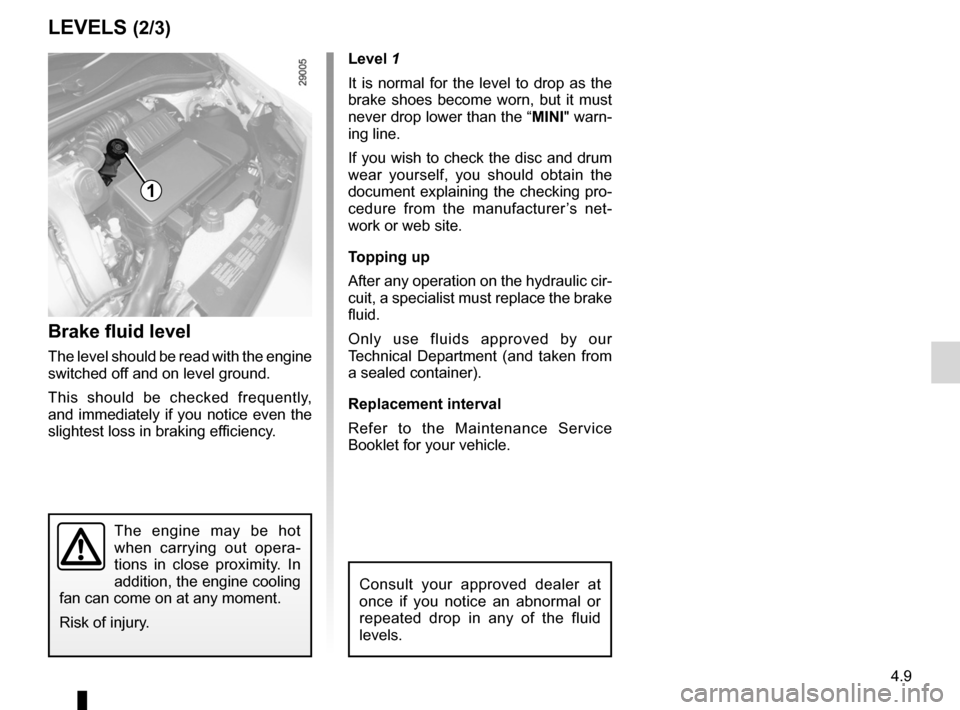
Level 1
It is normal for the level to drop as the
brake shoes become worn, but it must
never drop lower than the “MINI" warn-
ing line.
If you wish to check the disc and drum
wear yourself, you should obtain the
document explaining the checking pro-
cedure from the manufacturer ’s net -
work or web site.
Topping up
After any operation on the hydraulic cir-
cuit, a specialist must replace the brake
fluid.
Only use fluids approved by our
Technical Department (and taken from
a sealed container).
Replacement interval
Refer to the Maintenance Service
Booklet for your vehicle.
Brake fluid level
The level should be read with the engine
switched off and on level ground.
This should be checked frequently,
and immediately if you notice even the
slightest loss in braking efficiency.
LEVELS (2/3)
1
The engine may be hot
when carrying out opera -
tions in close proximity. In
addition, the engine cooling
fan can come on at any moment.
Risk of injury.
Consult your approved dealer at
once if you notice an abnormal or
repeated drop in any of the fluid
levels.
Page 206 of 264

ENG_NU_853-8_BCSK85_Renault_5
Additional cornering light
Due to their")
5.18
ENG_UD14672_3
Projecteurs avant avec lampes halogènes : remplacement des lampes (X\
85 - B85 - C85 - S85 - K85 - Renault)
ENG_NU_853-8_BCSK85_Renault_5
Additional cornering light
Due to their reduced accessibility
(sometimes requiring the removal of
bodywork or mechanical components),
we advise you to have your bulbs 7 re-
placed by an approved Dealer.
Bulb type: H7.
Front side light
Remove cover E, then pull bulb holder 6
to access the bulb.
Bulb type: W5W.
Direction indicator lights
Turn bulb holder F a quarter of a turn
and take out the bulb.
Bulb type: orange PY21 W.
Once the bulb has been replaced,
check that it is properly secured.
The bulbs are under pres -
sure and can break when
replaced.
Risk of injury.
HALOGEN HEADLIGHTS: changing bulbs (3/3)
The engine may be hot
when carrying out opera-
tions in close proximity. In
addition, the engine cooling
fan can come on at any moment.
Risk of injury.
To comply with local legislation, or
as a precaution, you can obtain an
emergency kit containing a set of
spare bulbs and fuses from an ap -
proved dealer.
E
6
F
7
Page 216 of 264
5.28
ENG_UD12592_2
Batterie : dépannage (X85 - B85 - C85 - S85 - K85 - Renault)
ENG_NU_853-8_BCSK85_Renault_5
Jaune NoirNoir texte
To avoid all risk of sparks:
– ensure that any consumers are
switched off before disconnecting or
reconnecting the battery;
– when charging, stop the charger
before connecting or disconnecting
the battery;
– to avoid creating a short circuit be -
tween the terminals, do not place
metal objects on the battery;
– always wait at least one minute after
the engine has been switched off
before disconnecting a battery;
– make sure that you reconnect the
battery terminals after refitting.
Battery
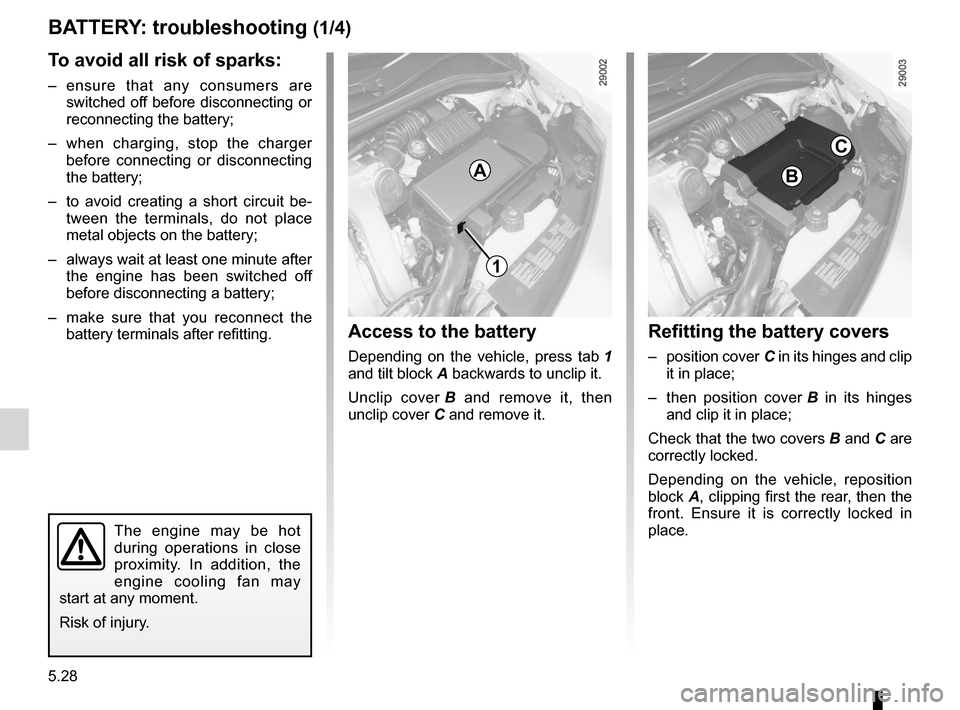
Refitting the battery covers
– position cover C in its hinges and clip
it in place;
– then position cover B in its hinges
and clip it in place;
Check that the two covers B and C are
correctly locked.
Depending on the vehicle, reposition
block A, clipping first the rear, then the
front. Ensure it is correctly locked in
place.
Access to the battery
Depending on the vehicle, press tab 1
and tilt block A backwards to unclip it.
Unclip cover B and remove it, then
unclip cover C and remove it.
BATTERY: troubleshooting (1/4)
AB
C
1
The engine may be hot
during operations in close
proximity. In addition, the
engine cooling fan may
start at any moment.
Risk of injury.
Page 217 of 264
JauneNoirNoir texte
5.29
ENG_UD12592_2
Batterie : dépannage (X85 - B85 - C85 - S85 - K85 - Renault)
ENG_NU_853-8_BCSK85_Renault_5
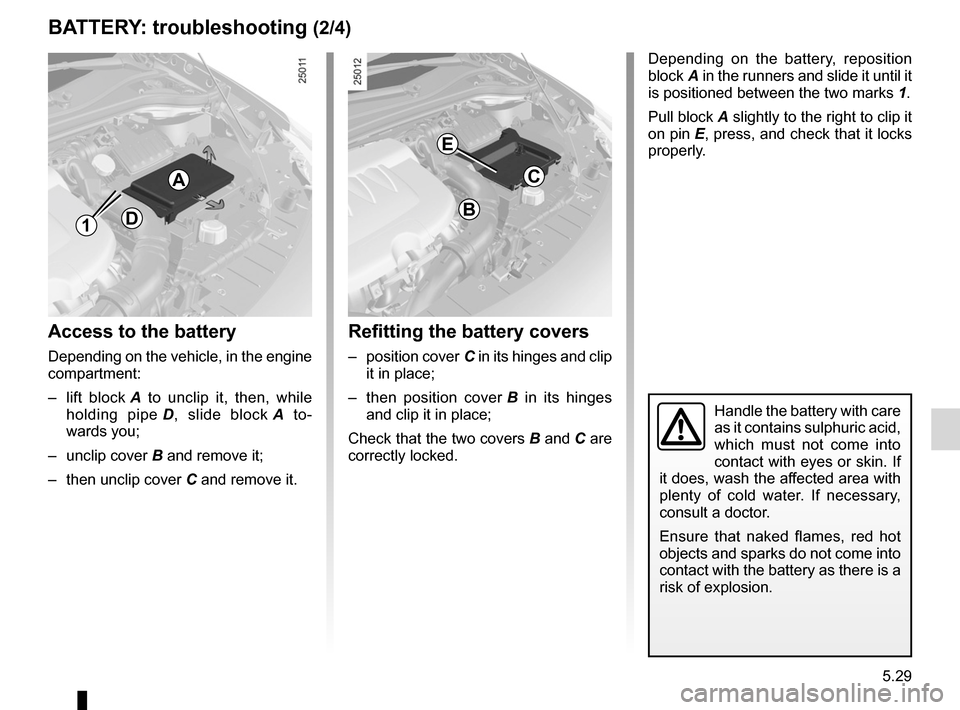
Depending on the battery, reposition
block A in the runners and slide it until it
is positioned between the two marks 1.
Pull block A slightly to the right to clip it
on pin E, press, and check that it locks
properly.
Refitting the battery covers
– position cover C in its hinges and clip
it in place;
– then position cover B in its hinges
and clip it in place;
Check that the two covers B and C are
correctly locked.
Access to the battery
Depending on the vehicle, in the engine
compartment:
– lift block A to unclip it, then, while
holding pipe D , slide block A to -
wards you;
– unclip cover B and remove it;
– then unclip cover C and remove it.
BATTERY: troubleshooting (2/4)
D
A
B
C
E
1
Handle the battery with care
as it contains sulphuric acid,
which must not come into
contact with eyes or skin. If
it does, wash the affected area with
plenty of cold water. If necessary,
consult a doctor.
Ensure that naked flames, red hot
objects and sparks do not come into
contact with the battery as there is a
risk of explosion.