2012 RENAULT CLIO SPORT TOURER check engine
[x] Cancel search: check enginePage 218 of 264
5.30
ENG_UD12592_2
Batterie : dépannage (X85 - B85 - C85 - S85 - K85 - Renault)
ENG_NU_853-8_BCSK85_Renault_5
Jaune NoirNoir texte
BATTERY: troubleshooting (3/4)
Special procedures may be
required to charge some
batteries. Contact your ap-
proved Dealer.
Avoid all risk of sparks which may
cause an immediate explosion and
charge the battery in a well-venti -
lated area. Risk of serious injury.
If your vehicle is to be left stationary for
a relatively long time, disconnect the
battery or have it recharged regularly,
particularly during cold weather. It will
then be necessary, with the engine run-
ning, to move the steering wheel slowly,
from lock to lock and to reprogram the
electronic equipment with a memory
feature, radio, etc. The battery should
be stored in a cool and dry location pro-
tected from frost.
Note: if you have disconnected or re -
charged a battery, move the steering
wheel slowly from lock to lock to reset
the system.
Have the battery’s charge status
checked regularly:
–
especially if you use your vehicle for
short journeys or for frequent driving
in town;
– when the exterior temperature drops
(in winter), the charge decreases .
In winter, only use the electrical
equipment that is really necessary;
– finally, you should understand that
the charge decreases naturally as a
result of certain permanent electrical
consumers such as the clock, after-
sales accessories, etc.
When many accessories are fitted to
the vehicle, have them connected to
the + after ignition feed. In this case, it
is advisable to have your vehicle fitted
with a battery which has an increased
nominal capacity. Contact an approved
Dealer.Connecting a battery charger
The battery charger must be com -
patible with a battery with nominal
voltage of 12 volts.
Switch the engine off and then discon -
nect both battery leads starting with
the negative terminal.
Do not disconnect the battery when the
engine is running. Follow the instruc-
tions given by the manufacturer for
the battery charger you are using.
Only a fully charged and well-main -
tained battery will have a long and
useful life and enable you to start the
vehicle’s engine normally.
The battery must be kept clean and dry.
Page 219 of 264
JauneNoirNoir texte
5.31
ENG_UD12592_2
Batterie : dépannage (X85 - B85 - C85 - S85 - K85 - Renault)
ENG_NU_853-8_BCSK85_Renault_5
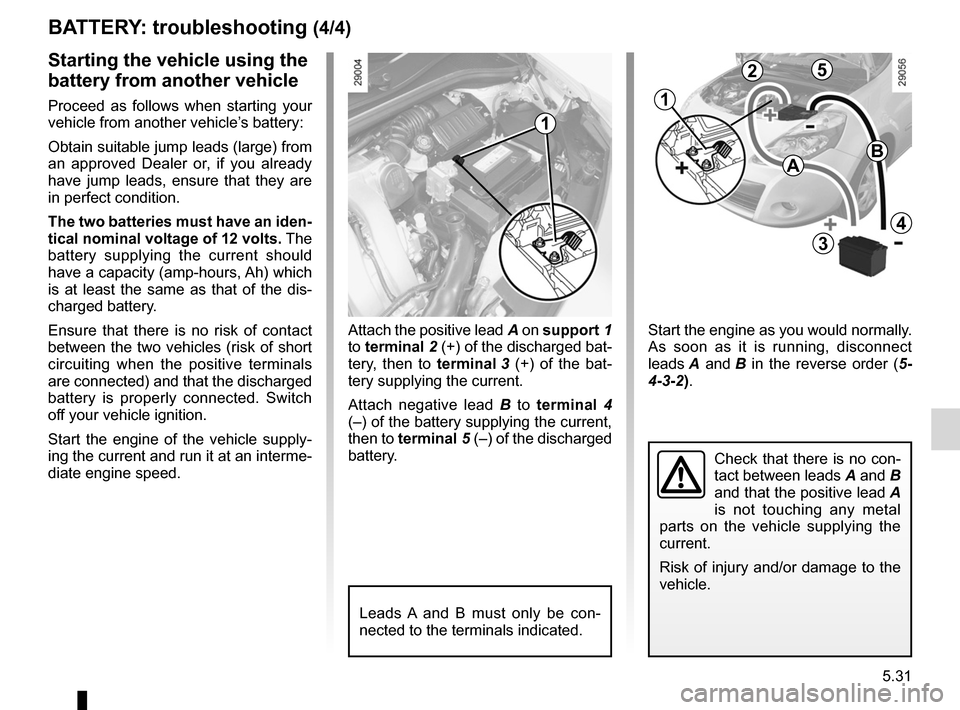
Start the engine as you would normally.
As soon as it is running, disconnect
leads A and B in the reverse order (5-
4-3-2).Attach the positive lead A on support 1
to terminal 2 (+) of the discharged bat-
tery, then to terminal 3 (+) of the bat -
tery supplying the current.
Attach negative lead B to terminal 4
(–) of the battery supplying the current,
then to terminal 5 (–) of the discharged
battery.
Starting the vehicle using the
battery from another vehicle
Proceed as follows when starting your
vehicle from another vehicle’s battery:
Obtain suitable jump leads (large) from
an approved Dealer or, if you already
have jump leads, ensure that they are
in perfect condition.
The two batteries must have an iden-
tical nominal voltage of 12 volts. The
battery supplying the current should
have a capacity (amp-hours, Ah) which
is at least the same as that of the dis-
charged battery.
Ensure that there is no risk of contact
between the two vehicles (risk of short
circuiting when the positive terminals
are connected) and that the discharged
battery is properly connected. Switch
off your vehicle ignition.
Start the engine of the vehicle supply -
ing the current and run it at an interme-
diate engine speed.
BATTERY: troubleshooting (4/4)
A
4
B
3
25
1
1
Leads A and B must only be con -
nected to the terminals indicated.
Check that there is no con-
tact between leads A and B
and that the positive lead A
is not touching any metal
parts on the vehicle supplying the
current.
Risk of injury and/or damage to the
vehicle.
Page 227 of 264
JauneNoirNoir texte
5.39
ENG_UD27405_4
Remorquage : dépannage (X85 - B85 - C85 - S85 - K85 - Renault)
ENG_NU_853-8_BCSK85_Renault_5
Towing a vehicle with an
automatic gearbox
With the engine switched off: the
transmission is no longer lubricated. It
is preferable to tow this type of vehi -
cle on a trailer or tow it with the front
wheels off the ground.
Under exceptional circumstances,
you may tow the vehicle with all four
wheels on the ground, only going
forward, with the gear lever in the
Neutral position, and for a distance
not exceeding 30 miles (50 km).
If the lever is stuck in P,
even though you are de -
pressing the brake pedal,
the lever can be released
manually.
To do this, unclip the upper section
of the cover at the base of the lever.
Press simultaneously on the mark
on the gaiter and the unlocking
button on the lever.
– Use a rigid towing bar.
If a rope or cable is used
(where the law allows this),
the vehicle being towed
must be able to brake.
– A vehicle must not be towed if it is
not fit to be driven.
– Avoid accelerating or braking
suddenly when towing, as this
may result in damage being
caused to the vehicle.
– When towing a vehicle, it is ad -
visable not to exceed 15 mph
(25 km/h).
– Do not push the vehicle if the
steering column is locked.
Towing procedure
Before any towing, check that the steer-
ing column is not locked.
If it is locked, insert the RENAULT card
into the reader and press the Start/Stop
button for five seconds without press-
ing on the pedals. The steering column
unlocks and the vehicle accessories
functions are supplied.
Leave the card in the reader while
towing.
Press the Start/Stop button twice in
succession once towing is finished (risk
of running down the battery).
TOWING: breakdown (2/3)
Do not leave the tools unse-
cured inside the vehicle as
they may come loose under
braking.
W h e n t h e e n g i n e i s
stopped, steering and brak-
ing assistance are not op -
erational.
Do not remove the key from
the ignition switch or the
card from the reader during
towing.
Page 232 of 264

5.44
ENG_UD13707_1
Anomalies de fonctionnement (L38 - X38 - Renault)
ENG_NU_853-8_BCSK85_Renault_5
Jaune NoirNoir texte
On the road POSSIBLE CAUSESACTION REQUIRED
White smoke from the exhaust. This is not necessarily a fault. Smoke
may be caused by regeneration of the
particle filter.Refer to the information on “Special fea-
tures of diesel versions” in Section 2.
Vibrations. Tyres not inflated to correct pressures,
incorrectly balanced or damaged.Check the tyre pressures. If this is not the
problem, have them checked by an ap
-
proved Dealer.
Coolant boiling in the coolant reservoir. Mechanical fault: cylinder head gasket
blown, faulty coolant pump.Stop the engine.
Consult an approved dealer.
OPERATING FAULTS (4/8)
Page 233 of 264

JauneNoirNoir texte
5.45
ENG_UD13707_1
Anomalies de fonctionnement (L38 - X38 - Renault)
ENG_NU_853-8_BCSK85_Renault_5
OPERATING FAULTS (5/8)
On the road POSSIBLE CAUSESACTION REQUIRED
Smoke under the bonnet. Short circuit or cooling circuit leak.Stop, switch off the ignition, stand away
from the vehicle and contact an ap-
proved Dealer.
Coolant circuit fault. Consult an approved dealer.
The oil pressure warning light comes on:
– while turning or braking, The level is too low. Top up the engine oil level (refer to the
information on “Engine oil level: topping
up/filling” in Section 4).
– at idle speed, Low oil pressure. Consult the nearest approved Dealer.
– is slow to go out or remains lit when
accelerating. Loss of oil pressure.
Stop the vehicle and contact an ap-
proved Dealer.
Loss of engine power. Clogged air filter.Replace the cartridge.
Fuel supply fault. Check the fuel level.
Faulty spark plugs, incorrect electrode
gaps. Consult an approved dealer.
Unstable idle speed or the engine stalls. Poor compression (spark plugs, ignition,
air leak).Consult an approved dealer.
Page 234 of 264

5.46
ENG_UD13707_1
Anomalies de fonctionnement (L38 - X38 - Renault)
ENG_NU_853-8_BCSK85_Renault_5
Jaune NoirNoir texte
On the road POSSIBLE CAUSESACTION REQUIRED
Steering becomes heavy. – assistance overheating, Leave to cool.
– weak or dead battery. Recharge or replace the battery.
The engine overheats. The coolant tem-
perature warning light comes on (or the
indicator needle is in the red area). Coolant pump: belt stretched or broken.
Engine cooling fan not working.
Stop the vehicle, switch off the engine
and contact an approved Dealer.
Coolant leaks. Check the condition of hoses and clips.
Check the coolant reservoir: it should
contain fluid. If it does not, top it up (once
it has cooled) . Take care not to scald
yourself. This action is only temporary;
consult your approved Dealer as soon as
possible.
OPERATING FAULTS (6/8)
Radiator: if there is a significant lack of coolant, remember that it must never be topped up using cold coolant while
the engine is very warm. After any procedure on the vehicle which has involved even partial draining of the cooling
system, it must be refilled with a new mixture prepared in the correct proportions. Reminder: only products approved
by our Technical Department may be used for this purpose.
Page 237 of 264

6.1
ENG_UD27584_9
Sommaire 6 (X85 - B85 - C85 - S85 - K85 - Renault)
ENG_NU_853-8_BCSK85_Renault_6
Section 6: Technical specifications
Vehicle identification plate . . . . . . . . . . . . . . . . . . . . . . . . . . . . . . . . . . . . . . . . . . . . . . . . . . . . . . . . . 6.2
Dimensions . . . . . . . . . . . . . . . . . . . . . . . . . . . . . . . . . . . . . . . . . . . . . . . . . . . . . . . . . . . . . . . . . . . . 6.4
Engine specifications . . . . . . . . . . . . . . . . . . . . . . . . . . . . . . . . . . . . . . . . . . . . . . . . . . . . . . . . . . . . . 6.6
Towing weights . . . . . . . . . . . . . . . . . . . . . . . . . . . . . . . . . . . . . . . . . . . . . . . . . . . . . . . . . . . . . . . . . 6.7
Weights . . . . . . . . . . . . . . . . . . . . . . . . . . . . . . . . . . . . . . . . . . . . . . . . . . . . . . . . . . . . . . . . . . . . . . . 6.7
Replacement parts and repairs . . . . . . . . . . . . . . . . . . . . . . . . . . . . . . . . . . . . . . . . . . . . . . . . . . . . . 6.8
Service sheets . . . . . . . . . . . . . . . . . . . . . . . . . . . . . . . . . . . . . . . . . . . . . . . . . . . . . . . . . . . . . . . . . . 6.9
Anti-corrosion check . . . . . . . . . . . . . . . . . . . . . . . . . . . . . . . . . . . . . . . . . . . . . . . . . . . . . . . . . . . . . 6.15