Page 369 of 429
Use the compact spare tire as a
temporary replacement only. Get
your regular tire repaired or replaced,
and put it back on your vehicle as
soon as you can.
Check the air pressure of the
compact spare tire every time you
check the other tires. It should be
inf lated to:
Follow these precautions:Replace the tire when you can see
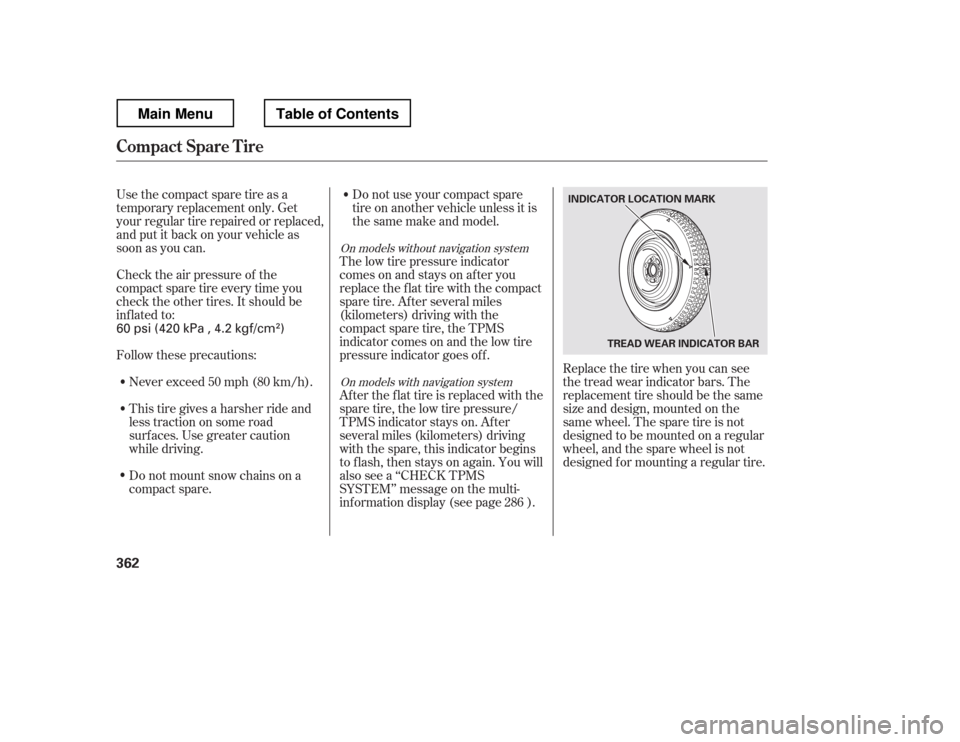
the tread wear indicator bars. The
replacement tire should be the same
sizeanddesign,mountedonthe
same wheel. The spare tire is not
designed to be mounted on a regular
wheel, and the spare wheel is not
designed f or mounting a regular tire.
Never exceed 50 mph (80 km/h).
This tire gives a harsher ride and
less traction on some road
surf aces. Use greater caution
while driving.
Do not mount snow chains on a
compact spare. Do not use your compact spare
tire on another vehicle unless it is
thesamemakeandmodel.
The low tire pressure indicator
comes on and stays on af ter you
replace the flat tire with the compact
spare tire. Af ter several miles
(kilometers) driving with the
compact spare tire, the TPMS
indicator comes on and the low tire
pressure indicator goes of f .
After the flat tire is replaced with the
spare tire, the low tire pressure/
TPMS indicator stays on. After
several miles (kilometers) driving
with the spare, this indicator begins
to f lash, then stays on again. You will
also see a ‘‘CHECK TPMS
SYSTEM
Page 392 of 429
CONT INUED
If your vehicle needs to be towed,
call a prof essional towing service or
organization. Never tow your vehicle
with just a rope or chain. It is very
dangerous.The operator will load
your vehicle on the back of a truck.
Any other method of towing will
damage the drive system. When you
contact the towing agency, inf orm
them a f lat-bed is required. If your vehicle gets stuck in sand,
mud, or snow, call a towing service
to pull it out (see the previous
column).
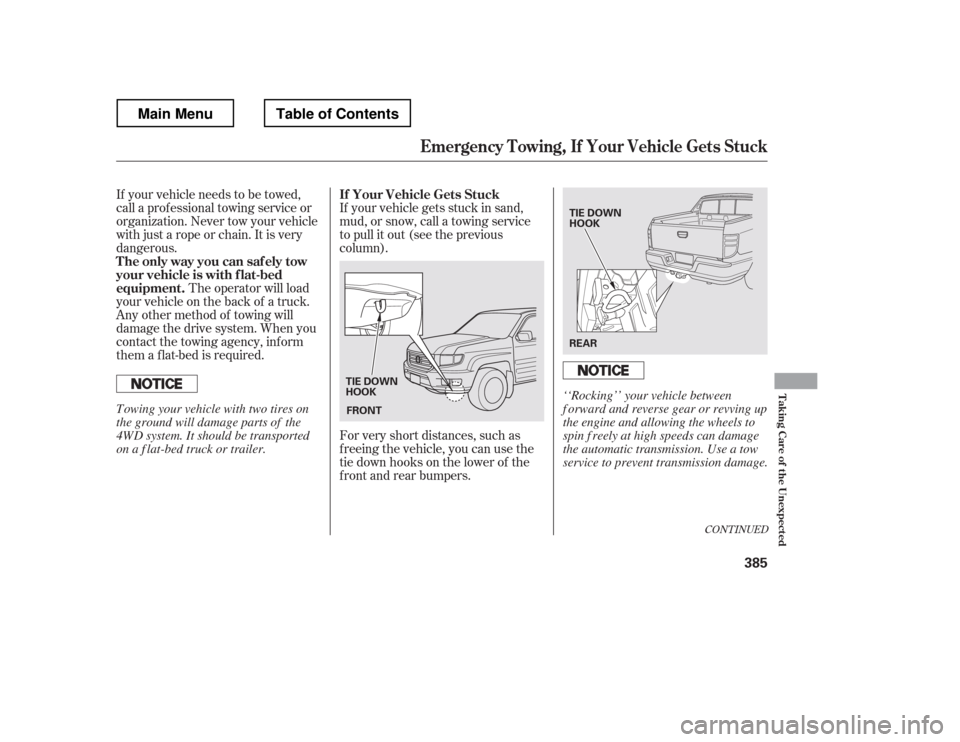
For very short distances, such as
f reeing the vehicle, you can use the
tie down hooks on the lower of the
f ront and rear bumpers.
Emergency Towing, If Your Vehicle Gets Stuck
The only way you can saf ely tow
your vehicle is with f lat-bed
equipment.
If Your Vehicle Gets Stuck
T aking Care of the Unexpected
385
FRONT
REAR
TIE DOWN
HOOK TIE DOWN
HOOK
‘‘Rocking’’ your vehicle between
f orward and reverse gear or revving up
the engine and allowing the wheels to
spin f reely at high speeds can damage
the automatic transmission. Use a tow
service to prevent transmission damage.
Towing your vehicle with two tires on
the ground will damage parts of the
4WD system. It should be transported
on a f lat-bed truck or trailer.
Main MenuTable of Contents
Page 398 of 429
�µ �µ
�µ�µ �µ �µ�µ�µ�µ�µ�µ�µ�µ�µ�µ�µ�µ�µ �µ �µ�Î
�Î �Î�Î
Specif ications
T echnical Inf ormat ion
391
Fuses
Engine
Alignment
Lights Battery
Tires
Capacities
Interior
Under-hoodType
BorexStroke
Displacement
Compression ratio
Spark plugs
Toe-in
Camber Caster3.50 x 3.66 in (89.0 x 93.0 mm)
211.8 cu-in (3,471 cm
)
10.0 : 1
ILZKR7B11 SXU22HCR11
0.00 in (0.0 mm)
0.00 in (0.0 mm) 0
Page 399 of 429
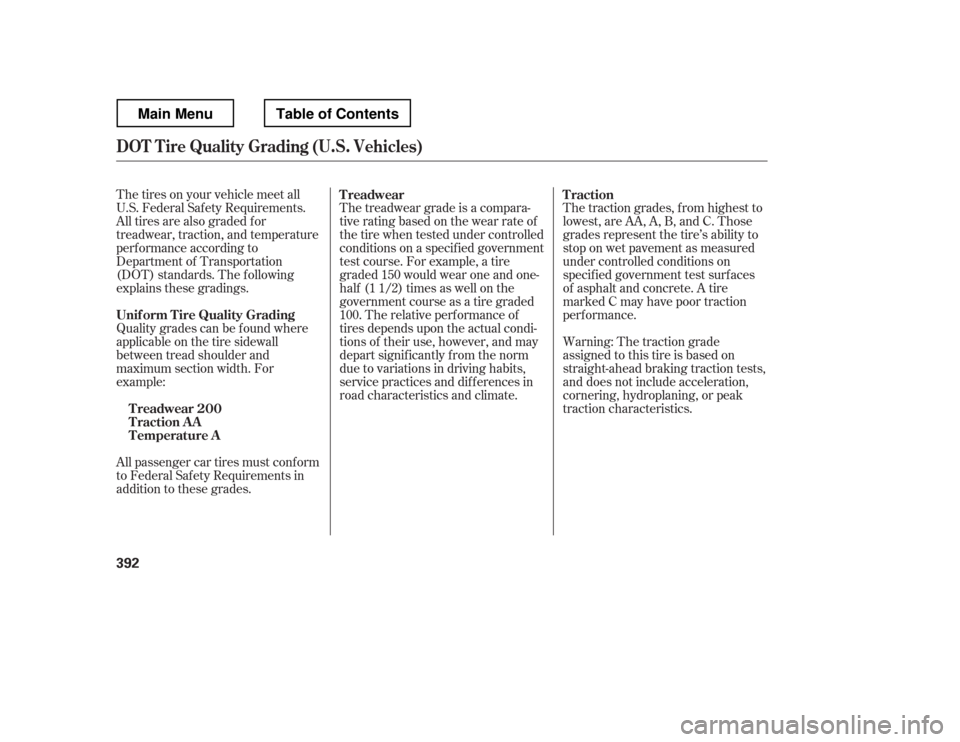
The tires on your vehicle meet all
U.S. Federal Saf ety Requirements.
All tires are also graded f or
treadwear, traction, and temperature
perf ormance according to
Department of Transportation
(DOT) standards. The f ollowing
explains these gradings.The treadwear grade is a compara-
tive rating based on the wear rate of
the tire when tested under controlled
conditions on a specif ied government
test course. For example, a tire
graded 150 would wear one and one-
half (1 1/2) times as well on the
government course as a tire graded
100. The relative perf ormance of
tires depends upon the actual condi-
tions of their use, however, and may
depart signif icantly f rom the norm
due to variations in driving habits,
service practices and dif f erences in
road characteristics and climate. The traction grades, f rom highest to
lowest, are AA, A, B, and C. Those
grades represent the tire
Page 401 of 429
�µ �µ �µ
�µ �µ �µ �µ
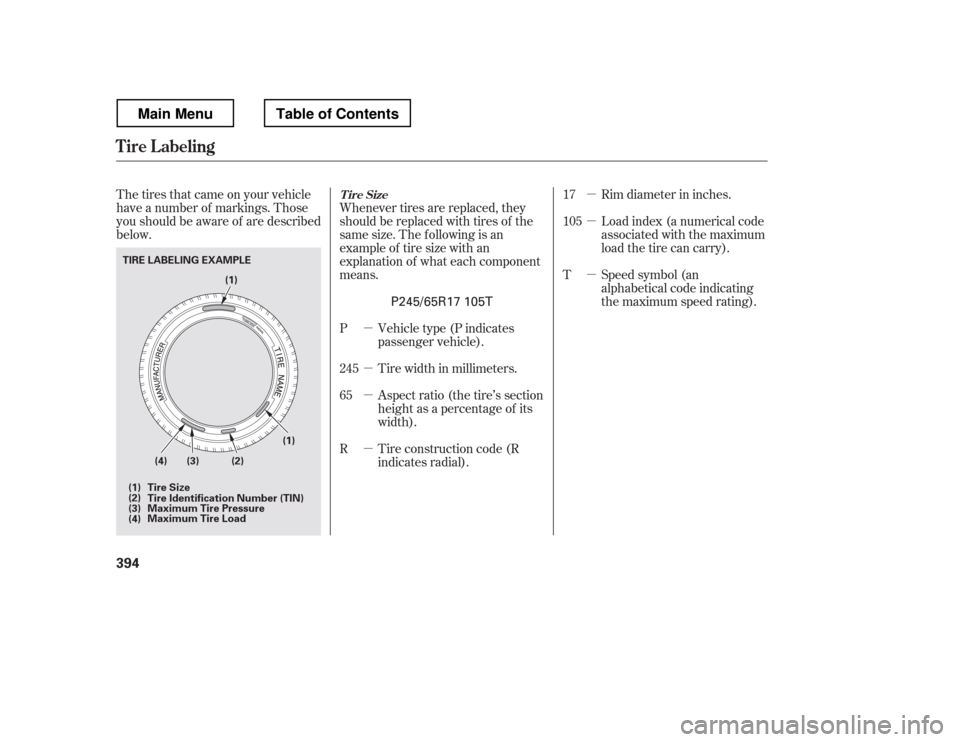
The tires that came on your vehicle
have a number of markings. Those
you should be aware of are described
below.
Rim diameter in inches.
Load index (a numerical code
associated with the maximum
load the tire can carry).
Speed symbol (an
alphabetical code indicating
the maximum speed rating).
Whenever tires are replaced, they
should be replaced with tires of the
same size. The f ollowing is an
exampleof tiresizewithan
explanation of what each component
means.
Vehicletype(Pindicates
passenger vehicle).
Tire width in millimeters.
Aspect ratio (the tire
Page 403 of 429
�µ
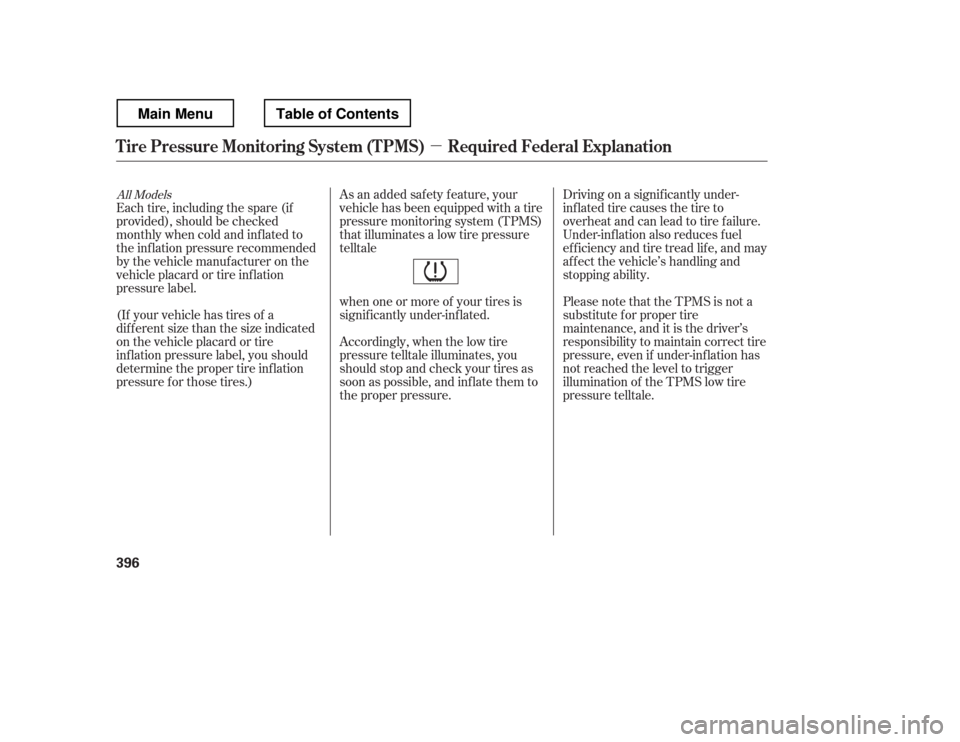
Accordingly, when the low tire
pressure telltale illuminates, you
should stop and check your tires as
soon as possible, and inf late them to
the proper pressure.Driving on a signif icantly under-
inf lated tire causes the tire to
overheat and can lead to tire failure.
Under-inf lation also reduces f uel
efficiency and tire tread life, and may
af f ect the vehicle
Page 404 of 429
�µ
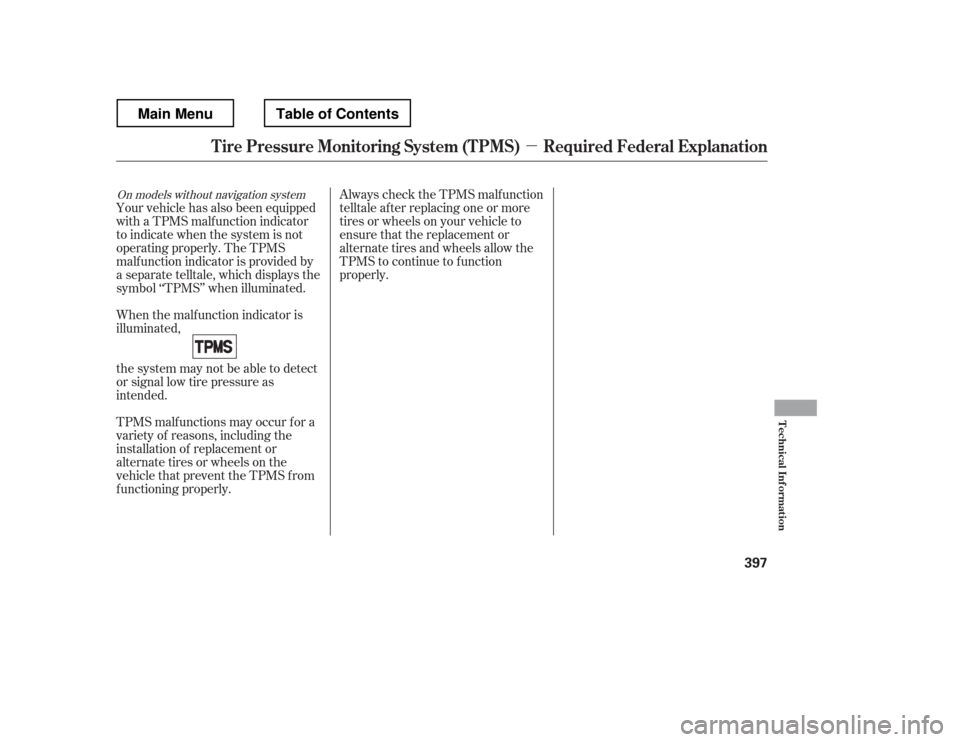
Always check the TPMS malf unction
telltale af ter replacing one or more
tires or wheels on your vehicle to
ensure that the replacement or
alternate tires and wheels allow the
TPMS to continue to f unction
properly.
TPMS malf unctions may occur f or a
variety of reasons, including the
installation of replacement or
alternate tires or wheels on the
vehicle that prevent the TPMS f rom
f unctioning properly.
When the malf unction indicator is
illuminated,
the system may not be able to detect
or signal low tire pressure as
intended.
Your vehicle has also been equipped
with a TPMS malf unction indicator
to indicate when the system is not
operating properly. The TPMS
malf unction indicator is provided by
a separate telltale, which displays the
symbol ‘‘TPMS
Page 405 of 429

�µ
TPMS malf unctions may occur f or a
variety of reasons, including the
installation of replacement or
alternate tires or wheels on the
vehicle that prevent the TPMS f rom
f unctioning properly.
Always check the TPMS malf unction
telltale af ter replacing one or more
tires or wheels on your vehicle to
ensure that the replacement or
alternate tires and wheels allow the
TPMS to continue to f unction
properly.
When the malf unction indicator is
illuminated, the system may not be
able to detect or signal low tire
pressure as intended.
Your vehicle has also been equipped
with a TPMS malf unction indicator
to indicate when the system is not
operating properly. The TPMS
malf unction indicator is combined
with the low tire pressure telltale.
When the system detects a
malf unction, the telltale will f lash f or
approximately one minute and then
remain continuously illuminated.
This sequence will continue upon
subsequent vehicle start-ups as long
as the malfunction exists.On models with navigation system
Tire Pressure Monitoring System (TPMS) Required Federal Explanat
ion
398
Main MenuTable of Contents