Page 288 of 429
This indicator comes on and stays on
if there is a problem with the tire
pressure monitoring system.
If this happens, the system will shut
of f and no longer monitor tire
pressures. Have the system checked
by your dealer as soon as possible.
If the low tire pressure indicator or
TPMS indicator comes on, the VSA
system automatically turns on even if
the VSA system is turned of f by
pressing the VSA OFF switch (see
page ). If this happens, you
cannot turn the VSA system of f by
pressing the VSA OFF switch again.
Although your tire pressure is
monitored, you must manually check
thetirepressuresmonthly.
The appropriate tire indicator and
low tire pressure indicator comes on
if a tire becomes signif icantly
underinf lated. See
on page .
For example, if you check and f ill
your tires in a warm area, then drive
in extremely cold weather, the tire
pressure will be lower than
measured and could be underinf lated
and cause the low tire pressure
indicator to come on. Or, if you
check and adjust your tire pressure
in cooler conditions, and drive into
extremely hot conditions, the tire
maybecomeoverinflated.However,
the low tire pressure indicator will
not come on if the tires are
overinf lated.
Refer to page for tire inflation
guidelines.
When you restart the vehicle with
thecompactsparetire,theTPMS
indicator may also come on and stay
on after driving several miles
(kilometers).
Each tire, including the spare, should
be checked monthly when cold, and
set to the recommended inf lation
pressure as specif ied on the tire
information label and in the owner
Page 292 of 429
CONT INUED
To see the inf lation pressures of all
f our tires, press the SEL/RESET
button. The display changes as
shown above.Each tire pressure is shown in PSI
(U.S. models) or in kPa (Canadian
models).
Each tire has its own pressure
sensor. If the air pressure of a tire
becomes signif icantly low, the
sensor in that tire immediately sends
a signal that causes the low tire
pressure/TPMS indicator in the
instrument panel to come on. If this
happens, you will see which tire is
losing pressure on the multi-
inf ormation display along with a
‘‘CHECK TIRE PRESSURE
Page 301 of 429
Driving with varying tire or wheel
sizes may cause the VSA to
malf unction. When replacing tires,
makesuretheyareof thesamesize
and type as your original tires (see
page ).
If you install winter tires, make sure
they are the same size as those that
were originally supplied with your
vehicle. Exercise the same caution
during winter driving as you would if
your vehicle was not equipped with
VSA.
VSA is turned on every time you
start the engine, even if you turned it
off the last time you drove the
vehicle.
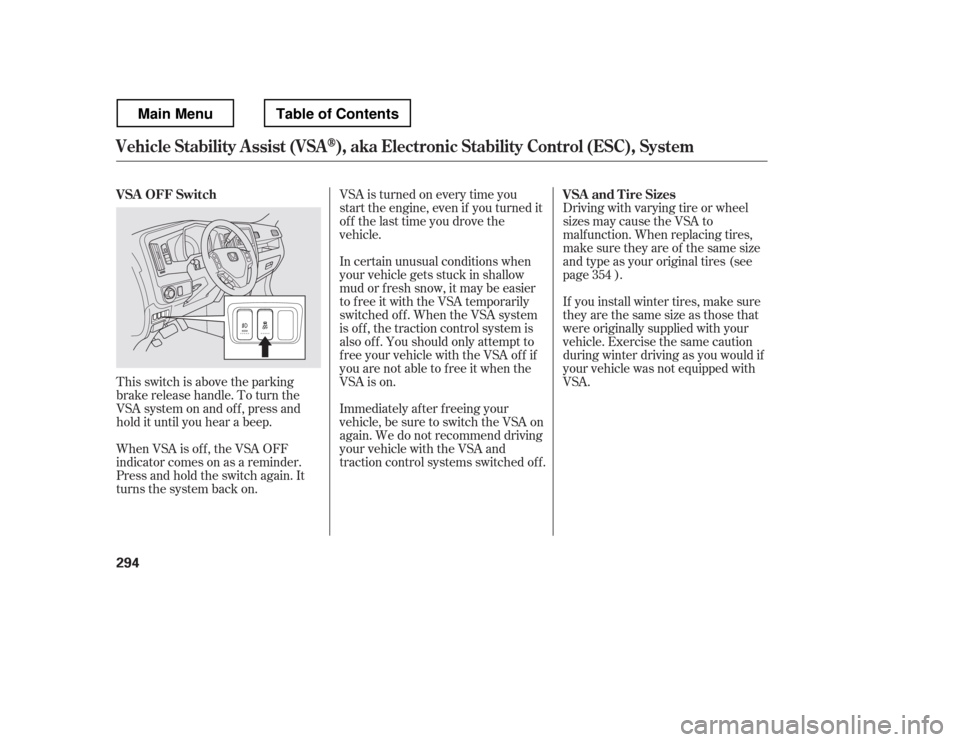
This switch is above the parking
brake release handle. To turn the
VSA system on and of f , press and
hold it until you hear a beep.
When VSA is off, the VSA OFF
indicator comes on as a reminder.
Press and hold the switch again. It
turns the system back on. In certain unusual conditions when
your vehicle gets stuck in shallow
mud or f resh snow, it may be easier
to free it with the VSA temporarily
switched of f . When the VSA system
is of f , the traction control system is
alsooff.Youshouldonlyattemptto
f ree your vehicle with the VSA of f if
you are not able to f ree it when the
VSA is on.
Immediately af ter f reeing your
vehicle, be sure to switch the VSA on
again. We do not recommend driving
your vehicle with the VSA and
traction control systems switched off.
354
VSA OFF Switch
VSA and Tire Sizes
Vehicle St abilit y A ssist (VSA), aka Electronic Stability Control (ESC), System
294
Main MenuTable of Contents
Page 316 of 429
Before you leave the pavement, be
sure to do all scheduled maintenance
and service, and inspect your vehicle
f or any problems. Pay special
attention to the condition of the tires,
and check the tire pressures.
After you return to the pavement,
caref ully inspect your vehicle to
make sure there is no damage that
could make driving it unsaf e.
Recheck the condition of the tires
and the tire pressures.
The route presents limits (too steep
or bumpy roads). You have limits
(driving skill and comf ort). And your
vehicle has limits (traction, stability,
and power).
Driving of f -highway can be
hazardous if you f ail to recognize
limits and take the proper
precautions.
To avoid loss of control or rollover,
be sure to f ollow all precautions and
recommendations.
Be sure to store cargo properly
and do not exceed your cargo load
limits (see page and ).
Be aware that a heavy load can
reduce ground clearance and your
ability to clear obstacles.
Whenever you drive, make sure
you and your passengers always
wear seat belts.
Keep your speed low, and never
go faster than the conditions allow.
It
Page 320 of 429

This section explains why it is
important to keep your vehicle well
maintained and how to f ollow basic
maintenance saf ety precautions.
This section also includes
instructions on how to read the
Maintenance Minder messages on
the inf ormation display or multi-
inf ormation display (depending on
the model), and instructions for
simple maintenance tasks you may
want to take care of yourself.U.S. Vehicles:
If you have the skills and tools to
perf orm more complex maintenance
tasks on your vehicle, you may want
to purchase the service manual. See
page f or inf ormation on how to
obtain a copy, or see your dealer. ......................
Maintenance Saf ety . 314
.................
Maintenance Minder . 315
..............................
Fluid Locations . 327
........................
Adding Engine Oil . 328
Changing the Engine Oil and
...........................................
Filter . 329
..............................
Engine Coolant . 331
....................
Windshield Washers . 332
....
Automatic Transmission Fluid . 333
....................................
Brake Fluid . 335
....................
Power Steering Fluid . 336
....................................
Timing Belt . 337
.............................................
Lights . 337
................
Cleaning the Seat Belts . 345
.....................................
Floor Mats . 346
..................
Dust and Pollen Filter . 346
.................................
Wiper Blades . 347
...........................................
Wheels . 349
...............................................
Tires . 349
...................
Checking the Battery . 357
.............................
Vehicle Storage . 358
..................................
Interior Care . 359
409
Maintenance
Maintenance, replacement, or
repair of emissions control
devices and systems may be done
by any automotive repair
establishment or individual using
parts that are ‘‘certif ied
Page 332 of 429

�µ�µ�µ �µ
�µ
�µ
�Ì
Youshouldcheckthefollowing
items at the specif ied intervals. If
you are unsure of how to perf orm
any check, turn to the appropriate
page listed.
Engine oil level Check every
time you fill the fuel tank. See
page .
Engine coolant level Check the
radiator reserve tank every time
you f ill the f uel tank. See page .
Automatic transmission Check
the f luid level monthly. See page . Brakes Check the f luid level
monthly. See page .
Tires Check the tire pressure
monthly. Examine the tread f or
wear and foreign objects. See page
.
Lights Check the operation of
all the lights monthly. See page .
According to state and federal
regulations, f ailure to perf orm
maintenance on the items marked
with will not void your emissions
warranties. However, all
maintenance services should be
perf ormed in accordance with the
intervals indicated by the odometer/
trip meter display or the multi-
inf ormation display. 255
333255
337349 335
CONT INUED
Maintenance Minder
Owner
Page 333 of 429
�Î �Î
�Ì �Ì
�µ�µ
�Î �Ì
Maintenance Minder
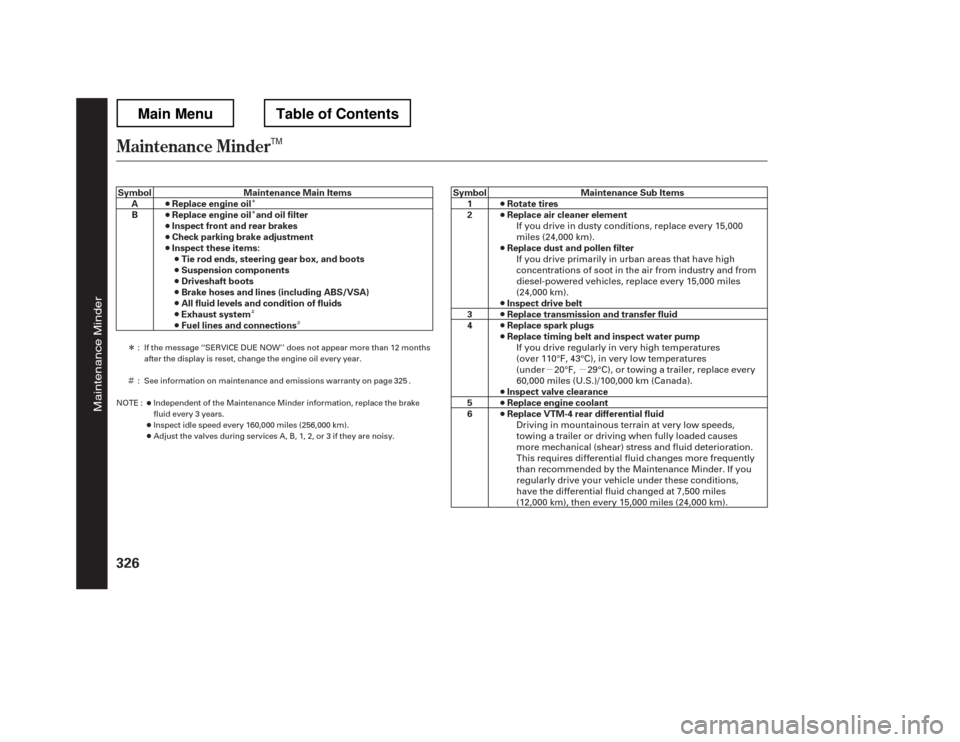
326 Maintenance Main Items
Replace engine oil
Replace engine oil and oil filter
Inspect front and rear brakes
Check parking brake adjustment
Inspect these items: Tie rod ends, steering gear box, and boots
Suspension components
Driveshaft boots
Brake hoses and lines (including ABS/VSA)
All fluid levels and condition of fluids
Exhaust system
Fuel lines and connections Maintenance Sub Items
Rotate tires
Replace air cleaner element
Replace dust and pollen filter
Inspect drive belt
Replace transmission and transfer fluid
Replace spark plugs
Replace timing belt and inspect water pump
Inspect valve clearance
Replace engine coolant
Replace VTM-4 rear differential fluid
Symbol
Symbol
A
B 1 2 3 4 5 6
TM
Inspect idle speed every 160,000 miles (256,000 km).
Adjust the valves during services A, B, 1, 2, or 3 if they are noisy.
See information on maintenance and emissions warranty on page .
Independent of the Maintenance Minder information, replace the brake
fluid every 3 years.
If the message ‘‘SERVICE DUE NOW’’ does not appear more than 12 months
after the display is reset, change the engine oil every year.
NOTE : : :
325If you drive in dusty conditions, replace every 15,000
miles (24,000 km).
If you drive primarily in urban areas that have high
concentrations of soot in the air from industry and from
diesel-powered vehicles, replace every 15,000 miles
(24,000 km).
If you drive regularly in very high temperatures
(over 110
Page 356 of 429
Slide the new wiper blade into the
holder until the tabs lock.
Slide the wiper blade assembly
onto the wiper arm. Make sure it
locks in place.
Lower the wiper arm against the
window.
Turn the ignition switch to the ON
(II) position, and turn the wiper
switch of f to return the wiper arms
to the parked position.Clean the wheels as you would the
rest of the exterior. Wash them with
thesamesolution,andrinsethem
thoroughly.
Aluminum alloy wheels have a
protective clear-coat that keeps
the aluminum f rom corroding and
tarnishing. Cleaning the wheels
with harsh chemicals (including
some commercial wheel cleaners)
or a stif f brush can damage the
clear-coat. To clean the wheels,
use a mild detergent and a sof t
brush or sponge. To saf ely operate your vehicle, your
tires must be the proper type and
size, in good condition with adequate
tread, and correctly inf lated.
The f ollowing pages give more
detailed inf ormation on how to take
care of your tires and what to do
when they need to be replaced.
6. 7. 8. 9.
If equipped
Wheels T ires
Wiper Blades, Wheels, Tires
Maint enance
349
Using tires that are excessively
worn or improperly inflated can
cause a crash in which you can
be seriously hurt or killed.
Follow all instructions in this
owner
