2012 FORD FOCUS ELECTRIC flat tire
[x] Cancel search: flat tirePage 242 of 380
To restore the full functionality of the tire pressure monitoring system,
have the damaged road wheel/tire repaired and remounted on your
vehicle. For additional information, refer toChanging tires with a
TPMS in this section.
When you believe your system is not operating properly
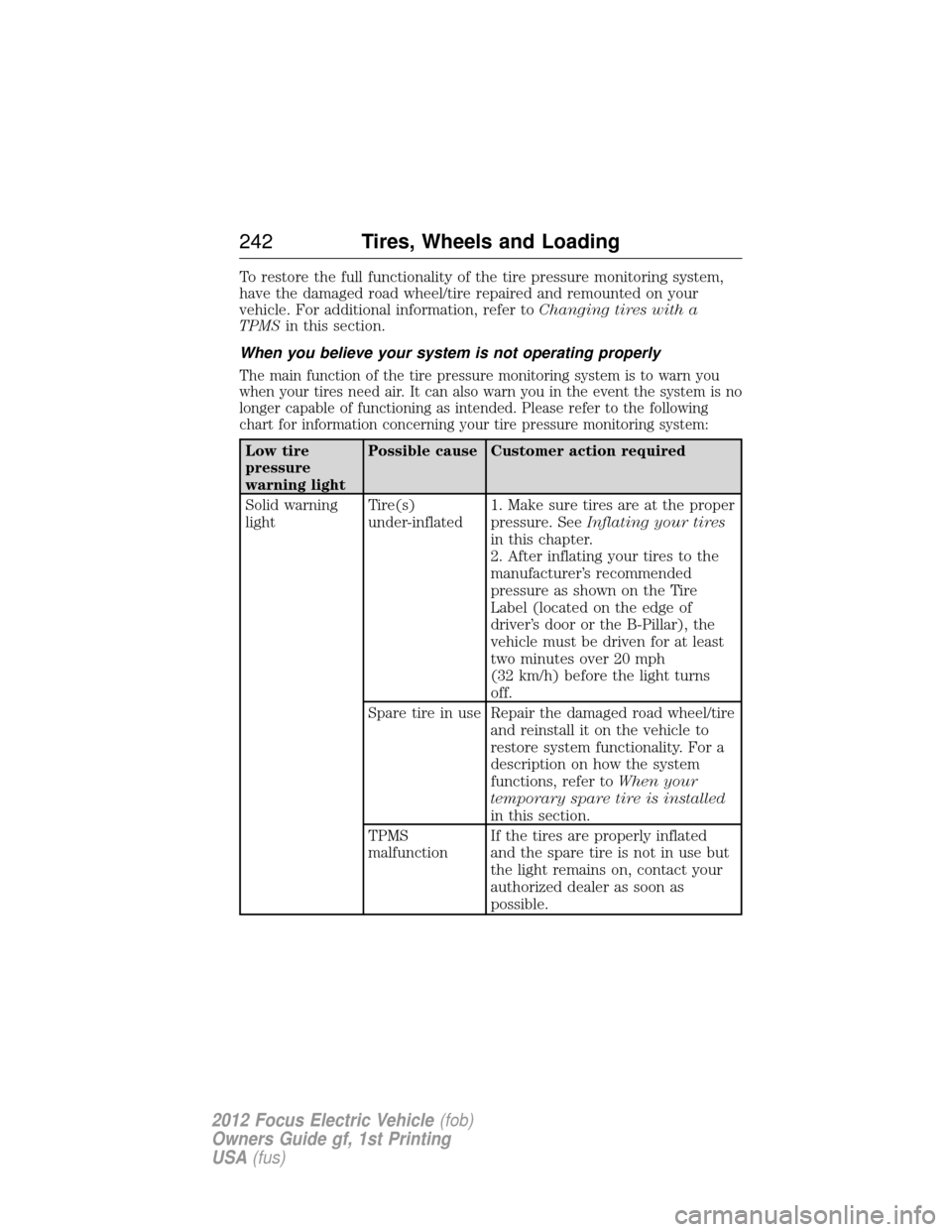
The main function of the tire pressure monitoring system is to warn you
when your tires need air. It can also warn you in the event the system is no
longer capable of functioning as intended. Please refer to the following
chart for information concerning your tire pressure monitoring system:
Low tire
pressure
warning light Possible cause Customer action required
Solid warning
light Tire(s)
under-inflated1. Make sure tires are at the proper
pressure. See
Inflating your tires
in this chapter.
2. After inflating your tires to the
manufacturer’s recommended
pressure as shown on the Tire
Label (located on the edge of
driver’s door or the B-Pillar), the
vehicle must be driven for at least
two minutes over 20 mph
(32 km/h) before the light turns
off.
Spare tire in use Repair the damaged road wheel/tire and reinstall it on the vehicle to
restore system functionality. For a
description on how the system
functions, refer to When your
temporary spare tire is installed
in this section.
TPMS
malfunction If the tires are properly inflated
and the spare tire is not in use but
the light remains on, contact your
authorized dealer as soon as
possible.
242
Tires, Wheels and Loading
2012 Focus Electric Vehicle (fob)
Owners Guide gf, 1st Printing
USA (fus)
Page 243 of 380
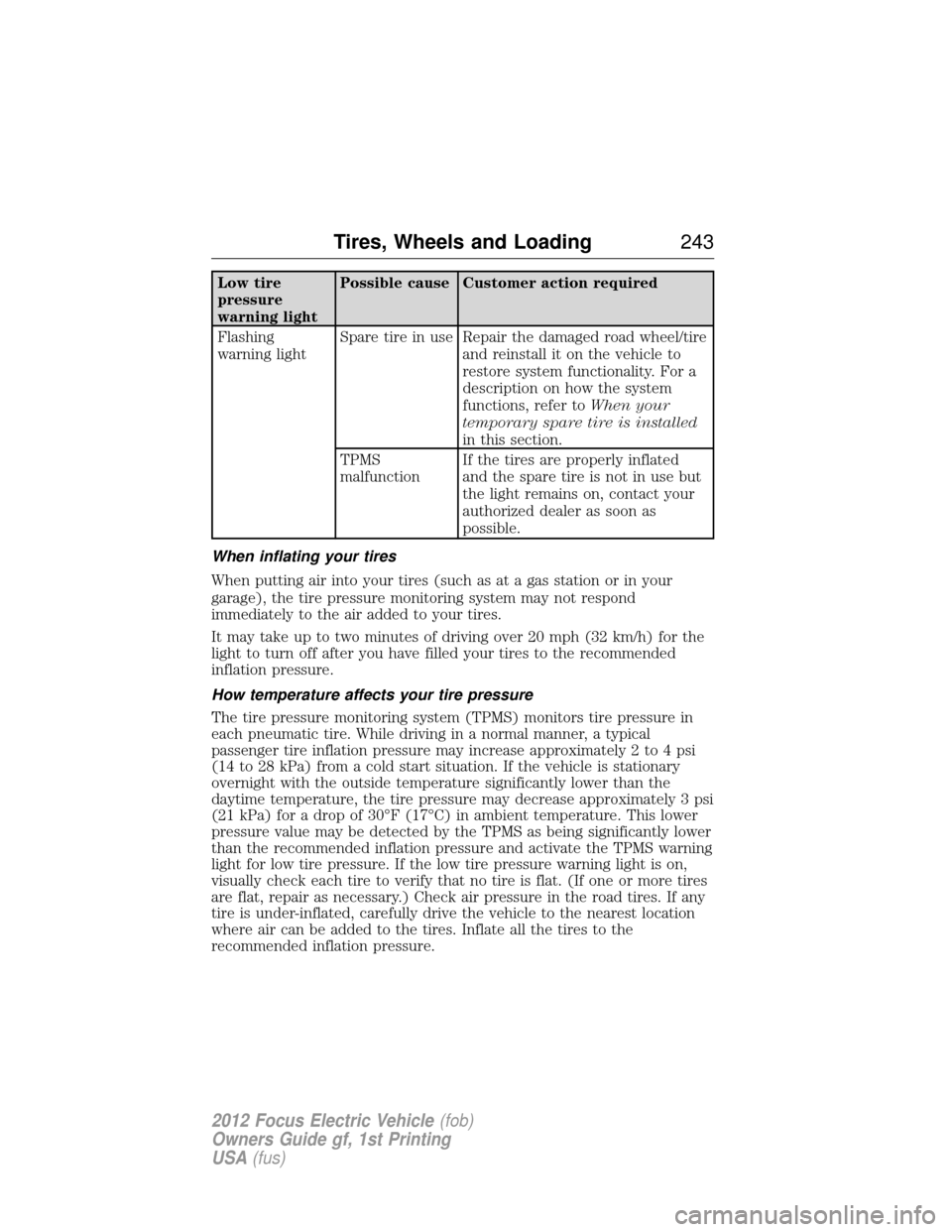
Low tire
pressure
warning lightPossible cause Customer action required
Flashing
warning light Spare tire in use Repair the damaged road wheel/tire
and reinstall it on the vehicle to
restore system functionality. For a
description on how the system
functions, refer to When your
temporary spare tire is installed
in this section.
TPMS
malfunction If the tires are properly inflated
and the spare tire is not in use but
the light remains on, contact your
authorized dealer as soon as
possible.
When inflating your tires
When putting air into your tires (such as at a gas station or in your
garage), the tire pressure monitoring system may not respond
immediately to the air added to your tires.
It may take up to two minutes of driving over 20 mph (32 km/h) for the
light to turn off after you have filled your tires to the recommended
inflation pressure.
How temperature affects your tire pressure
The tire pressure monitoring system (TPMS) monitors tire pressure in
each pneumatic tire. While driving in a normal manner, a typical
passenger tire inflation pressure may increase approximately 2 to 4 psi
(14 to 28 kPa) from a cold start situation. If the vehicle is stationary
overnight with the outside temperature significantly lower than the
daytime temperature, the tire pressure may decrease approximately 3 psi
(21 kPa) for a drop of 30°F (17°C) in ambient temperature. This lower
pressure value may be detected by the TPMS as being significantly lower
than the recommended inflation pressure and activate the TPMS warning
light for low tire pressure. If the low tire pressure warning light is on,
visually check each tire to verify that no tire is flat. (If one or more tires
are flat, repair as necessary.) Check air pressure in the road tires. If any
tire is under-inflated, carefully drive the vehicle to the nearest location
where air can be added to the tires. Inflate all the tires to the
recommended inflation pressure.
Tires, Wheels and Loading 243
2012 Focus Electric Vehicle(fob)
Owners Guide gf, 1st Printing
USA (fus)
Page 262 of 380
If the steering wanders or pulls, check for:
•an improperly inflated tire.
• uneven tire wear.
• loose or worn suspension components.
• loose or worn steering components.
• improper steering alignment.
A high crown in the road or high crosswinds may also make the steering
seem to wander/pull.
Brake-shift interlock
This vehicle is equipped with a brake-shift interlock feature that prevents
the gearshift lever from being moved from P (Park) when the ignition is
in the on position unless the brake pedal is pressed, your charge cord
may be plugged into the vehicle, or there may be a fault with the
associated electrical system. If this is the case, you must follow the
instructions in your instrument cluster display before your vehicle will
start.
If you cannot move the gearshift lever out of P (Park) with ignition on
and the brake pedal pressed, it is also possible that a fuse has blown or
the vehicle’s brake lamps are not operating properly. Refer to Fuses and
relays in theRoadside Emergencies chapter.
If your charge cord is not connected and there is not a fault with the
associated electrical system, the fuse is not blown and the brake lamps
are working properly, the following procedure will allow you to move the
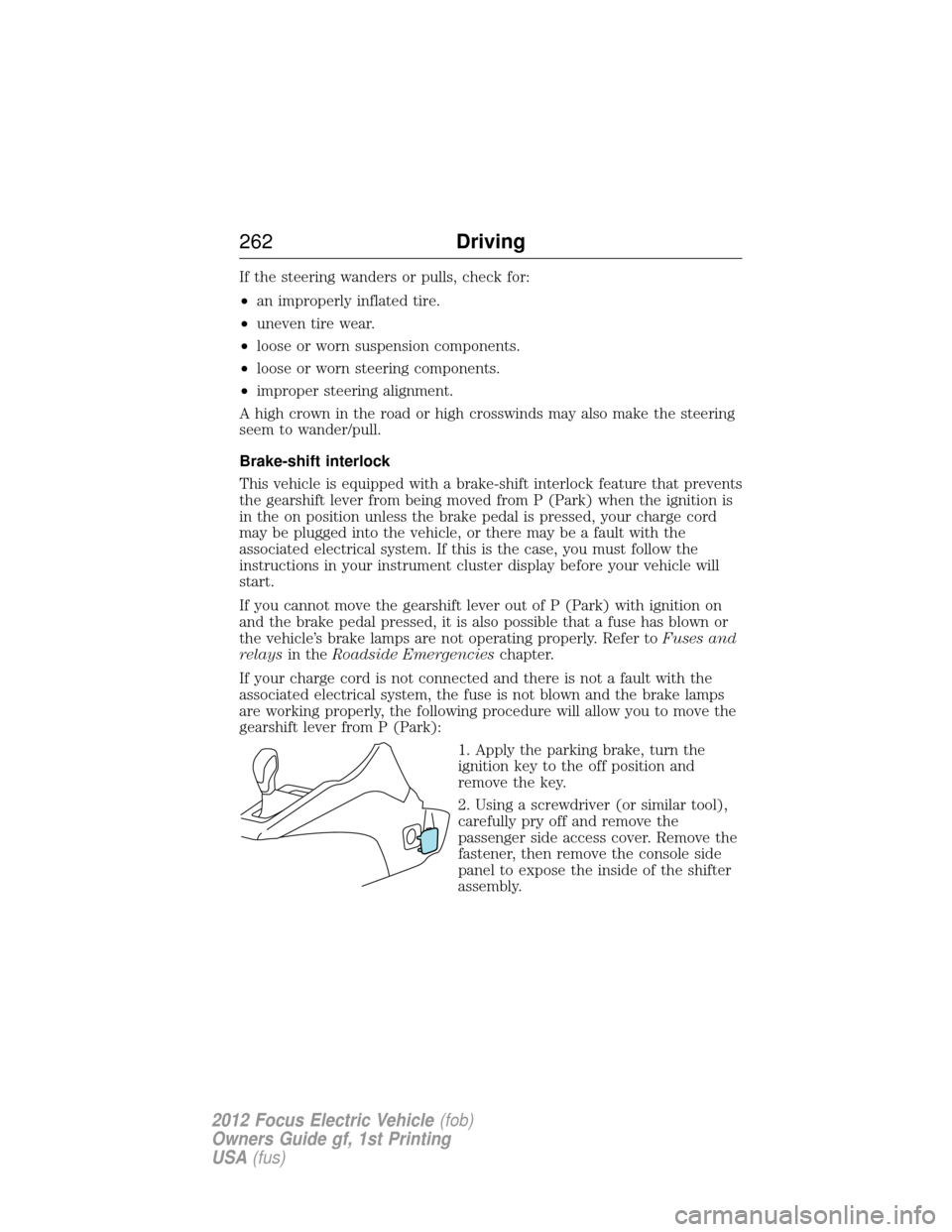
gearshift lever from P (Park): 1. Apply the parking brake, turn the
ignition key to the off position and
remove the key.
2. Using a screwdriver (or similar tool),
carefully pry off and remove the
passenger side access cover. Remove the
fastener, then remove the console side
panel to expose the inside of the shifter
assembly.
262Driving
2012 Focus Electric Vehicle (fob)
Owners Guide gf, 1st Printing
USA (fus)
Page 275 of 380
ROADSIDE ASSISTANCE
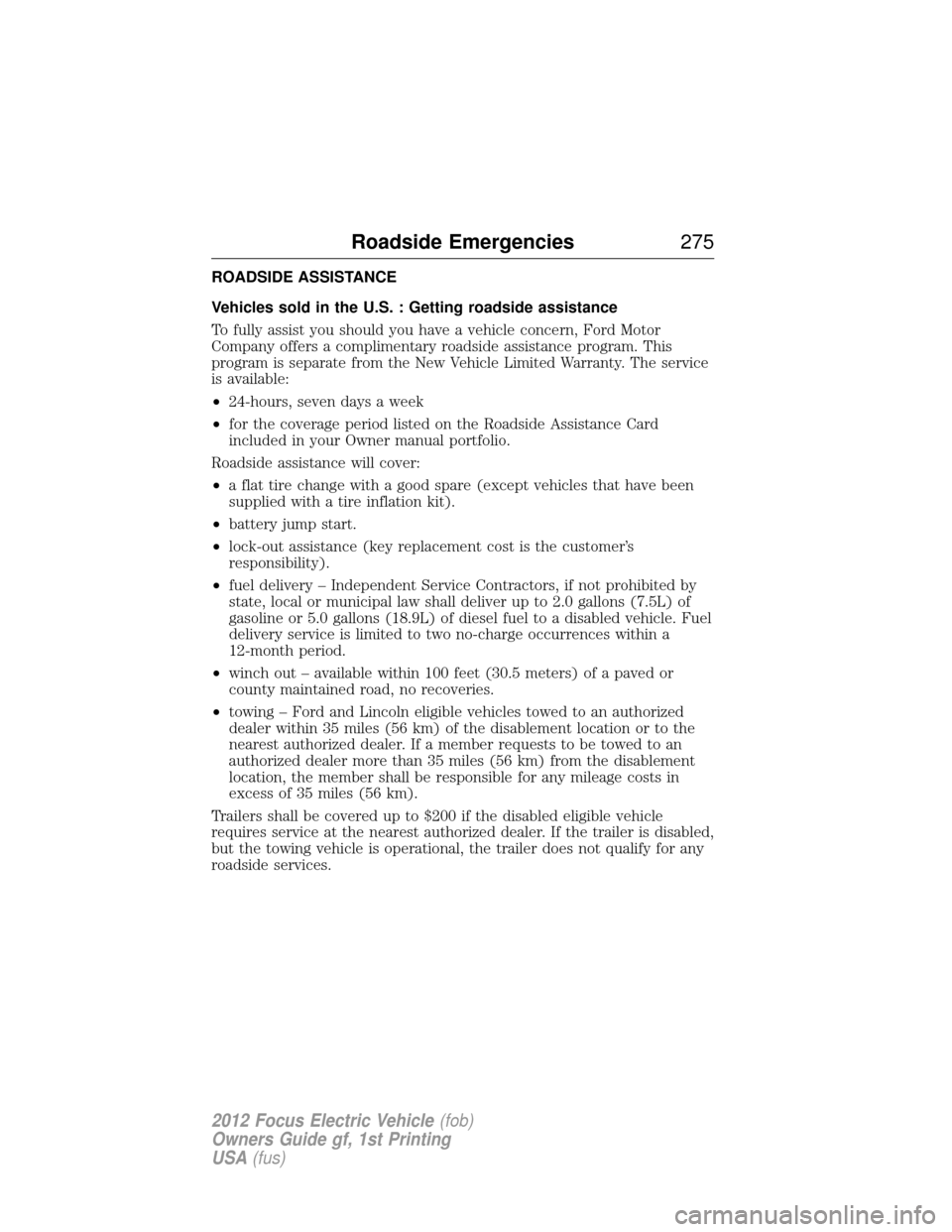
Vehicles sold in the U.S. : Getting roadside assistance
To fully assist you should you have a vehicle concern, Ford Motor
Company offers a complimentary roadside assistance program. This
program is separate from the New Vehicle Limited Warranty. The service
is available:
•24-hours, seven days a week
• for the coverage period listed on the Roadside Assistance Card
included in your Owner manual portfolio.
Roadside assistance will cover:
• a flat tire change with a good spare (except vehicles that have been
supplied with a tire inflation kit).
• battery jump start.
• lock-out assistance (key replacement cost is the customer’s
responsibility).
• fuel delivery – Independent Service Contractors, if not prohibited by
state, local or municipal law shall deliver up to 2.0 gallons (7.5L) of
gasoline or 5.0 gallons (18.9L) of diesel fuel to a disabled vehicle. Fuel
delivery service is limited to two no-charge occurrences within a
12-month period.
• winch out – available within 100 feet (30.5 meters) of a paved or
county maintained road, no recoveries.
• towing – Ford and Lincoln eligible vehicles towed to an authorized
dealer within 35 miles (56 km) of the disablement location or to the
nearest authorized dealer. If a member requests to be towed to an
authorized dealer more than 35 miles (56 km) from the disablement
location, the member shall be responsible for any mileage costs in
excess of 35 miles (56 km).
Trailers shall be covered up to $200 if the disabled eligible vehicle
requires service at the nearest authorized dealer. If the trailer is disabled,
but the towing vehicle is operational, the trailer does not qualify for any
roadside services.
Roadside Emergencies 275
2012 Focus Electric Vehicle(fob)
Owners Guide gf, 1st Printing
USA (fus)
Page 287 of 380
CHANGING THE TIRES
If you get a flat tire while driving, do not apply the brake heavily.
Instead, gradually decrease your speed. Hold the steering wheel firmly
and slowly move to a safe place on the side of the road.
Note:The tire pressure monitoring system (TPMS) indicator light will
illuminate when the spare tire is in use. To restore the full functionality
of the monitoring system, all road wheels equipped with tire pressure
monitoring sensors must be mounted on the vehicle.
Have a flat serviced by an authorized dealer in order to prevent damage to
the TPMS sensors, refer to Tire pressure monitoring system (TPMS) in
the Tires, Wheels and Loading chapter. Replace the spare tire with a road
tire as soon as possible. During repairing or replacing of the flat tire, have
the authorized dealer inspect the TPMS sensor for damage.
WARNING: The use of tire sealants may damage your tire
pressure monitoring system (TPMS) and should not be used.
However, if you must use a sealant, the TPMS sensor and valve stem on
the wheel must be replaced by an authorized Ford dealer.
WARNING: Refer toTire pressure monitoring system (TPMS)
in the Tires, Wheels and Loading chapter for important
information. If the tire pressure monitor sensor becomes damaged, it
will no longer function.
Dissimilar Spare Tire and Wheel Assembly Information
WARNING: Failure to follow these guidelines could result in an
increased risk of loss of vehicle control, injury or death.
If you have a dissimilar spare tire and wheel assembly , then it is
intended for temporary use only. This means that if you need to use it,
you should replace it as soon as possible with a road tire and wheel
assembly that is the same size and type as the road tires and wheels that
were originally provided by Ford. If the dissimilar spare tire or wheel is
damaged, it should be replaced rather than repaired.
A dissimilar spare tire and wheel assembly is defined as a spare tire or
wheel that is different in brand, size or appearance from the road tires
and wheels and can be one of three types:
1. T-type mini-spare: This spare tire begins with the letter “T” for tire
size and may have “Temporary Use Only” molded in the sidewall
Roadside Emergencies 287
2012 Focus Electric Vehicle(fob)
Owners Guide gf, 1st Printing
USA (fus)
Page 289 of 380
The usage of a full-size dissimilar spare tire and wheel assembly can lead
to impairment of the following:
•Handling, stability and braking performance
• Comfort and noise
• Ground clearance and parking at curbs
• Winter weather driving capability
• Wet weather driving capability
• All-wheel driving capability (if applicable)
• Load leveling adjustment (if applicable)
When driving with the full-size dissimilar spare tire and wheel assembly,
additional caution should be given to:
• Towing a trailer
• Driving vehicles equipped with a camper body
• Driving vehicles with a load on the cargo rack
Drive cautiously when using a full-size dissimilar spare tire and wheel,
and seek service as soon as possible.
TEMPORARY MOBILITY KIT
Note: The temporary mobility kit sealant compound in the canister is to
be used for one tire only. See your Ford authorized dealer for additional
replacement sealant canisters.
The temporary mobility kit is located in the floor of the cargo area. The
temporary mobility kit consists of an air compressor to reinflate the tire
and a sealing compound in a canister that will seal most punctures
caused by nails or similar objects. This kit will provide a temporary seal
allowing you to drive your vehicle up to 120 miles (200 km) at a
maximum speed of 50 mph (80 km/h).
Roadside Emergencies 289
2012 Focus Electric Vehicle(fob)
Owners Guide gf, 1st Printing
USA (fus)
Page 290 of 380
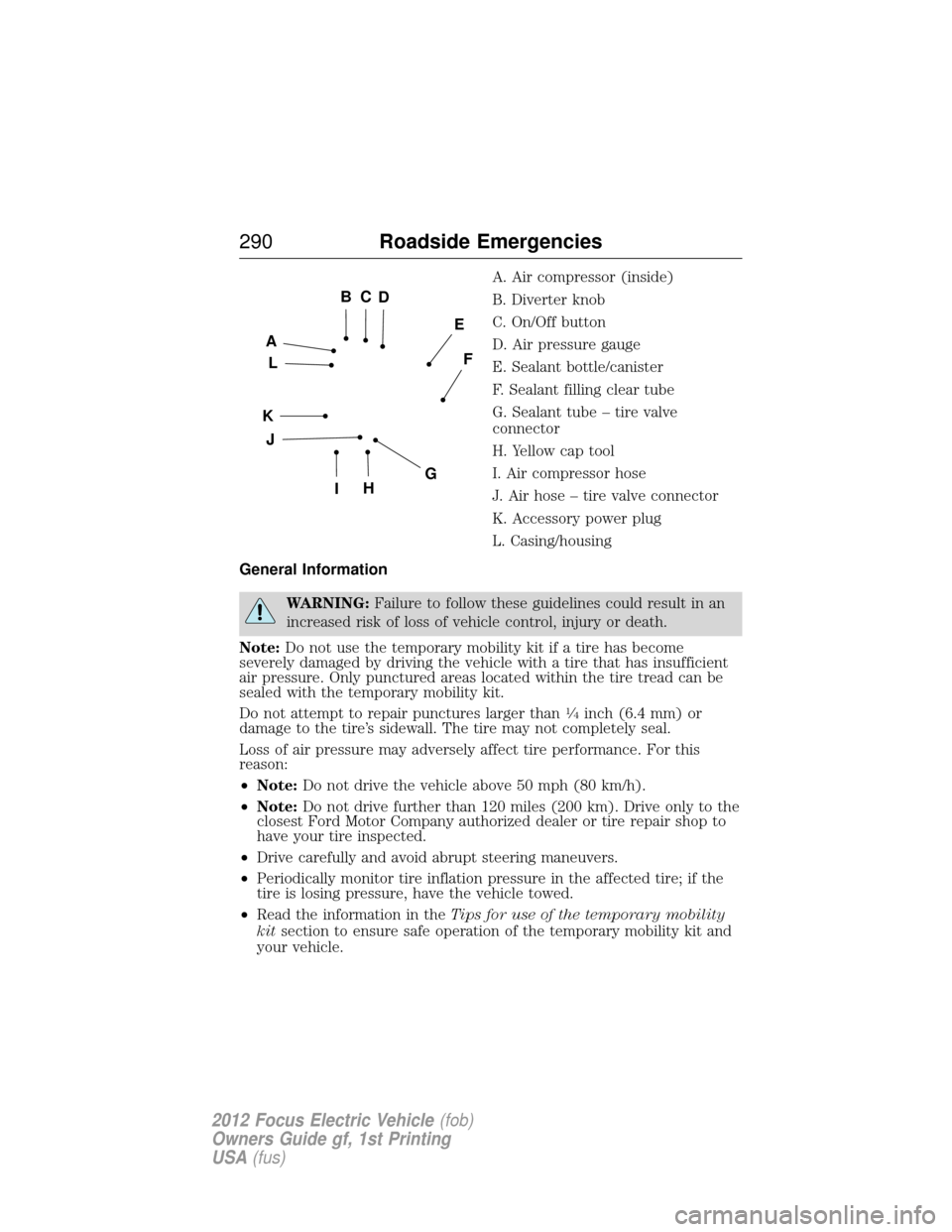
A. Air compressor (inside)
B. Diverter knob
C. On/Off button
D. Air pressure gauge
E. Sealant bottle/canister
F. Sealant filling clear tube
G. Sealant tube – tire valve
connector
H. Yellow cap tool
I. Air compressor hose
J. Air hose – tire valve connector
K. Accessory power plug
L. Casing/housing
General Information
WARNING: Failure to follow these guidelines could result in an
increased risk of loss of vehicle control, injury or death.
Note: Do not use the temporary mobility kit if a tire has become
severely damaged by driving the vehicle with a tire that has insufficient
air pressure. Only punctured areas located within the tire tread can be
sealed with the temporary mobility kit.
Do not attempt to repair punctures larger than
14inch (6.4 mm) or
damage to the tire’s sidewall. The tire may not completely seal.
Loss of air pressure may adversely affect tire performance. For this
reason:
• Note: Do not drive the vehicle above 50 mph (80 km/h).
• Note: Do not drive further than 120 miles (200 km). Drive only to the
closest Ford Motor Company authorized dealer or tire repair shop to
have your tire inspected.
• Drive carefully and avoid abrupt steering maneuvers.
• Periodically monitor tire inflation pressure in the affected tire; if the
tire is losing pressure, have the vehicle towed.
• Read the information in the Tips for use of the temporary mobility
kit section to ensure safe operation of the temporary mobility kit and
your vehicle.
A
L
BCD
E
F
GHI
K
J
290 Roadside Emergencies
2012 Focus Electric Vehicle (fob)
Owners Guide gf, 1st Printing
USA (fus)
Page 291 of 380
Tips for use of the Temporary Mobility Kit
Read the following list of tips to ensure safe operation of the temporary
mobility kit:
•Before operating the temporary mobility kit, make sure your vehicle is
safely off the road and away from moving traffic. Turn on the hazard
lights.
• Always set the parking brake to ensure the vehicle doesn’t move
unexpectedly.
• Do not remove any foreign objects, such as nails or screws, from the
tire.
• When using the temporary mobility kit, leave the motor running so the
compressor doesn’t drain the vehicle’s battery.
• Do not allow the compressor to operate continuously for more than
15 minutes; this will help prevent the compressor from overheating.
• Never leave the temporary mobility kit unattended when it is
operating.
• Sealant compound contains latex. Make sure that you use the
non-latex gloves provided to avoid an allergic reaction.
• Keep the temporary mobility kit away from children.
• Only use the temporary mobility kit when the ambient temperature is
between -22°F (–30°C) and 158°F (70°C).
• Only use the sealing compound before the use by date. The use by
date is on the lower right hand corner of the label located on the
sealant canister (bottle). Note:Check the use by date regularly and
replace the canister after four years.
• Do not store the temporary mobility kit unsecured inside the
passenger compartment of the vehicle as it may cause injury during a
sudden stop or collision. Always store the kit in its original location.
• After sealant use, the TPMS sensor and valve stem on the wheel must
be replaced by an authorized Ford dealer.
• When inflating a tire or other objects, use the black air hose only. Do
not use the transparent hose which is designed for sealant application
only.
• Operating the temporary mobility kit could cause an electrical
disturbance in radio, CD, and DVD player operation (if equipped). .
Roadside Emergencies 291
2012 Focus Electric Vehicle(fob)
Owners Guide gf, 1st Printing
USA (fus)