Page 275 of 380
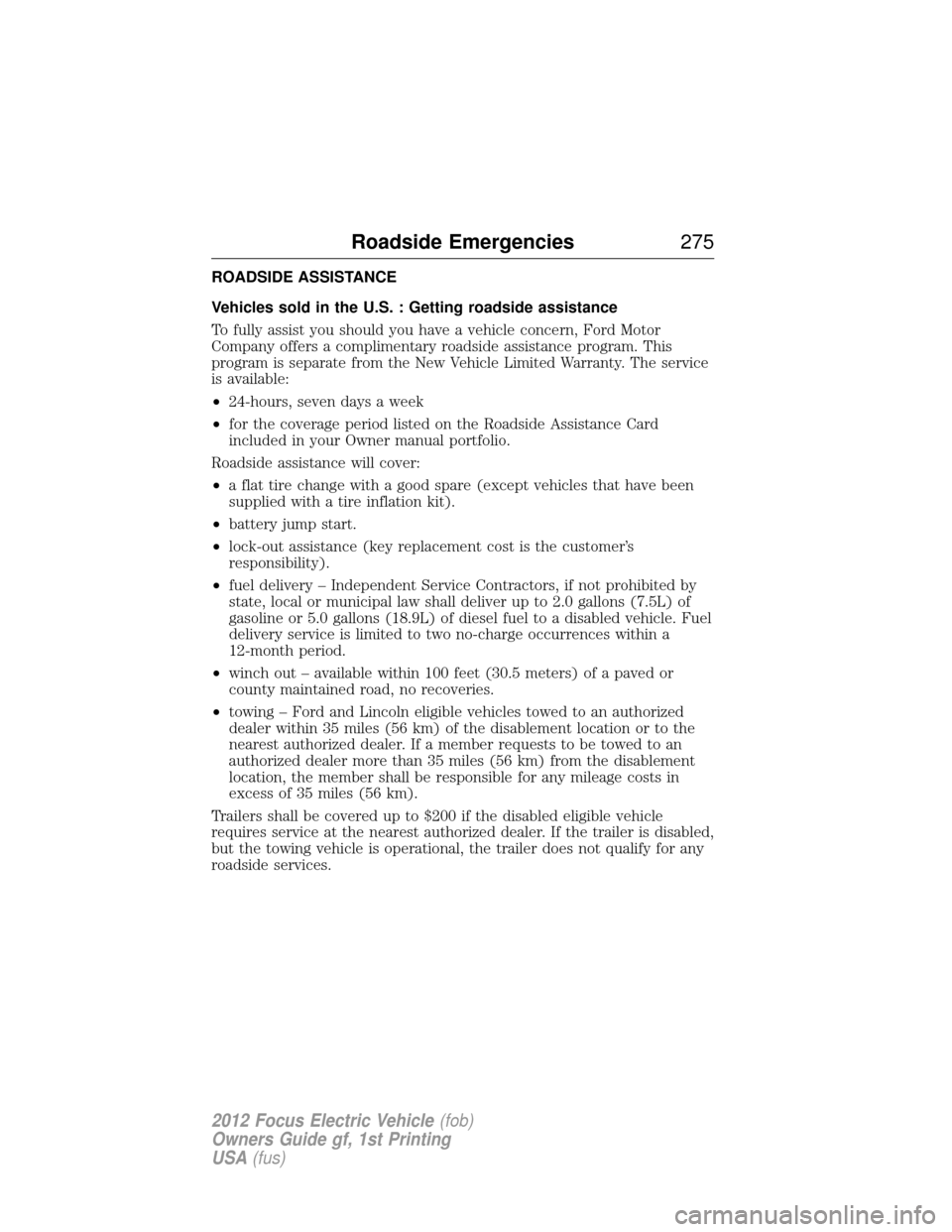
ROADSIDE ASSISTANCE
Vehicles sold in the U.S. : Getting roadside assistance
To fully assist you should you have a vehicle concern, Ford Motor
Company offers a complimentary roadside assistance program. This
program is separate from the New Vehicle Limited Warranty. The service
is available:
•24-hours, seven days a week
• for the coverage period listed on the Roadside Assistance Card
included in your Owner manual portfolio.
Roadside assistance will cover:
• a flat tire change with a good spare (except vehicles that have been
supplied with a tire inflation kit).
• battery jump start.
• lock-out assistance (key replacement cost is the customer’s
responsibility).
• fuel delivery – Independent Service Contractors, if not prohibited by
state, local or municipal law shall deliver up to 2.0 gallons (7.5L) of
gasoline or 5.0 gallons (18.9L) of diesel fuel to a disabled vehicle. Fuel
delivery service is limited to two no-charge occurrences within a
12-month period.
• winch out – available within 100 feet (30.5 meters) of a paved or
county maintained road, no recoveries.
• towing – Ford and Lincoln eligible vehicles towed to an authorized
dealer within 35 miles (56 km) of the disablement location or to the
nearest authorized dealer. If a member requests to be towed to an
authorized dealer more than 35 miles (56 km) from the disablement
location, the member shall be responsible for any mileage costs in
excess of 35 miles (56 km).
Trailers shall be covered up to $200 if the disabled eligible vehicle
requires service at the nearest authorized dealer. If the trailer is disabled,
but the towing vehicle is operational, the trailer does not qualify for any
roadside services.
Roadside Emergencies 275
2012 Focus Electric Vehicle(fob)
Owners Guide gf, 1st Printing
USA (fus)
Page 280 of 380
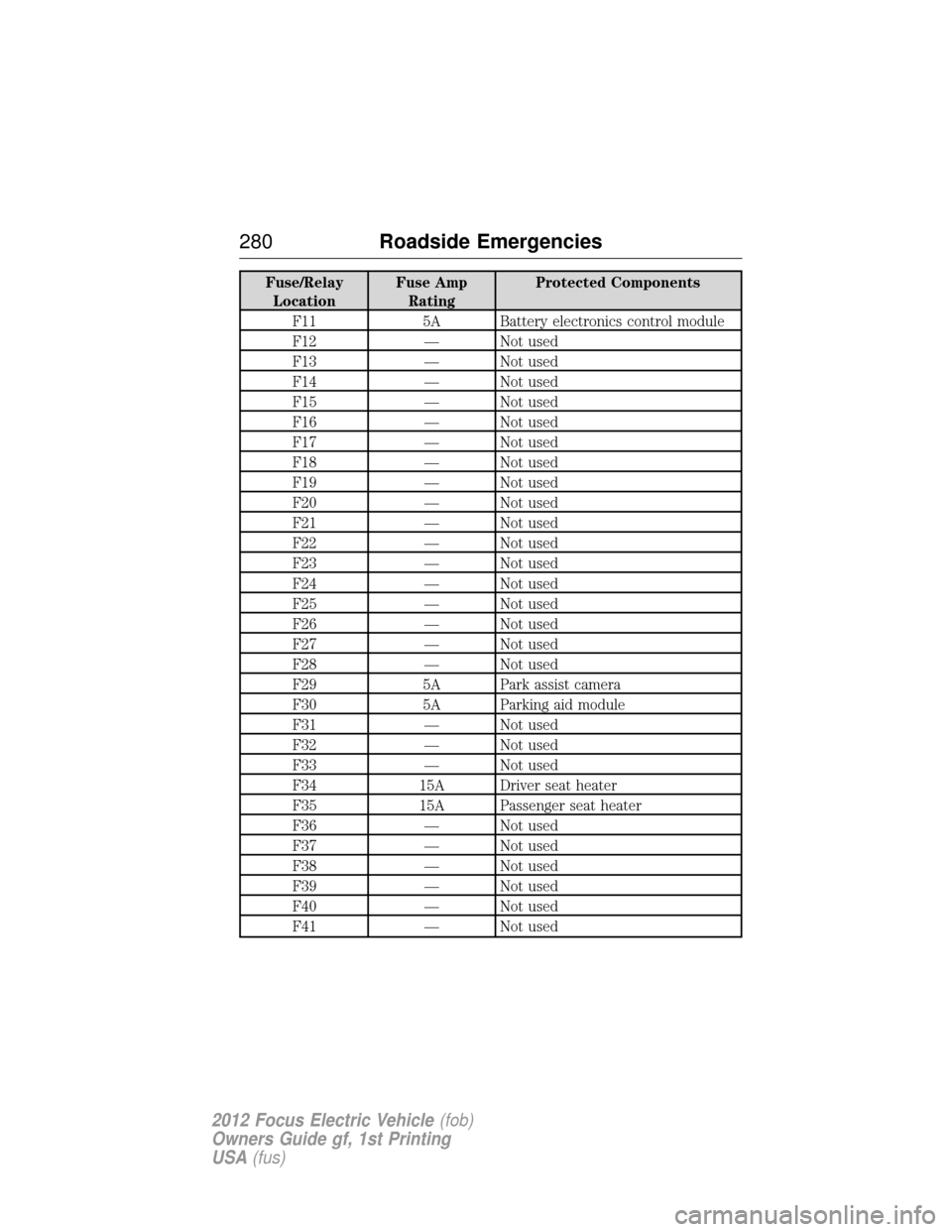
Fuse/RelayLocation Fuse Amp
Rating Protected Components
F11 5A Battery electronics control module
F12 — Not used
F13 — Not used
F14 — Not used
F15 — Not used
F16 — Not used
F17 — Not used
F18 — Not used
F19 — Not used
F20 — Not used
F21 — Not used
F22 — Not used
F23 — Not used
F24 — Not used
F25 — Not used
F26 — Not used
F27 — Not used
F28 — Not used
F29 5A Park assist camera
F30 5A Parking aid module
F31 — Not used
F32 — Not used
F33 — Not used
F34 15A Driver seat heater
F35 15A Passenger seat heater
F36 — Not used
F37 — Not used
F38 — Not used
F39 — Not used
F40 — Not used
F41 — Not used
280 Roadside Emergencies
2012 Focus Electric Vehicle (fob)
Owners Guide gf, 1st Printing
USA (fus)
Page 283 of 380
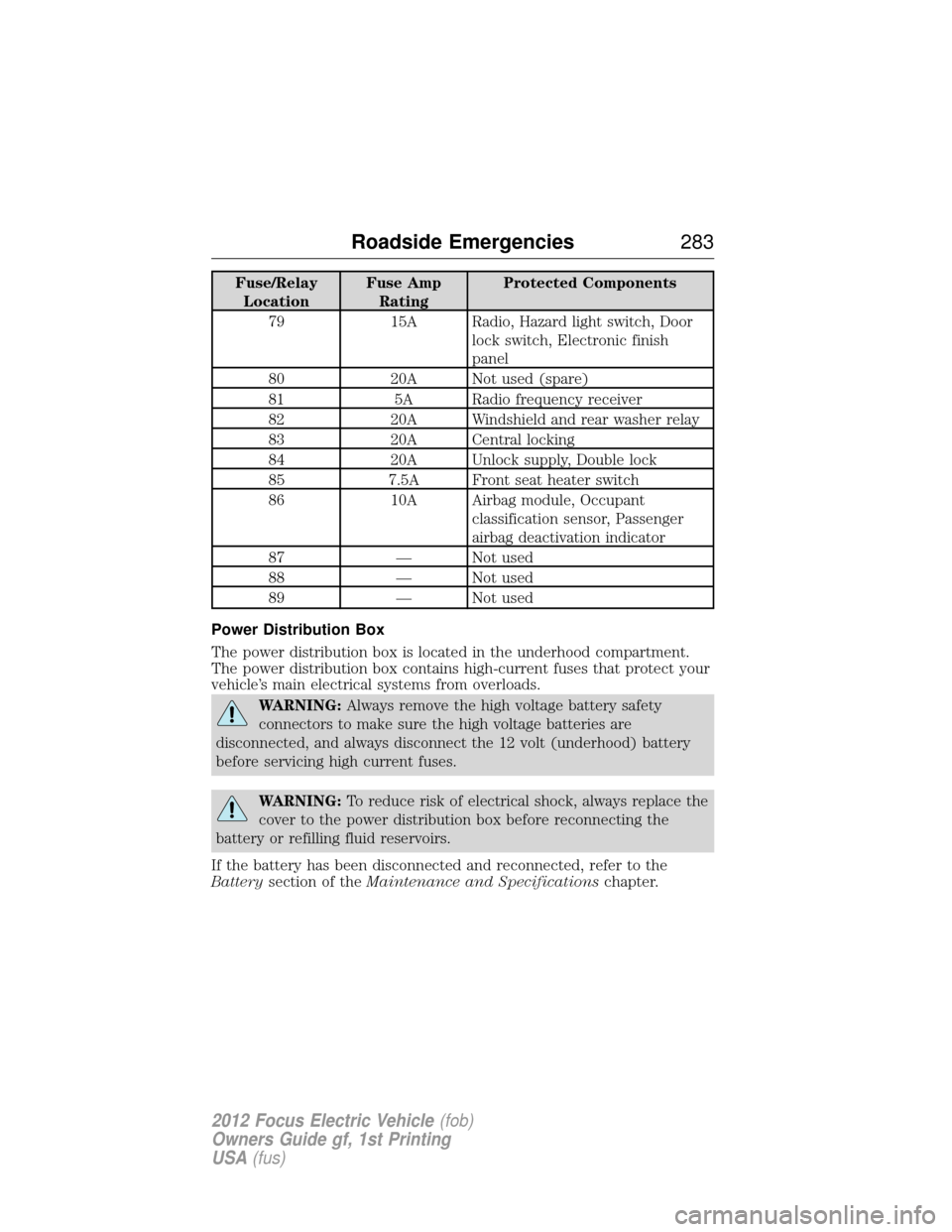
Fuse/RelayLocation Fuse Amp
Rating Protected Components
79 15A Radio, Hazard light switch, Door
lock switch, Electronic finish
panel
80 20A Not used (spare)
81 5A Radio frequency receiver
82 20A Windshield and rear washer relay
83 20A Central locking
84 20A Unlock supply, Double lock
85 7.5A Front seat heater switch
86 10A Airbag module, Occupant
classification sensor, Passenger
airbag deactivation indicator
87 — Not used
88 — Not used
89 — Not used
Power Distribution Box
The power distribution box is located in the underhood compartment.
The power distribution box contains high-current fuses that protect your
vehicle’s main electrical systems from overloads.
WARNING: Always remove the high voltage battery safety
connectors to make sure the high voltage batteries are
disconnected, and always disconnect the 12 volt (underhood) battery
before servicing high current fuses.
WARNING: To reduce risk of electrical shock, always replace the
cover to the power distribution box before reconnecting the
battery or refilling fluid reservoirs.
If the battery has been disconnected and reconnected, refer to the
Battery section of the Maintenance and Specifications chapter.
Roadside Emergencies 283
2012 Focus Electric Vehicle(fob)
Owners Guide gf, 1st Printing
USA (fus)
Page 285 of 380
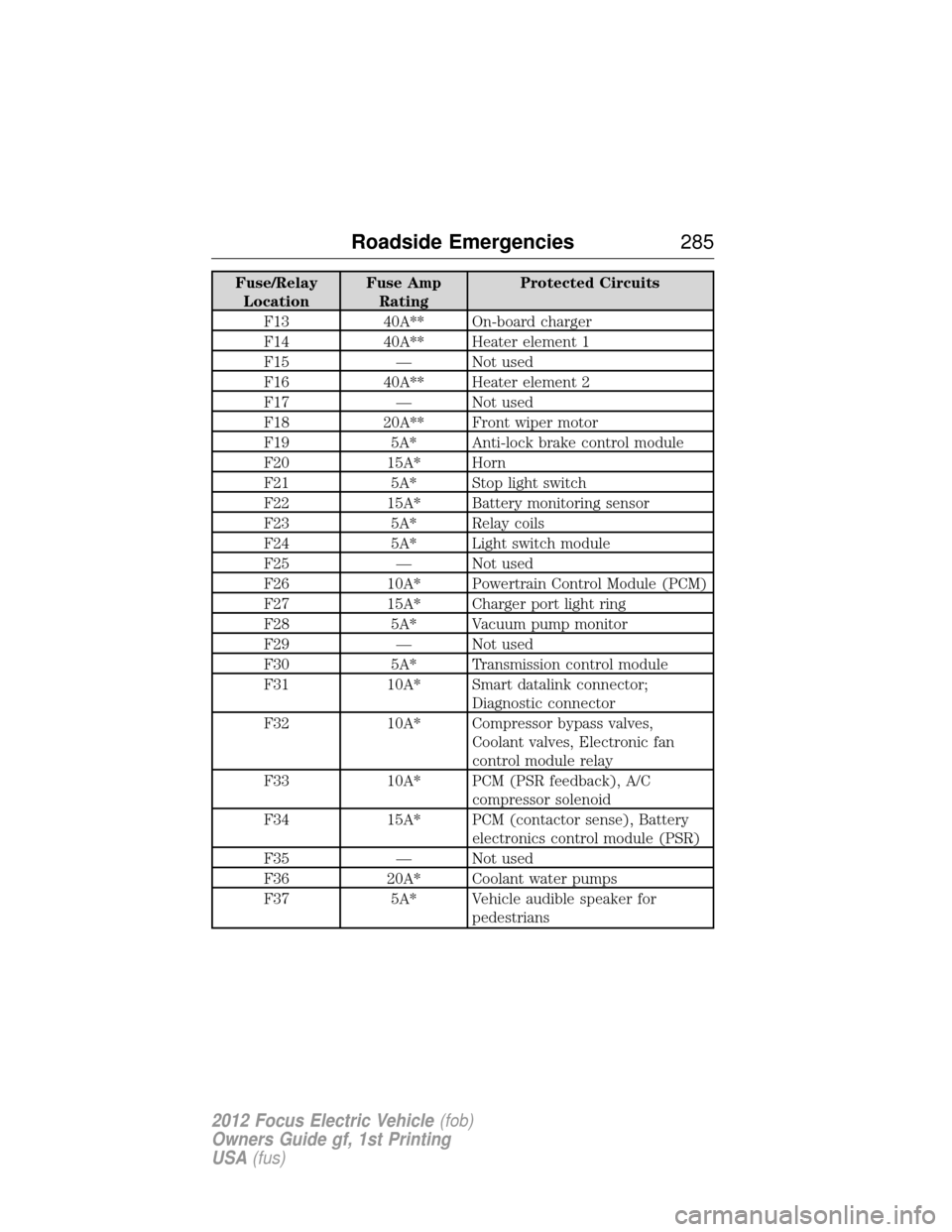
Fuse/RelayLocation Fuse Amp
Rating Protected Circuits
F13 40A** On-board charger
F14 40A** Heater element 1
F15 — Not used
F16 40A** Heater element 2
F17 — Not used
F18 20A** Front wiper motor
F19 5A* Anti-lock brake control module
F20 15A* Horn
F21 5A* Stop light switch
F22 15A* Battery monitoring sensor
F23 5A* Relay coils
F24 5A* Light switch module
F25 — Not used
F26 10A* Powertrain Control Module (PCM)
F27 15A* Charger port light ring
F28 5A* Vacuum pump monitor
F29 — Not used
F30 5A* Transmission control module
F31 10A* Smart datalink connector;
Diagnostic connector
F32 10A* Compressor bypass valves,
Coolant valves, Electronic fan
control module relay
F33 10A* PCM (PSR feedback), A/C
compressor solenoid
F34 15A* PCM (contactor sense), Battery
electronics control module (PSR)
F35 — Not used
F36 20A* Coolant water pumps
F37 5A* Vehicle audible speaker for
pedestrians
Roadside Emergencies 285
2012 Focus Electric Vehicle(fob)
Owners Guide gf, 1st Printing
USA (fus)
Page 291 of 380
Tips for use of the Temporary Mobility Kit
Read the following list of tips to ensure safe operation of the temporary
mobility kit:
•Before operating the temporary mobility kit, make sure your vehicle is
safely off the road and away from moving traffic. Turn on the hazard
lights.
• Always set the parking brake to ensure the vehicle doesn’t move
unexpectedly.
• Do not remove any foreign objects, such as nails or screws, from the
tire.
• When using the temporary mobility kit, leave the motor running so the
compressor doesn’t drain the vehicle’s battery.
• Do not allow the compressor to operate continuously for more than
15 minutes; this will help prevent the compressor from overheating.
• Never leave the temporary mobility kit unattended when it is
operating.
• Sealant compound contains latex. Make sure that you use the
non-latex gloves provided to avoid an allergic reaction.
• Keep the temporary mobility kit away from children.
• Only use the temporary mobility kit when the ambient temperature is
between -22°F (–30°C) and 158°F (70°C).
• Only use the sealing compound before the use by date. The use by
date is on the lower right hand corner of the label located on the
sealant canister (bottle). Note:Check the use by date regularly and
replace the canister after four years.
• Do not store the temporary mobility kit unsecured inside the
passenger compartment of the vehicle as it may cause injury during a
sudden stop or collision. Always store the kit in its original location.
• After sealant use, the TPMS sensor and valve stem on the wheel must
be replaced by an authorized Ford dealer.
• When inflating a tire or other objects, use the black air hose only. Do
not use the transparent hose which is designed for sealant application
only.
• Operating the temporary mobility kit could cause an electrical
disturbance in radio, CD, and DVD player operation (if equipped). .
Roadside Emergencies 291
2012 Focus Electric Vehicle(fob)
Owners Guide gf, 1st Printing
USA (fus)