Page 124 of 306
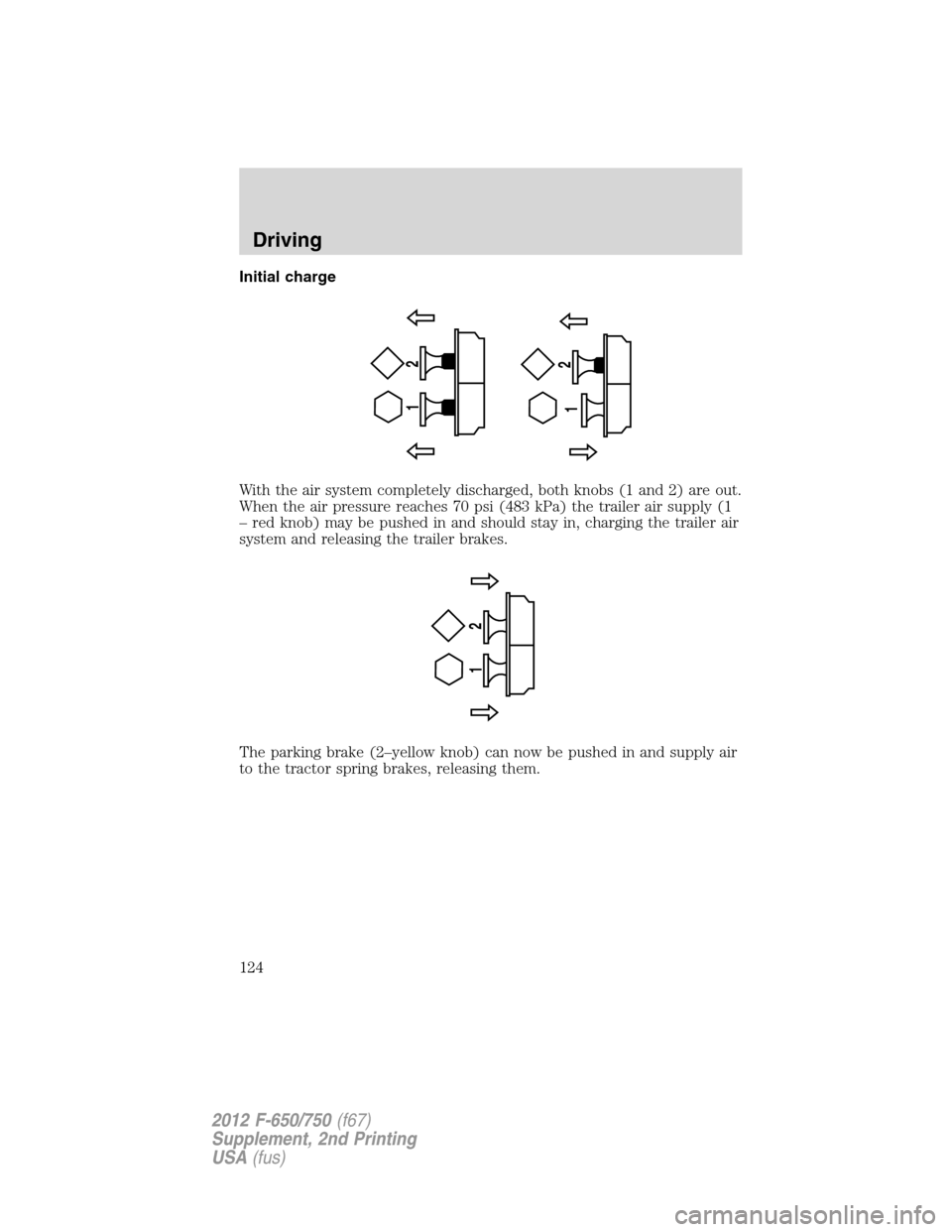
Initial charge
With the air system completely discharged, both knobs (1 and 2) are out.
When the air pressure reaches 70 psi (483 kPa) the trailer air supply (1
– red knob) may be pushed in and should stay in, charging the trailer air
system and releasing the trailer brakes.
The parking brake (2–yellow knob) can now be pushed in and supply air
to the tractor spring brakes, releasing them.
12 12
12
Driving
124
2012 F-650/750(f67)
Supplement, 2nd Printing
USA(fus)
Page 125 of 306
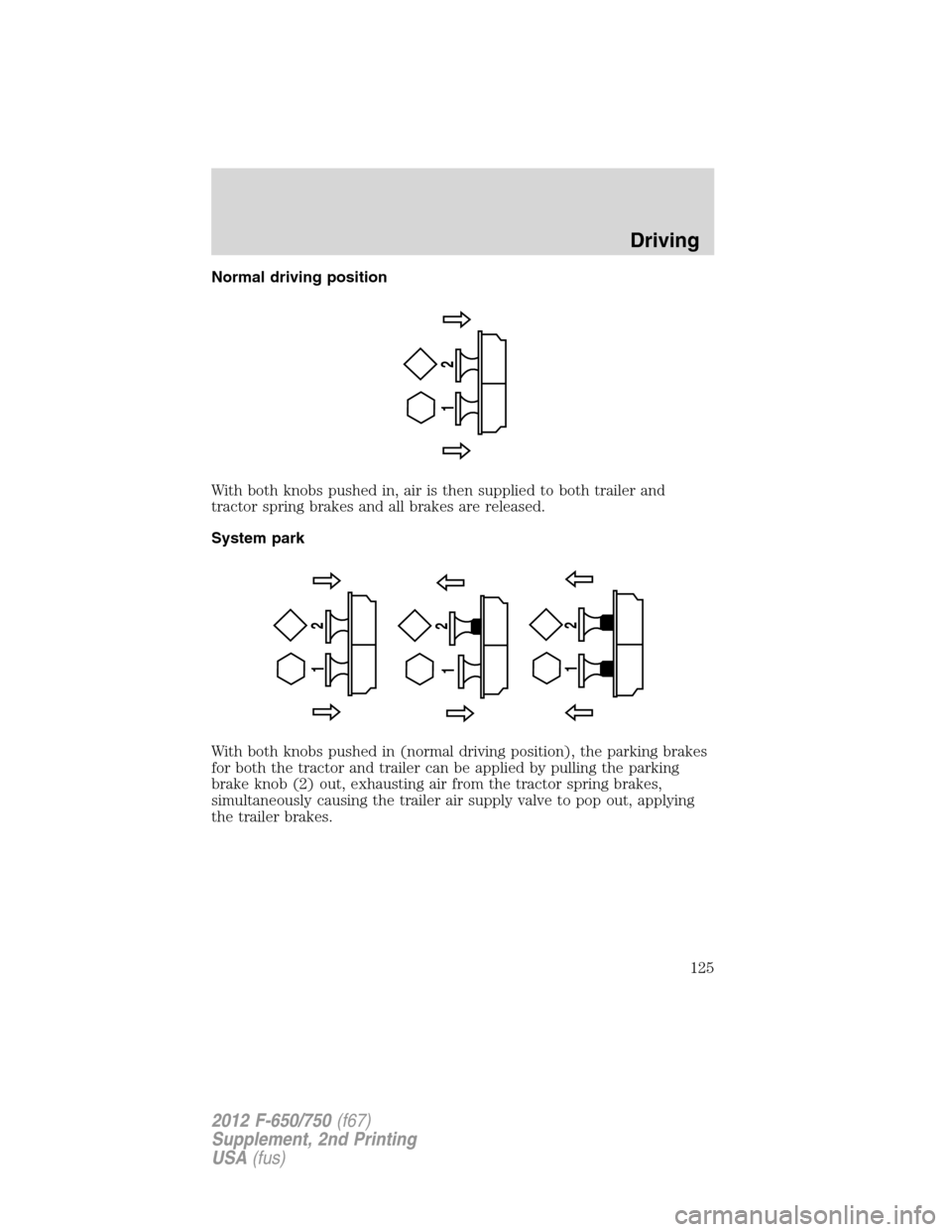
Normal driving position
With both knobs pushed in, air is then supplied to both trailer and
tractor spring brakes and all brakes are released.
System park
With both knobs pushed in (normal driving position), the parking brakes
for both the tractor and trailer can be applied by pulling the parking
brake knob (2) out, exhausting air from the tractor spring brakes,
simultaneously causing the trailer air supply valve to pop out, applying
the trailer brakes.
12
12
12
12
Driving
125
2012 F-650/750(f67)
Supplement, 2nd Printing
USA(fus)
Page 126 of 306
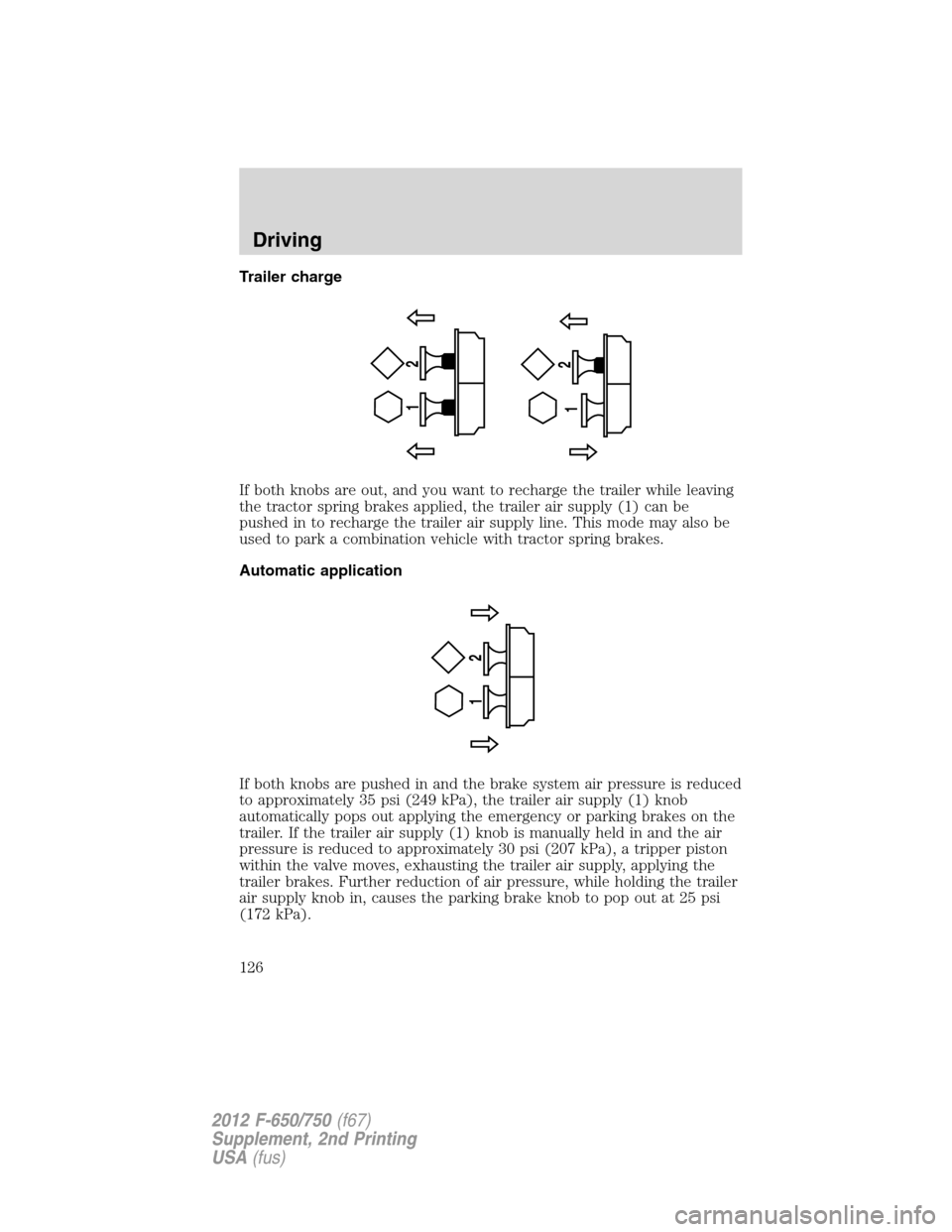
Trailer charge
If both knobs are out, and you want to recharge the trailer while leaving
the tractor spring brakes applied, the trailer air supply (1) can be
pushed in to recharge the trailer air supply line. This mode may also be
used to park a combination vehicle with tractor spring brakes.
Automatic application
If both knobs are pushed in and the brake system air pressure is reduced
to approximately 35 psi (249 kPa), the trailer air supply (1) knob
automatically pops out applying the emergency or parking brakes on the
trailer. If the trailer air supply (1) knob is manually held in and the air
pressure is reduced to approximately 30 psi (207 kPa), a tripper piston
within the valve moves, exhausting the trailer air supply, applying the
trailer brakes. Further reduction of air pressure, while holding the trailer
air supply knob in, causes the parking brake knob to pop out at 25 psi
(172 kPa).
12 12
12
Driving
126
2012 F-650/750(f67)
Supplement, 2nd Printing
USA(fus)
Page 127 of 306

Actuation of trailer park (emergency) or tractor bobtail position
To actuate the trailer brakes only, pull out the trailer air supply knob (1).
The trailer brakes are now applied whether emergency or spring brakes
are used on the trailer.
This mode is also used when the tractor or truck with trailer is used
during bobtail operation.
ANTI-LOCK BRAKE SYSTEM (ABS)
Your vehicle is equipped with an anti-lock braking system (ABS). This
system helps you maintain steering control during emergency stops by
keeping the brakes from locking. Noise from the ABS pump motor and
brake pedal pulsation may be observed during ABS braking; any
pulsation or mechanical noise you may feel or hear is normal.
When hard braking is required, apply continuous force on the brake
pedal. Do not pump the brake pedal since this reduces the effectiveness
of the ABS and increases your vehicle’s stopping distance. The ABS
activates immediately, allowing you to retain steering control during hard
braking and on slippery surfaces. However, the ABS does not decrease
stopping distance.
ABS warning light
The
light in the instrument cluster momentarily illuminates when the
ignition is turned on. If the light does not illuminate during start up,
remains on after the vehicle reaches 5–10 mph (8–16 km/h), or flashes,
the ABS may be disabled and may need to be serviced.
Even when the ABS is disabled, normal braking is still effective. If
the
light illuminates with the parking brake released, have your
brake system serviced immediately.
1
2
Driving
127
2012 F-650/750(f67)
Supplement, 2nd Printing
USA(fus)
Page 128 of 306
TRACTION CONTROL (IF EQUIPPED)
Your vehicle may be equipped with a traction control system which helps
you maintain stability and steerability, especially on slippery road
surfaces such as snow- or ice-covered roads and gravel roads, by
reducing engine power and/or selectively applying the rear brakes.
Note:The traction control system does not apply the brakes when
vehicle speed is above 25 mph (40 km/h).
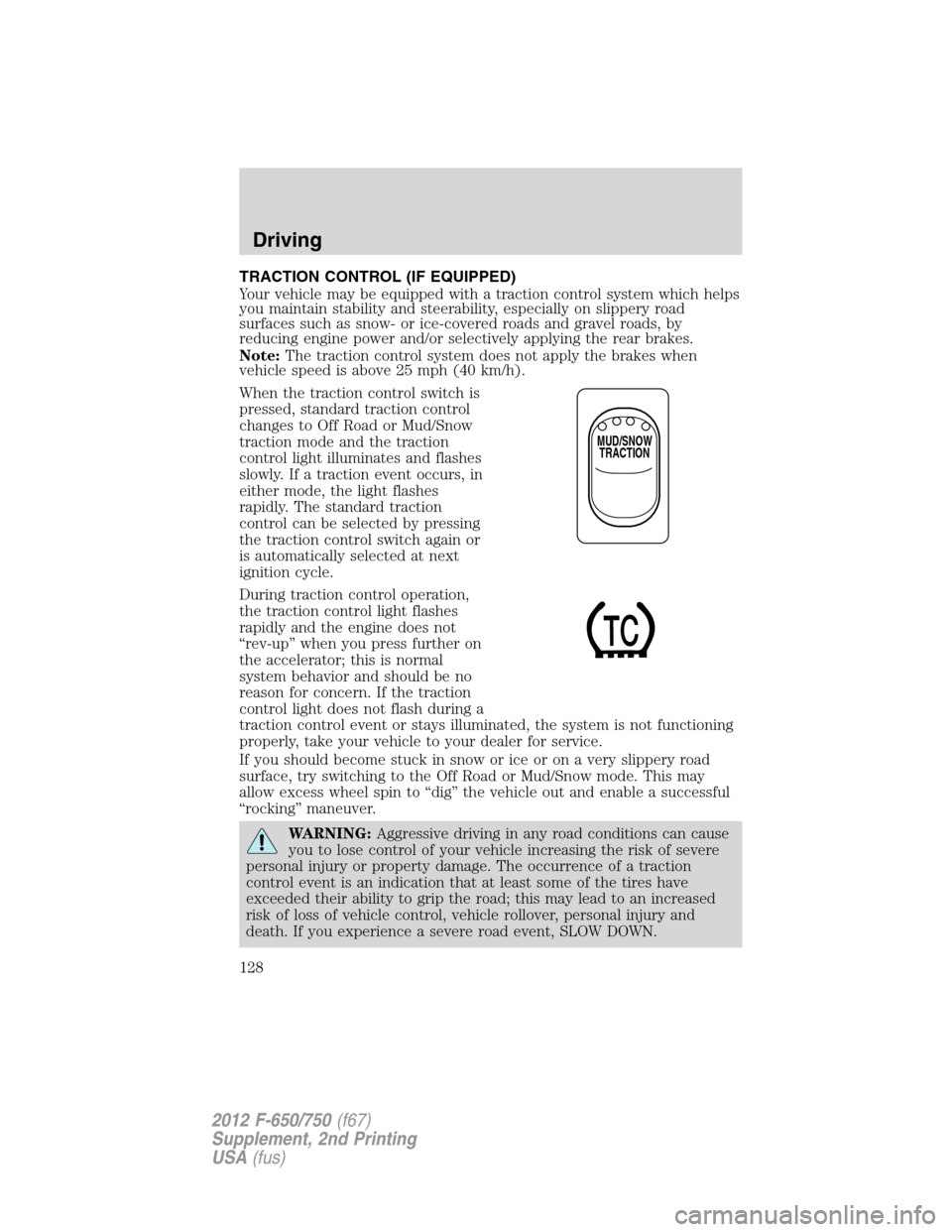
When the traction control switch is
pressed, standard traction control
changes to Off Road or Mud/Snow
traction mode and the traction
control light illuminates and flashes
slowly. If a traction event occurs, in
either mode, the light flashes
rapidly. The standard traction
control can be selected by pressing
the traction control switch again or
is automatically selected at next
ignition cycle.
During traction control operation,
the traction control light flashes
rapidly and the engine does not
“rev-up” when you press further on
the accelerator; this is normal
system behavior and should be no
reason for concern. If the traction
control light does not flash during a
traction control event or stays illuminated, the system is not functioning
properly, take your vehicle to your dealer for service.
If you should become stuck in snow or ice or on a very slippery road
surface, try switching to the Off Road or Mud/Snow mode. This may
allow excess wheel spin to “dig” the vehicle out and enable a successful
“rocking” maneuver.
WARNING:Aggressive driving in any road conditions can cause
you to lose control of your vehicle increasing the risk of severe
personal injury or property damage. The occurrence of a traction
control event is an indication that at least some of the tires have
exceeded their ability to grip the road; this may lead to an increased
risk of loss of vehicle control, vehicle rollover, personal injury and
death. If you experience a severe road event, SLOW DOWN.
MUD/SNOW
TRACTION
Driving
128
2012 F-650/750(f67)
Supplement, 2nd Printing
USA(fus)
Page 130 of 306
Tractor-trailer connections
WARNING:To reduce the risk of personal injury, use extreme
caution when making brake and light connections. Inclement
weather and accumulated road contamination deposits on handhold
and stepping surfaces require extra care to avoid slip and falls. Provide
adequate lighting of working areas.
WARNING:Do not climb on the back of the tractor unless it
has been provided with a deck plate and handholds. Use a
three-point stance when climbing up and down from a deck plate. Do
not jump from the vehicle. Whenever possible, make all connections
while standing on the ground.
Connecting and disconnecting a trailer with air suspension and air
suspension dump switch (if equipped)
When connecting to a trailer:
•Press the lower portion of the dump switch to exhaust air from the air
suspension system.
•After making the connection to the trailer, press the upper portion of
the dump switch, then raise the landing gear.
When disconnecting the trailer:
•
Lower the landing gear, then press the lower portion of the dump switch.
•Disconnect the brake hoses, trailer-side and rear light connectors,
then pull the release lever on the fifth-wheel.
The upper portion of the dump switch must be pressed before operating
with a trailer or operating in the bobtail mode.
Suspension conversions
It is not recommended, or approved, that suspension conversions be
performed. However, it is understood that, on occasion, aftermarket add-on
suspensions are installed by others on the truck chassis which allow
operator control for weight transfer from other axles (i.e., air lift axles).
WARNING:When operating a loaded vehicle, the driver must
keep all adjustable axles on the ground at all times, supporting
their share of the vehicle’s load. Failure to do so can overload other
axles, tires, wheels, springs, steering components, brakes and frames,
resulting in early component failure, loss of vehicle control, possible
property damage and personal injury.
Driving
130
2012 F-650/750(f67)
Supplement, 2nd Printing
USA(fus)
Page 131 of 306

BRAKE-SHIFT INTERLOCK
Vehicles equipped with a gasoline engine have a brake-shift interlock
feature that prevents the gearshift lever from being moved from P (Park)
when the ignition is in the on position and the brake pedal is not pressed.
If you cannot move the gearshift lever out of P (Park) with the ignition
in the on position and the brake pedal pressed, it is possible that a fuse
has blown or the vehicle’s brake lamps are not operating properly. Refer
toFuses and relaysin theRoadside Emergencieschapter.
If the fuse is not blown and the brake lamps are working properly, the
following procedure will allow you to move the gearshift lever from P (Park):
1. Apply the parking brake, and turn
the engine off.
2. Remove the lower finish panel
below the steering column
3. Turn the key to on (position 4),
but do not start engine.
4. Pull back on the solenoid, and at
the same time, shift the
transmission into N (Neutral).
5. Start the vehicle.
See your authorized dealer as
soon as possible if this
procedure is used.
WARNING:Do not drive
your vehicle until you verify
that the brake lamps are working.
1
2
34
5
Driving
131
2012 F-650/750(f67)
Supplement, 2nd Printing
USA(fus)
Page 132 of 306

WARNING:When doing this procedure, you will be taking the
vehicle out of park which means the vehicle can roll freely. To
avoid unwanted vehicle movement, always fully set the parking brake
prior to doing this procedure. Use wheel chocks if appropriate.
WARNING:If the parking brake is fully released, but the brake
warning lamp remains illuminated, the brakes may not be
working properly. See your authorized dealer.
AUTOMATIC TRANSMISSION OPERATION (IF EQUIPPED)
Main transmission, auxiliary transmission, transfer case and power take-off
(PTO) control shift patterns can be found on a placard or decal on the
driver’s sun visor, on the instrument panel or on the shift control itself.
The main transmission control is used to select the various gear ratios or
speeds of the transmission. Selecting D (Direct Drive), does not change
the transmission gear ratio, but is used where the gear ratios in the main
transmission are adequate to handle the vehicle operation.
If the transmission fails to shift properly, check the inline 10A fuse
located in the battery cables above the battery.
WARNING:Hold the brake pedal down while you move the
gearshift lever between positions. If you don’t hold the brake
pedal down, your vehicle may move unexpectedly and cause property
damage, personal injury or death.
6–speed TorqShift�transmission
This vehicle is equipped with an adaptive transmission shift strategy.
Adaptive transmission shift strategy offers the optimal transmission
operation and shift quality. When the vehicle’s battery has been
disconnected for any type of service or repair, the transmission will need
to relearn the normal shift strategy parameters, much like having to reset
your radio stations when your vehicle battery has been disconnected.
The adaptive transmission shift strategy allows the transmission to
relearn these operating parameters. This learning process could take
PRND 4 2 1
Driving
132
2012 F-650/750(f67)
Supplement, 2nd Printing
USA(fus)