Page 7 of 306

FEDERAL HIGHWAY ADMINISTRATION REGULATION
Regulations such as those issued by the Federal Highway Administration
or issued pursuant to the Occupational Safety and Health Act (OSHA),
and/or state and local laws and regulations may require additional
equipment for the way you intend to use the vehicle. It is the
responsibility of the registered owner to determine the applicability of
such laws and regulations to your intended use for the vehicle, and to
arrange for the installation of required equipment. Your dealer has
information about the availability of equipment which may be ordered for
your vehicle.
ENTERING, EXITING AND/OR CLIMBING ON THIS VEHICLE
You must be careful and deliberate to minimize the possibility of personal
injury from a slip and fall when entering, exiting and/or climbing on this
vehicle. Always use the steps and assist handles before climbing. Do not
skip any steps or assist handles. Use three point contact at all times with
at least two feet and one hand or two hands and one foot firmly placed
during all phases of entering, exiting and/or climbing. Always keep your
shoe soles and hands clean. Keep the steps and assist handles free of
snow, ice, oil, grease, substances or debris. Be sure to use extra care in
bad weather. Avoid wearing thick gloves. Always perform trailer hook-up
while standing on the ground.
WARNING:Do not carry items while entering, exiting, and/or
climbing. Make sure you keep a firm grip. Always FACE the
VEHICLE STEP and HANDLE SYSTEM while climbing up and down.
Do not climb behind the cab unless you have three point contact with
a step and handle system at all times.
Introduction
7
2012 F-650/750(f67)
Supplement, 2nd Printing
USA(fus)
Page 13 of 306
Engine starting (parking brake applied)
Air brakesVerify air brake operation in the following manner
(chock the wheels, if necessary. Push in the
parking brake and on tractors, also push in the
tractor parking brake knob):
1. Verify the air compressor or governor cut-out
pressure is approximately 120 psi (827 kPa).
2. Turn off the engine, then turn the key back to
the on position, without starting the engine.
3. Without the brake pedal applied, note the air
pressure drop for one minute; it should be less
than 2 psi (14 kPa) for single vehicles and 3 psi
(21 kPa) for combination vehicles.
4. Press and hold the brake pedal with 90 psi
(621 kPa) or more and make sure there is no
more than a 3 psi (21 kPa) per minute leak; for
combination vehicles, no more than 4 psi
(28 kPa) per minute.
5. Pump the brake pedal to deplete the system of
air pressure. The warning light and chime should
activate at 57 psi (393 kPa).
6. Pump the brake pedal and make sure the
parking brake and trailer parking brake knobs
pop out at 20 psi (138 kPa) or higher.
Automatic
transmission fluidInspect the automatic transmission fluid with the
engine idling at normal operating temperature
and the parking brake applied. If fluid needs to
be added, refer toTransmission fluidin the
Maintenance and Specificationschapter.
Vehicle Inspection Guide
13
2012 F-650/750(f67)
Supplement, 2nd Printing
USA(fus)
Page 19 of 306
Rear wheels
SpacersVerify dual wheels are evenly separated and that
tires are not touching one another.
RimsInspect for damaged or bent rims. Rims should
not have welding repairs and no rust trails that
indicate it is loose on the wheel.
Lug nutsVerify all lug nuts are present and not loose (look
for rust trails around the lug nuts); there should
be no cracks radiating from the lug bolt holes or
distortion of the bolt holes.
Trailer
If you are pulling a trailer, an inspection of the trailer similar to that of
the tractor should be done. The inspection should follow trailer
manufacturer recommendations and should include at a minimum:
general condition, landing gear, doors, sides, lights, reflectors,
suspension, brakes, tires, wheels, cargo placement, stability and
tie-downs.
Transmission
If your vehicle is equipped with an automatic transmission, regularly
inspect the transmission’s neutral start switch. The engine should only
start in the N (Neutral) or P (Park) positions.
WARNING:If the unit starts in gear and/or the neutral start
switch is not functioning correctly, the vehicle may inadvertently
move which could result in property damage, personal injury or death.
Inspect the transmission fluid level and shift linkage for proper
operation.
Vehicle Inspection Guide
19
2012 F-650/750(f67)
Supplement, 2nd Printing
USA(fus)
Page 26 of 306

Traction control (if equipped)
(diesel engine only):Illuminates
and flashes slowly if the Off Road or
Mud/Snow mode is selected.
Illuminates and flashes rapidly
during a traction control event.
Traction control (if equipped)
(gasoline engine only):
Illuminates when the traction
control is active. If the light remains
on, have the system serviced
immediately, refer to theDrivingchapter for more information.
Trailer anti-lock brake system
(ABS):Illuminates briefly when the
engine is powered-up and only when
a PLC trailer or a PLC diagnostic
tool is connected. If the light
remains on after the vehicle is
started, continues to flash or fails to
illuminate, have the system serviced
immediately.
Turn signal:Illuminates when the
left or right turn signal or the
hazard lights are turned on. If the
indicators stay on or flash faster, check for a burned out bulb.
Wait to start (diesel engine
only):Illuminates when the air
intake heater is in operation and
special starting procedures are
required. Refer toStartingin theDrivingchapter.
WARNING:If equipped with an air intake heater, DO NOT use
ether or any other starting fluids. The use of starting fluids
(ether) in an engine equipped with an air intake heater could result in
damage and/or personal injury.
Instrument Cluster
26
2012 F-650/750(f67)
Supplement, 2nd Printing
USA(fus)
Page 62 of 306
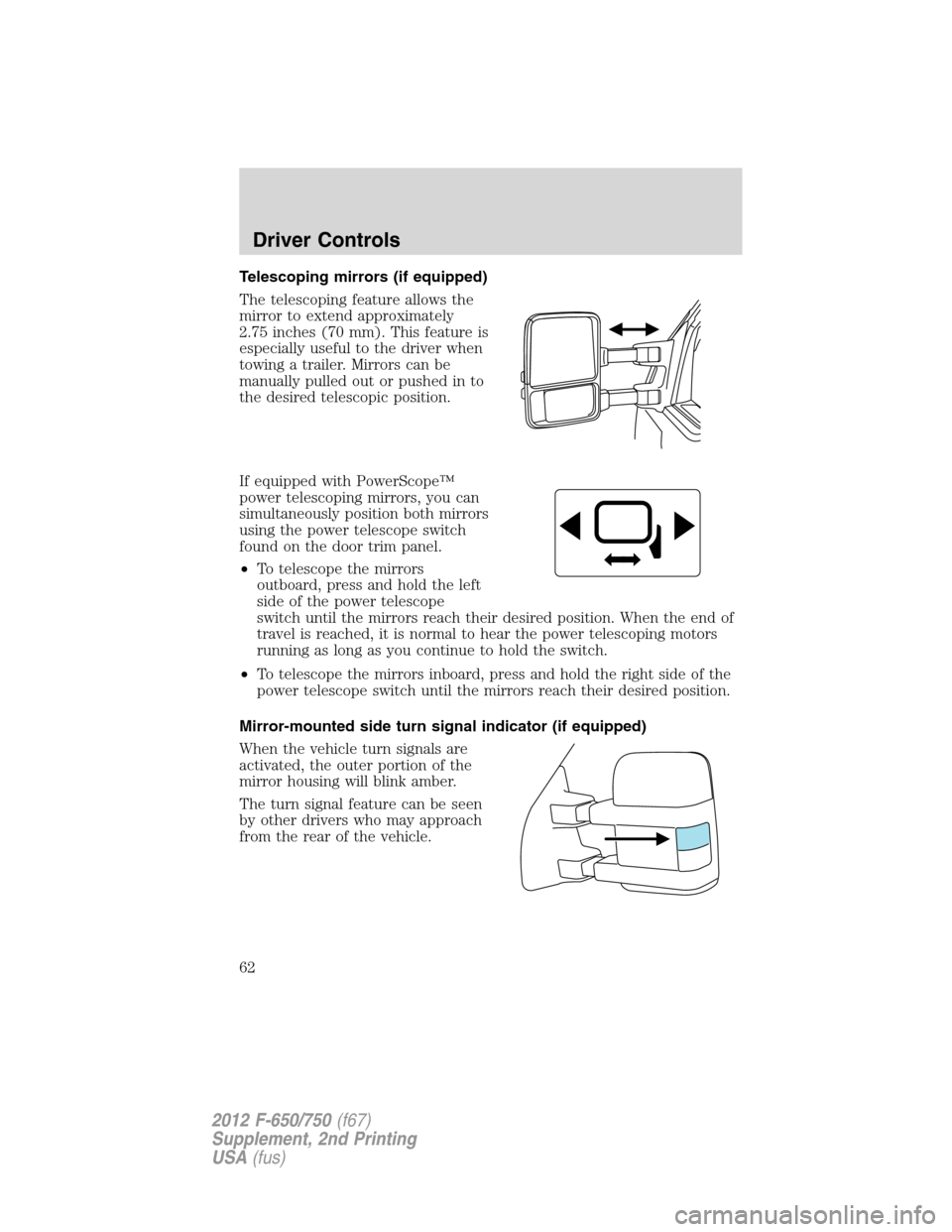
Telescoping mirrors (if equipped)
The telescoping feature allows the
mirror to extend approximately
2.75 inches (70 mm). This feature is
especially useful to the driver when
towing a trailer. Mirrors can be
manually pulled out or pushed in to
the desired telescopic position.
If equipped with PowerScope™
power telescoping mirrors, you can
simultaneously position both mirrors
using the power telescope switch
found on the door trim panel.
•To telescope the mirrors
outboard, press and hold the left
side of the power telescope
switch until the mirrors reach their desired position. When the end of
travel is reached, it is normal to hear the power telescoping motors
running as long as you continue to hold the switch.
•To telescope the mirrors inboard, press and hold the right side of the
power telescope switch until the mirrors reach their desired position.
Mirror-mounted side turn signal indicator (if equipped)
When the vehicle turn signals are
activated, the outer portion of the
mirror housing will blink amber.
The turn signal feature can be seen
by other drivers who may approach
from the rear of the vehicle.
Driver Controls
62
2012 F-650/750(f67)
Supplement, 2nd Printing
USA(fus)
Page 123 of 306
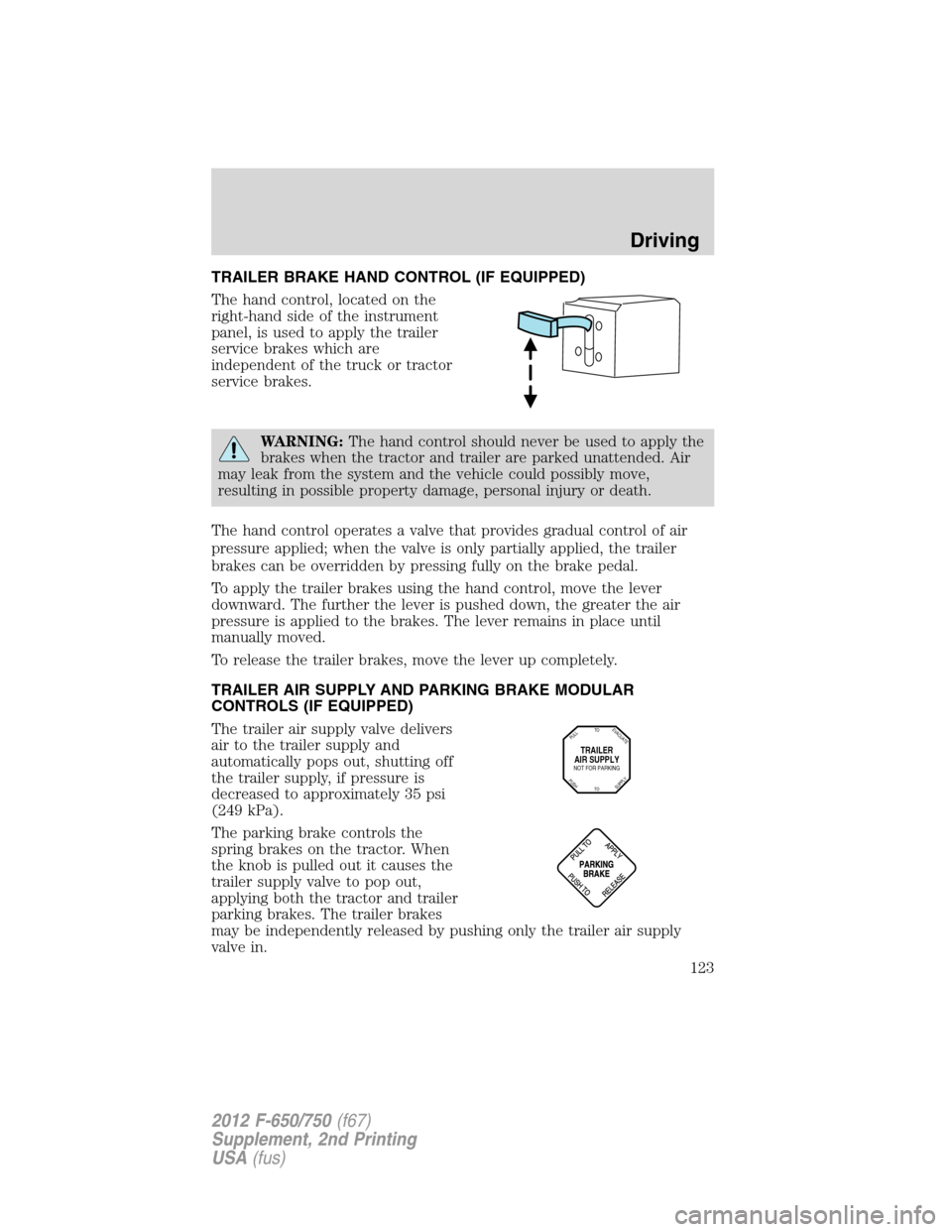
TRAILER BRAKE HAND CONTROL (IF EQUIPPED)
The hand control, located on the
right-hand side of the instrument
panel, is used to apply the trailer
service brakes which are
independent of the truck or tractor
service brakes.
WARNING:The hand control should never be used to apply the
brakes when the tractor and trailer are parked unattended. Air
may leak from the system and the vehicle could possibly move,
resulting in possible property damage, personal injury or death.
The hand control operates a valve that provides gradual control of air
pressure applied; when the valve is only partially applied, the trailer
brakes can be overridden by pressing fully on the brake pedal.
To apply the trailer brakes using the hand control, move the lever
downward. The further the lever is pushed down, the greater the air
pressure is applied to the brakes. The lever remains in place until
manually moved.
To release the trailer brakes, move the lever up completely.
TRAILER AIR SUPPLY AND PARKING BRAKE MODULAR
CONTROLS (IF EQUIPPED)
The trailer air supply valve delivers
air to the trailer supply and
automatically pops out, shutting off
the trailer supply, if pressure is
decreased to approximately 35 psi
(249 kPa).
The parking brake controls the
spring brakes on the tractor. When
the knob is pulled out it causes the
trailer supply valve to pop out,
applying both the tractor and trailer
parking brakes. The trailer brakes
may be independently released by pushing only the trailer air supply
valve in.
TRAILER
AIR SUPPLY
NOT FOR PARKING
TO
TOPULL
SUPPLY
EVACUATE
PUSH
Driving
123
2012 F-650/750(f67)
Supplement, 2nd Printing
USA(fus)
Page 124 of 306
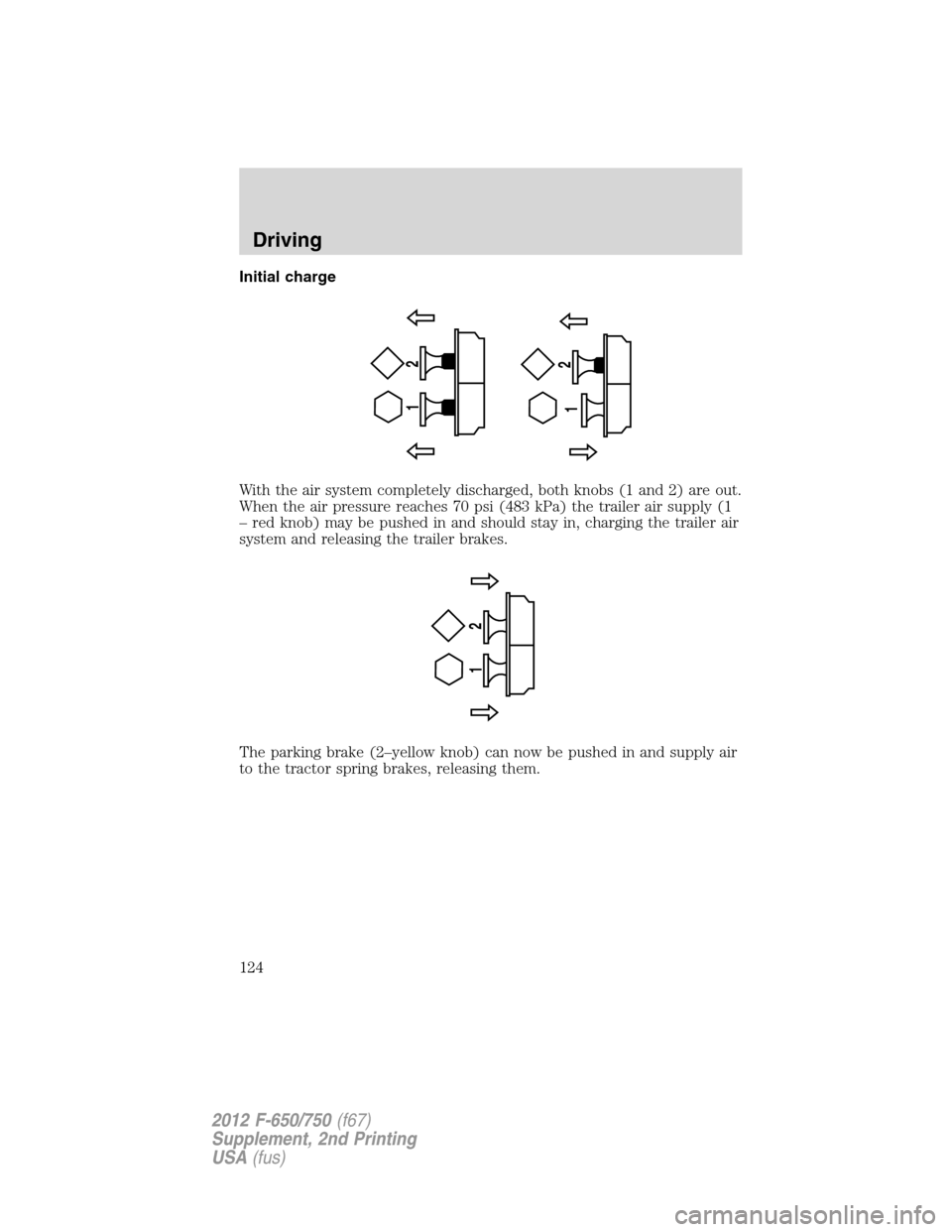
Initial charge
With the air system completely discharged, both knobs (1 and 2) are out.
When the air pressure reaches 70 psi (483 kPa) the trailer air supply (1
– red knob) may be pushed in and should stay in, charging the trailer air
system and releasing the trailer brakes.
The parking brake (2–yellow knob) can now be pushed in and supply air
to the tractor spring brakes, releasing them.
12 12
12
Driving
124
2012 F-650/750(f67)
Supplement, 2nd Printing
USA(fus)
Page 125 of 306
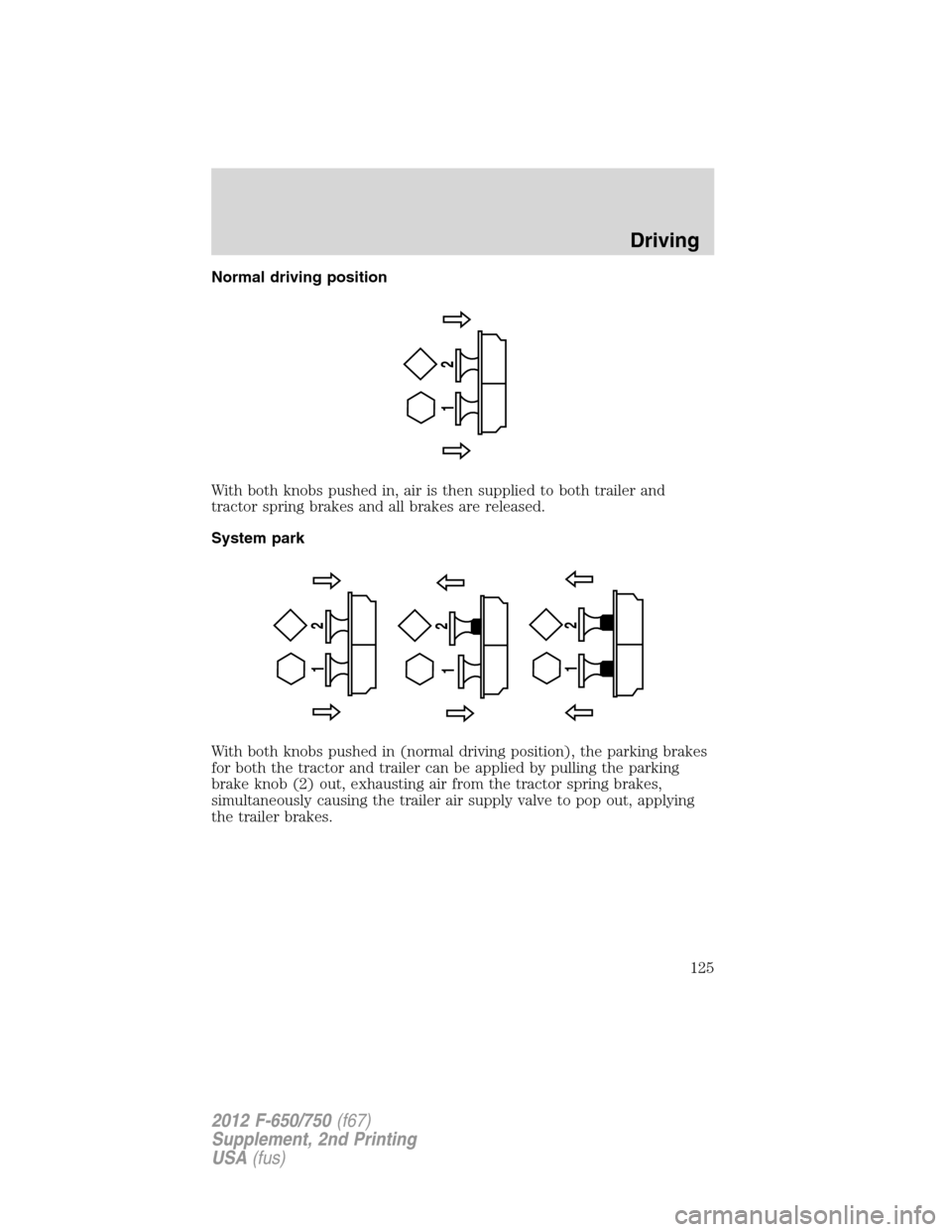
Normal driving position
With both knobs pushed in, air is then supplied to both trailer and
tractor spring brakes and all brakes are released.
System park
With both knobs pushed in (normal driving position), the parking brakes
for both the tractor and trailer can be applied by pulling the parking
brake knob (2) out, exhausting air from the tractor spring brakes,
simultaneously causing the trailer air supply valve to pop out, applying
the trailer brakes.
12
12
12
12
Driving
125
2012 F-650/750(f67)
Supplement, 2nd Printing
USA(fus)