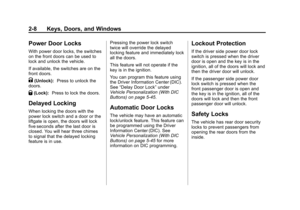
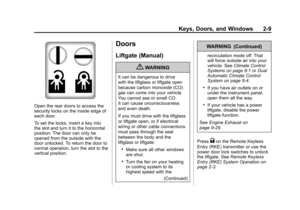
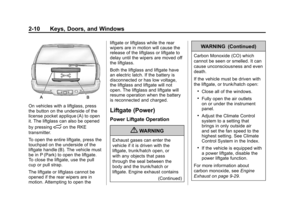
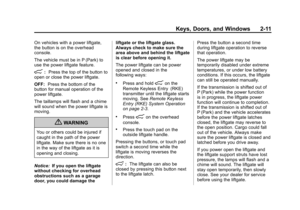
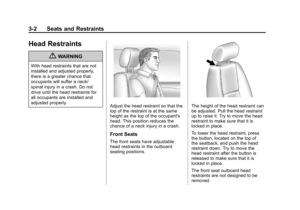
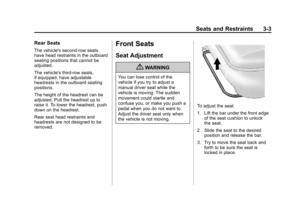
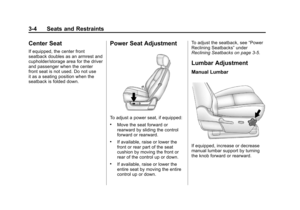
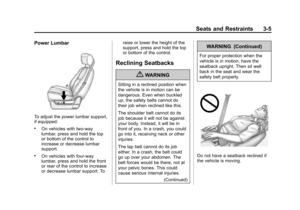
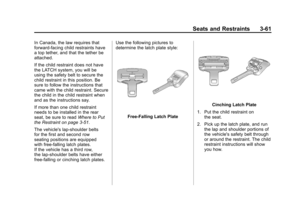
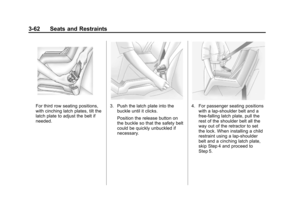
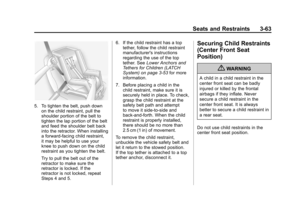
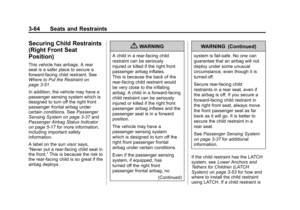
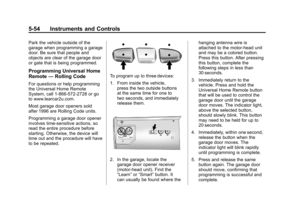
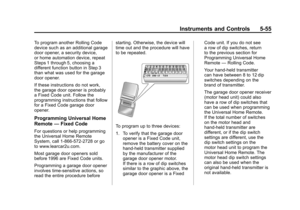
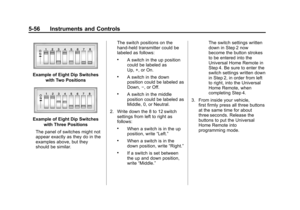
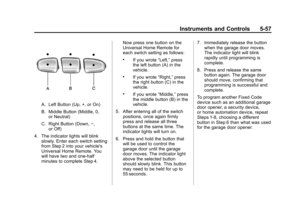
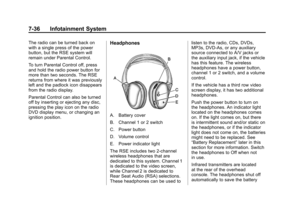
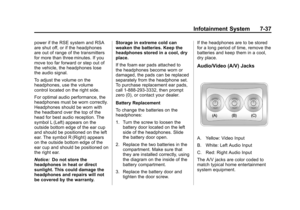
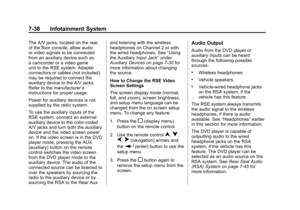
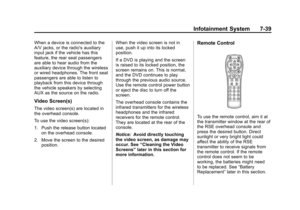
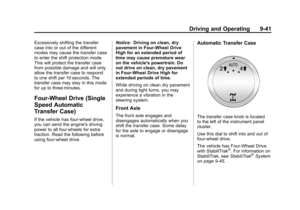
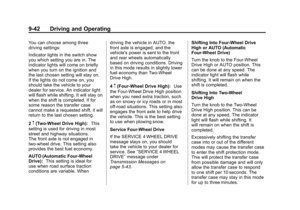
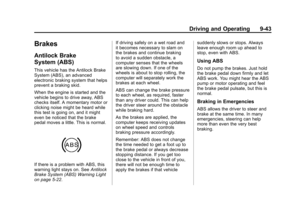
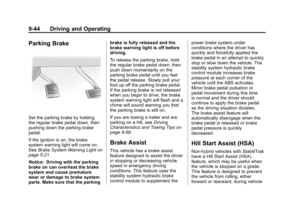
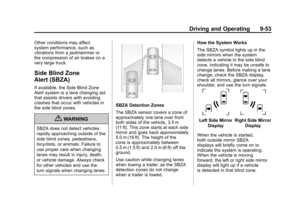
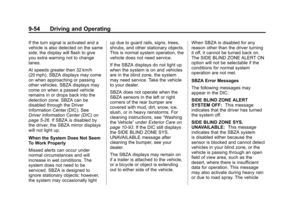
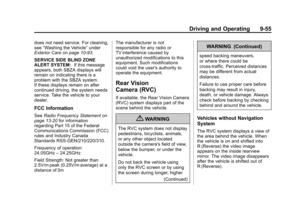
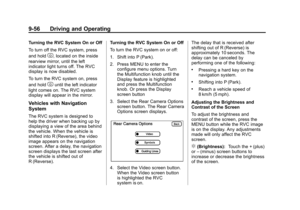
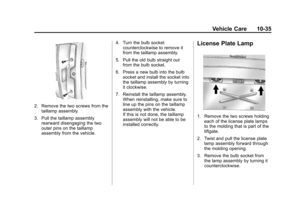
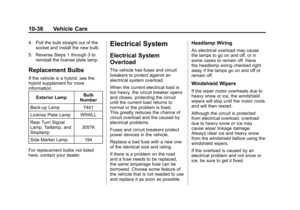
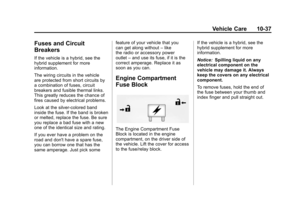
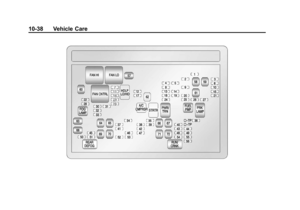
Page 377 of 514

Black plate (27,1)Chevrolet Tahoe/Suburban Owner Manual - 2012
Vehicle Care 10-27
Infrequent Usage: Remove the
black, negative (−) cable from the
battery to keep the battery from
running down.
Extended Storage: Remove the
black, negative (−) cable from the
battery or use a battery trickle
charger.
Four-Wheel Drive
Transfer Case
When to Check Lubricant
Refer toMaintenance Schedule on
page 11‑3 to determine when to
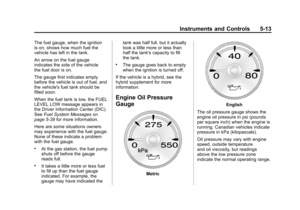
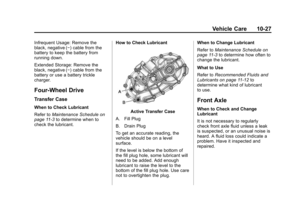
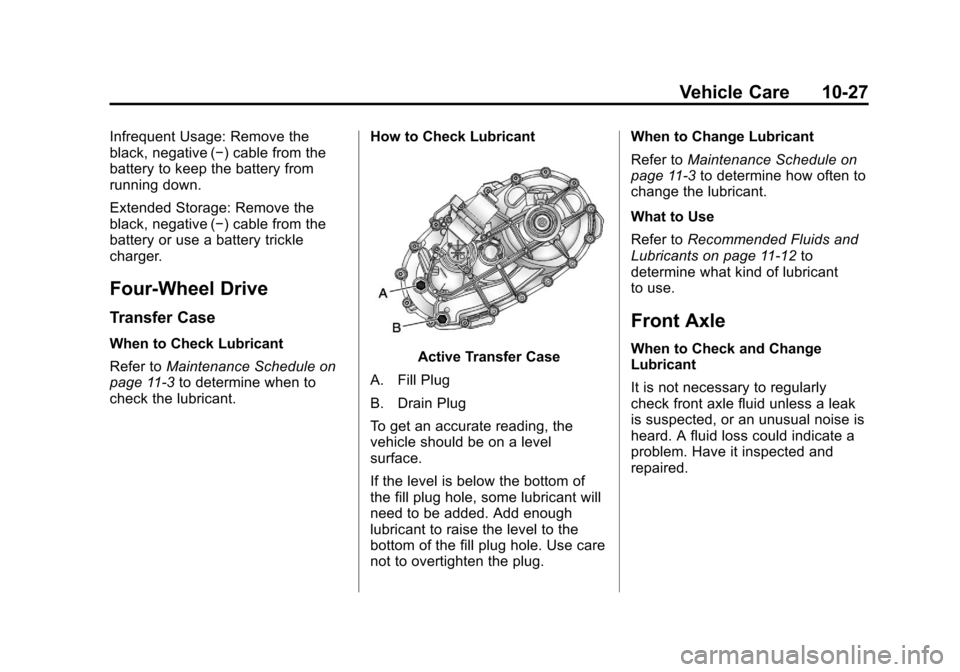
check the lubricant. How to Check LubricantActive Transfer Case
A. Fill Plug
B. Drain Plug
To get an accurate reading, the
vehicle should be on a level
surface.
If the level is below the bottom of
the fill plug hole, some lubricant will
need to be added. Add enough
lubricant to raise the level to the
bottom of the fill plug hole. Use care
not to overtighten the plug. When to Change Lubricant
Refer to
Maintenance Schedule on
page 11‑3 to determine how often to
change the lubricant.
What to Use
Refer to Recommended Fluids and
Lubricants on page 11‑12 to
determine what kind of lubricant
to use.
Front Axle
When to Check and Change
Lubricant
It is not necessary to regularly
check front axle fluid unless a leak
is suspected, or an unusual noise is
heard. A fluid loss could indicate a
problem. Have it inspected and
repaired.
Page 378 of 514

Black plate (28,1)Chevrolet Tahoe/Suburban Owner Manual - 2012
10-28 Vehicle Care
How to Check Lubricant
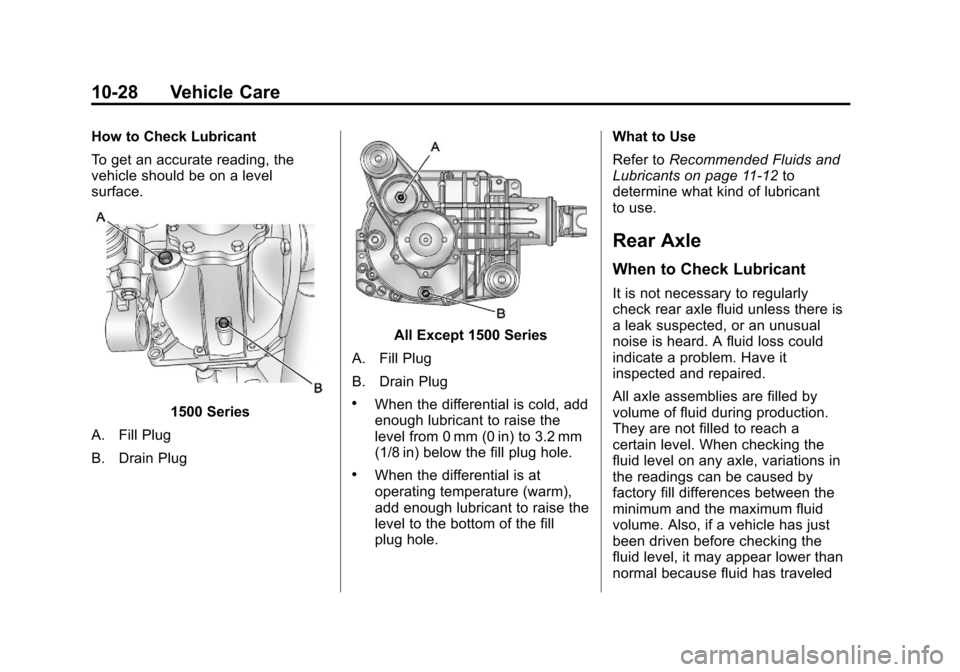
To get an accurate reading, the
vehicle should be on a level
surface.
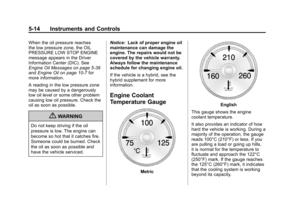
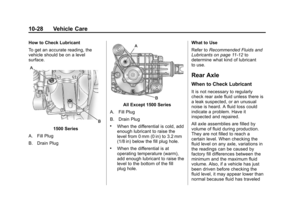
1500 Series
A. Fill Plug
B. Drain Plug
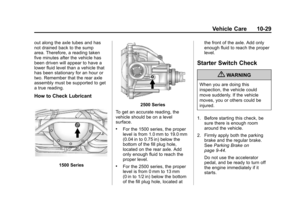
All Except 1500 Series
A. Fill Plug
B. Drain Plug
.When the differential is cold, add
enough lubricant to raise the
level from 0 mm (0 in) to 3.2 mm
(1/8 in) below the fill plug hole.
.When the differential is at
operating temperature (warm),
add enough lubricant to raise the
level to the bottom of the fill
plug hole. What to Use
Refer to
Recommended Fluids and
Lubricants on page 11‑12 to
determine what kind of lubricant
to use.
Rear Axle
When to Check Lubricant
It is not necessary to regularly
check rear axle fluid unless there is
a leak suspected, or an unusual
noise is heard. A fluid loss could
indicate a problem. Have it
inspected and repaired.
All axle assemblies are filled by
volume of fluid during production.
They are not filled to reach a
certain level. When checking the
fluid level on any axle, variations in
the readings can be caused by
factory fill differences between the
minimum and the maximum fluid
volume. Also, if a vehicle has just
been driven before checking the
fluid level, it may appear lower than
normal because fluid has traveled
Page 379 of 514

Black plate (29,1)Chevrolet Tahoe/Suburban Owner Manual - 2012
Vehicle Care 10-29
out along the axle tubes and has
not drained back to the sump
area. Therefore, a reading taken
five minutes after the vehicle has
been driven will appear to have a
lower fluid level than a vehicle that
has been stationary for an hour or
two. Remember that the rear axle
assembly must be supported to get
a true reading.
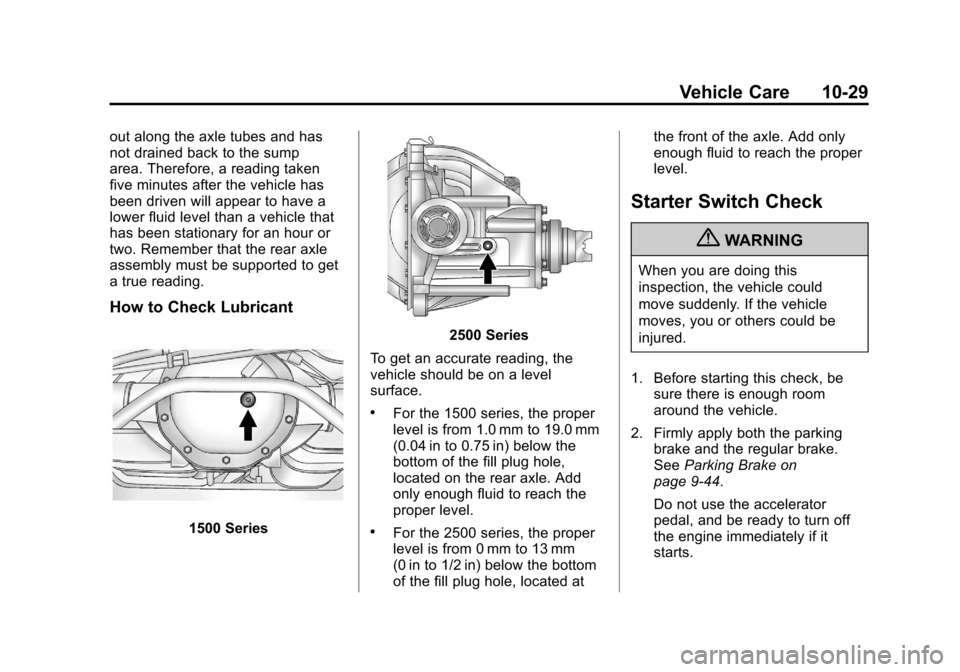
How to Check Lubricant
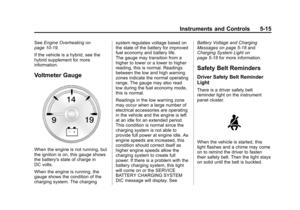
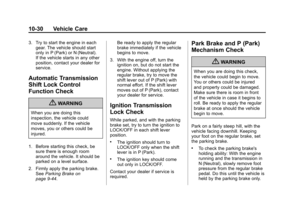
1500 Series
2500 Series
To get an accurate reading, the
vehicle should be on a level
surface.
.For the 1500 series, the proper
level is from 1.0 mm to 19.0 mm
(0.04 in to 0.75 in) below the
bottom of the fill plug hole,
located on the rear axle. Add
only enough fluid to reach the
proper level.
.For the 2500 series, the proper
level is from 0 mm to 13 mm
(0 in to 1/2 in) below the bottom
of the fill plug hole, located at the front of the axle. Add only
enough fluid to reach the proper
level.
Starter Switch Check
{WARNING
When you are doing this
inspection, the vehicle could
move suddenly. If the vehicle
moves, you or others could be
injured.
1. Before starting this check, be sure there is enough room
around the vehicle.
2. Firmly apply both the parking brake and the regular brake.
See Parking Brake on
page 9‑44.
Do not use the accelerator
pedal, and be ready to turn off
the engine immediately if it
starts.
Page 380 of 514

Black plate (30,1)Chevrolet Tahoe/Suburban Owner Manual - 2012
10-30 Vehicle Care
3. Try to start the engine in eachgear. The vehicle should start
only in P (Park) or N (Neutral).
If the vehicle starts in any other
position, contact your dealer for
service.
Automatic Transmission
Shift Lock Control
Function Check
{WARNING
When you are doing this
inspection, the vehicle could
move suddenly. If the vehicle
moves, you or others could be
injured.
1. Before starting this check, be sure there is enough room
around the vehicle. It should be
parked on a level surface.
2. Firmly apply the parking brake. See Parking Brake on
page 9‑44. Be ready to apply the regular
brake immediately if the vehicle
begins to move.
3. With the engine off, turn the ignition on, but do not start the
engine. Without applying the
regular brake, try to move the
shift lever out of P (Park) with
normal effort. If the shift lever
moves out of P (Park), contact
your dealer for service.
Ignition Transmission
Lock Check
While parked, and with the parking
brake set, try to turn the ignition to
LOCK/OFF in each shift lever
position.
.The ignition should turn to
LOCK/OFF only when the shift
lever is in P (Park).
.The ignition key should come
out only in LOCK/OFF.
Contact your dealer if service is
required.
Park Brake and P (Park)
Mechanism Check
{WARNING
When you are doing this check,
the vehicle could begin to move.
You or others could be injured
and property could be damaged.
Make sure there is room in front
of the vehicle in case it begins to
roll. Be ready to apply the regular
brake at once should the vehicle
begin to move.
Park on a fairly steep hill, with the
vehicle facing downhill. Keeping
your foot on the regular brake, set
the parking brake.
.To check the parking brake's
holding ability: With the engine
running and the transmission in
N (Neutral), slowly remove foot
pressure from the regular brake
pedal. Do this until the vehicle is
held by the parking brake only.
Page 381 of 514

Black plate (31,1)Chevrolet Tahoe/Suburban Owner Manual - 2012
Vehicle Care 10-31
.To check the P (Park)
mechanism's holding ability:
With the engine running, shift to
P (Park). Then release the
parking brake followed by the
regular brake.
Contact your dealer if service is
required.
Wiper Blade Replacement
Windshield wiper blades should
be inspected for wear or cracking.
See Maintenance Schedule on
page 11‑3.
Replacement blades come in
different types and are removed in
different ways.
Front Wiper Blade
Replacement
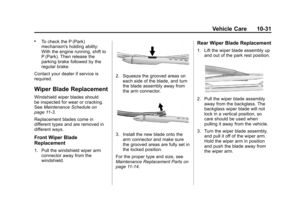
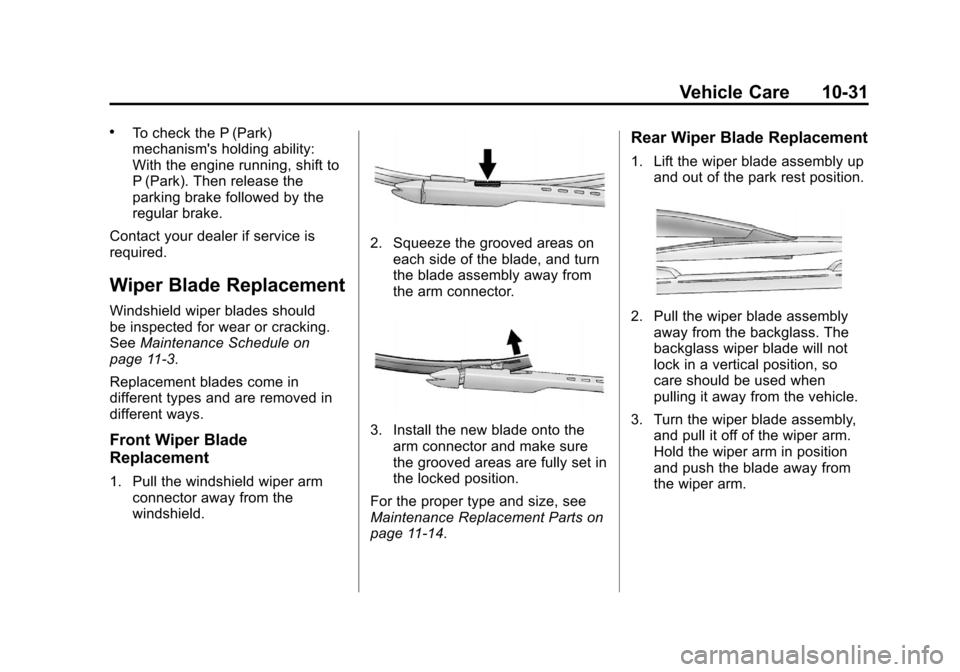
1. Pull the windshield wiper arm connector away from the
windshield.
2. Squeeze the grooved areas oneach side of the blade, and turn
the blade assembly away from
the arm connector.
3. Install the new blade onto thearm connector and make sure
the grooved areas are fully set in
the locked position.
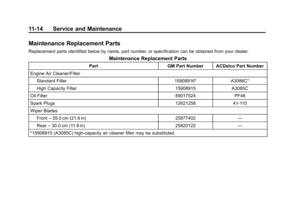
For the proper type and size, see
Maintenance Replacement Parts on
page 11‑14.
Rear Wiper Blade Replacement
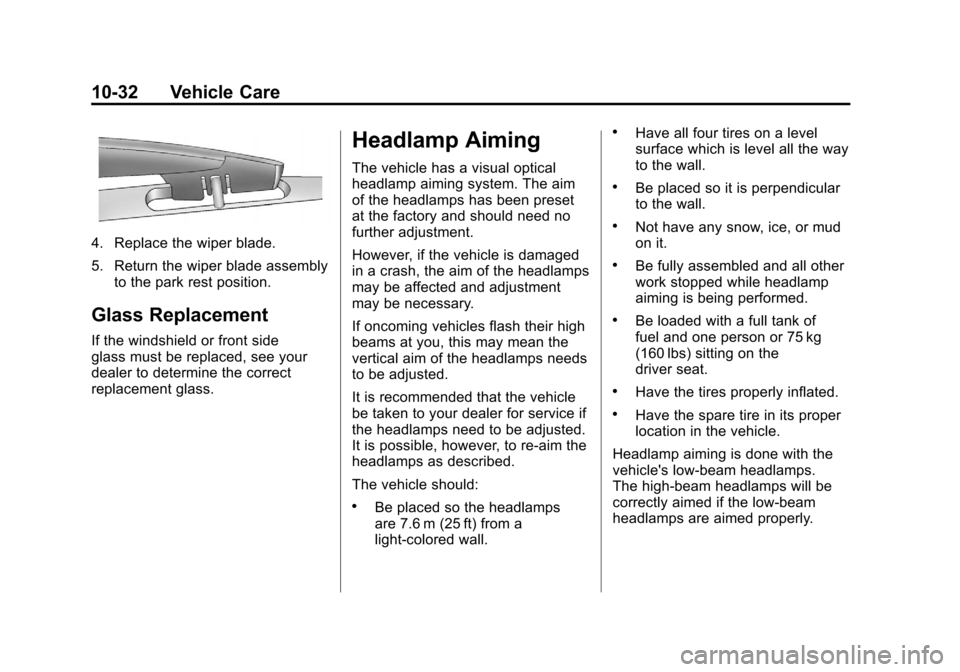
1. Lift the wiper blade assembly up and out of the park rest position.
2. Pull the wiper blade assemblyaway from the backglass. The
backglass wiper blade will not
lock in a vertical position, so
care should be used when
pulling it away from the vehicle.
3. Turn the wiper blade assembly, and pull it off of the wiper arm.
Hold the wiper arm in position
and push the blade away from
the wiper arm.
Page 382 of 514

Black plate (32,1)Chevrolet Tahoe/Suburban Owner Manual - 2012
10-32 Vehicle Care
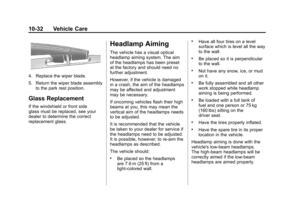
4. Replace the wiper blade.
5. Return the wiper blade assemblyto the park rest position.
Glass Replacement
If the windshield or front side
glass must be replaced, see your
dealer to determine the correct
replacement glass.
Headlamp Aiming
The vehicle has a visual optical
headlamp aiming system. The aim
of the headlamps has been preset
at the factory and should need no
further adjustment.
However, if the vehicle is damaged
in a crash, the aim of the headlamps
may be affected and adjustment
may be necessary.
If oncoming vehicles flash their high
beams at you, this may mean the
vertical aim of the headlamps needs
to be adjusted.
It is recommended that the vehicle
be taken to your dealer for service if
the headlamps need to be adjusted.
It is possible, however, to re-aim the
headlamps as described.
The vehicle should:
.Be placed so the headlamps
are 7.6 m (25 ft) from a
light‐colored wall.
.Have all four tires on a level
surface which is level all the way
to the wall.
.Be placed so it is perpendicular
to the wall.
.Not have any snow, ice, or mud
on it.
.Be fully assembled and all other
work stopped while headlamp
aiming is being performed.
.Be loaded with a full tank of
fuel and one person or 75 kg
(160 lbs) sitting on the
driver seat.
.Have the tires properly inflated.
.Have the spare tire in its proper
location in the vehicle.
Headlamp aiming is done with the
vehicle's low-beam headlamps.
The high-beam headlamps will be
correctly aimed if the low-beam
headlamps are aimed properly.
Page 383 of 514

Black plate (33,1)Chevrolet Tahoe/Suburban Owner Manual - 2012
Vehicle Care 10-33
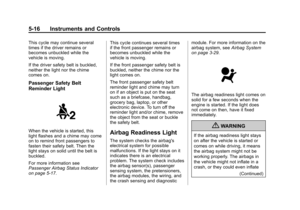
To adjust the vertical aim:
1. Open the hood. SeeHood on
page 10‑5
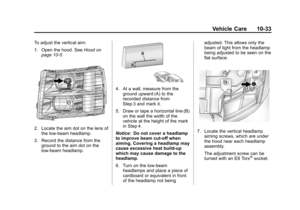
2. Locate the aim dot on the lens of the low‐beam headlamp.
3. Record the distance from the ground to the aim dot on the
low‐beam headlamp.
4. At a wall, measure from theground upward (A) to the
recorded distance from
Step 3 and mark it.
5. Draw or tape a horizontal line (B) on the wall the width of the
vehicle at the height of the mark
in Step 4.
Notice: Do not cover a headlamp
to improve beam cut-off when
aiming. Covering a headlamp may
cause excessive heat build-up
which may cause damage to the
headlamp.
6. Turn on the low-beam
headlamps and place a piece of
cardboard or equivalent in front
of the headlamp not being adjusted. This allows only the
beam of light from the headlamp
being adjusted to be seen on the
flat surface.
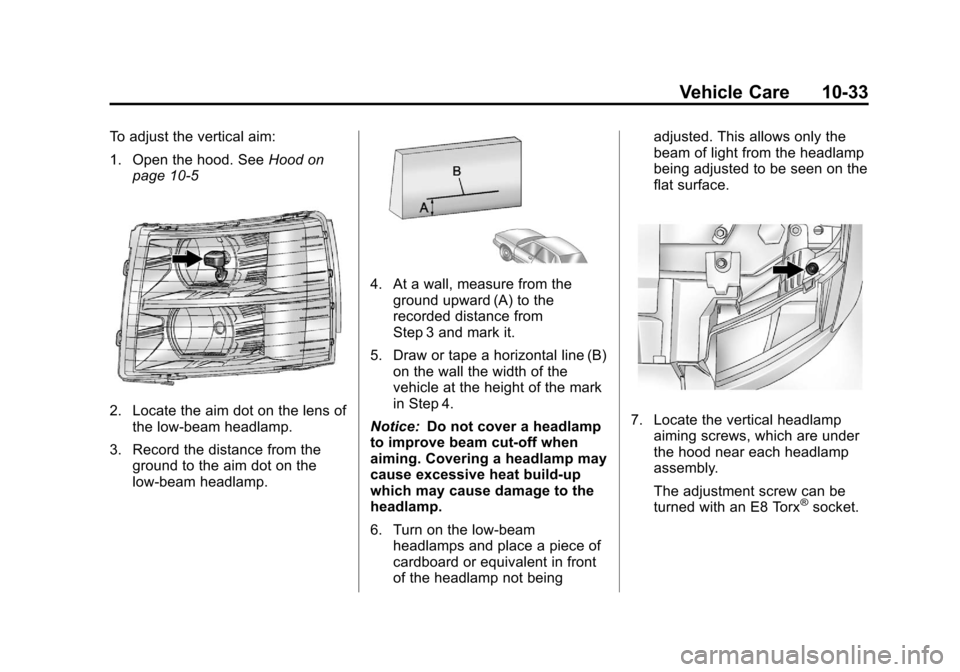
7. Locate the vertical headlamp
aiming screws, which are under
the hood near each headlamp
assembly.
The adjustment screw can be
turned with an E8 Torx
®socket.
Page 384 of 514

Black plate (34,1)Chevrolet Tahoe/Suburban Owner Manual - 2012
10-34 Vehicle Care
8. Turn the vertical aiming screwuntil the headlamp beam is
aimed to the horizontal tape
line. Turn it clockwise or
counterclockwise to raise or
lower the angle of the beam.
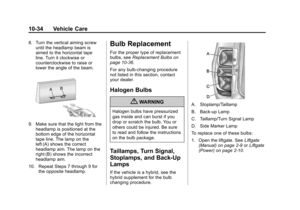
9. Make sure that the light from theheadlamp is positioned at the
bottom edge of the horizontal
tape line. The lamp on the
left (A) shows the correct
headlamp aim. The lamp on the
right (B) shows the incorrect
headlamp aim.
10. Repeat Steps 7 through 9 for the opposite headlamp.
Bulb Replacement
For the proper type of replacement
bulbs, see Replacement Bulbs on
page 10‑36.
For any bulb‐changing procedure
not listed in this section, contact
your dealer.
Halogen Bulbs
{WARNING
Halogen bulbs have pressurized
gas inside and can burst if you
drop or scratch the bulb. You or
others could be injured. Be sure
to read and follow the instructions
on the bulb package.
Taillamps, Turn Signal,
Stoplamps, and Back-Up
Lamps
If the vehicle is a hybrid, see the
hybrid supplement for the bulb
changing procedure.
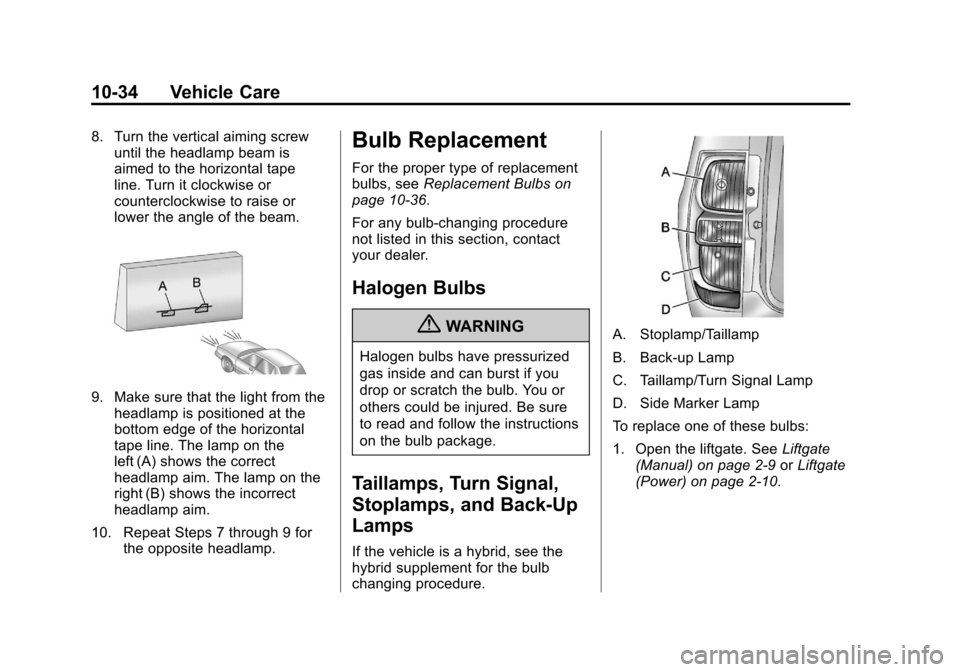
A. Stoplamp/Taillamp
B. Back-up Lamp
C. Taillamp/Turn Signal Lamp
D. Side Marker Lamp
To replace one of these bulbs:
1. Open the liftgate. See Liftgate
(Manual) on page 2‑9 orLiftgate
(Power) on page 2‑10.