2012 AUDI R8 SPYDER seats
[x] Cancel search: seatsPage 141 of 236

Always remember: Even though your vehicle is
equipped with an Advanced Airbag system, a
child should always ride in the seat properly
restrained for its age and size.
_&. WARNING
Improperly installed child safety seats in
crease the risk of serious personal injury
and death in a collision.
- Always make sure that the safety belt re
tractor is locked when installing a child
safety seat. An unlocked safety belt re
tractor cannot hold the child safety seat
in place during normal driving or in a
crash .
- Always buckle the child safety seat firmly
in place even if a child is not sitting in it.
A loose child safety seat can fly around
during a sudden stop or in a collision.
- The inflating airbag will hit the child
safety seat or infant carrier with great
force and will smash the child safety seat
and child against the backrest, door or
roof.
- Forward-facing child safety seats or in
fant carriers installed on the front pas
senger's seat may interfere with the de ployment of the airbag and cause serious
injury to the child.
- Always read and heed all WARNINGS
whenever using a child restrained in ave
hicle is being used
c:::;, page 130. Special
precautions apply when installing a child
safety seat on the front passenger seat
c:::;, page 111, Child restraints on the front
seat -some important things to know.
_&. WARNING
-
Always take special precautions if you
must install a forward or rearward-facing
child restraint on the front passenger's
seat in exceptional situations:
- Whenever a forward or rearward-facing child restra int is installed on the front
passenger seat, the
PASSENGER AIR
BAG OFF
light must come on and stay on
whenever the ignition is switched on.
Child Safety 139
-If the PASSENGER AIR BAG OFF light
does not come on and stay on, perform
the checks described
c:::;, page 120, Moni
toring the Advanced Airbag System.
- If the PASSENGER AIR BAG OFF light
does not come on and stay on whenever
the ignition is switched on the inflating
airbag will hit the child safety seat or in
fant carrier with great force and will
smash the child safety seat and child
against the backrest, door or roof. Have
the airbag system inspected immediately
by your Audi dealer.
- Improper installation of child restraints
can reduce their effectiveness or even prevent them from providing any protec
tion.
- An improperly installed child restraint
can interfere with the airbag as it de
ploys and seriously injure or even kill the
child.
- Always carefully follow the manufactur
er's instructions provided with the child
safety seat or carrier.
- Never place additional items on the seat
that can increase the total weight regis
tered by the weight-sensing mat and can
cause injury in a crash.
_&. WARNING
Forward-facing child restraints:
- Always make sure the forward-facing
seat has been designed and certified by
its manufacturer for use on a front seat
with a passenger front and side airbag.
- Never put the forward-facing child re straint up, against or very near the in
strument panel.
- Always move the passenger seat into its
rearmost position in the seat's fore and
aft adjustment range, as far away from
the airbag as possible before installing
the forward-facing child restraint. The
backrest must be adjusted to an upright
position. •
•
Page 143 of 236

A loose chi ld safety seat can fly around
dur ing a sudden stop or in a crash.
- Always make sure the seat backrest to
wh ich the child restraint is installed is in
an upr ight position . Otherwise, the seat
back with the child safety seat attached
to it could fly forward in the event of an
acc ident or other emergency situat ion.
- Always read and heed all WARNINGS
whenever using a child rest rain ed in ave
hicle is being used
~page 130. Spec ial
precautions apply when installing a ch ild
sa fety sea t on the fron t passenge r sea t
~ page 111, Child restrain ts on the fron t
seat -some impor tant things to know.
Deactivating the convertible locking
retractor
The convertible locking retractor for child re
straints will be deactivated automatically
when the belt is wound all the way back into the retractor.
~ P ress the red button on the safety be lt
buck le . The belt tongue will pop out of the
buck le.
~ G ui de the safety belt all the way back into
i ts stowed posit ion.
A lways let the safety belt retract comp lete ly
into its stowed posit ion. The safety belt can
now be used as an ord inary safety belt with
out the convert ible lock ing retractor for chi ld
restra ints .
If the convert ible locking retractor s hou ld be
activated inadvertently, the safety belt must be unfastened and guided completely back in
to its stowed position to deactivate th is fea
ture . If the convertib le loc king retractor is not
deactivated, the safe ty belt will g radua lly be
come tighter and uncomfo rt a b le to wear .
A WARNING
Imprope rly insta lled child sa fe ty seats in
crease the risk of ser ious personal inju ry
and death in a collision .
Child Safet y 141
-Never unfasten the safety belt to deacti
vate the convertible locking retracto r for
child restraints while the vehicle is mov
ing. You would not be restrained and
could be serious ly inju red in an accide nt.
- Always read a nd heed a ll WARNI NGS
wheneve r us ing a child restrained in ave
hicle is being used
Q page 130 . Special
prec autions app ly wh en insta lling a child
safety sea t on the fro nt passe nger seat
Q page 111, Child restraints on the fron t
seat -some important things to know.
Additional Information
Sources of information about child
restraints and their use
T he re a re a number of sources of additiona l
in forma tion a bout child re st ra in t se lec tion, in
stalla tion and use:
N HTSA advises that the best ch ild safety seat
i s the one t hat fits you r ch ild and fits in you r
vehicle, and that yo u will u se correc tly and
c onsistently.
Try before you buy!
U .S National Highway Traffic Safety Admin
istration
Tel.: 1-888-327-4236 (TTY: 1 -800 -424 -9153)
www . n htsa .gov
National SAFE KIDS Campaign
Tel.: (202) 662-0600
www .safe kids .org
Safety BeltSafe U.S.A
Tel.: (800) 7 45-SAFE (English)
Tel.: (800) 747-SANO (Span is h)
www .carseat .org
T ransport Canada Information Centre
Tel.: 1 (800) 333-03 71 or call
1 (613) 998-8616 if you are in the Ottawa
area
www .tc .gc.ca/ roadsafe ty
Audi Customer Relations
Tel.: (800) 822-2834 •
•
Page 150 of 236

148 Intelligent technology
Dynamic energy management
While th e veh icle is be ing dr iven , dynamic en
e rgy management distributes the energy gen
erated according to the needs of the individu
a l components . It reg ulates cons umption, so
that more electrical energy is not being used
t han is being generated and ensures an opti
mal state of charge for the battery .
(D Tips
- But even energy management cannot
negate the limits of physics. Consider
that the power and life of a battery are li mited .
- If starting ab ility is threatened, you are
i nformed by a warn ing
<=> page 148,
Driver notification in the instrument
cluster display .
What you should know
The highest priority is given to maintaining
starting capability.
The battery is severely taxed in short-distance
d riving, in city traffic and duri ng the co ld time
of year. Abu ndant e lectr ica l energy is re
qu ired, but only a little is g ene rated . It is also
cr itica l if t he engine is not run ning and ele ct ri
cal componen ts ar e turned on. In th is in
stance energy is being consumed but none is
being generate d.
It is in precisely these si tua tions that you w ill
notice energy management actively regula t
ing the distrib ution o f energy .
Vehicle stands for an extended period
If you do not drive you r vehicle over a period
of severa l days or weeks, elect rical compo
n ents are grad ually cu t back o r swi tched off .
This redu ce s energy cons umption and mai n
tains s ta rting cap abili ty over a longer period .
T a ke into considerat ion tha t when you u nlock
your ve hicle, some co nvenience func tions,
such as the remote key or power sea t adj ust
men t, may not be available. The convenience
f u nctions will be avai lable again when you
turn on th e ignition and start the engine. With the engine turned off
If you
listen to the radio, for examp le, w it h
t h e engine t urned off, the battery is being dis
c h arged .
If starti ng capab il ity is jeopard ized d ue to en
ergy consu mptio n, a mess age a ppea rs in the
drive r informa tion d isplay .
You have to start t he engine to charge the
ba tte ry.
With the engine running
Althoug h electrical energy is generated when
the vehicle is being d riven, the battery can be
come discharged. This happens mostly when
li ttle energy is being ge ne rated and a g reat
deal consumed a nd t he battery's state of
c h arge is not opt imal.
To b ring the energy bala nce back into equ ili
br iu m , consume rs wh ich req uire espe cially
l ar ge amounts of ene rgy a re temporar ily cu t
ba ck or sw itched o ff. H ea ting systems in par
t icu lar require a grea t deal of energy . If you
not ice, for examp le, that the heated seatsat or
the heated rear window are not heating, they have been temporarily cut back or switched
off . These systems w ill be available again as
soon as the e ne rgy balance has been restored.
You w ill also notice that engine id le speed has
been increased slightly . T hi s is normal and not
a cause for concern. By increasing engine id le
speed the additional energy required is gener
ated and the battery is charged .
Driver notification in the instrument
cluster display
If bat tery power drops in to the range where i t
can limit the ability of the engi ne to start, this
is shown in the instrument cluster display
with the following driver message:
(•] Low battery charge: battery will be
charged while driving
T h is not ifi cat io n r eminds yo u that t he start ing
ca pabili ty of the engi ne may be lim ite d. As
soon as you s tart dr iv ing again, the battery .,..
Page 161 of 236

Plastic parts and imitation leather
You can clean plastic parts and imitation
leather with a damp cloth . If this does not re
move the dirt, you can treat these parts only
with specia l
solvent-free plastic cleaning and
care products.
A WARNING
So lvents can change the properties of
some plast ics and make it harder for the
airbag to dep loy.
-
- Never clean the instrument panel or the
surface of Airbag modules with cleaning
products that contain solvents.
- Products containing solvents w ill make
the surface of this part porous.
- Serious injur ies can result if plastic parts
come loose when the airbag is deployed.
- Always read and heed all WARNINGS and
the informat ion
c::;,page 153.
(D Note
Clean ing agents containing solvents will
attack the material and can change the
way it behaves.
Carbon-fiber parts
Applies to vehicles: with carbo n-fiber parts
The carbon-fiber parts of your vehicle have a
pa inted surface. They do not require any spe
cial care and are cleaned like plast ic parts
¢pag e 159.
Fabrics and fabric coverings
Fabrics and fabr ic coverings (e.g. seats, door
trim panels, etc.) should be cleaned at regular
intervals with a vacu um cleaner. This removes
surface dirt particles which could become em
bedded in the fabric through use. Steam
cleaners shou ld not be used, because the
steam tends to push the dirt deeper into the
fabric and lock it there.
Cleaning and protection 159
Normal cleaning
Generally, we recommend using a soft sponge
or a lint-free microfiber cloth to the clean fab
ric. Brushes shou ld only be used for carpets
and floor mats, since other fabric surfaces could be harmed by brushes.
Normal surface stains can be cleaned using a
commercially available foam cleaner . Spread
the foam on the s urface of the fabric with a
soft sponge and work it in gently. Do not satu
rate the fabric. Then pat the foam dry using
absorbent, dry cloths (e.g. m icrofiber cloth)
and vacuum it after it has dried completely.
Cleaning stains
Stains caused by beverages (e.g. coffee, fruit
juice , etc.) can be treated with a mild deter
gent solution. Apply the detergent solution
with a sponge . In the case of stubborn stains,
a detergent paste can be applied directly to
the stain and worked into the fabric. After
wards, use copious amounts of clean water to
remove the remaining deterge nt. Apply the
water with a damp doth or sponge and pat
the fabric dry with an absorbent, dry cloth .
Stains from chocolate or makeup should have
detergent paste (e.g. ox-gall soap) rubbed in
to them. Afterwards, remove the soap with
water (damp sponge) .
Alcohol can be used to treat stains from
grease, oil, lipstick or a ballpoint pen. Melted
grease or dye must be patted off using ab
sorbent materia l.
It may be necessary to re
treat the areas with detergent paste and wa
ter.
In the case of general soiling of the upho ls
tery and cover material, we recommend hiring
a specia list t hat has the equipment to clean
the seat covers and other fabr ic surfaces by
shampooing and spray extraction.
A WARNING
Always read and heed all WARNINGS and
the information
c::;, page 153.
•
•
Page 162 of 236

160 Cleaning and protection
Open Velcro fasteners on your clothing can
damage the seat cover. Please make sure
that Velcro fasteners are closed.
Natural leather
App lies to vehicles: with natura l leather
Audi makes great efforts to maintain the
properties, natural look and feel of interior leather.
General
We offer many different types of leather on
our vehicles. Most are different types of nappa
leather, which has a smooth surface and
comes in various colors.
The intensity of the color determines the visu
al characteristics and appearance . If the sur
face of the leather has a typical natural look,
then the leather is a nappa leather that has
been left in a relatively natural condition. This
leather offers particularly good comfort and
breathes well. Fine veins, closed grains, insect
bites, skin folds, and subtle variations in color
remain visible. These characteristics demon
strate that the material is natural.
Natural nappa leather is not covered by a col
or finish.
It is therefore more sensitive to soil
ing and wear, which is something you need to
consider if children, animals or other factors
might prove to be particularly hard on the
l eather.
By contrast, leather types that are covered by
a colored finish layer are more durable. This
has a positive effect on the leather's resist
ance to wear and soiling in daily use. On the
other hand, the typical characteristics of natu
ral leather are barely or not apparent. Howev
er, this does not mean that the leather itself is of inferior quality.
Care and handling
Because of the exclusive nature of the types of
leather that Audi uses and their unique prop
erties (such as sensitivity to oils, grease, soil ing, etc.), you will need to be somewhat care- ful
with these leathers, and a certain type of
care is required . For example, dark clothing
materials can discolor leather seats (especial
ly if such clothing is damp and was not dyed
correctly). Dust and dirt particles in pores,
folds, and seams can have an abrasive effect and can damage the leather surface as well as
weaken seams .
The leather should be cleaned regularly as needed. After having been used for a relatively
long time, your leather seats will acquire a
rich aged finish. This is a characteristic of nat
ural leather and a sign of true quality.
In order to maintain the value of this natural
product over the life of your vehicle, you
should follow the recommendat ions below:
(D Note
- To keep your leather from bleaching out,
do not allow it to be exposed to bright
sunlight for long periods of time. If you
have to leave the vehicle parked outside
for long periods, cover the leather to protect it from direct exposure to sun
light.
- Sharp objects on clothing, such as zip
pers, rivets or sharp pieces on belts can
leave permanent scratches or scrape
marks on the surface of the leather .
(D Tips
-After each time you clean the leather and
at regular intervals, use a leather preser
vative creme that contains UV-blockers
and that works into the leather. This
creme will nourish and moisturize the
leather, helping it to breathe and stay
supple .
It also helps to build up a protec
tive coating on the surface.
- Clean the leather every 2 -3 months,
and clean any areas that get soiled .
- Remove fresh marks made by ballpoint
pens, ink, lipstick, shoe polish, etc. as
soon as possible.
- Preserve the color of the leather as need
ed by using a spec ial colored leather care
creme to touch up areas of uneven color .
Page 216 of 236

214 Fuses and bulbs
Fuse panel @
Consumer
Automatically dimming in-
side mirror, garage door
8 opener (Homel
ink), washer
pump relay, power outlets
relay
10
[ru button
11 Pressure sensor, climate
controls
12 Airbag
Fuse panel @
No . II Consumer
II
1 Radiator fan (1)
Radia
tor fan (2)
Exterior lighting
4 Exterior lighting
6 Blower regulator
Fuse panel@
No . II Consumer
II
1 Rear view camera
2
Tire pressure monitoring
system
4 Cell phone package, te
le-
phone antenna amplifier
5 Instrument cluster
6 Networking gateway
7 Steering column lever
8
Diagnostic interface, brake
pedal switch, selector lever
9 Rain/light sensor
10 Light switch
11 Special functions control
module
15 Sound amplifier
Radio
Fuse panel E
No. Consumer
3 Auxiliary water pump
5 Supply terminal 15, starter
Amps
10
10 5
5
Amps
40 40
40
40
40
Amps
5
10
7.5 5
5
5
10 5
5
5
30
20
Amps
10
30
Fuse panel @
No. Consumer
6 Pump for brake booster
7 Horn
8 Wiper motor
9 Wiper motor
10 Headlight washer system
12 Power outlets and cigarette
lighter
Fuse panel
®
No. !!Consumer
1 Electronic Stabi lity Control
2 Electronic Stability Control
4
5
6 Rear
window defogger
Power locking system
Interior lights, washer noz
zles
Anti-theft alarm system
Climate controls
Heated seats
10 Lumbar support
11 Control module for doors
12 Control module for doors
Bulbs
Note
Amps
15
20
30
30
30
20
ll Amps ,
10
25
30
20
20
5
10
25
10
30
10
Your vehicle is equipped with maintenance
free headlights and rear lights. However, if a
bulb has to be changed, please consult your
authorized Audi dealer or other qualified
workshop.
Page 225 of 236
A
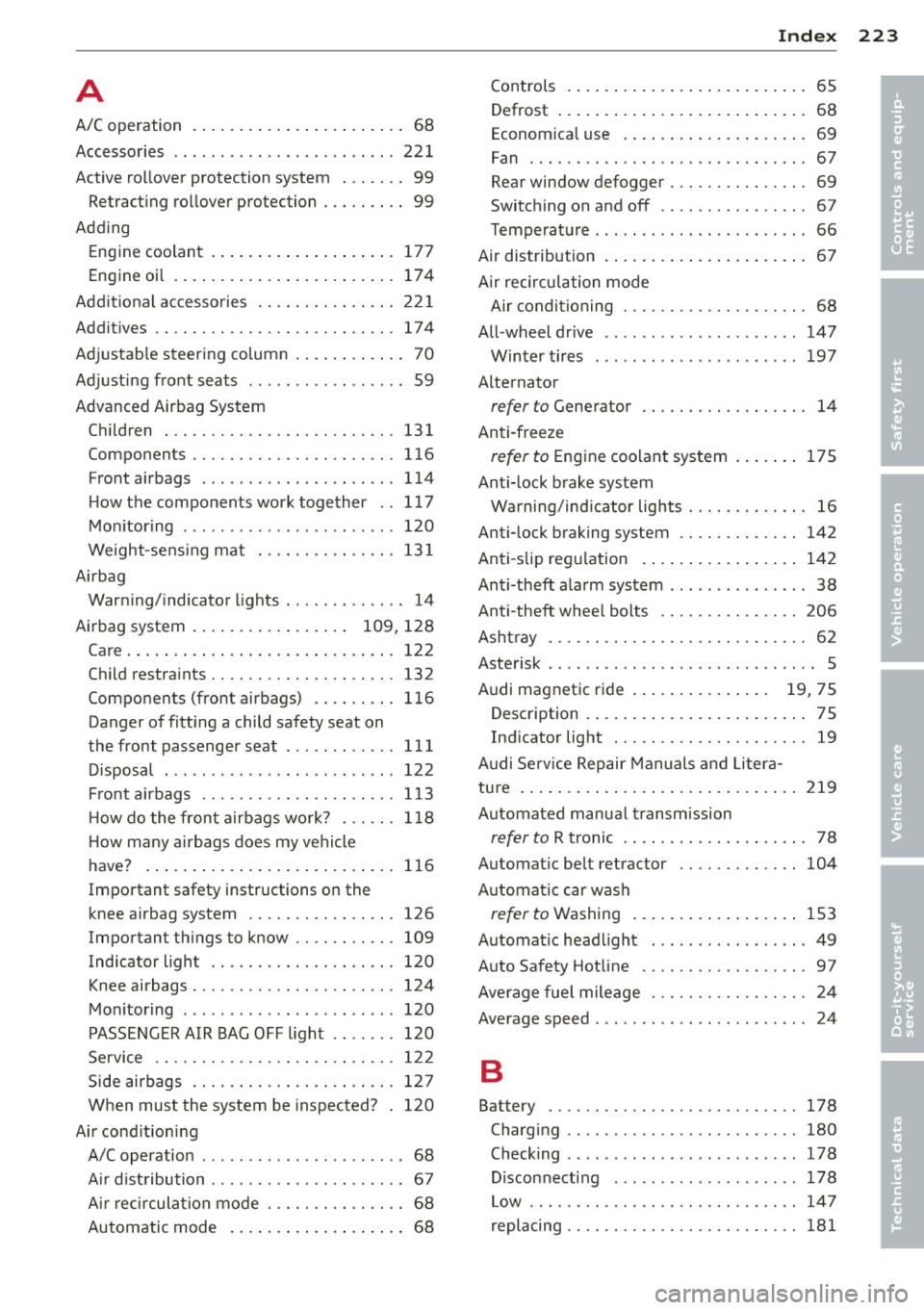
A/C operation . . . . . . . . . . . . . . . . . . . . . . . 68
Accessories .. ... .. .. ...... .. .. .. .. . 221
Active ro llover protection system . . . . . . . 99
Retract ing ro llover protection . .. .. .. .. 99
Add ing
Engine coolant . ....... ... .. .. .. ... 177
Engine oi l .. .. ... ..... ... .. .. .. ... 174
Addit io nal accesso ries ...... .. .. .. .. . 22 1
Addit ives . . . . . . . . . . . . . . . . . . . . . . . . . . 17 4
Ad justab le steer ing column . ... .. .. .... 70
Adj usti ng front seats ....... .. .. .. .. .. 59
Advanced Airbag System Ch ildren . .. ............. .... .. .. . 131
Components .. ........... .. .. .. ... 116
Front airbags . . . . . . . . . . . . . . . . . . . . . 114
H ow the components work together . . 117
M oni toring . ................ ... ... 120
Weight-se nsing mat ...... .. .. .. .. . 13 1
Airbag War ning/ indicator lights . .. .. .. .. .. .. 14
Airbag system . . . . . . . . . . . . . . . . . 109, 128
Care ... .. .. .. .... .. .... ... .. .. ... 122
Child restra ints ........... .... .. ... 132
Components (front airbags) .. .. .. .. . 116
Danger of fitting a child safety seat on
the front passenger seat . . . . . . . . . . . . 11 1
Disposal . ................ ... ... .. 122
Fr ont airbags ............ .... .. ... 1 13
H ow do the front a irbags work? . .. .. . 118
H ow many airbags does my vehicle
have? ... .. .. .... .. .... ... .. .. ... 116
Important safety instructions on the
knee airbag system ....... .. .. .. .. . 126
Important things to know . . . . . . . . . . . 109
Indicator light ........... .. .. .. ... 120
Knee airbags . . . . . . . . . . . . . . . . . . . . . . 124
Mo nitor ing . ................ ... ... 120
P ASSENGER AIR BAG OFF l ight .. ... .. 120
Service . . . . . . . . . . . . . . . . . . . . . . . . . . 12 2
Side airbags .. ........... .. .. .. ... 12 7
When mus t the system be inspected? . 120
Ai r cond itioni ng
A/C operation . . . . . . . . . . . . . . . . . . . . . . 68
A ir dist ribution ........... .. .. .. .... 67
A ir r eci rcula tion mode ..... .. .. .. .. .. 68
Automatic mode . . . . . . . . . . . . . . . . . . . 68
Inde x 223
Controls . . . . . . . . . . . . . . . . . . . . . . . . . . 65
Defrost ... .. .. .... . ... ...... ... .. . 68
Econom ica l use . ... . .. ..... ... .. .. . 69
Fan ........ .. .. .................. 67
Rear window defogger . ............. . 69
Switching on and off ................ 67
T emperature ... .. .. . .. .... .... .. .. . 66
Air distribution . . . . . . . . . . . . . . . . . . . . . . 67
A ir recircu lation mode
Air condi tioning . . . . . . . . . . . . . . . . . . . . 68
All -wheel drive .. .. .. ..... .......... 147
Winter tires . . . . . . . . . . . . . . . . . . . . . . 197
A lternator
refer to Generator . . . . . . . . . . . . . . . . . . 14
Anti-freeze
refer to Engine coolan t sys tem ... .. .. 175
Anti- lock b rake system
Warning/ind icator lights .......... .. . 16
Anti- lock braking system ......... .... 142
Anti -slip reg ulation . .. ... .... ... .. .. 142
Anti-theft ala rm system ......... .... .. 38
Anti-theft whee l bolts ........... .... 206
Ashtray .. .. .. .. .. .... ........... .. . 62
Asterisk ...... .. .... .. ........ ...... . 5
Audi magnet ic r ide . . . . . . . . . . . . . . . 19, 75
Description . ... .... . ... ...... ... .. . 75
Ind icator light . .. ................. . 19
Audi Se rv ice Repair Manuals and Lit era-
ture .. ... .. .. .... ... .. .. ..... ... .. 219
Automated manual t ransmission
refer to R tronic . . . . . . . . . . . . . . . . . . . . 78
Automat ic be lt retractor ......... .. .. 104
A utomat ic car wash
refer to Washing . . . . . . . . . . . . . . . . . . 153
Automat ic head light . .............. .. 49
Auto Safety Hot line .................. 97
Ave rage fuel mileage . . . . . . . . . . . . . . . . . 24
Average speed . . . . . . . . . . . . . . . . . . . . . . . 24
B
Battery .... .. .. .. .. .. ........... .. 178
Charg ing .. .... .. ................. 180
Checking . . . . . . . . . . . . . . . . . . . . . . . . . 178
Disconnecting ... .. . .. .... .... .. .. 178
Low .... .. .. .. .. .. ............... 14 7
replacing .. .. .. .. .... ............. 181
•
•
Page 226 of 236

224 Index
State of charge ............... .... . 147
Vehicles not driven for long periods . .. 178
Winter operation . . . . . . . . . . . . . 178, 179
Working on the battery . . . . . . . . . . . . . 179
Battery voltage . . . . . . . . . . . . . . . . . . . . . . 18
Before driving . . . . . . . . . . . . . . . . . . . . . . . 91
Blended gasoline .............. .... . 164
Booster seats ............. .. .. .... . 13 7
Brake system Anti -lock brake system ........ .. .... 16
Brake assist system ......... .. .. .. . 142
Brake fluid ....................... 178
Brake light defective ................ 18
Brake power assist unit ............. 145
Brakes ... .. ................ ..... . 145
Ceramic brakes ............ ... .... . 145
Malfunc tion .............. ... .... .. 13
Warning/indicator lights ....... .... .. 13
Worn brake pads symbol . . . . . . . . . . . . . 17
Break-in period .............. .. .... . 150
Bulbs ...... ........... ........ ... . 214
C
California Proposition 65 Warning ..... 169
Battery specific ............... .... 180
Capacities ... ................ ..... . 217
Carbon-fiber parts Exterior .. ................. .. .. .. . 157
I nter ior .. ................. .. .. .. . 159
Car care ... .. ................ ... ... 153
Cargo area
refer to L uggage compartment . . . . . . . . 96
Car key .. .... ............... .. .. .. .. 32
Catalytic converter ......... .. .. .. .. . 150
Certification ................. ..... . 222
Changing a flat tire .................. 206
Chassis
refer to Audi magnetic ride ..... .. .... 75
Checking Engine coolant level .......... ... .. . 176
Tire pressure ................. .... . 189
Child restraints
Danger of using child restraints in the
front seat . . . . . . . . . . . . . . . . . . . . . . . . 111
Where can I get additional information
about child restraints and their use? .. 141 Child safety
..... .. ............. .... 130
Convertible locking retractor ......... 138
Impo rtant safety instructions for using
child safety seats .............. .... 133
Important things to know when driving
with children .. .. ................ . 130
Child safety seats . . . . . . . . . . . . . . . . . . . 135
Booster seats .... ................. 137
Convertible child seats ............. 136
Convertible locking retractor ....... .. 138
How do I properly install a child safety
seat in my vehicle? ....... ...... .. .. 133
Infant seats ..... ................ . 135
Installing . ................... .... 138
Safety instructions ............. .. .. 133
Cigarette lighter . . . . . . . . . . . . . . . . . . . . . 62
Cleaning Alcantara (synthetic suede) ....... ... 161
Engine compartment ........... .... 162
Exhaust tail pipes . ............. .. .. 158
Fabrics and fabric coverings . .. ... ... 159
Leather .......................... 161
Matte finish paint ................. 155
Radio and navigation display ..... .. .. 158
Safety belts . .. .. ............. .. .. 162
Cleaning and protection ... ....... .. .. 153
Cleaning the navigation display .... .. .. 158
Cleaning the radio display ............ 158
Climate controls . .. ... .......... .... . 65
Dust filter . . . . . . . . . . . . . . . . . . . . . . . . . 6S
Heating .......... .... ........... .. 65
Pollen filter . . . . . . . . . . . . . . . . . . . . . . . 65
Ventilation . . . . . . . . . . . . . . . . . . . . . . . . 65
Clock ............................... 9
Closing Engin e compartment lid . . . . . . . . . . . . 170
Clutch overheating .... ......... ... .. . 19
Cold tire inflation pressure ........ .. .. 187
coming home . .. .. ............... ... 49
Compass mirror ... ... ......... ... .. . 57
Compliance ..... .. ................. 222
Consumer Information . . . . . . . . . . . 97, 219
Contacting NHTSA . ... .......... .. ... 97
Controls and displays . . . . . . . . . . . . . . . . . . 6
Convertible child safety seats . .. ...... 136