2012 AUDI A3 air bag
[x] Cancel search: air bagPage 65 of 280

belts and the airbag system only offer
maximum protection when the seatback
is upright and the safety belts are prop
erly positioned on the body . The more
the seatback is reclined, the greater the
risk of personal injury from an incorrect
seating pos it ion and improperly posi
tioned safety belts!
Adjusting the power
seat
Adjustment switches
Ap plies to vehicles: with power driver seat
For an in tuitive operation, the swi tches @
and @ are distinctly shaped and positioned
to reflect their adjustment functions .
Fig. 65 Adjust men t sw it c h es : locat ions on driver 's seat
Push or pull e ither switch in exactly the same
direction you like the corresponding part of
the seat to mov e.
@ Moving the seat forward or backward
@ Adjusting the angle of the seatback and
he ad restraints
© Adjust ing the lumbar support
Seats and storage 63
Power seat adjustment
Applies to vehicles: with power driver seat
The switches can be moved in various direc
tions to allow precise adjustment.
Fig. 66 Sea t cush io n adju stme nt: sw it c h m otions
Push or pull the switch in the same direction
you like the seat cushion to move.
Moving the entire seatback or forward
.,. Push the switch back at the tip or forward
at the rear@c::>
,&..
Adjusting the seat height
.,. To raise the sea t, pull t he switch at both
ends, @
and@ c::> ,&. .
.,. To lower the seat, push the switch down
evenly,
@ and @<=:>,&. .
Tilting the seat cushion back or forward
.,. To tilt ba ck the seat cushion, pull the switch
a t the fron t only, @ c::> ,&. .
.,. Alternatively, push the switch at the rear
only,
@ <=:> ,&. .
.,. To tilt forward the seat cushion, push the
sw itch
at the front only@ Q ,&..
.,. Alternatively, pull the switch at the rear on
ly @
Q ,&. .
A WARNING
-Never adjust the driver's seat while the
vehicle is moving. If you do this whi le the
veh icle is moving, you will be out of posi
tion . Always adjust the driver 's seat
when the vehicle is not mov ing.
- Be careful when adjusting the seat
height. Check to see that no one is in the
way, or serious injury could result!
Page 66 of 280

64 Seats and storage
-Beca use the driver seat can be electrical
ly ad justed with the ign ition key re
moved, never leave children unattended
in the vehicle . Unsupervised use of the
electric seat adjustments may cause seri o us in jury.
Adjusting the seatback
App lies to vehicles: with power driver seat
u-
Fig . 67 Drive r's seat: switc h for seatback adjustment
• Push or pull the top of the switch in the
same direction you like the seatback to tilt
¢fig. 67.
A WARNING
- Never adjust the seatback whi le the vehi
cle is moving. If you adjust your seatback
w hil e the vehicle is mov ing, you wi ll be
o ut of pos ition. Always adjust the seat
back when the vehicle is no t mov ing.
- T o redu ce the r is k of injury in the case of
sudden bra king or accident, front pas
sengers must never ride in a moving ve
hicle with the seatback reclined. Safety
belts and the airbag system only offe r
maximum protection when the seatback
is upright and the safety belts are prop
er ly posit ioned on the body . The more
the seatback is reclined, the greate r the
risk of personal injury from an incorrect
seating posit ion and improperly posi
tioned safety be lts!
Adjusting the lumbar
support
Applies to vehicles: with lumba r support
The lumbar support can be adjusted to fit the
natural curvature of the occupant's spine.
F ig . 68 Driver seat: switc h for lumbar ad justment
Ad justing the curv atur e
.,. Push the front of t he sw itch plate c:> fig . 68
in order to in cr ease the curva ture.
• Push the rear o f the switch plate in order to
decrease the curvature.
A dj usting the height
• Push on the top of the switch p late in order
t o move the s upport higher .
• Push on the bottom of the switch p late in
order to move t he support lower.
A WARNING
-
Never adjust the lumbar support while the
vehicle is moving. If you adjust your seat
while the vehicle is moving, you will be out
of position. Always adjust the lumbar sup
port when the vehicle is not mov ing .
Page 78 of 280

76 Seats and storage
& WARNING
-Always remove objects from the instru
ment panel. Any items not put away
could slide around inside the vehicle
while driving or when accelerating or
when applying the brakes or when driv
ing around a corner.
- When you are driving make sure that
anything you may have placed in the cen
ter console or other storage locations
cannot fall out into the footwells. In case
of sudden braking you would not be able
to brake, depress the clutch or acceler
ate.
- Any pieces of clothing that you have
hung up must not interfere with the driv
er's view. The coat hooks are designed
only for lightweight clothing. Never hang
any clothing with hard, pointed or heavy
objects in the pockets on the coat hooks.
During sudden braking or in an accident -
especially if the airbag is deployed -
these objects could injure any passen
gers inside the vehicle .
Glove compartment
The glove compartment is illuminated and
can be locked .
Fig. 89 Glove compar tment
To open glove compartment
"' Pull the handle~ fig. 89 in the direct ion of
the arrow push down lid to th e fully op en
position.
1 ) Not ava ilab le o n veh icl es with Audi N avigat ion Sys
t e m .
To close glove compartment
"' Push the glove compartment lid upward un-
til the lock engages.
The light will illuminate when the parking/
headlights are turned on and the glove com
partment is open.
In the glove compartment lid, you will find a
place to store a pen and a pad of paper .
In the glove compartment, you will find the
CD-changer* for navigation system* . A sepa
rate Owner's Manual is in vehicles that have a
factory-installed CD changer and navigation
system.
A WARNING
To reduce the risk of personal injury in an
accident or sudden stop, always keep the
glove compartment closed while driving.
Ga Storage compartment for small
objects
Applies to vehicles: with storage compartment in center
console
Fig. 90 Cen te r c onso le s torage compar tme nt
"' To open the compartment, press the cover
Cg ~fig. 90.
-
"' To close the compartment, push the drawer
all the way in until it clicks in place.
An additional storage compartment
1> for rela
tively small objects is located in the center
console next to the brake lever.
Page 79 of 280

Compartments in the door trims
There are storage compartments in the door
trims .
Fig. 91 Storage compartment in the door trim
A WARNING
Always read and heed all WARNINGS
c:::> page 139, Important safety instruc
tions on the side airbag system.
Storage net in footwell
Applies to vehicles: with storage net in footwell
There Is a storage net in the passenger's foot
well.
Fig. 92 Storage net in passenger's footwell
(D Tips
Do not keep any sharp or pointed objects
in the storage net -they are a persona l in
jury risk.
S ea ts a nd s to rage 77
Storage net in the seatbacks
Applies to vehicles: wit h storage net in the front seat
backs
There is a storage net behind both front seat
backs.
Fig. 93 Storage net on th e d river's seatback
(D Tips
Do not keep any sharp or pointed objects
i n the storage net -th is increases the risk
of pe rsonal injury.
Side storage in the luggage
compartment
Applies to vehicles: wit h storage net in luggage compart
ment
There is a compartment with a net on the
right side of the luggage compartment.
Fig . 9 4 Side compartment in the luggage compart
ment
The compartment is suitable for holding
small items .
Page 80 of 280
78 Seats and storage
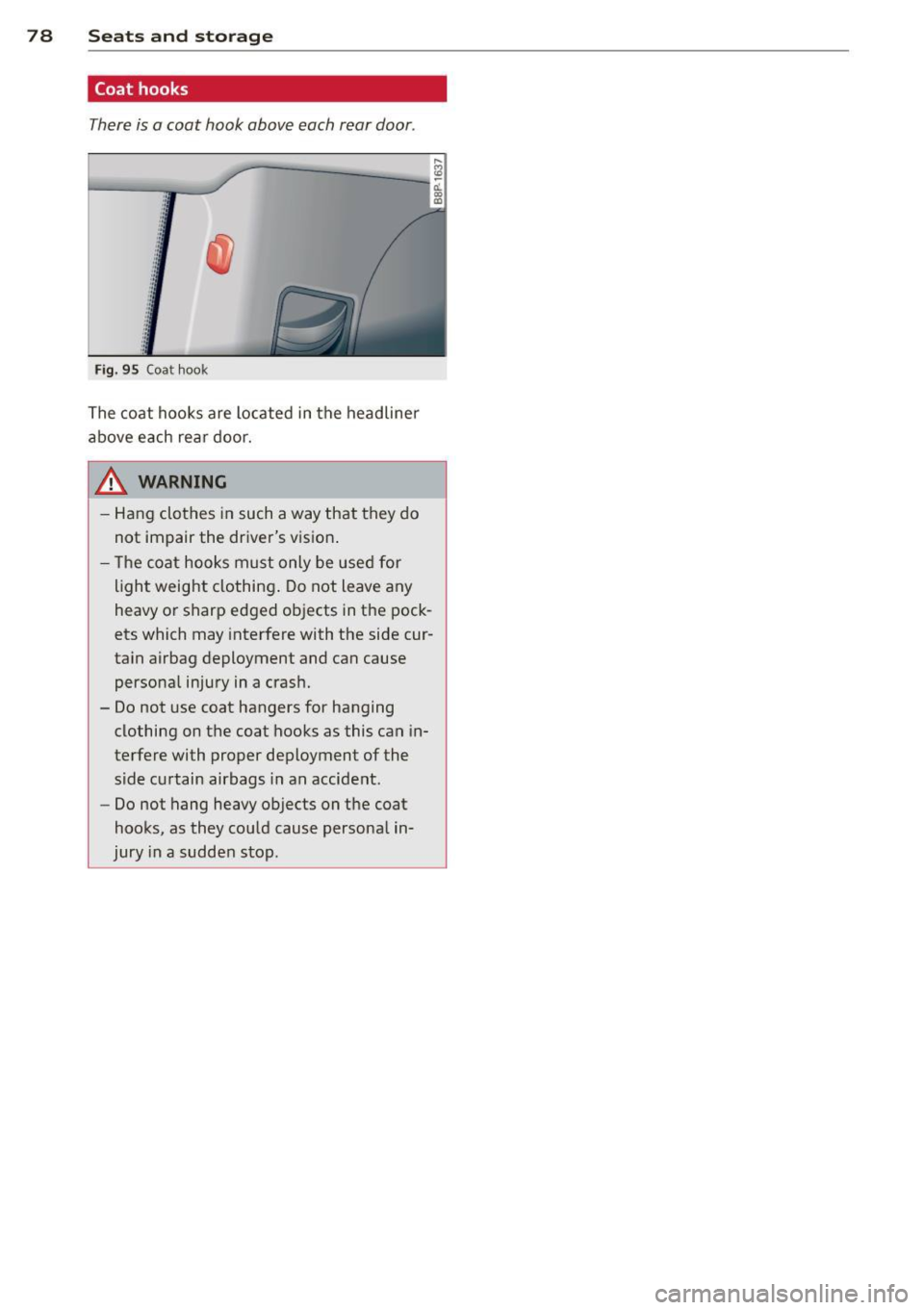
Coat hooks
There is a coat hook above each rear door .
.. ., ' . 'I ., '
Fi g. 9 5 Coa t hook
The coat hooks are located in the headliner
above each rear door.
A WARNING
- Hang clothes in such a way that they do
not impair the driver's vision .
- Th e coat hooks must only be use d for
ligh t weight clothing . Do not leave any
heavy or sharp edged objects in the pock
ets which may interfere with the side cur
tain airbag deployment and can cause
perso na l injury in a cras h.
- Do not use coat hangers for hanging clothing on the coat hooks as this can in
terfere with proper deployment of the side curtain airbags in an accident.
- Do not hang heavy objects on t he coat
hooks, as they could cause persona l in
jury in a sudden stop.
Page 90 of 280

88 On the road
On the road
Steering
Adjustable steering wheel
The height and reach of the steering wheel
can be adjusted .
Fig. 101 Lever under the steering column
First, adjust the driver's seat correctly.
• Push the lever
c:> fig . 101 down as far as it
will go
c:> & .
• Move the steer ing whee l to the desired po-
s it ion.
• Push the lever back up as far as it will go.
There must be at least 10 inches (25 cm) be tween your chest and the center of the steer
i ng wheel. If you cannot si t more than 10 in
ches (25 cm) from the steering whee l, see if
adaptive equipment is available to help you
reach the pedals and increase the distance
from the steering whee l.
F or detai led information on how to adjust the
driver's seat, see
c:> page 63, Power seat ad
justment.
The stee ring wheel can be adjusted even when
the ignition is turned off.
8_ WARNING
Improper use of steering wheel adjust
ment and improper seating position can
cause serious personal injury .
- Adjust the steering whee l co lumn on ly
when the vehicle is not moving to pre
vent loss of veh icle control.
- Always make sure that the ad justment
lever is securely pushed up so that the
-
position of the steering wheel cannot be
changed unintentionally when the vehi
cle is mov ing.
- Adj ust the driver's seat or steering whee l
so that there is a minimum of 10 inches
(25 cm) between your breastbone and
the steering wheel
c:> page 104,
fig. 117.
If you cannot maintain this
minim um distance, the airbag system
cannot protect you properly.
- If physical limitations prevent you from sitt ing 10 inches (25 cm) or more from
the steering wheel, check wit h your au
thorized A udi dealer to see if adaptive
equipment is available .
- Pointing the steering wheel toward your
face decreases the ability of the s upple
mental driver's airbag to protect you in
an accident. Always make sure that the
steer ing whee l is po inted towards your
chest.
- Always hold the steering wheel on the
outside of the steering wheel rim with
your hands at the 9 o'clock and 3 o'clock
positions to help reduce the risk of per
sonal injury if the driver's a irbag inflates .
- Never hold the steering wheel at the
12 o'clock position or with your hands at
other positions inside the steer ing wheel
rim or on the steering wheel hub. Ho ld
ing the steering whee l the wrong way
can cause se rious inj uries to the hands,
arms and head if the driver's airbag in
f lates .
Page 105 of 280

Driving Safely
General notes
Safe driving habits
Please remember -safety first!
This chapter contains important information,
tips, instructions and warnings that you need
to read and observe for your own safety, the
safety of your passengers and others . We have
summarized here what you need to know
about safety belts, airbags, ch ild restra ints as
well as child safety. You r safety is for us
priori
ty number 1.
Always observe t he information
a nd warn ings in th is se ct ion - for yo ur own
safety as well as that of your passengers .
The information in this se ction applies to all
model ve rsion s of your veh icle . Some of the
feat ures descr ibed in th is sec tions may be
standa rd equipment on some models, or may
be optional equipment on others . If you are
not sure, ask yo ur authorized Aud i dea ler.
A WARNING
- Always make sure that you follow the in
st ruct ions and heed the WARNINGS i n
this Manual. It is in your interest and in
the inte rest of you r passengers.
- Always keep the complete Owne r's Liter
at ure in your Audi when you lend or sell
yo ur vehicle so that this important info r
mation will always be ava ilable to the
dr iver and passenge rs.
- Always keep the Owner's literature handy
so that you can find i t eas ily if you have
ques tion s.
Safety equipment
The safety features are part of the occupant
restraint syst em and work togeth er to help
redu ce the risk of injury in a wide variety of
accident situations .
Your safety and the safety of your passenge rs
should not be left to chance. Advances in
t echnology have made a var iety o f fea tures
avai lable to he lp red uce the risk of i njury in an
Dr iving Safel y 103
accident . The following is a list of just a few of
the safety features in yo ur Audi :
- sophis tic ated s afety be lts fo r driver and a ll
passenger sea ting posit ions,
- s afety bel t prete nsio ners ,
- safety belt force lim ite rs fo r the front sea ts,
- safety belt he ight adjustment systems for
the front seats ,
- automatic safety be lt height adjustment for
the rear seats,
- head restra ints for each seating posit ion,
- front airbags,
- side airbags in the front seats and outer rea r
seats *,
- side c urtai n airbags ,
- specia l LATCH an cho rages for child re-
s tr ain ts,
- he ad restra ints for each sea ting posit ion,
- adj ustab le steering colum n.
These ind iv idual safety features , can work to
gether as a system to he lp protect you and
you r passengers in a w ide range of accide nts.
T hese fe;;itures c;;innot work ;;is ;;i system if
t h ey a re not always cor re ct ly adjus ted and co r
re ct ly used .
Safety is everybody' s responsibility!
Important things to do before driving
Safety is everybody 's job! Vehicle and occu
pant safety always depends on the informed
and careful driver .
For you r safety and the safety of your passen
gers,
before driving always:
.,. Make s ure that all lights and signals are op
erating correctly .
.,. Make sure that the tire pressure is correct .
.,. Make su re that all windows are clean and
afford good v isib ility to the o utside.
.,. Sec ure a ll luggage a nd other items carefu lly
~ page 75.
.,. Mak e s ure th at nothing can interfe re wi th
t he peda ls .
.,. Adjust front seat, head restraint and mir
rors co rrectly for your height.
•
•
Page 106 of 280

104 Driving Safel y
• Instruct passengers to adjust the head re
straints according to their height.
• Make sure to use the right child restra int
correct ly to protect children<=>
page 143 ,
Child Safe ty .
• Sit properly in your seat and make sure that
you r passenge rs do the same<=>
page 61 ,
General recomm endations .
• Fasten your safety bel t an d wear it properly.
Also ins truc t you r passengers to f aste n t heir
sa fety belts properly<=>
page 113 .
What impairs driving safety?
Safe driving i s directly rela ted to the condi
t ion of the vehicle , the driver as well as the
driver 's abili ty to concentrate on the road
without being distracted .
The driver is responsib le fo r the s afety of the
ve hicl e an d all of i ts occupants . If you r ability
to d rive is impai red, safety r is k s for everybody
i n the vehicle increase and yo u also become a
hazard to everyone else on the road <=>
&_.
Therefore:
• Do no t let yo urself be dist racted by passen
gers or by using a cellular telephone.
• NEV ER drive when yo ur dr iv ing ability is im
paired (by medicat ions, alcohol , drugs, etc.).
• Observe all traffic laws , rules of the road
and speed limits and plain common sense .
• ALWAYS adjust you r speed to road , traff ic
and weathe r con dit ions .
• Take frequent b reaks on long t rips. Do not
dr ive for more than two hours a t a str etch .
• Do NOT drive whe n you are t ired , under
pressure or when you are stressed .
A WARNING
Impaired driving safety increases the risk
of serious personal injury and death when
ever a veh icle is being used.
Proper occupant
seating positions
Proper seating position for the driver
The proper driver seating position is impor
t ant for safe, relaxed driving.
Fi g. 1 17 Correc t seat ing posit ion
For yo ur own safety and to reduce the risk of
injury in the event of an accident, we recom
mend that you adjust t he driver's seat to the
fo llow ing pos ition:
• Ad just the driver's seat so that you can easi
ly push the pedals all the way to the floor
while keepi ng your knee(s) slightly bent
¢ &_ .
• Adjust the a ngle of the seatback so that it is
in an upr ight position so that your back
comes in full conta ct w ith it when you d rive.
• Adjust t he steer ing whee l so that there is a
d is tance of at least 1 0 inches (2 5 cm) be
t ween the steer ing whee l and yo ur breast
bone
~ fig. 117. I f not possible, see your a u
thorized A udi dealersh ip about adaptive
equ ipment.
• Adjust the steering wheel so that t he steer
ing wheel and airbag cover poi nts at your
ch est and not a t your face .
• Grasp the top of the s teer ing wh ee l with
your elb ow(s) slightly ben t.
• Adjust t he head rest ra in t so t he up per edge
is as even as poss ible wi th th e top of y our
head . If that is not possi ble, try to adjust
the head restraint so that it is as close to
this pos ition as possib le .
• Fasten and wear safety be lts correctly
<=>page 116.