2011 TOYOTA VERSO S stop start
[x] Cancel search: stop startPage 330 of 664
3305-2. Driving procedures
enabled, the system will turn off and the
brake hold standby indicator light will go off. In addition, if any of the conditions are detected while the system is holding
the brake, a warning buzzer will sound and a message will be shown on the multi-information display. The parking
brake will then be set automatically.
■Brake hold function
●If the brake pedal is left released for a
period of about 3 minutes after the system has started holding the brake, the parking brake will be set automati-
cally. In this case, a warning buzzer sounds and a message is shown on the multi-information display.
●To turn the system off while the sys-tem is holding the brake, firmly
depress the brake pedal and press the button again.
●The brake hold function may not hold the vehicle when the vehicle is on a steep incline. In this situation, it may
be necessary for the driver to apply the brakes. A warning buzzer will sound and the multi-information dis-
play will inform the driver of this situa- tion. If a warning message is shown on the multi-information display, read
the message and follow the instruc- tions.
■When the parking brake is set auto-matically while the system is hold-
ing the brakes
Perform any of the following operations to release the parking brake:
●Depress the accelerator pedal. (The parking brake will not be released
automatically if the seat belt is not fas- tened.)
●Operate the parking brake switch with the brake pedal depressed.
Make sure that the parking brake indica-
tor light goes off. ( P.326)
■When an inspection at any autho-
rized Toyota retailer or Toyota authorized repairer, or any reliable repairer is necessary
When the brake hold standby indicator (green) does not illuminate even when the brake hold switch is pressed with the
brake hold system operating conditions met, the system may be malfunctioning. Have the vehicle inspected at any
authorized Toyota retailer or Toyota authorized repairer, or any reliable repairer.
■If “Brake Hold Malfunction Press
Brake to Deactivate Visit Your Dealer” or “Brake Hold Malfunction Visit Your Dealer” is displayed on
the multi-information display
The system may be malfunctioning. Have the vehicle inspected by any
authorized Toyota retailer or Toyota authorized repairer, or any reliable repairer.
■Warning messages and buzzers
Warning messages and buzzers are used to indicate a system malfunction or to inform the driver of the need for cau-
tion. If a warning message is shown on the multi-information display, read the message and follow the instructions.
■If the brake hold operated indicator
flashes
P.574
WARNING
■When the vehicle is on a steep
incline
When using the brake hold system on a steep incline, exercise caution. The
brake hold function may not hold the vehicle in such a situation.
■When stopped on a slippery road
The system cannot stop the vehicle when the gripping ability of the tires
has been exceeded. Do not use the system when stopped on a slippery road.
Page 380 of 664
3805-5. Using the driving support systems
When a vehicle is detected running ahead of you, the system automatically deceler-
ates your vehicle. When a greater reduction in vehicle speed is necessary, the sys-
tem applies the brakes (the stop lights will come on at this time). The system will
respond to changes in the speed of the vehicle ahead in order to maintain the vehi-
cle-to-vehicle distance set by the driver. Approach warning warns you when the sys-
tem cannot decelerate sufficiently to prevent your vehicle from closing in on the
vehicle ahead.
When the vehicle ahead of you stops, your vehicle will also stop (vehicle is stopped
by system control). After the vehicle ahead starts off, pressing the “+RES” switch or
depressing the accelerator pedal (start-off operation) will resume follow-up cruising.
If the start-off operation is not performed, system control continues to keep your
vehicle stopped.
When the turn signal lever is operated and your vehicle moves to an overtaking lane
while driving at 50 mph (80 km/h) or more, the vehicle will accelerate to help to over-
take a passing vehicle.
The system’s identification of what is an overtaking lane may be determined solely
based on the location of the steering wheel in the vehicle (left side driver position
versus right side driver position.) If the vehicle is driven to a region where the over-
taking lane is on a different side from where the vehicle is normally driven, the vehi-
cle may accelerate when the turn signal lever is operated in the opposite direction to
the overtaking lane (e.g., if the driver normally operates the vehicle in a region
where the overtaking lane is to the right but then drives to a region where the over-
taking lane is to the left, the vehicle may accelerate when the right turn signal is acti-
vated).
Example of acceleration
When there are no longer any preceding vehicles driving slower than the
set speed
The system accelerates until the set speed is reached. The system then returns to
constant speed cruising.
1Press the cruise control main
switch to activate the cruise con-
trol.
Dynamic radar cruise control indicator
will come on and a message will be dis-
played on the multi-information display.
Press the switch again to deactivate the
cruise control.If the cruise control main switch is
pressed and held for 1.5 seconds or
more, the system turns on in constant
C
Setting the vehicle speed
(vehicle-to-vehicle distance
control mode)
Page 382 of 664
3825-5. Using the driving support systems
*1: When the set speed is shown in
“km/h”
*2: When the set speed is shown in
“MPH”
Increasing the set speed by the
accelerator pedal
1 Accelerate with accelerator
pedal operation to the desired
vehicle speed
2 Press the “-SET” switch
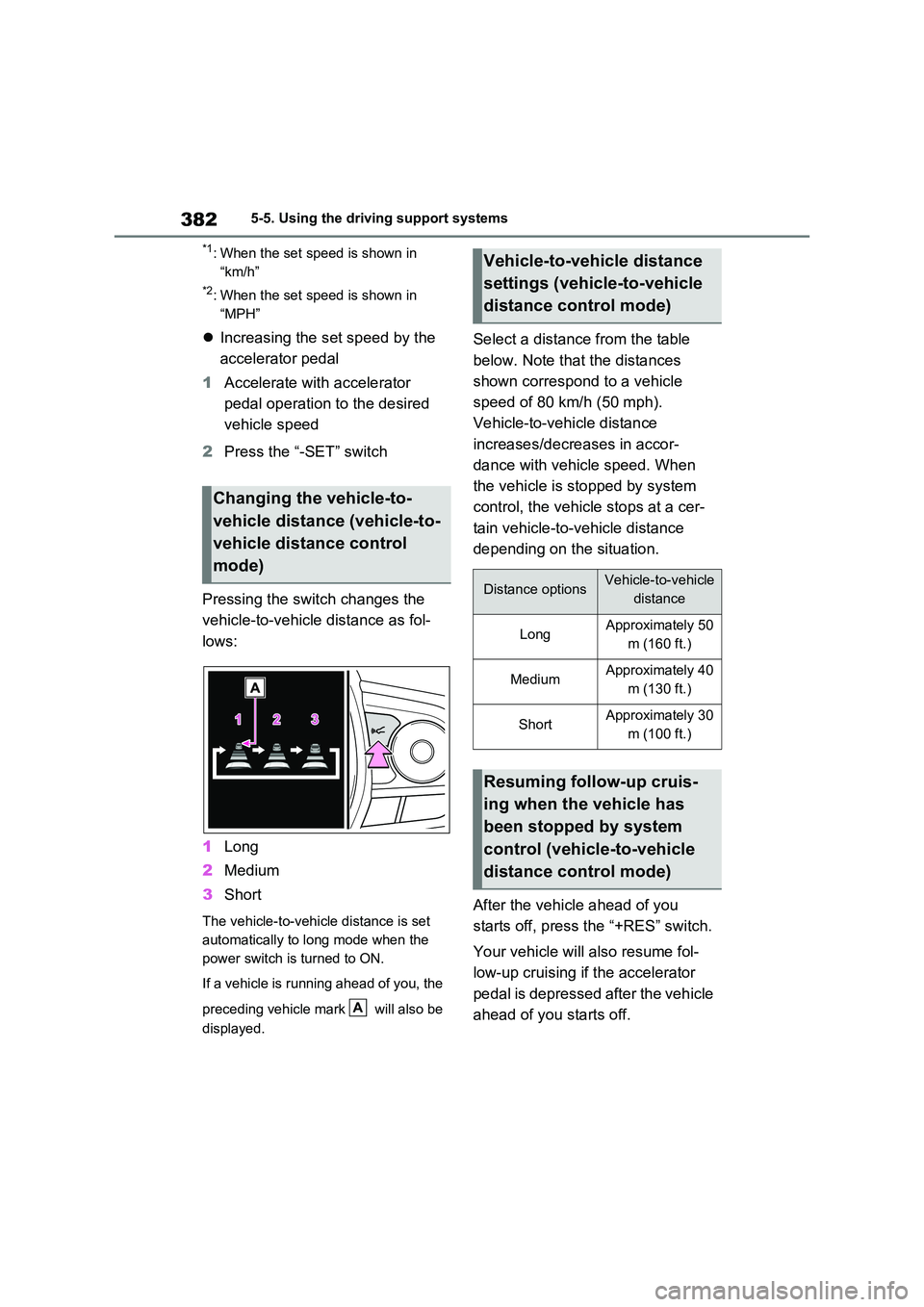
Pressing the switch changes the
vehicle-to-vehicle distance as fol-
lows:
1 Long
2 Medium
3 Short
The vehicle-to-vehicle distance is set
automatically to long mode when the
power switch is turned to ON.
If a vehicle is running ahead of you, the
preceding vehicle mark will also be
displayed.
Select a distance from the table
below. Note that the distances
shown correspond to a vehicle
speed of 80 km/h (50 mph).
Vehicle-to-vehicle distance
increases/decreases in accor-
dance with vehicle speed. When
the vehicle is stopped by system
control, the vehicle stops at a cer-
tain vehicle-to-vehicle distance
depending on the situation.
After the vehicle ahead of you
starts off, press the “+RES” switch.
Your vehicle will also resume fol-
low-up cruising if the accelerator
pedal is depressed after the vehicle
ahead of you starts off.
Changing the vehicle-to-
vehicle distance (vehicle-to-
vehicle distance control
mode)
A
Vehicle-to-vehicle distance
settings (vehicle-to-vehicle
distance control mode)
Distance optionsVehicle-to-vehicle
distance
LongApproximately 50
m (160 ft.)
MediumApproximately 40
m (130 ft.)
ShortApproximately 30
m (100 ft.)
Resuming follow-up cruis-
ing when the vehicle has
been stopped by system
control (vehicle-to-vehicle
distance control mode)
Page 385 of 664

385
5 5-5. Using the driving support systems
Driving
speed limit
Press and hold the “-SET” switch.
Dynamic Radar Cruise Control with
Road Sign Assist can be
enabled/disabled in the screen
on the multi-information display.
(P.186)
■Dynamic radar cruise control with
full-speed range can be set when
●The shift lever is in D.
●The desired set speed can be set
when the vehicle speed is approxi-
mately 30 km/h (20 mph) or more.
(However, when the vehicle speed is
set while driving at below approxi-
mately 30 km/h [20 mph], the set
speed will be set to approximately 30
km/h [20 mph].)
■Accelerating after setting the vehi-
cle speed
The vehicle can accelerate by operating
the accelerator pedal. After accelerat-
ing, the set speed resumes. However,
during vehicle-to-vehicle distance con-
trol mode, the vehicle speed may
decrease below the set speed in order
to maintain the distance to the preced-ing vehicle.
■When the vehicle stops while fol-
low-up cruising
●Pressing the “+RES” switch while the
vehicle ahead stops will resume fol-
low-up cruising if the vehicle ahead
starts off within approximately 3 sec-
onds after the switch is pressed.
●If the vehicle ahead starts off within 3
seconds after your vehicle stops, fol-
low-up cruising will be resumed.
■Automatic cancelation of vehicle-
to-vehicle distance control mode
Vehicle-to-vehicle distance control
mode is automatically canceled in the
following situations.
●VSC is activated.
●TRC is activated for a period of time.
●When the VSC or TRC system is
turned off.
●The sensor cannot detect correctly
because it is covered in some way.
●Pre-collision braking is activated.
●The parking brake is operated.
●The vehicle is stopped by system con-
trol on a steep incline.
●The following are detected when the
vehicle has been stopped by system
control:
• The driver is not wearing a seat belt.
• The driver’s door is opened.
• The vehicle has been stopped for
about 3 minutes
If vehicle-to-vehicle distance control
mode is automatically canceled for any
reasons other than the above, there
may be a malfunction in the system.
Contact any authorized Toyota retailer
or Toyota authorized repairer, or any
reliable repairer.
■Automatic cancelation of constant
speed control mode
Constant speed control mode is auto-
matically canceled in the following situa-
tions:
Enabling/Disabling the
Dynamic Radar Cruise Con-
trol with Road Sign Assist
(vehicles with RSA)
Page 392 of 664
3925-5. Using the driving support systems
release when the desired speed is
reached.
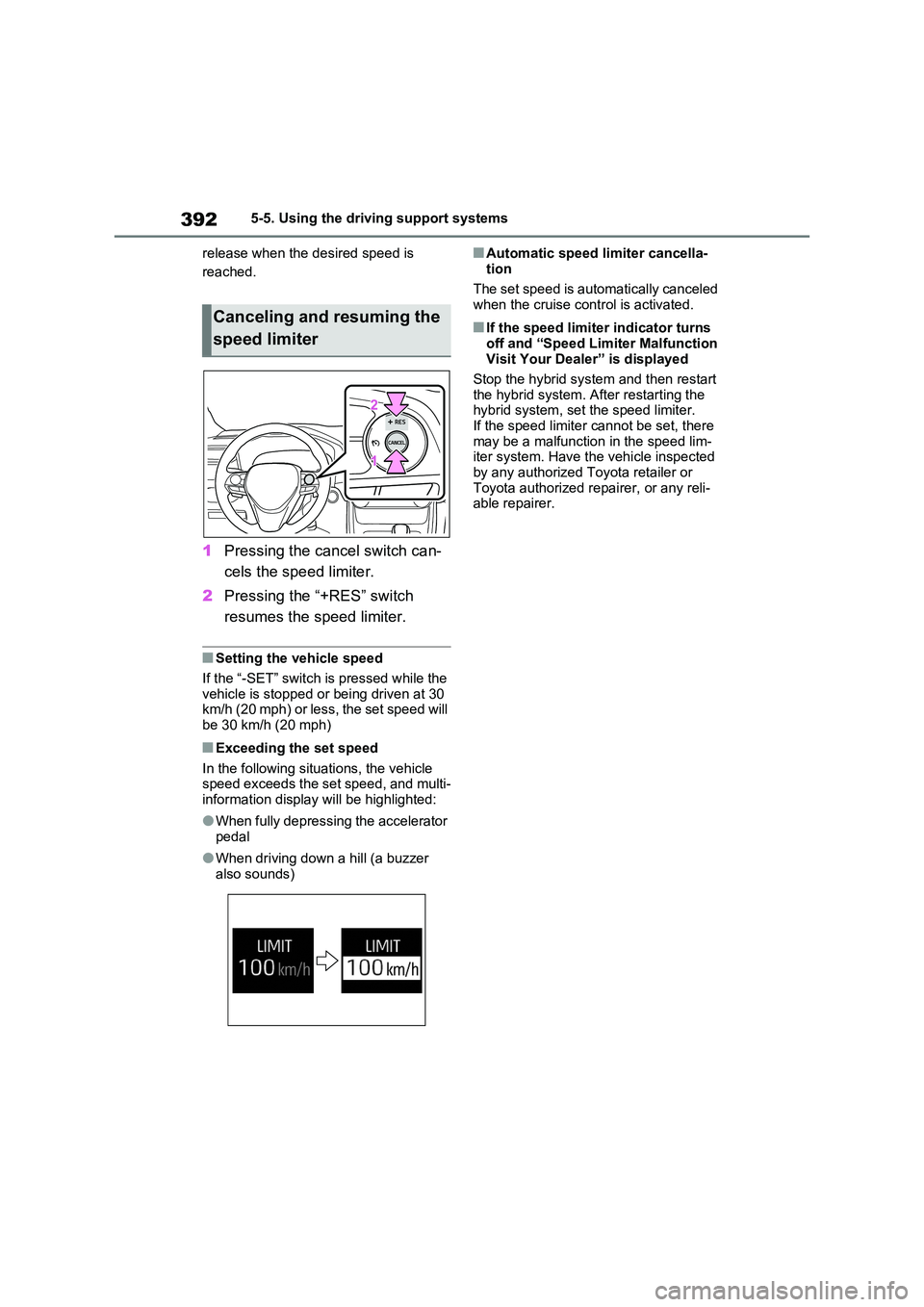
1 Pressing the cancel switch can-
cels the speed limiter.
2 Pressing the “+RES” switch
resumes the speed limiter.
■Setting the vehicle speed
If the “-SET” switch is pressed while the
vehicle is stopped or being driven at 30 km/h (20 mph) or less, the set speed will be 30 km/h (20 mph)
■Exceeding the set speed
In the following situations, the vehicle speed exceeds the set speed, and multi-information display will be highlighted:
●When fully depressing the accelerator pedal
●When driving down a hill (a buzzer also sounds)
■Automatic speed limiter cancella-
tion
The set speed is automatically canceled when the cruise control is activated.
■If the speed limiter indicator turns
off and “Speed Limiter Malfunction Visit Your Dealer” is displayed
Stop the hybrid system and then restart
the hybrid system. After restarting the hybrid system, set the speed limiter.If the speed limiter cannot be set, there
may be a malfunction in the speed lim- iter system. Have the vehicle inspected by any authorized Toyota retailer or
Toyota authorized repairer, or any reli- able repairer.
Canceling and resuming the
speed limiter
Page 410 of 664

4105-5. Using the driving support systems
■The BSM function is operational
when
The BSM function is operational when
all of the following conditions are met:
●The BSM function is on.
●The shift lever is in a position other
than R.
●The vehicle speed is greater than
approximately 16 km/h (10 mph).
■The BSM function will detect a
vehicle when
The BSM function will detect a vehicle
present in the detection area in the fol-
lowing situations:
●A vehicle in an adjacent lane over-
takes your vehicle.
●You overtake a vehicle in an adjacent
lane slowly.
●Another vehicle enters the detection
area when it changes lanes.
■Conditions under which the BSM
function will not detect a vehicle
The BSM function is not designed to
detect the following types of vehicles
and/or objects:
●Small motorcycles, bicycles, pedestri-
ans, etc.*
●Vehicles traveling in the opposite
direction
●Guardrails, walls, signs, parked vehi-
cles and similar stationary objects*
●Following vehicles that are in the
same lane*
●Vehicles traveling 2 lanes away from
your vehicle*
●Vehicles which are being overtaken
rapidly by your vehicle
*: Depending on the conditions, detec-
tion of a vehicle and/or object may
occur.
■Conditions under which the BSM
function may not function correctly
●The BSM function may not detect
vehicles correctly in the following situ-
ations:
• When the sensor is misaligned due to
a strong impact to the sensor or its
surrounding area
• When mud, snow, ice, a sticker, etc. is
covering the sensor or surrounding
area on the rear bumper
• When driving on a road surface that is
wet with standing water during bad
weather, such as heavy rain, snow, or
fog
• When multiple vehicles are approach-
ing with only a small gap between
each vehicle
• When the distance between your vehi-
cle and a following vehicle is short
• When there is a significant difference
in speed between your vehicle and
the vehicle that enters the detection
area
• When the difference in speed
between your vehicle and another
vehicle is changing
• When a vehicle enters a detection
area traveling at about the same
speed as your vehicle
• As your vehicle starts from a stop, a
vehicle remains in the detection area
• When driving up and down consecu-
tive steep inclines, such as hills, dips
in the road, etc.
• When driving on roads with sharp
bends, consecutive curves, or uneven
surfaces
• When vehicle lanes are wide, or when
driving on the edge of a lane, and the
vehicle in an adjacent lane is far away
from your vehicle
• When an accessory (such as a bicycle
carrier) is installed to the rear of the
vehicle
• When there is a significant difference
in height between your vehicle and
the vehicle that enters the detection
area
• Immediately after the BSM func-
tion/RCTA function are turned on
• When towing a trailer
Page 427 of 664
427
5 5-5. Using the driving support systems
Driving
trol is operating
• The Parking Support Brake deter-
mines that an immediate brake opera-
tion is necessary to avoid a collision.
■The Parking Support Brake func-
tion (static objects) will stop oper-
ating when
The function will stop operating if any of
the following conditions are met:
●Hybrid system output restriction con-
trol
• The Parking Support Brake is dis-
abled.
• The system determines that the colli-
sion has become avoidable with nor-
mal brake operation.
• The static object is no longer approxi-
mately 2 to 4 m (6 to 13 ft.) away from
the vehicle or in the traveling direction
of the vehicle.
●Brake control
• The Parking Support Brake is dis-
abled.
• Approximately 2 seconds have
elapsed since the vehicle was
stopped by brake control.
• The brake pedal is depressed after
the vehicle is stopped by brake con-
trol.
• The static object is no longer approxi-
mately 2 to 4 m (6 to 13 ft.) away from
the vehicle or in the traveling direction
of the vehicle.
■Detection range of the Parking Sup-
port Brake function (static objects)
The detection range of the Parking Sup-
port Brake function (static objects) dif-
fers from the detection range of the
Toyota parking assist-sensor. (P.418)
Therefore, even if the Toyota parking
assist-sensor detects an object and pro-
vides a warning, the Parking Support
Brake function (static objects) may not
start operating.
■Objects that the Parking Support
Brake function (static objects) may
not detect
The sensors may not be able to detect
certain objects, such as the following:
●Pedestrian
●Cotton, snow, and other materials that
are poor reflectors of sonic waves
●Objects which are not perpendicular
to the ground, are not perpendicular to
the traveling direction of the vehicle,
are uneven or are waving
●Low objects
●Thin objects such as wires, fences,
ropes and signposts
●Objects that are extremely close to
the bumper
●Sharply-angled objects
●Tall objects with upper sections pro-
jecting outwards in the direction of
your vehicle
■Situations in which the Parking
Support Brake function (static
objects) may not operate
When the shift lever is in N
■Toyota parking assist-sensor
buzzer
Regardless of whether the Toyota park-
ing assist-sensor function is enabled or
not (P.415), if the Parking Support
Brake function (static objects) is enabled
(P.421), the front or rear sensors
detect an object and brake control and
hybrid system output restriction control
are performed, the Toyota parking
assist-sensor buzzer will sound to notify
the driver of the approximate distance to
the object.
■Situations in which the Parking
Support Brake function (static
objects) may operate even if there
is no possibility of a collision
In some situations, such as the follow-
ing, the Parking Support Brake function
(static objects) may operate even
though there is no possibility of a colli-
sion.
●Vehicle surroundings
• When driving on a narrow road
Page 431 of 664
431
5 5-5. Using the driving support systems
Driving
• Vehicles are approaching from the
right or left at the rear of the vehicle at
a traveling speed of more than
approximately 8 km/h (5 mph)
• The shift lever is in R.
• The Parking Support Brake deter-
mines that a stronger than normal
brake operation is necessary to avoid
a collision with an approaching vehi-
cle.
●Brake control
• Hybrid system output restriction con-
trol is operating
• The Parking Support Brake deter-
mines that an emergency brake oper-
ation is necessary to avoid a collision
with an approaching vehicle.
■The Parking Support Brake func-
tion (rear-crossing vehicles) will
stop operating when
The function will stop operating if any of
the following conditions are met:
●Hybrid system output restriction con-
trol
• The Parking Support Brake is dis-
abled.
• The collision becomes avoidable with
normal brake operation.
• A vehicle is no longer approaching
from the right or left at the rear of the
vehicle.
●Brake control
• The Parking Support Brake is dis-
abled.
• Approximately 2 seconds have
elapsed since the vehicle was
stopped by brake control.
• The brake pedal is depressed after
the vehicle is stopped by brake con-
trol.
• A vehicle is no longer approaching
from the right or left at the rear of the
vehicle.
■Detection area of the Parking Sup-
port Brake function (rear-crossing
vehicles)
The detection area of the Parking Sup-
port Brake function (rear-crossing vehi-
cles) differs from the detection area of
the RCTA function (P.412). Therefore, even if the RCTA function detects a
vehicle and provides an alert, the Park-
ing Support Brake function (rear-cross-
ing vehicles) may not start operating.
■Conditions under which the Park-
ing Support Brake function (rear-
crossing vehicles) will not detect a
vehicle
The Parking Support Brake function
(rear-crossing vehicles) is not designed
to detect the following types of vehicles
and/or objects:
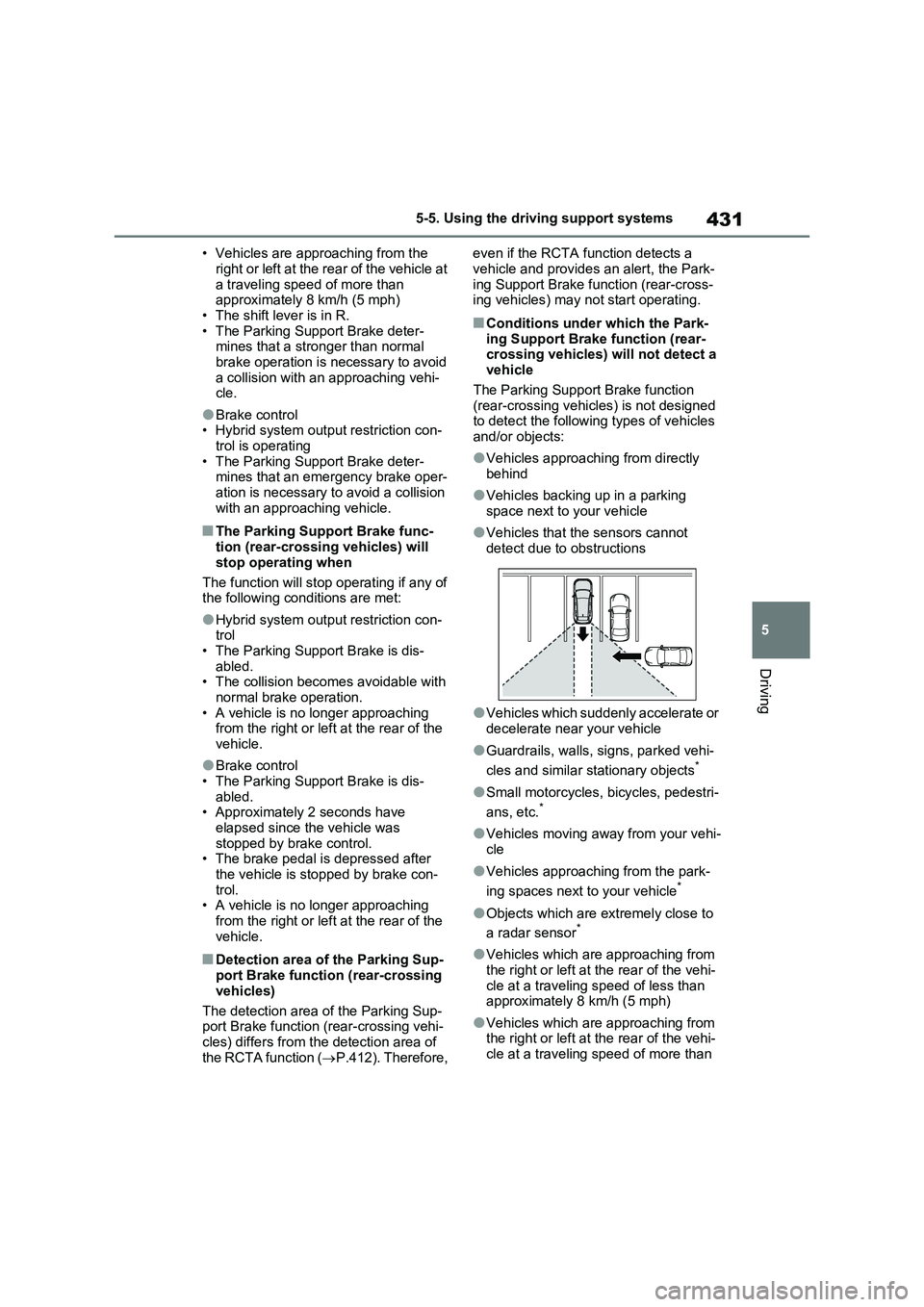
●Vehicles approaching from directly
behind
●Vehicles backing up in a parking
space next to your vehicle
●Vehicles that the sensors cannot
detect due to obstructions
●Vehicles which suddenly accelerate or
decelerate near your vehicle
●Guardrails, walls, signs, parked vehi-
cles and similar stationary objects*
●Small motorcycles, bicycles, pedestri-
ans, etc.*
●Vehicles moving away from your vehi-
cle
●Vehicles approaching from the park-
ing spaces next to your vehicle*
●Objects which are extremely close to
a radar sensor*
●Vehicles which are approaching from
the right or left at the rear of the vehi-
cle at a traveling speed of less than
approximately 8 km/h (5 mph)
●Vehicles which are approaching from
the right or left at the rear of the vehi-
cle at a traveling speed of more than