2011 SKODA YETI service
[x] Cancel search: servicePage 210 of 252

Breakdown assistance
Breakdown assistance
Space for first-aid box and warning triangle Fig. 163 Placing of the warning triangle/placing of the first-aid box
The warning triangle can be attached to the trim panel of the rear wall with rub-
ber straps
⇒
fig. 163 - left.
The warning triangle, which is included in the equipment with the spare wheel,
can be stowed in a removable box on the right next to the spare wheel ⇒ page 75.
The first-aid box can be attached to the right side of the luggage compartment
with a strap ⇒ fig. 163 - right. Note
Pay attention to the use-by-date of the contents of the first-aid box.
● We recommend a first-aid kit from the range of ŠKODA Original Accessories
that you can purchase from an authorised
ŠKODA Service Partner.
● If you also want to equip your vehicle with a warning triangle, we recommend
a warning triangle from the range of
ŠKODA Original Accessories that you can pur-
chase from authorised ŠKODA Service Partners.
Fire extinguisher The fire extinguisher is attached with straps in a holder under the driver seat. Please read carefully the instructions which are attached to the fire extinguish-
er.
The fire extinguisher must be checked by an authorised person or company annu-
ally (please observe the differing legal requirements). WARNING
If the fire extinguisher is not correctly attached, in case of sudden manoeu-
vres or an accident it can be
“thrown” through the interior compartment and
cause injuries. Note
● The fire extinguisher must comply with the relevant and valid legal require-
ments.
● Pay attention to the expiration date of the fire extinguisher. If the fire extin-
guisher is used after the expiration date, its proper function is no longer assured.
● The fire extinguisher is part of the scope of delivery in certain countries only.
Vehicle tool kit Fig. 164 Luggage compartment: Example for placing the vehicle tool kit
£208
Breakdown assistance
Page 215 of 252

WARNING (Continued)
● Secure the base plate of the lifting jack with suitable means to prevent
possible moving. A soft and slippery ground under the base plate may move
the lifting jack, causing the vehicle to fall down. It is therefore always neces-
sary to place the lifting jack on a solid surface or use a wide and stable base.
Use a non-slip base (e.g. a rubber foot mat) if the
surface is smooth, such as
cobbled stones, a tiled floor, etc.
● Attach the lifting jack only at the attachment points provided for this pur-
pose.
Securing wheels against being stolen You need a special adapter for loosening the safety wheel bolts.
Fig. 171 Illustration image: Safety wheel
bolt with adapter
– Pull off the full wheel trim/cap from the wheel hub or cap from the safety
wheel bolt.
– Insert the adapter B with its toothed side into the inner toothing of the head
of the safety wheel bolt A
⇒
fig. 171 .
– Insert the wheel wrench fully onto the adapter B .
– Slacken the wheel bolt, or tighten it firmly ⇒ page 211.
– Reinstall the full wheel trim/wheel cap after removing the adapter or place the
cap onto the safety wheel bolt.
– Have the tightening torque checked with a torque wrench as soon as possi-
ble. Steel and light alloy wheels must be tightened to a tightening torque of
120
Nm. The safety wheel bolts on vehicles fitted with them (one safety wheel bolt per
wheel) can only be loosened or tighten up by using the adapter provided.
It is meaningful to note the code number hammered into the rear side of the
adapter or the rear side of the safety wheel bolts. You can obtain a replacement
adapter from an authorised
ŠKODA Service Partner, if necessary, by quoting this
number.
We recommend that you always carry the adapter for the wheel bolts with you in
the vehicle. It should be stowed in the vehicle tool kit. CAUTION
Damage can occur to the adapter and safety wheel bolt if the safety wheel bolt is
tightened up too much. Note
The set of safety wheel bolts can be obtained from an authorised ŠKODA Service
Partner.
Tyre repair kit General information The tyre repair kit is located in a box under the carpet in the luggage compart-
ment.
Use the tyre repair kit to reliably repair tyre damage caused by foreign bodies or a
puncture with diameters up to 4 mm. Do not remove foreign bodies, e.g. screws or
nails, from the tyre!
The repair can be undertaken on the vehicle immediately.
The repair with the tyre repair kit is not at all intended to replace a permanent
repair on the tyre, this repair only serves to reach the next specialist garage.
Do not use the tyre repair kit:
● to repair wheel damage,
● in outside temperatures of less than -20 °C (-4 °F),
● with tears or punctures greater than 4 mm in size,
● to repair damage to the tyre wall,
● when driving with very low tyre pressure or with a completely flat tyre,
● if the use-by-date (see inflation bottle) has passed. £ 213
Breakdown assistance Using the system Safety Driving Tips General Maintenance Breakdown assistance Technical data
Page 220 of 252

The maximum towing speed is
50 km/h.
Driver of the towed vehicle
– Switch the ignition on so that the steering wheel is not blocked and you can
also operate the turn signal lights, the headlight flasher, the windscreen wip-
ers and windscreen washer system.
– Take the vehicle out of gear or move the selector lever into position N if your
vehicle is fitted with an automatic gearbox.
Note that the brake servo unit and power steering only operate if the engine is
running. You will require significantly greater physical force to depress the brake
pedal and to steer the vehicle if the engine is not running.
When using a tow rope, always ensure that the tow rope is always kept taught. CAUTION
● Do not tow start the engine - danger of damaging the engine. On vehicles with
a catalytic converter, unburnt fuel may get into the catalytic converter where it
may ignite. This in turn may damage or destroy the catalytic converter. You can
use the battery of another vehicle as a jump-start aid ⇒ page 216, Jump-starting
.
● If the gearbox of your vehicle no longer contains any oil because of a defect,
your vehicle must only be towed in with the driven wheels raised clear of the
ground, or on a special vehicle transporter or trailer.
● The vehicle must be transported on a special vehicle or trailer if it is not possi-
ble to tow in the vehicle in the way described or if the towing distance is greater
than 50
km.
● To protect both vehicles when tow-starting or towing, the tow rope should be
elastic. Thus one should only use plastic fibre rope or a rope made out of a similar-
ly elastic material.
● One should be constantly vigilant not to allow impermissibly high towing
forces or jerky loadings. There is always a risk of excessive stresses and damage
resulting at the points to which you attach the tow rope or tow bar when you at-
tempt to tow a vehicle which is not standing on a paved road.
● Attach the tow rope or the tow bar only to the towing eyes provided for this
purpose ⇒ page 218
, Front towing eye and ⇒ page 219, Rear towing eye Note
● We recommend a tow rope from the range of
ŠKODA Original Accessories that
you can purchase from an authorised ŠKODA Service Partner.
● Towing another vehicle requires a certain amount of practice. Both drivers
should be familiar with the particular points about towing a vehicle. Unskilled driv-
ers should not attempt to tow in another vehicle or to be towed in.
● When towing, respect the national legal provisions, especially those which re-
late to the identification of the towing vehicle and the vehicle being towed.
● The tow rope must not be twisted as it may in certain circumstances result in
the front towing eye being unscrewed out of your vehicle.
Front towing eye The towing eye is stored in the box of the vehicle tool kit.
Fig. 175 Front bumper: Removing the cover/installing the towing eye
–
Press on the upper half of the cover in direction of arrow 1
⇒ fig. 175 .
– Pull the cover out of the front bumper.
– Screw in the towing eye by hand to the left up to the stop ⇒ fig. 175 - right and
tighten it as much as possible. For tightening, we recommend that you use for
example the wheel wrench, the lashing eye of another vehicle or a similar ob-
ject which you can push through the eye.
– In order to reinstall the cover after screwing out the towing eye, first of all in-
sert the upper part of the cover and then press in the lower part. The cover
must engage firmly. £218
Breakdown assistance
Page 225 of 252

Bulbs
Changing bulbs The relevant lamp must always be switched off before a light bulb is replaced.
Defect light bulbs should only be replaced with light bulbs of the same type. The
designation is located on the light socket or the glass bulb.
Changing certain bulbs is not something which you can do yourself, but requires
to be done by a specialist. Other parts of the vehicle must be removed in order to
change the light bulbs. This applies, in particular, to bulbs which can only be
reached from the engine compartment.
We therefore recommend that you have any bulbs changed by an authorised
ŠKODA Service Partner or, in exceptional cases, by calling on other professional
assistance.
Please note that the engine compartment is a hazardous area ⇒
page 190, Work-
ing in the engine compartment.
We recommend that you always have a small box of replacement bulbs in your ve-
hicle. You can purchase replacement bulbs from the range of the ŠKODA Original
Accessories 1)
.
The set of light bulbs can be stowed in the box in the luggage compartment.
Fitted with a xenon headlight
Change of bulbs on vehicles with Xenon lights (low beam lights, parking lights and
main beam lights) should be undertaken by a specialist garage.
Bulb - Overview Front headlight Halogen headlight Xenon headlight
Low beam H4 D1S
Main beam H4 D1S
Parking lights W5W W5W BL
Daylight driving lights P13W
Turn signals HPC24WY
Fog lights H7 Rear light unit Bulb
Reversing lights, brake lights and rear fog light P21W
Turn signals PY21W
Parking lights W5W
Others Bulb
Licence plate light C5W
3. Brake light LED
Entry lighting W5W
front interior lighting W5W
Reading lights W5W
Rear interior lighting C5W
Luggage compartment light W5W
Door warning light W5W
Lighting in storage compartment on front passenger
side C3W
WARNING
● Bulbs H7 and H4 are pressurised and may burst when changing the bulb -
risk of injury!
● It is recommended to wear gloves and safety glasses when changing a
bulb.
● Gas discharge bulbs (xenon bulbs) operate with a high voltage, professio-
nal knowledge is required - danger to life! CAUTION
Do not take hold of the glass bulb with naked fingers (even the smallest amount
of dirt reduces the working life of the light bulb). Use a clean cloth, serviette or
something similar. Note
This Owner's Manual only describes the replacement of bulbs where it is assumed
that no major complications will arise. Other light bulbs should be changed by your
specialist garage. 1)
The small box with replacement bulbs is part of the basic equipping of the vehicle in some countries. 223
Fuses and light bulbs Using the system Safety Driving Tips General Maintenance Breakdown assistance Technical data
Page 227 of 252
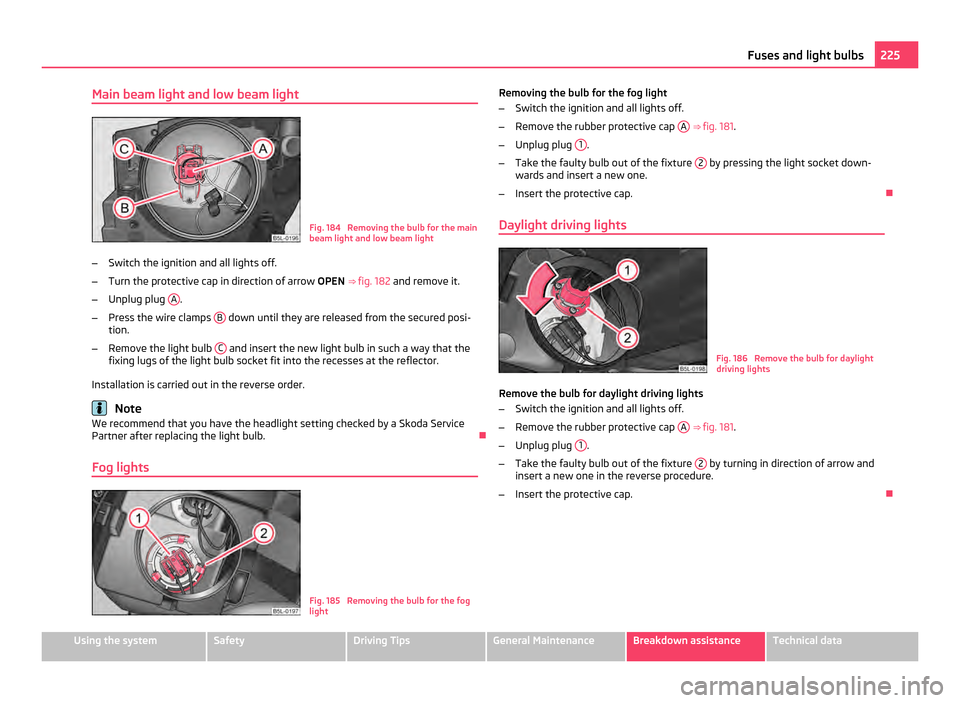
Main beam light and low beam light
Fig. 184 Removing the bulb for the main
beam light and low beam light
– Switch the ignition and all lights off.
– Turn the protective cap in direction of arrow OPEN ⇒ fig. 182 and remove it.
– Unplug plug A .
– Press the wire clamps B down until they are released from the secured posi-
tion.
– Remove the light bulb C and insert the new light bulb in such a way that the
fixing lugs of the light bulb socket fit into the recesses at the reflector.
Installation is carried out in the reverse order. Note
We recommend that you have the headlight setting checked by a Skoda Service
Partner after replacing the light bulb.
Fog lights Fig. 185 Removing the bulb for the fog
light Removing the bulb for the fog light
–
Switch the ignition and all lights off.
– Remove the rubber protective cap A ⇒ fig. 181
.
– Unplug plug 1 .
– Take the faulty bulb out of the fixture 2 by pressing the light socket down-
wards and insert a new one.
– Insert the protective cap.
Daylight driving lights Fig. 186 Remove the bulb for daylight
driving lights
Remove the bulb for daylight driving lights
– Switch the ignition and all lights off.
– Remove the rubber protective cap A
⇒ fig. 181 .
– Unplug plug 1 .
– Take the faulty bulb out of the fixture 2 by turning in direction of arrow and
insert a new one in the reverse procedure.
– Insert the protective cap. 225
Fuses and light bulbs Using the system Safety Driving Tips General Maintenance Breakdown assistance Technical data
Page 231 of 252

The identification plate is affixed to the lower part of the column between the
front and rear doors on the front passenger side.
WARNING
Do not exceed the permissible overall weight - risk of accident and damage to
the vehicle.
Identification details Fig. 191 Vehicle data sticker
Vehicle data sticker
The vehicle data sticker ⇒ fig. 191 is located on the floor of the luggage compart-
ment and is also stated in the Service schedule.
The vehicle data sticker contains the following data:
Vehicle identification number (VIN)
Vehicle type
Gearbox code, paint number, interior equipment number, engine output, en-
gine code
Partial description of the vehicle
7GG, 7MB, 7MG - vehicles with DPF ⇒ page 159
Vehicle identification number (VIN)
The vehicle identification number - VIN (vehicle body number) is stamped into the
engine compartment on the right hand shock absorber dome. This number is also
located on a sign on the lower left hand edge below the windscreen.
Engine number
The engine number is stamped into the engine block. 1 2
3
4
5 Sticker on inside of fuel filler flap
The stickers are affixed to the inside of the fuel filler flap and contain the follow-
ing information:
● The prescribed types of fuel,
● Tyre size,
● Tyre pressure.
Fuel consumption according to the ECE standards
and EU guidelines Depending on the range of the special equipment, style of driving, traffic situa-
tion, weather influences and vehicle condition, the consumption values which in
practice result when using the vehicle can deviate from the indicated values.
Urban traffic
The consumption measurement in urban traffic begins with starting of the cold
engine. Afterwards the normal urban traffic is simulated.
Non-urban traffic
For the consumption measurement in non-urban traffic the vehicle, as in daily mo-
toring, is accelerated and braked several times in all gears. The vehicle speed
changes within the range from 0 to 120 km/h.
Combined traffic
The consumption value in the combined traffic consists of 37 % from the value for
the urban traffic and of 63 % from the value for the non-urban traffic. Note
● Please note that the information stated in the official vehicle registration
documents always takes priority. 229
Technical data Using the system Safety Driving Tips General Maintenance Breakdown assistance Technical data
Page 233 of 252

Engine oil specifications
The grade of engine oil should be selected in accordance with pre-
cise specifications.
The engine of your vehicle has been factory-filled with a high-grade oil which you
can use throughout the year - except in extreme climatic regions.
You can mix various oils together with each other when refilling with oil. This does
not, however, apply for models with flexible service intervals (QG1).
Engine oils are, of course, undergoing continuous further development. Thus the
information stated in this Owner's Manual is only correct at the time of publica-
tion.
Specialist garages are informed by ŠKODA about the latest changes. We recom-
mend having this oil change undertaken by a specialist garage.
The specifications (VW standards) stated in the following must be indicated sepa-
rately or together with other specifications on the bottle.
Engine oil specifications for models with flexible service intervals (QG1) Petrol engines Specification Content
a) 1.2 ltr./77 kW TSI - EU5 VW 504 00 3.6
1.4 ltr./90 kW TSI - EU5 VW 503 00, VW 504 00 3.6
1.8 ltr/118 kW TSI - EU2, EU5
1.8 ltr/112 kW TSI - EU5
VW 504 00 4.6
a)
Oil capacity with oil filter change. Inspect oil level when filling; do not fill up too much. The oil level
must be between the markings ⇒ page 191, Check engine oil level
.Diesel engines Specification Content
1.6 l/77 kW TDI CR - EU5 VW 507 00 4.3
2.0 ltr./81 kW TDI CR DPF - EU5 VW 507 00 4.3
2.0 ltr./103 kW TDI CR DPF - EU4, EU5 VW 507 00 4.3
2.0 ltr./125 kW TDI CR DPF - EU5 VW 507 00 4.3 Engine oil specifications for vehicles with fixed service intervals (QG2)
Petrol engines Specification Content
1.2 ltr./77 kW TSI - EU5 VW 502 00 3.6
1.4 ltr./90 kW TSI - EU5 VW 501 01, VW 502 00 3.6
1.8 ltr/118 kW TSI - EU2, EU5
1.8 ltr/112 kW TSI - EU5
VW 502 00 4.6
If the oils specified above are not available, oils according to ACEA A2 or ACEA A3
can be used once for refilling.
Diesel engines Specification Content
1.6 l/77 kW TDI CR - EU5 VW 507 00 4.3
2.0 ltr./81 kW TDI CR DPF - EU5 VW 507 00 4.3
2.0 ltr./103 kW TDI CR DPF - EU4, EU5 VW 507 00 4.3
2.0 ltr./125 kW TDI CR DPF - EU5 VW 507 00 4.3
If the oils specified above are not available, oils according to ACEA B3 or ACEA B4
can be used once for refilling.
CAUTION
Only the above-mentioned oils may be used on vehicles with flexible service inter-
vals (QG1). We recommend always refilling with oil of the same specification since
this will maintain the properties of the oil. In exceptional cases, you must top up
only once engine oil complying with Specification VW 502 00 (only for petrol en-
gines) or Specification VW 505 01 (only for diesel engines) to maximum 0.5 litres.
You must not use other engine oils - risk of engine damage! Note
● Before a long drive we recommend that you purchase and carry with you en-
gine oil which complies with the specification for your vehicle. Consequently, you
will always have the correct engine oil for refilling.
● We recommend using oils from the ŠKODA Original Accessories.
● For further information - see Service shedule. 231
Technical data Using the system Safety Driving Tips General Maintenance Breakdown assistance Technical data
Page 245 of 252

Operation in winter
Battery . . . . . . . . . . . . . . . . . . . . . . . . . . . . . . . . . . . . . 198
Biodiesel . . . . . . . . . . . . . . . . . . . . . . . . . . . . . . . . . . . 187
De-icing windows . . . . . . . . . . . . . . . . . . . . . . . . . . . 182
Outside temperature . . . . . . . . . . . . . . . . . . . . . . . . . . . 15
Overview of the engine compartment . . . . . . . . . . . 191
P Paint . . . . . . . . . . . . . . . . . . . . . . . . . . . . . . . . . . . . . . . . 182
Paint damage . . . . . . . . . . . . . . . . . . . . . . . . . . . . . . . . 182
Panoramic sliding roof . . . . . . . . . . . . . . . . . . . . . . . . . 42
Park Assist . . . . . . . . . . . . . . . . . . . . . . . . . . . . . . . . . . 105
Parking . . . . . . . . . . . . . . . . . . . . . . . . . . . . . . . . . . . . . 103
Parking aid Front and rear . . . . . . . . . . . . . . . . . . . . . . . . . . . . . . 104
rear . . . . . . . . . . . . . . . . . . . . . . . . . . . . . . . . . . . . . . . . 103
Parking light . . . . . . . . . . . . . . . . . . . . . . . . . . . . . . . . . 47
Parking the vehicle . . . . . . . . . . . . . . . . . . . . . . . . . . 103
Passive Safety . . . . . . . . . . . . . . . . . . . . . . . . . . . . . . . 128
Payload . . . . . . . . . . . . . . . . . . . . . . . . . . . . . . . . . . . . . 228
Pedals . . . . . . . . . . . . . . . . . . . . . . . . . . . . . . . . . . . 70, 102
Petrol . . . . . . . . . . . . . . . . . . . . . . . . . . . . . . . . . . . . . . . 186
Petrol engines Starting the engine . . . . . . . . . . . . . . . . . . . . . . . . . 101
Polishing . . . . . . . . . . . . . . . . . . . . . . . . . . . . . . . . . . . . 182
Power steering . . . . . . . . . . . . . . . . . . . . . . . . . . . . . . 158 Warning light . . . . . . . . . . . . . . . . . . . . . . . . . . . . . . . . 25
Power windows . . . . . . . . . . . . . . . . . . . . . . . . . . . . . . . 39 Button in the driver's door . . . . . . . . . . . . . . . . . . . 39
Button in the front passenger door and in therear doors . . . . . . . . . . . . . . . . . . . . . . . . . . . . . . . . . 40
Operational faults . . . . . . . . . . . . . . . . . . . . . . . . . . . . 42
with central locking system . . . . . . . . . . . . . . . . . . . 41
R Radiator fan . . . . . . . . . . . . . . . . . . . . . . . . . . . . . . . . . 195 Rear-view mirror
Exterior mirror . . . . . . . . . . . . . . . . . . . . . . . . . . . . . . 58
Interior mirror . . . . . . . . . . . . . . . . . . . . . . . . . . . . . . . 58
Rear armrest . . . . . . . . . . . . . . . . . . . . . . . . . . . . . . . . . 69
Rear fog light . . . . . . . . . . . . . . . . . . . . . . . . . . . . . . . . . 49 Warning light . . . . . . . . . . . . . . . . . . . . . . . . . . . . . . . . 24
Rear interior lighting . . . . . . . . . . . . . . . . . . . . . . . . . . 52
Rear seats . . . . . . . . . . . . . . . . . . . . . . . . . . . . . . . . . . . . 66
Rear window Heater . . . . . . . . . . . . . . . . . . . . . . . . . . . . . . . . . . . . . . 53
Rear window heater . . . . . . . . . . . . . . . . . . . . . . . . . . . 53
Recharge battery . . . . . . . . . . . . . . . . . . . . . . . . . . . . 198
Recommendation for changing gears . . . . . . . . . . . 14
Refuelling . . . . . . . . . . . . . . . . . . . . . . . . . . . . . . . . . . . 187
Remote control . . . . . . . . . . . . . . . . . . . . . . . . . . . . . . . 37 Synchronisation . . . . . . . . . . . . . . . . . . . . . . . . . . . . . 38
Removing seats . . . . . . . . . . . . . . . . . . . . . . . . . . . . . . . 67
Replacement of parts . . . . . . . . . . . . . . . . . . . . . . . . 207
Replacing fuses . . . . . . . . . . . . . . . . . . . . . . . . . . . . . . 220
Replacing the wiper blades . . . . . . . . . . . . . . . . . . . . 57
Roof aerial . . . . . . . . . . . . . . . . . . . . . . . . . . . . . . . . . . . 181
Roof luggage rack system . . . . . . . . . . . . . . . . . . . . . 76
Running in . . . . . . . . . . . . . . . . . . . . . . . . . . . . . . . . . . 162
S
Safe securing . . . . . . . . . . . . . . . . . . . . . . . . . . . . . . . . . 34
Safety . . . . . . . . . . . . . . . . . . . . . . . . . . . . . . . . . . . . . . 128
Safety information Engine compartment . . . . . . . . . . . . . . . . . . . . . . . 190
Safety wheel bolts . . . . . . . . . . . . . . . . . . . . . . . . . . . 213
Saving electrical energy . . . . . . . . . . . . . . . . . . . . . . 163
Seat belt height adjuster Seat belts . . . . . . . . . . . . . . . . . . . . . . . . . . . . . . . . . . 134
Seat belts . . . . . . . . . . . . . . . . . . . . . . . . . . . . . . . . . . . 132 Belt tensioners . . . . . . . . . . . . . . . . . . . . . . . . . . . . . 135
Cleaning . . . . . . . . . . . . . . . . . . . . . . . . . . . . . . . . . . . . 185
fastening . . . . . . . . . . . . . . . . . . . . . . . . . . . . . . . . . . . 134
Safety information . . . . . . . . . . . . . . . . . . . . . . . . . . 133 taking off . . . . . . . . . . . . . . . . . . . . . . . . . . . . . . . . . . . 135
Warning light . . . . . . . . . . . . . . . . . . . . . . . . . . . . . . . 28
Seat belt warning light . . . . . . . . . . . . . . . . . . . . . . . 134
Seat heating . . . . . . . . . . . . . . . . . . . . . . . . . . . . . . . . . . 69
Selector lever . . . . . . . . . . . . . . . . . . . . . . . . . . . . . . . . . 113
Selector lever-emergency unlocking . . . . . . . . . . . . 116
Selector lever lock Warning light . . . . . . . . . . . . . . . . . . . . . . . . . . . . . . . . 27
Selector lever positions . . . . . . . . . . . . . . . . . . . . . . . . 113
Service reminder indicator . . . . . . . . . . . . . . . . . . . . . 12
Setting temperature Heating . . . . . . . . . . . . . . . . . . . . . . . . . . . . . . . . . . . . 88
Setting the clock . . . . . . . . . . . . . . . . . . . . . . . . . . . . . . 13
Shifting . . . . . . . . . . . . . . . . . . . . . . . . . . . . . . . . . . . . . 102
Side airbag . . . . . . . . . . . . . . . . . . . . . . . . . . . . . . . . . . . 141
Side lights . . . . . . . . . . . . . . . . . . . . . . . . . . . . . . . . . . . . 45
Snow chains . . . . . . . . . . . . . . . . . . . . . . . . . . . . . . . . . 205
Spare wheel . . . . . . . . . . . . . . . . . . . . . . . . . . . . . . . . . 209
Speedometer . . . . . . . . . . . . . . . . . . . . . . . . . . . . . . . . . . 11
Stabilisation system . . . . . . . . . . . . . . . . . . . . . . . . . . 153
START-STOP . . . . . . . . . . . . . . . . . . . . . . . . . . . . . . . . . 110
Starting the engine . . . . . . . . . . . . . . . . . . . . . . . . . . 100 after fuel tank has run empty . . . . . . . . . . . . . . . . 101
Diesel engines . . . . . . . . . . . . . . . . . . . . . . . . . . . . . . 101
Petrol engines . . . . . . . . . . . . . . . . . . . . . . . . . . . . . . 101
Static separation net . . . . . . . . . . . . . . . . . . . . . . . . . . 73
Steering active driver-steering recommendation . . . . . . . 155
Steering force assistance . . . . . . . . . . . . . . . . . . . . . 158
Storage compartment Lighting . . . . . . . . . . . . . . . . . . . . . . . . . . . . . . . . . . . . . 52
Storage compartments . . . . . . . . . . . . . . . . . . . . . . . . 80
Storage facilities . . . . . . . . . . . . . . . . . . . . . . . . . . . . . . 80
Sun . . . . . . . . . . . . . . . . . . . . . . . . . . . . . . . . . . . . . . . . . . 54
Switching off the engine . . . . . . . . . . . . . . . . . . . . . . 101
Switch off Anti-spin regulation (ASR) Warning light . . . . . . . . . . . . . . . . . . . . . . . . . . . . . . . . 27 243
Index Using the system Safety Driving Tips General Maintenance Breakdown assistance Technical data