2011 SKODA YETI service
[x] Cancel search: servicePage 121 of 252

for your mobile phone, use your mobile phone exclusively in the adapter so that
the radiation in the vehicle drops to a minimum. This also improves the quality of
the connection.
Operation of mobile phones or two-way radio systems may interfere with func-
tioning of the electronic systems of your vehicle. The reasons for this may be:
● no external aerial,
● external aerial incorrectly installed,
● transmission power greater than 10 watts. WARNING
● If a mobile phone or a two-way radio system is operated in the vehicle
without using an external aerial or an external aerial which has been incor-
rectly installed, this can increase the strength of the electromagnetic field in
the interior of the vehicle.
● Please concentrate fully at all times on your driving!
● You must not install two-way radio systems, mobile phones or mounts on
the covers of the airbags or within the immediate deployment range of air-
bags. This might result in injuries to the occupants in the event of an accident.
● Never leave a mobile phone on a seat, on the dash panel or in another
area, from which it can be thrown during a sudden braking manoeuvre, an ac-
cident or a collision. In this case, the occupants of the vehicle might be injured. Note
Observe the country-specific regulations for the use of mobile phones in vehicles.
Universal telephone preinstallation GSM II Introduction The universal telephone preinstallation GSM II has a built-in “speakerphone”. It
provides convenient operation by voice, via the multifunction steering wheel or
radio-navigation system.
All communication between a telephone and the hands-free system of your vehi-
cle can only be established with the help of the Bluetooth ®
technology. The
adapter serves only for charging the telephone and for transmitting the signal to
the external aerial of the vehicle. To ensure an optimum signal transmission, always leave the telephone with the
adapter in the telephone mount.
Furthermore the volume can be changed individually during the call at any time
with the button for setting the radio or radio navigation system or with the but-
tons on the multifunction steering wheel.
WARNING
Pay attention primarily to the traffic situation! As the driver you are fully re-
sponsible for road safety. Use the telephone system only to such an extent
that you are in full control of your vehicle at any time. Note
● Please refer to the following guidelines ⇒ page 118, Mobile phones and two-
way radio systems.
● Should you have any questions, please contact an authorised ŠKODA Service
Partner.
Phone Phonebook A phone phonebook is part of the mobile phone preinstallation with voice control.
In the phone phonebook there are 2,500 free memory locations available. Each
contact can contain up to 4 telephone numbers. This phone phonebook can be
used in line with the mobile telephone.
On vehicles fitted with the radio navigation system Columbus, a maximum of 1200
telephone contacts are shown in the display of this appliance.
After the first connection of the telephone, the system begins to load the phone
book from the phone and the SIM card into the memory of the control unit.
Each time the telephone has established a new connection with the hands-free
system, an update of the relevant phone book is performed. The updating can
take a few minutes. During this time the phone book, which was stored after the
last update was completed, is available. Newly stored telephone numbers are only
shown after the updating has ended.
If the number of contacts loaded exceeds 2 500, the phone book is not complete.
If a telephone event (e.g. incoming or outgoing call, dialogue of the voice control)
occurs during the updating procedure, the updating is interrupted. After the tele-
phone event has ended, the updating starts anew. 119
Communication Using the system Safety Driving Tips General Maintenance Breakdown assistance Technical data
Page 122 of 252
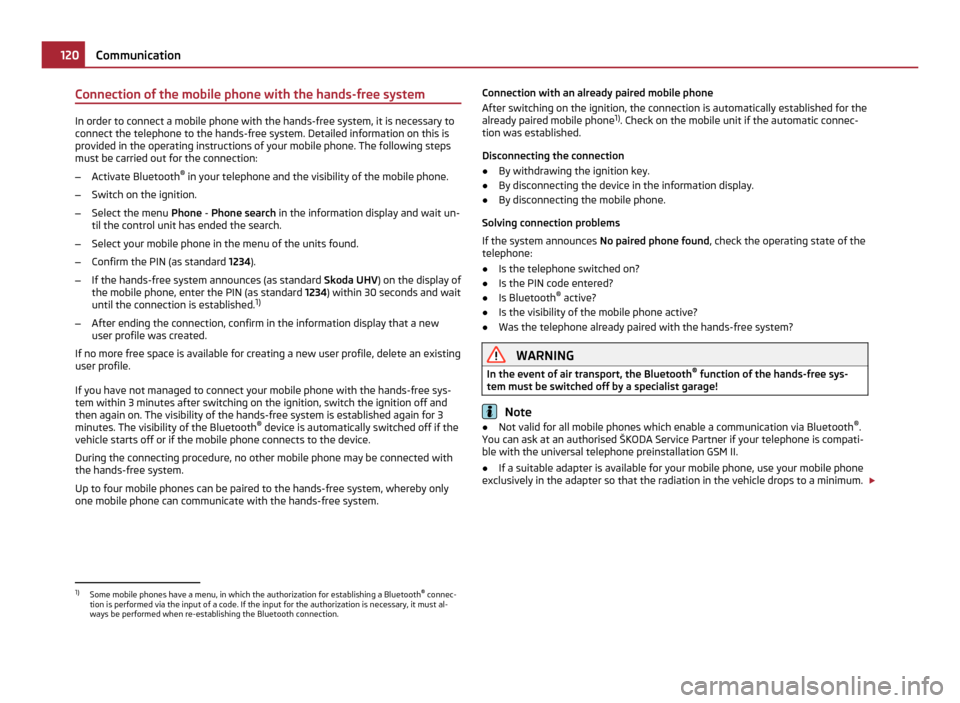
Connection of the mobile phone with the hands-free system
In order to connect a mobile phone with the hands-free system, it is necessary to
connect the telephone to the hands-free system. Detailed information on this is
provided in the operating instructions of your mobile phone. The following steps
must be carried out for the connection:
– Activate Bluetooth ®
in your telephone and the visibility of the mobile phone.
– Switch on the ignition.
– Select the menu Phone - Phone search in the information display and wait un-
til the control unit has ended the search.
– Select your mobile phone in the menu of the units found.
– Confirm the PIN (as standard 1234).
– If the hands-free system announces (as standard Skoda UHV) on the display of
the mobile phone, enter the PIN (as standard 1234) within 30 seconds and wait
until the connection is established. 1)
– After ending the connection, confirm in the information display that a new
user profile was created.
If no more free space is available for creating a new user profile, delete an existing
user profile.
If you have not managed to connect your mobile phone with the hands-free sys-
tem within 3 minutes after switching on the ignition, switch the ignition off and
then again on. The visibility of the hands-free system is established again for 3
minutes. The visibility of the Bluetooth ®
device is automatically switched off if the
vehicle starts off or if the mobile phone connects to the device.
During the connecting procedure, no other mobile phone may be connected with
the hands-free system.
Up to four mobile phones can be paired to the hands-free system, whereby only
one mobile phone can communicate with the hands-free system. Connection with an already paired mobile phone
After switching on the ignition, the connection is automatically established for the
already paired mobile phone
1)
. Check on the mobile unit if the automatic connec-
tion was established.
Disconnecting the connection
● By withdrawing the ignition key.
● By disconnecting the device in the information display.
● By disconnecting the mobile phone.
Solving connection problems
If the system announces No paired phone found, check the operating state of the
telephone:
● Is the telephone switched on?
● Is the PIN code entered?
● Is Bluetooth ®
active?
● Is the visibility of the mobile phone active?
● Was the telephone already paired with the hands-free system? WARNING
In the event of air transport, the Bluetooth ®
function of the hands-free sys-
tem must be switched off by a specialist garage! Note
● Not valid for all mobile phones which enable a communication via Bluetooth ®
.
You can ask at an authorised ŠKODA Service Partner if your telephone is compati-
ble with the universal telephone preinstallation GSM II.
● If a suitable adapter is available for your mobile phone, use your mobile phone
exclusively in the adapter so that the radiation in the vehicle drops to a minimum. £1)
Some mobile phones have a menu, in which the authorization for establishing a Bluetooth ®
connec-
tion is performed via the input of a code. If the input for the authorization is necessary, it must al-
ways be performed when re-establishing the Bluetooth connection. 120
Communication
Page 139 of 252

Airbag system
Description of the airbag system General information on the airbag system The front airbag system is complementary to the three-point seat belts and offers
additional protection for the head and chest area of the driver and passenger in
the event of a frontal collision.
In the event of a side collision, the side airbags reduce the risk of injury to the oc-
cupants to the part of their body facing the side of the accident.
The airbag system is only functional after the ignition has been switched on.
The operational readiness of the airbag system is monitored electronically. The
airbag warning light comes on for a few seconds each time the ignition is switch-
ed on.
The airbag system (according to vehicle equipment) consists of:
● an electronic control unit;
● the front airbags for the driver and front passenger ⇒ page 138;
● driver's knee airbag ⇒ page 140;
● the side airbags ⇒ page 141;
● head airbags ⇒
page 143;
● an airbag indicator light in the instrument cluster ⇒ page 24;
● a front passenger airbag switch ⇒ page 145;
● an indicator light for a switched off front seat passenger airbag in the middle
of the dash panel ⇒
page 145.
A fault in the airbag system exists if:
● the airbag indicator light does not light up when the ignition is switched on,
● the warning light does not go out after about 4 seconds after the ignition is
switched on,
● the airbag indicator light goes out and comes on again after the ignition is
switched on,
● the airbag indicator light comes on or flickers when driving,
● the airbag indicator light showing a switched-off front passenger airbag in the
middle of the dash panel flashes. WARNING
● To enable the occupants of a car to be protected with the greatest possi-
ble effect when the airbag is deployed, the front seats must be ⇒
page 129,
Correct seated position correctly adjusted to match the body size of the occu-
pant.
● If you do not fasten the seat belts when driving, lean too far forward or
adopt an incorrect seated position, you are exposing yourself to increased risk
of injury in the event of an accident.
● Have the airbag system checked immediately by a specialist garage if a
fault exists. Otherwise, there is a risk of the airbag not being activated in the
event of an accident.
● No modifications of any kind may be made to parts of the airbag system.
● It is prohibited to manipulate individual parts of the airbag system as this
might result in the airbag being deployed.
● The protective function of the airbag system is sufficient for only one acci-
dent. The airbag system must then be replaced if the airbag has been de-
ployed.
● The airbag system needs no maintenance during its working life.
● If you sell your car, please hand over the complete vehicle documentation
to the new owner. Please note that the documents relating to the possibility
of deactivating the front passenger airbag are also part of the vehicle docu-
ments!
● If the vehicle or individual parts of the airbag system are scrapped, it is es-
sential to observe the relevant safety precautions. The authorised
ŠKODA
Service Partners are familiar with these regulations.
● When disposing of vehicle or parts of the airbag system, it is important to
comply with the national legal requirements.
When are the airbags deployed? The airbag system is designed in such a way that the driver and front passenger
airbag are deployed in the event of a violent frontal collision
.
In the case of a violent side crash , the side airbag in the front seat and the head
airbag on the side on which the collision occurs are deployed. £ 137
Airbag system Using the system Safety Driving Tips General Maintenance Breakdown assistance Technical data
Page 144 of 252

The load of the occupants is cushioned when plunging into the fully inflated air-
bag and the risk of injury to the entire upper body (chest, stomach and pelvis) is
reduced on the side facing the door.
Important safety information on the side airbag Correct use of the airbag system considerably reduces the risk of
injury! WARNING
● It is essential to always switch off ⇒ page 144 , Deactivating an airbag the
front passenger front airbag when attaching a child safety seat on the front
passenger seat where the child is seated with its back facing in direction of
travel (in some countries also when the child is facing the direction of travel).
If this is not done, there is a risk of the child suffering severe or even fatal in-
juries if the front passenger front airbag is deployed. When transporting a
child on the front passenger seat, please comply with the appropriate national
regulations regarding the use of child safety seats.
● Your head should never be positioned in the deployment area of the side
airbag. You might suffer severe injuries in the event of an accident. This ap-
plies in particular to children who are transported without using a suitable
child safety seat ⇒ page 148, Child safety and side airbag
.
● If children adopt an incorrect seated position when travelling, they may be
exposed to an increased risk of injury in the event of an accident. This can re-
sult in serious injuries ⇒ page 146
, What you should know about transporting
children!.
● There must not be any further persons, animals as well as objects posi-
tioned between the occupants and the deployment area of the airbag. No ac-
cessories, such as a can holder, should be attached to the doors.
● The airbag control unit operates together with the pressure sensors,
which are attached in the front doors. For this reason no adjustments must be
carried out at the doors as well as at the door panels (for example additional
installation of loudspeakers). Resulting damages can have a negative affect
on the operation of the airbag system. All work on the front doors and their
panels must only be carried out by a specialist garage. WARNING (Continued)
● In the event of a side collision, the side airbags will not function properly, if
the sensors cannot measure the increasing air pressure inside the doors, be-
cause the air can escape through large, non-sealed openings in the door pan-
el.
–Never drive with removed inner door panels.
– Never drive, if parts of the inner door panel have been removed and the
remaining openings have not been properly sealed.
– Never drive, if the loudspeakers in the doors have been removed, only if
the loudspeaker openings have been properly sealed.
– Always make sure that the openings are covered or filled, if additional
loudspeakers or other equipment parts are installed in the inner door pan-
els.
– Always work with an authorised ŠKODA Service Partner or have it car-
ried out by a competent specialist workshop.
● Only hang light items of clothing on the clothes hooks to the vehicle. Nev-
er leave any heavy or sharp-edged objects in the pockets of the items of cloth-
ing.
● Ensure that there are no excessive forces, such as violent knocks, kicks
etc., impact on the backrests of the seats otherwise the system may be dam-
aged. The side airbags would not be deployed in such a case!
● Any seat or protective covers which you fit to the driver or front passenger
seats must only be of the type expressly authorized by ŠKODA. In view of the
fact that the airbag inflates out of the backrest of the seat, use of non-ap-
proved seat or protective covers would considerably impair the protective
function of the side airbag.
● Any damage to the original seat covers in the area of the side airbag mod-
ule must be repaired without delay by your specialist garage.
● The airbag modules in the front seats must not display any damage, cracks
or deep scratches. It is not permissible to use force in order to open the mod-
ules.
● Any work on the side airbag system including removing and installing sys-
tem components because of other repair work (e.g. removing seats) must only
be carried out by a specialist garage. 142
Airbag system
Page 147 of 252

If the airbag was switched off using diagnostic equipment:
●
The warning light for the airbag system lights up for 4 seconds after switching
on the ignition and then flashes for 12 seconds afterwards in 2 second intervals.
The following situation applies if the airbag has been switched off using the
switch for the airbag in the storage compartment:
● the airbag indicator light in the instrument cluster comes on for about 4 sec-
onds each time the ignition is switched on;
● switching off the airbag is indicated in the middle of the dash panel by the
lighting up of the yellow indicator light in display
⇒ fig. 129 . Note
Your authorised ŠKODA Service Partner will be able to advise you whether nation-
al legislation in your country allows airbags in your vehicle to be deactivated, and
which ones.
Switch for the front passenger front airbag Fig. 129 Storage compartment: Switch for the front passenger front airbag/warning light for
a switched off front seat passenger airbag
Only the front passenger front airbag is deactivated with the switch.
Deactivating an airbag
– Switch off the ignition.
– Turn the slot of the airbag switch using the key in the position 2 (
OFF)
⇒ fig. 129 .
– Check whether the airbag indicator light in the display
in
the middle of the dash panel lights up when the ignition is switched on
⇒ fig. 129 - right. Switching on an airbag
–
Switch off the ignition.
– Turn the slot of the airbag switch using the key in the position 1 (
ON)
⇒ fig. 129 .
– Check whether the airbag indicator light in the display
in
the middle of the dash panel lights up when the ignition is switched on
⇒ fig. 129 - right. The warning light goes out 65 seconds after the ignition
is switched on.
The airbag should only be switched off under exceptional circumstances
⇒ page 144.
Indicator light in display (airbag switched off)
The airbag indicator light is located in the middle of the dash panel ⇒ fig. 129 -
right.
If the front passenger front airbag is switched off, the warning light comes on
about 4 seconds after the ignition is switched on.
There is a system fault present in the airbag switch off ⇒ if the indicator light
flashes. Please have the car inspected immediately by a specialist garage. WARNING
● The driver is responsible for whether the airbag is switched on or switched
off.
● Only switch off the airbag when the ignition is switched off! Otherwise a
fault can occur in the system for the airbag deactivation.
● If the yellow indicator light in display
(airbag switched
off) flashes:
–Front passenger airbag is not deployed in the event of an accident!
– It is also important to have the system inspected without delay by a
specialist garage. 145
Airbag system Using the system Safety Driving Tips General Maintenance Breakdown assistance Technical data
Page 157 of 252

Operating principle
The TCS switches on automatically when the engine is started and then conducts
a self-test. The system monitors the speeds of the driven wheels with the aid of
the ABS sensors. If the wheels are spinning, the force transmitted to the road sur-
face is automatically adapted by reducing the engine speed. The system operates
at all speeds.
The TCS operates in combination with the ABS ⇒ page 157,
Antilock brake system
(ABS). The TCS will not function if a fault exists in the ABS system.
The TCS warning light lights up in the instrument cluster when there is a fault on
the TCS ⇒ page 27.
During an intervention of the system, the TCS warning light flashes in the in-
strument cluster ⇒ page 27.
Switching off
You can also switch off the TCS system by pressing the ⇒ fig. 138 button, or, in ve-
hicles with ESP, by pressing the ⇒ fig. 137 button. The TCS warning light lights up
in the instrument cluster when the TCS is switched off .
The TCS should normally always be switched on. It may be good practice in certain
exceptional cases, such as when you wish to have wheel slip, to switch off the
system.
Examples:
● when driving with snow chains,
● when driving in deep snow or on a loose surface,
● when it is necessary to rock a car free when it has become stuck.
then you should switch on the TCS again.
TCS Off-road
After switching on the Off-road mode ⇒ page 160
, TCS Off-road is activated.
TCS Off-road provides a more effective acceleration of the vehicle on an unfirm
ground, as it allows higher traction between the slipping wheels and the ground.
The system operates when starting off or at low speeds. WARNING
You should always adjust your style of driving to the conditions of the road
surface and the traffic situation. The increased safety offered must not tempt
you to take greater risks than otherwise - risk of an accident! Note
● All four wheels must be fitted with the same tyres in order to achieve prob-
lem-free operation of the TCS. Differing rolling circumferences of the tyres can
lead to an undesirable reduction in the engine output.
● Changes to vehicle (e.g. on engine, on the brakes, on chassis or another combi-
nation of tyres and wheels) can influence the function of the TCS ⇒
page 207, Ac-
cessories, changes and replacement of parts.
Active driver-steering recommendation (DSR) This function indicates to the driver in critical situations a steering recommenda-
tion in order to stabilise the vehicle. The active driver-steering recommendation is
activated, for example, on the right and left vehicle side when braking sharply on
different road surfaces. WARNING
Even with this function the vehicle cannot steer itself! The driver is further-
more responsible for the steering of the vehicle!
Brakes What has a negative effect on braking efficiency?
Wear-and-tear
Wear-and-tear to the brake pads is greatly dependent on the operating conditions
of the vehicle and your style of driving. Particularly if you drive a great deal in
towns and over short distances or if you adopt a sporty style of driving, it may be
necessary to have the thickness of the brake pads inspected at a specialist garage
between the service inspections.
Wet roads or road salt
There may be a certain delay before the brakes take full effect under certain con-
ditions such as when driving through water, during heavy rain showers or after
the vehicle has been washed in an automatic vehicle wash, since the brake discs
and brake pads may be moist or even have a coating of ice on them in winter. You
should dry the brakes as soon as possible by applying and releasing the brakes
several times. £ 155
Intelligent technology Using the system Safety Driving Tips General Maintenance Breakdown assistance Technical data
Page 161 of 252

Basic setting of the system
After changing the tyre inflation pressures, after changing one or several wheels,
the position of a wheel on the vehicle (e.g. exchanging the wheels between the
axles) or when the warning light lights up while driving, a basic setting of the sys-
tem must be carried out as follows.
● Inflate all tyres to the specified inflation pressure ⇒ page 201.
● Switch on the ignition.
● Press button
⇒ fig. 139
for more than 2
seconds. While pressing the but-
ton, the warning light lights up. At the same time the memory of the system is
erased and the new calibration is started, which is confirmed with an audible sig-
nal and then the warning light goes out.
● If the warning light does not go out after the basic setting, there is a fault in
the system. Have the vehicle inspected by your nearest specialist garage.
Warning light lights up
If the tyre inflation pressure of at least one wheel is insufficiently inflated in com-
parison to the stored basic value, the warning light ⇒ lights up.
Warning light flashes
If the warning light flashes, there is a system fault. Have the vehicle inspected by
your nearest specialist garage. WARNING
● When the warning light lights up, immediately reduce the speed and
avoid sudden steering and brake manoeuvres. Please stop the vehicle without
delay at the nearest possible stop and inspect the tyres and their inflation
pressures.
● The driver is responsible for the correct tyre inflation pressures. For this
reason, the tyre inflation pressures must be checked regularly.
● Under certain circumstances (e.g. sporty style of driving, wintry or unpaved
roads) the warning light can be delayed or does not light up at all.
● The tyre pressure monitoring system does not take away the responsibility
from the driver for the correct tyre inflation pressure. Note
The tyre pressure monitoring system:
● does not replace the regular tyre inflation pressure control, because the sys-
tem cannot detect an even pressure loss; ●
cannot warn in case of very rapid tyre inflation pressure loss, e.g. in case of
sudden tyre damage. In this case carefully bring the vehicle to a standstill without
sudden steering movements and without sharp braking.
● In order to ensure a proper functioning of the tyre inflation pressure-control
system, it is necessary to carry out the basic setting again every 10 000 km or 1x a
year.
Diesel particle filter (diesel engine) In the diesel particle filter the resulting soot particles are collected
and burnt during the combustion of diesel fuel. Fig. 140 Vehicle data sticker
Code 7GG , 7MB or 7MG on the vehicle data sticker, see ⇒ fig. 140 , indicates that
your vehicle is equipped with a diesel particle filter. The vehicle data sticker is lo-
cated on the floor of the luggage compartment and is also stated in the Service
schedule.
The diesel particle filter filters the soot particles completely from the exhaust. The
soot is collected in the diesel particle filter and burnt regularly. To assist this pro-
cedure, we recommend not to drive regularly over short distances.
If the diesel particle filter is full or there is a fault, it is indicated by the warning
light . £ 159
Intelligent technology Using the system Safety Driving Tips General Maintenance Breakdown assistance Technical data
Page 167 of 252

Regular servicing
A poorly tuned engine uses an unnecessarily high amount of fuel.
Having your vehicle serviced regularly at a specialist garge enables you to satisfy
one of the requirements for economical motoring even before you set off on your
journey. Keeping your vehicle properly serviced not only has a positive effect on
the safety of your vehicle and maintaining its value, but also saves on fuel.
A poorly tuned engine can result in a fuel consumption which is 10 % higher than
normal.
The foreseen maintenance work should be undertaken exactly according to the
Service schedule by a specialist garage.
Also check the oil level after refuelling. Oil consumption is dependent to a consid-
erable extent on the load and speed of the engine. Oil consumption could be as
high as 0.5 litres/1 000 km depending on your style of driving.
It is quite normal that a new engine has a higher oil consumption at first, and rea-
ches its lowest level only after a certain running in time. It is therefore not possi-
ble to correctly assess the oil consumption of a new vehicle until after you have
driven about 5 000 km. For the sake of the environment
● You can achieve additional improvements in your fuel economy by using high-
lubricity oils.
● Check the ground below your car at regular intervals to detect any leakages in
good time. Please have your vehicle inspected by a specialist garage if you find
any stains caused by oil or other fluids on the floor. Avoid driving short distances Short distances result in an above-average high fuel consumption.
Fig. 144 Fuel consumption in litres/100
km at different temperatures
– Avoid driving a distance of no more than 4 km if the engine is cold.
The engine and catalytic converter must first have reached their optimal operat-
ing temperature in order to effectively reduce fuel consumption and pollutant
emissions.
The cold engine vehicle consumes approx. 15 - 20 litres/100 km of fuel immediate-
ly after starting. Fuel consumption drops to 10 litres/100 km after just 1 kilometre.
The engine reaches its operating temperature (outside temperature and engine
dependent) only after about 4 to 10 kilometres and the fuel consumption then
stabilizes. You should therefore avoid driving short distances whenever possible.
An important factor in this connection is also the ambient temperature. The
⇒ fig. 144 shows the different fuel consumptions for the same distance, on the
one hand at +20 °C and on the other hand at -10
°C. Your vehicle has a higher fuel
consumption in winter than in summer.
Checking tyre inflation pressures Tyres which are correctly inflated save fuel.
Always ensure that your tyres are inflated to the correct pressure at all times. The
rolling resistance will be increased if the tyre filling pressure is too low. This will
not only increase fuel consumption but also tyre wear and the driving behaviour
will worsen.
Always check the inflation pressure of the tyres when cold. £ 165
Driving and the environment Using the system Safety Driving Tips General Maintenance Breakdown assistance Technical data