2011 SKODA YETI service
[x] Cancel search: servicePage 198 of 252

CAUTION
Brake fluid damages the paintwork of the vehicle. For the sake of the environment
Due to issues with disposal, the special tools and knowledge required, we recom-
mend you have the brake fluid replaced by an authorised Service Partner ŠKODA.
Battery General information Improper handling of the vehicle battery can cause damage. We therefore recom-
mend you have work on the vehicle battery carried out by an authorised ŠKODA
Service Partner.
There is a risk of injuries, scalding, accidents and burns when carrying out any
work on the battery and on the electrical system. For this reason, it is essential to
comply with the warning instructions ⇒ stated below and with the general ap-
plicable rules of safety. WARNING
● The battery acid is strongly corrosive and must, therefore, be handled with
the greatest of care. Always wear protective gloves, eye and skin protection
when handling batteries. Corrosive fumes in the air irritate the air passages
and lead to conjunctivitis and inflammation of the air passages in the lungs.
Battery acid corrodes dental enamel and creates deep wounds after contact
with the skin which take a long time to heal. Repeated contact with diluted
acids causes skin diseases (inflammations, ulcers, slin cracks). Acids coming in-
to contact with water are diluted accompanied by significant development of
heat.
● Do not tilt the battery otherwise battery electrolyte may flow out of the
battery vent openings. Protect the eyes with safety glasses or a shield! There
is the danger of suffering blindness! If any battery electrolyte gets into your
eye, rinse out your eye immediately with clear water for several minutes. Con-
tact a doctor without delay. WARNING (Continued)
● Splashes of acid on your skin or clothes should be neutralised as soon as
possible using soap suds and then rinsed with plenty of water. If acid was
swallowed, seek immediate medical attention.
● Keep batteries out of the reach of children.
● Hydrogen is released when you charge a battery and a highly explosive gas
mixture is produced. An explosion can be caused through sparkling over dur-
ing unclamping or loosening of the cable plug while the ignition is on.
● Bridging of the poles will create a short circuit (e.g. through metal objects,
cables). Possible consequences of a short circuit: Melting of lead struts, explo-
sion and burning of the battery, jets of acid spurting out.
● It is prohibited to work with a naked flame and light, to smoke or to carry
out any activities which produce sparks. Avoid creating sparks when working
with cables and electrical devices. Strong sparking represents a risk of injury.
● Before carrying out any work on the electrical system, switch off the en-
gine, the ignition as well as all electrical components and disconnect the neg-
ative cable (-) on the battery. If you wish to replace a bulb it is sufficient to
switch off the appropriate light.
● Never charge a frozen or thawed battery - risk of explosion and caustic
burns! Replace a frozen battery.
● Never jump-start the batteries which have a too low electrolyte level - risk
of explosion and caustic burns!
● Never use a battery which is damaged - risk of explosion! Immediately re-
place a damaged battery. CAUTION
● You must only disconnect the battery if the ignition is switched off, otherwise
the electrical system (electronic components) of the vehicle may be damaged.
When disconnecting the battery from the electrical system of the vehicle, first dis-
connect the negative terminal (-) of the battery. Then disconnect the positive ter-
minal (+).
● When reconnecting the battery, first connect the positive terminal (+) and only
then the negative terminal (-) of the battery. You must on no account connect the
cables wrongly - risk of a cable fire.
● Ensure that battery acid does not come into contact with the vehicle body oth-
erwise damage could occur to the paintwork. £196
Inspecting and Replenishing
Page 199 of 252

●
Do not place the battery in direct daylight in order to protect the battery hous-
ing from the effects of ultra-violet light.
● If the vehicle has not been driven for more than 3 to 4 weeks, the battery will
discharge This is because certain electrical components consume electricity (e. g.
control units) also in idle state. You can prevent the discharging of the battery by
disconnecting the negative terminal or charging the battery constantly with a very
low charging current. For the sake of the environment
A removed battery is a special type of waste which is harmful to the environment
- contact your specialist garage regarding disposing of the battery. Note
● Please also refer to the guidelines ⇒ page 198
, also after connecting the bat-
tery.
● You should replace batteries older than 5 years.
Battery cover Fig. 157 Engine compartment: Polyester cover of the vehicle battery/plastic cover of the vehi-
cle battery
The battery is located in the engine compartment in a polyester cover ⇒ fig. 157 -
left or in a polyester cover ⇒ fig. 157 - right.
– Open the battery cover in direction of arrow 1 or press the interlock on the
side of the battery cover in direction of arrow 2
⇒
fig. 157, fold the cover up
and remove the battery.
– The installation of the battery cover takes place in the reverse order. The edge of the polyester battery cover
⇒
fig. 157 - left is inserted between the
battery and the side wall of the battery cover when working on the battery.
Battery control Fig. 158 The battery: Electrolyte level
indicator
The battery is practically maintenance-free under normal operating conditions.
We recommend you have the electrolyte level checked by a specialist garage from
time to time, especially in the following cases.
● High outside temperatures.
● Long daily drives
● After each charge ⇒
page 198.
On vehicles with a vehicle battery fitted with a colour indicator, the so-called mag-
ic eye ⇒ fig. 158 , the electrolyte level can be determined by looking at the change
in colour.
Air bubbles can influence the colour of the indicator. For this reason carefully
knock on the indicator before carrying out the check.
● Black colour - electrolyte level is correct.
● Colourless or light yellow colour - electrolyte level too low, the battery must be
replaced. Note
● The battery electrolyte level is periodically checked by an authorised
ŠKODA
Service Partner as part of the Inspection Service.
● For technical reasons, on vehicles with the description “AGM”, the electrolyte
level cannot be checked.
● Vehicles with a “START-STOP” system are fitted with a battery control unit for
checking the energy level for the recurring engine start. 197
Inspecting and Replenishing Using the system Safety Driving Tips General Maintenance Breakdown assistance Technical data
Page 200 of 252

Operation in winter
The battery has to provide greater amounts of electricity during the winter. It also
has only part of the initial power output at low temperatures that it has at normal
temperatures.
A discharged battery may already freeze at temperatures just below 0 °C.
We therefore recommend that you have the battery checked by a specialist ga-
rage before the start of winter and recharged if necessary. WARNING
Never charge a frozen or thawed battery - risk of explosion and caustic burns.
Replace a frozen battery.
Charging the battery A properly charged battery is essential for reliably starting the en-
gine.
– Read the warning notes ⇒ in General information on page 196 and
⇒ .
– Switch the ignition and all electrical components off.
– Only for “quick-charging”: Disconnect both battery cables (first of all “nega-
tive
”, then “positive”).
– Carefully attach the terminal clamps of the charger to the battery terminals
(red = “positive
”, black = “negative”).
– You can now plug the mains cable of the charger into the power socket and
switch on the charger.
– When charging is completed: switch the charger off and unplug the mains ca-
ble from the power socket.
– Only then should you disconnect the terminal clamps of the charger.
– Reconnect the cables to the battery (first of all “positive”, then “negative”).
It is not normally necessary to disconnect the cables of the battery if you recharge
the battery using low amperages (as for example from a mini-charger). Please al-
so refer to the instructions from the charger manufacturer.
A charging current of 0.1 of the total battery capacity (or lower) is that which
should be used until full charging is achieved. It is, however, necessary to disconnect both cables before charging the battery
with high amperages, so-called
“quick-charging ”.
“Quick-charging” a battery is dangerous ⇒ in General information on page 196.
It requires a special charger and specialist knowledge. We recommend having the
quick charging of vehicle batteries undertaken by a specialist garage.
A discharged battery may already freeze at temperatures just below 0
°C ⇒ . We
recommend that you no longer use a battery which has thawed out because the
casing of the battery may be cracked through the formation of ice and this would
allow battery electrolyte to flow out.
The vent plugs of the battery should not be opened for charging. WARNING
● Never charge a frozen or thawed battery - risk of explosion and caustic
burns. Replace a frozen battery.
● Never charge a battery which has a too low electrolyte level - risk of explo-
sion and caustic burns. CAUTION
On vehicles with the “START/STOP” system, the pole terminal of the charger must
not be connected directly to the negative terminal of the vehicle battery, but only
to the engine earth ⇒ fig. 174.
Disconnecting and reconnecting the battery On disconnecting and reconnecting the battery the following functions are initially
deactivated or are no longer able to operate fault-free.
Operation Operating measure
Electrical power window (operational faults) ⇒ page 42
Enter the car stereo/radio navigation system
code number see operating instructions for the
car stereo/radio navigation sys-
tem
Setting the clock ⇒ page 13
Data in the multi-functional indicator are de-
leted. ⇒ page 14
We recommend having the vehicle checked by an authorised ŠKODA Service Part-
ner to ensure full functionality of all electrical systems.
198
Inspecting and Replenishing
Page 201 of 252
Replacing the battery
When replacing a battery, the new new battery must have the same capacity,
voltage (12
V), amperage and be the same size. Suitable types of vehicle battery
are available from an authorised ŠKODA Service Partner.
We recommend you have a battery change carried out by an authorised ŠKODA
Service Partner, who will properly install the new battery and dispose of the origi-
nal one. CAUTION
Vehicles with a “START-STOP” system are fitted with a special battery type which
allows the battery control unit to check the energy level for recurring engine start.
This battery must only be replaced by a battery of the same type. For the sake of the environment
Batteries contain poisonous substances such as sulphuric acid and lead. For this
reason, it must be disposed of properly. Under no circumstances must it be dis-
posed of in the communal rubbish.
Automatic consumer shut-off Under heavy load on the vehicle battery, the vehicle electrical system manage-
ment automatically takes various measures to avoid draining the vehicle battery.
●
The idling speed is raised to allow the generator to deliver more electricity to
the electrical system.
● If necessary, some electrical consumers are limited in their performance or are
temporarily switched off completely. Note
Despite such intervention by the vehicle electric system management, the vehicle
battery may be drained. For example, when the ignition is switched on a long time
with the engine turned off or the side or parking lights are turned on during lon-
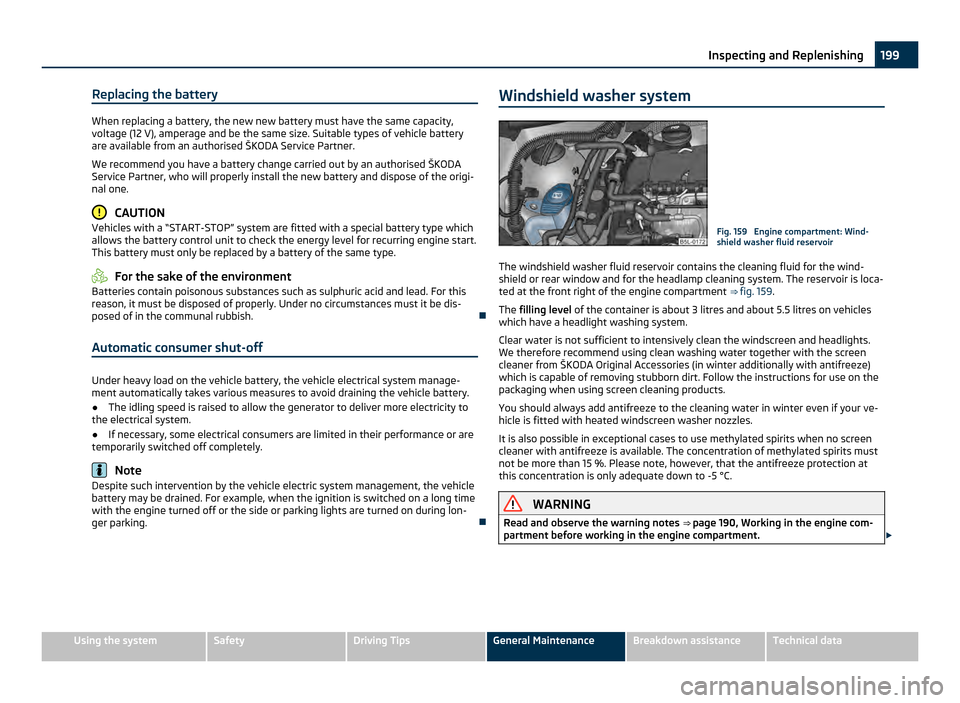
ger parking. Windshield washer system Fig. 159 Engine compartment: Wind-
shield washer fluid reservoir
The windshield washer fluid reservoir contains the cleaning fluid for the wind-
shield or rear window and for the headlamp cleaning system. The reservoir is loca-
ted at the front right of the engine compartment ⇒ fig. 159 .
The filling level of the container is about 3 litres and about 5.5 litres on vehicles
which have a headlight washing system.
Clear water is not sufficient to intensively clean the windscreen and headlights.
We therefore recommend using clean washing water together with the screen
cleaner from
ŠKODA Original Accessories (in winter additionally with antifreeze)
which is capable of removing stubborn dirt. Follow the instructions for use on the
packaging when using screen cleaning products.
You should always add antifreeze to the cleaning water in winter even if your ve-
hicle is fitted with heated windscreen washer nozzles.
It is also possible in exceptional cases to use methylated spirits when no screen
cleaner with antifreeze is available. The concentration of methylated spirits must
not be more than 15 %. Please note, however, that the antifreeze protection at
this concentration is only adequate down to -5 °C. WARNING
Read and observe the warning notes ⇒ page 190
, Working in the engine com-
partment before working in the engine compartment. £ 199
Inspecting and Replenishing Using the system Safety Driving Tips General Maintenance Breakdown assistance Technical data
Page 202 of 252

CAUTION
● On no account should you add radiator antifreeze or other additives to the
windscreen washer fluid.
● If the vehicle is fitted with a headlight cleaning system, you should only add
cleaning products which do not attack the polycarbonate glass of the headlights
to the windshield washer fluid. Please contact an authorised
ŠKODA Service Part-
ner who will help you select a suitable cleaning agent. 200
Inspecting and Replenishing
Page 205 of 252

Changing wheels around
Fig. 162 Changing wheels around
If significantly greater wear is present on the front tyres, we recommend changing
the front wheels around with the rear wheels as shown in the diagram ⇒
fig. 162.
You will then obtain approximately the same life for all the tyres.
It may be advantageous to swap the tyres over “crosswise” when uneven wear
characteristic arise on the running surfaces of the tyres (but not in the case of uni-
directional tyres). We recommend that you contact an authorised ŠKODA Service
Partner. They have extensive knowledge about the possible combinations.
We recommend that you change the wheels around every 10 000 km in order to
achieve even wear on all wheels and to obtain optimal tyre life.
New tyres and wheels Tyres and wheel rims are important design elements. One should therefore use
the tyres and wheel rims which have been released for use by
ŠKODA. They are
exactly matched to the vehicle type and therefore contribute significantly to good
road holding and safe driving characteristics ⇒ .
Only fit radial tyres of the same type on all 4 wheels, size (rolling circumference)
and, if possible, the same tread pattern on one axle.
Authorised
ŠKODA Service Partners have access to the most current information
about which tyres we have released for use on your vehicle.
We recommend that you have any work relating to tyres or wheels carried out by
an authorised ŠKODA Service Partner. Authorised ŠKODA Service Partners have all
of the necessary special tools and replacement parts available plus the required
specialist knowledge and are also in a position to properly dispose of the old tyres.
A large number of authorised ŠKODA Service Partners also have an attractive
range of tyres and wheels available. The tyre/wheel combinations which are approved for your vehicle are indicated in
your vehicle documents. Approval and licensing may differ according to the legis-
lation prevailing in individual countries.
Proper knowledge of the tyre data makes it easier for you to select the correct
type of tyre. Tyres do, for example, have the following inscription on their walls:
225/50R
17 91 T
What this means is: 225 Tyre width in mm
50 Height/width ratio in %
R Code letter for the type of tyre -
R adial 17 Diameter of wheel in inches
91 Load index
T Speed symbol
The following speed restrictions apply to tyres.
Speed symbol Permissible maximum speed
S 180 km/h
T 190 km/h
U 200 km/h
H 210 km/h
V 240 km/h
W 270 km/h
Y 300 km/h
The date of manufacture
is also stated on the tyre wall (possibly only on the in-
side of wheel):
DOT ... 20 11...
means, for example, that the tyre was manufactured in the 20th week of the year
2011.
Any spare wheel which differs from the tyres fitted to the vehicle (e.g. winter
tyres or low-profile tyres) should only be used only for a short time in the event of
a puncture and when adopting an appropriately cautious style of driving. It should
be replaced as quickly as possible by a normal wheel. £ 203
Wheels and Tyres Using the system Safety Driving Tips General Maintenance Breakdown assistance Technical data
Page 206 of 252

WARNING
● Only use those tyres or wheel rims which have been approved for your
model of ŠKODA vehicle. Failure to observe this instruction will adversely af-
fect the road safety of your vehicle - risk of accident! Approval and licensing of
your vehicle on public roads may also become void as a result.
● You must on no account drive at a higher speed than is permissible for
your tyres - risk of an accident resulting from tyre damage and loss of control
over your vehicle.
● Tyres which are 6 years old or more should only be fitted in exceptional ca-
ses and when adopting an appropriately cautious style of driving.
● Never fit tyres which have already been used without having adequate
knowledge of their previous history. Tyres age even if they have not been
used at all or only very little. A spare tyre must only be used in exceptional ca-
ses and only then when adopting an appropriately cautious style of driving.
● Do not, where possible, replace individual tyres but at least replace them
on both wheels of a given axle at the same time. Always fit the tyres with the
deeper tread depth to the front wheels. For the sake of the environment
Old tyres must be disposed of in conformity with the appropriate regulations. Note
It is not normally possible to fit wheels from other models of cars for technical
reasons. This may also apply in certain circumstances to the wheels of the same
type of vehicle.
Wheel bolts Wheels and
wheel bolts are matched to each other in terms of design. Each time
you fit other wheels - e.g. light alloy wheels or wheels with winter tyres - you
must therefore also use the matching wheel bolts of the correct length and shape
of spherical cap. This is essential to ensure that the wheels are tightly fitted and
that the brake system operates properly.
If you retrofit wheel trims (or have this done), please also ensure that an ade-
quate flow of air remains assured for cooling the brake system.
Authorised
ŠKODA Service Partners are instructed in the technical possibilities
which exist regarding converting or retrofitting tyres, wheels and wheel trims. WARNING
● In case of incorrect treatment of the wheel bolts, the wheel can loosen
when the car is moving - risk of accident!
● The wheel bolts must be clean and must turn easily. However, they must
never be treated with grease or oil.
● If the wheel bolts are tightened to a too low tightening torque, the rim can
lossen when the car is moving - risk of accident! A tightening torque which is
too high can damage the bolts and threads and this can result in permanent
deformation of the contact surfaces on the rim. CAUTION
The prescribed tightening torque of the wheel bolts for steel and light alloy
wheels is 120 Nm.
Winter tyres The handling of your vehicle will be significantly improved when driving on wintry
roads if you fit winter tyres. Summer tyres do not offer the same grip on ice, snow
and at temperatures below 7 °C because of their construction (width, rubber
blend, tread pattern). This particularly applies to vehicles which are equipped with
low-profile tyres
or high-speed tyres (code index H or V on wall of tyre).
Winter tyres must be mounted on all four wheels to obtain the best handling
characteristics.
You must only fit those types of winter tyre which are approved for your vehicle.
The permissible sizes of winter tyres are stated in your vehicle documents. Ap-
provals may differ because of national legislation.
Please remember that the tyres should be inflated to 20
kPa (0.2 bar) more than is
the case for summer tyres ⇒ page 201.
Winter tyres no longer offer the same winter performance once the tyre tread has
worn down to a depth of about 4 mm.
Ageing also causes winter tyres to lose most of their winter performance proper-
ties - even in cases where the remaining tread depth is still clearly more than 4
mm.
Speed restrictions apply to winter tyres as well as to summer tyres ⇒ page 203,
⇒ .
£204
Wheels and Tyres
Page 209 of 252

Accessories, changes and replacement of parts
General ŠKODA vehicles have been built according to the latest discoveries in safety engi-
neering. Thus one should not change the condition in which the vehicle was deliv-
ered from the manufacturer without some thought.
If you want to retrofit the vehicle with accessories, if a vehicle part is to be re-
placed with a new one, or when technical changes are to be made, the following
instructions must be observed:
● Advise should always be obtained from an authorised ŠKODA Service Partner
before buying any accessories or parts and before making any technical changes
⇒ .
● The guidelines and instructions issued by ŠKODA must be observed when
making technical changes.
Adhering to the prescribed procedures will prevent any kind of damage to the ve-
hicle, and its travelling and operating safety will be maintained. The vehicle also
complies with German road transport regulations (StVZO). More information is
available from an authorised
ŠKODA Service Partner who can also perform the
necessary work properly.
Interference on the electronic components and their software can lead to opera-
tional faults. This interference can also impair systems that are not directly affec-
ted because the electronic components are networked. In other words, the vehi-
cle's road-worthiness may be put at risk and increased wear on parts may arise.
Any damage caused by technical changes made without consent by ŠKODA is ex-
cluded from the warranty – see the warranty certificate. WARNING
● Work or modifications on your vehicle, which have been carried out unpro-
fessionally, can cause operational faults - risk of accident!
● We advise you, in your own interest, to only use ŠKODA Original Accesso-
ries and ŠKODA Original Parts which have been expressly approved for use on
your vehicle. Reliability, safety and suitability have been established for
ŠKODA Original Accessories and ŠKODA
Original Parts.
● Although we constantly monitor the market, we are not able to assess or
warrant the parts even though in some instances such parts may have a type
approval or may have been approved by a nationally recognised testing labo-
ratory. Note
● ŠKODA Original Accessories and
ŠKODA Original Parts can be bought from au-
thorised ŠKODA Service Partners who also professionally undertake the assembly
of parts which were purchased there.
● We recommend having all work undertaken by an authorised ŠKODA Service
Partner.
● All ŠKODA Original Accessories and Original Parts from the Original Accessories
catalogue, such as a towing device, child seats, etc. are authorised.
● We recommend that you also buy car stereos, aerials or other electrical acces-
sories from an authorised
ŠKODA Service Partner, who should also carry out the
installation. 207
Accessories, changes and replacement of parts Using the system Safety Driving Tips General Maintenance Breakdown assistance Technical data