2011 SKODA YETI inflation pressure
[x] Cancel search: inflation pressurePage 30 of 252

Tyre inflation pressure
The warning light
lights up, if there is a substantial drop in inflation pressure in
one of the tyres. Reduce the speed and check or correct as soon as possible the
inflation pressure in the tyres ⇒ page 201.
An audible signal sounds as an additional warning signal.
If the warning light flashes, there is a system fault. Visit the nearest specialist ga-
rage and have the fault rectified.
Further information about the tyre pressure monitoring system ⇒ page 158.WARNING
● When the warning light lights up, immediately reduce the speed and
avoid sudden steering and brake manoeuvres. Please stop the vehicle without
delay at the nearest possible stop and inspect the tyres and their inflation
pressures.
● Under certain circumstances (e.g. sporty style of driving, wintry or unpaved
roads) the warning light can be delayed or does not light up at all.Note
If the battery has been disconnected, the warning light comes on after switch-
ing on the ignition. The warning light must go out after driving a short distance.
Antilock brake system (ABS) The warning light
shows the functionality of the ABS.
The warning light comes on for a few seconds after the ignition has been switch-
ed on or when starting the engine. The warning light goes out after an automatic
check sequence has been completed.
A fault in the ABS
The system is not functioning properly if the ABS warning light does not go out
within a few seconds after switching on the ignition, does not light up at all or
lights up while driving. The vehicle will only be braked by the normal brake sys-
tem. Visit a specialist garage immediately and adjust your style of driving appropri-
ately as you will not know how great the damage is.
Further information about ABS ⇒ page 157, Antilock brake system (ABS)
.A fault in the entire brake system
If the ABS warning light
comes on together with the brake system warning
light (handbrake must be released), there is a fault not only in the ABS but also
in another part of the brake system ⇒ .
WARNING
● If the brake system warning light comes on together with the ABS
warning light stop the vehicle immediately and check the brake fluid level
in the reservoir ⇒ page 195
, Brake fluid. If the fluid level has dropped below
the MIN marking, do not drive any further - risk of accident! Contact a Škoda
dealer to obtain professional assistance.
● Pay attention to the following instructions ⇒
page 190, Working in the en-
gine compartment before checking the brake fluid level and opening the bon-
net.
● If the brake fluid is at the correct level, the ABS control function has failed.
The rear wheels may then block very rapidly when braking. In certain circum-
stances, this can result in the rear end of the car breaking away - risk of skid-
ding! Drive carefully to the nearest specialist garage and have the fault recti-
fied.
Seat belt warning light The warning light
comes on after the ignition is switched on as a reminder for
the driver and front passenger to fasten the seat belt. The warning light only goes
out if the driver or front passenger has fastened his seat belt.
If the seat belt has not been fastened by the driver or front passenger, a perma-
nent warning signal sounds at vehicle speeds greater than 20 km/h and simulta-
neously the warning light flashes.
If the seat belt is not fastened by the driver or front passenger during the next 90
seconds, the warning signal is deactivated and the warning light lights up per-
manently.
For further information on the seat belts ⇒ page 132,
Seat belts.
Boot lid The warning light
comes on when the ignition is switched on if the luggage
compartment door is open. If the boot lid opens while driving
, the warning light
lights up and an audible signal sounds. £28
Instruments and warning lights
Page 130 of 252

Safety
Passive Safety
Basic information
Driving the safe way Passive safety measures reduce the risk of injury in accident situa-
tions.
In this section you will find important information, tips and notes on the subject of
passive safety in your vehicle. We have combined everything here which you
should be familiar with, for example, regarding seat belts, airbags, child seats and
safety of children. Therefore, please follow especially the notes and warnings in
this section in your own interest and in the interest of your passengers. WARNING
● This chapter contains important information on how to use the vehicle for
the driver and his occupants. You will find further information on safety, which
concerns you and those travelling with you, in the following chapters of this
Owner's Manual.
● The complete on-board literature should always be in the vehicle. This ap-
plies in particular, if you rent out or sell the vehicle.
Safety equipment The safety equipment is part of the occupant protection and it can
reduce the risk of injuries in accident situations.
“Do not put at risk
” your safety and the safety of those travelling with you . In the
event of an accident, the safety equipment can reduce the risk of injuries.
The following list contains part of the safety equipment in your vehicle:
● Three-point seat belts for all the seats,
● belt force limiter for front seats,
● belt tensioner for front seats, ●
seat belt height adjuster for front seats,
● front airbag for the driver and front passenger,
● driver's knee airbag,
● front side airbags,
● rear side airbags,
● head airbags;
● anchoring points for child seat using the “ISOFIX” system,
● anchoring points for child seat using the “Top Tether” system,
● head restraint adjustable for height,
● adjustable steering column.
The specified safety equipment works together, in order to optimally protect you
and those travelling with you in accident situations. The safety equipment does
not protect you or the people travelling with you, if you or your occupants adopt
an incorrect seated position or the equipment is not correctly adjusted or used.
For this reason you will be provided with information on why these equipment
components are very important, how it protects you and the occupants, what
should be observed when using the equipment and how you and the people trav-
elling with you can make full use of the existing safety equipment. This Owner's
Manual contains important warning notes, which you and those travelling with
you should pay attention to in order to reduce a risk of injury.
Safety concerns everybody!
Before setting off The driver is always fully responsible for his occupants and for the
operating safety of the vehicle.
For your own safety and the safety of the people travelling with you, please pay
attention to the following points before setting off:
● Ensure that the lighting and the turn signal systems are functioning properly.
● Inspect the tyre inflation pressure.
● Ensure that all the windows offer a good visibility to the outside. £128
Passive Safety
Page 160 of 252
The Brake Assist is able to help you achieve a shorter braking distance in emer-
gency situations by rapidly producing the pressure required in the brake system. It
fully exploits the attributes of the ABS. After you release the brake pedal, the
function of the Brake Assist is automatically switched off and the brakes operate
in the normal way.
The Brake Assist is part of the ESP system. If a fault occurs in the ESP, the Brake
Assist function is also not available. Further information on the ESP
⇒ page 153.WARNING
● The Brake Assist is also not able to overcome the physical limits of your car
in terms of the braking distance required.
● Adapt your speed to the conditions of the road surface and to the traffic
situation.
● The increased safety offered by the Brake Assist must not tempt you to
take a greater safety risk than otherwise.
Uphill Start Assist The uphill start assist makes it easier to start off on steep hills. The system assists
a start off by holding the brake pressure produced by the brake pedal actuation
for approx. 2 seconds after releasing the brake pedal. The driver can therefore
move his foot from the brake pedal to the accelerator pedal and start off on the
slope, without having to actuate the handbrake. The brake pressure drops gradu-
ally the more you operate the accelerator pedal. If the vehicle does not start off
within 2 seconds, it starts to roll back.
The uphill start assist is active as of a 3 % slope, if the driver door is closed. It is
always active on slopes when in forward or reverse start off. When driving down-
hill, it is inactive.
Electromechanical power steering The power steering enables you to steer the vehicle with less physical force.
With the electromechanical power steering, the steering assist is automatically
adapted to the speed and to the steering angle.
It is still possible to fully steer the vehicle if the power steering fails or if the en-
gine is not running (vehicle being towed in). The only difference is that greater
physical effort is required. If there is a fault in the power steering, the warning light
or lights up in the
instrument cluster ⇒
page 25. WARNING
Contact your specialist garage if the power steering is defective.
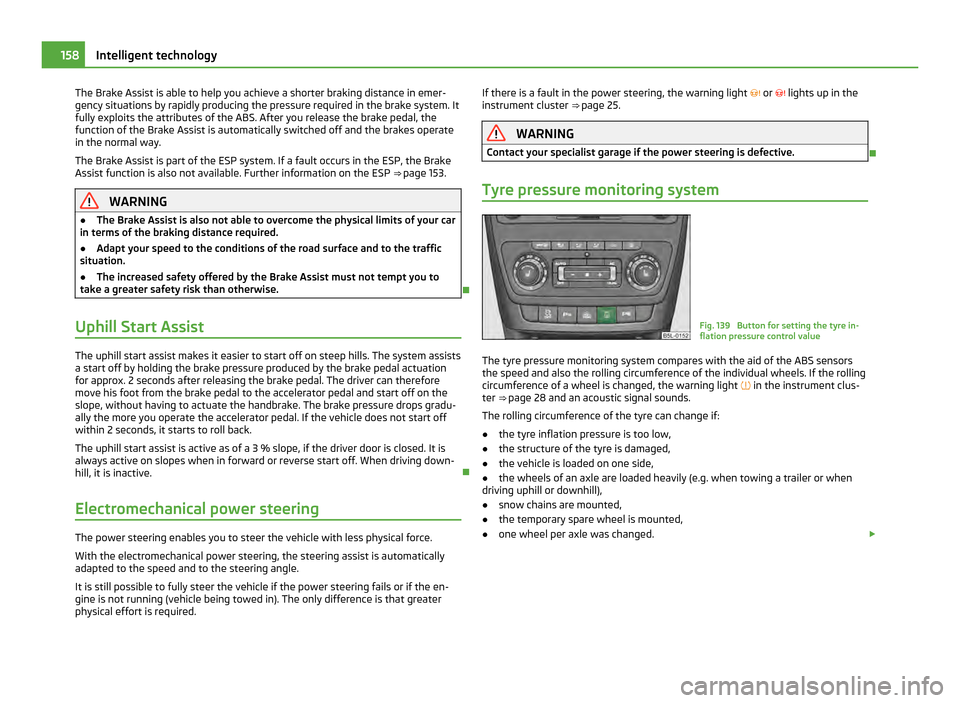
Tyre pressure monitoring system Fig. 139 Button for setting the tyre in-
flation pressure control value
The tyre pressure monitoring system compares with the aid of the ABS sensors
the speed and also the rolling circumference of the individual wheels. If the rolling
circumference of a wheel is changed, the warning light
in the instrument clus-
ter ⇒ page 28 and an acoustic signal sounds.
The rolling circumference of the tyre can change if:
● the tyre inflation pressure is too low,
● the structure of the tyre is damaged,
● the vehicle is loaded on one side,
● the wheels of an axle are loaded heavily (e.g. when towing a trailer or when
driving uphill or downhill),
● snow chains are mounted,
● the temporary spare wheel is mounted,
● one wheel per axle was changed. £158
Intelligent technology
Page 161 of 252

Basic setting of the system
After changing the tyre inflation pressures, after changing one or several wheels,
the position of a wheel on the vehicle (e.g. exchanging the wheels between the
axles) or when the warning light lights up while driving, a basic setting of the sys-
tem must be carried out as follows.
● Inflate all tyres to the specified inflation pressure ⇒ page 201.
● Switch on the ignition.
● Press button
⇒ fig. 139
for more than 2
seconds. While pressing the but-
ton, the warning light lights up. At the same time the memory of the system is
erased and the new calibration is started, which is confirmed with an audible sig-
nal and then the warning light goes out.
● If the warning light does not go out after the basic setting, there is a fault in
the system. Have the vehicle inspected by your nearest specialist garage.
Warning light lights up
If the tyre inflation pressure of at least one wheel is insufficiently inflated in com-
parison to the stored basic value, the warning light ⇒ lights up.
Warning light flashes
If the warning light flashes, there is a system fault. Have the vehicle inspected by
your nearest specialist garage. WARNING
● When the warning light lights up, immediately reduce the speed and
avoid sudden steering and brake manoeuvres. Please stop the vehicle without
delay at the nearest possible stop and inspect the tyres and their inflation
pressures.
● The driver is responsible for the correct tyre inflation pressures. For this
reason, the tyre inflation pressures must be checked regularly.
● Under certain circumstances (e.g. sporty style of driving, wintry or unpaved
roads) the warning light can be delayed or does not light up at all.
● The tyre pressure monitoring system does not take away the responsibility
from the driver for the correct tyre inflation pressure. Note
The tyre pressure monitoring system:
● does not replace the regular tyre inflation pressure control, because the sys-
tem cannot detect an even pressure loss; ●
cannot warn in case of very rapid tyre inflation pressure loss, e.g. in case of
sudden tyre damage. In this case carefully bring the vehicle to a standstill without
sudden steering movements and without sharp braking.
● In order to ensure a proper functioning of the tyre inflation pressure-control
system, it is necessary to carry out the basic setting again every 10 000 km or 1x a
year.
Diesel particle filter (diesel engine) In the diesel particle filter the resulting soot particles are collected
and burnt during the combustion of diesel fuel. Fig. 140 Vehicle data sticker
Code 7GG , 7MB or 7MG on the vehicle data sticker, see ⇒ fig. 140 , indicates that
your vehicle is equipped with a diesel particle filter. The vehicle data sticker is lo-
cated on the floor of the luggage compartment and is also stated in the Service
schedule.
The diesel particle filter filters the soot particles completely from the exhaust. The
soot is collected in the diesel particle filter and burnt regularly. To assist this pro-
cedure, we recommend not to drive regularly over short distances.
If the diesel particle filter is full or there is a fault, it is indicated by the warning
light . £ 159
Intelligent technology Using the system Safety Driving Tips General Maintenance Breakdown assistance Technical data
Page 167 of 252

Regular servicing
A poorly tuned engine uses an unnecessarily high amount of fuel.
Having your vehicle serviced regularly at a specialist garge enables you to satisfy
one of the requirements for economical motoring even before you set off on your
journey. Keeping your vehicle properly serviced not only has a positive effect on
the safety of your vehicle and maintaining its value, but also saves on fuel.
A poorly tuned engine can result in a fuel consumption which is 10 % higher than
normal.
The foreseen maintenance work should be undertaken exactly according to the
Service schedule by a specialist garage.
Also check the oil level after refuelling. Oil consumption is dependent to a consid-
erable extent on the load and speed of the engine. Oil consumption could be as
high as 0.5 litres/1 000 km depending on your style of driving.
It is quite normal that a new engine has a higher oil consumption at first, and rea-
ches its lowest level only after a certain running in time. It is therefore not possi-
ble to correctly assess the oil consumption of a new vehicle until after you have
driven about 5 000 km. For the sake of the environment
● You can achieve additional improvements in your fuel economy by using high-
lubricity oils.
● Check the ground below your car at regular intervals to detect any leakages in
good time. Please have your vehicle inspected by a specialist garage if you find
any stains caused by oil or other fluids on the floor. Avoid driving short distances Short distances result in an above-average high fuel consumption.
Fig. 144 Fuel consumption in litres/100
km at different temperatures
– Avoid driving a distance of no more than 4 km if the engine is cold.
The engine and catalytic converter must first have reached their optimal operat-
ing temperature in order to effectively reduce fuel consumption and pollutant
emissions.
The cold engine vehicle consumes approx. 15 - 20 litres/100 km of fuel immediate-
ly after starting. Fuel consumption drops to 10 litres/100 km after just 1 kilometre.
The engine reaches its operating temperature (outside temperature and engine
dependent) only after about 4 to 10 kilometres and the fuel consumption then
stabilizes. You should therefore avoid driving short distances whenever possible.
An important factor in this connection is also the ambient temperature. The
⇒ fig. 144 shows the different fuel consumptions for the same distance, on the
one hand at +20 °C and on the other hand at -10
°C. Your vehicle has a higher fuel
consumption in winter than in summer.
Checking tyre inflation pressures Tyres which are correctly inflated save fuel.
Always ensure that your tyres are inflated to the correct pressure at all times. The
rolling resistance will be increased if the tyre filling pressure is too low. This will
not only increase fuel consumption but also tyre wear and the driving behaviour
will worsen.
Always check the inflation pressure of the tyres when cold. £ 165
Driving and the environment Using the system Safety Driving Tips General Maintenance Breakdown assistance Technical data
Page 173 of 252

●
spare wheel and tyre repair kit,
● shovel.
Safe off-road driving Adopt a correct seated position and always fasten the seat belt correctly. Make
sure that your front passenger and your passengers seated on the rear seats al-
ways fasten their seat belts correctly.
When driving off-road, it is perhaps more useful to adopt a slightly different seat-
ed position. Depending on the terrain, an increased force may be required to turn
the steering wheel because the force is transferred from the front wheels to the
steering wheel. You must be seated in such a way that you have good front visibil-
ity, especially when driving uphill or downhill. You must never be seated in such a
way that the distance between your chest and the middle of the airbag cover is
less than 25 cm ⇒
page 139.
Under no circumstances must you drive off-road with high heels, slippery or open
shoes. You should wear shoes which fit your feet well and allow you to get a feel
for the pedals. WARNING
Observe the important guidelines ⇒
page 168.
Before driving off-road ●
Make sure the tyres are suitable for the planned off-road journey. Before you
drive through difficult terrain, equip your vehicle with off-road tyres.
● Fill up your tank. The fuel consumption of the vehicle is much higher when
driving off-road than when driving on the road.
● Install the towing eye at the front or at the rear before driving off-road. It is
not always possible to install the towing eye if the vehicle got stuck.
● Always check the inflation pressure of all the tyres and if necessary correct it.
● Check the vehicle tool kit and supplement it according to your needs.
● Fill with engine oil up to the line A , so that the engine is sufficiently supplied
with engine oil when the vehicle is in a tilted position ⇒
page 191, Check engine
oil level.
● Top up wash fluid.
● Stow your load as low as possible in the vehicle and attach all the items which
are loose. Off-road driving ●
Never be alone when driving off-road and be prepared to encounter unexpec-
ted situations. Travel together with at least two off-road vehicles. Equipment with
which you can call for help in an emergency is particularly useful.
● Drive slowly through unclear terrain.
● You must stop when encountering difficult passages and explore the continu-
ation of the route on foot. If you cannot go on or if you doubt the safety of the
route, turn back and choose another way.
● Drive slowly over hilltops. Make sure that the wheels of the vehicle do not lift
off the ground, as this could severely damage the vehicle and it may become disa-
bled.
● Drive slowly on difficult stretches of the route. When driving on a slippery
ground, shift up into the next higher gear and make sure that the vehicle always
stays in motion. Do not drive too fast so that you don't lose control over your vehi-
cle.
● If your vehicle got stuck in sand, snow or sludge, it may be more effective to
reverse the vehicle than trying to drive forwards.
● Place stones, footmats or pieces of wood under the spinning wheels in order
to achieve traction on a sandy or slippery ground.
● Do no drive through water before reading what you must take into account
⇒ page 167.
● Keep sufficient distance from other vehicles even at low speeds. When the
first vehicle suddenly gets stuck, the following vehicle can still stop in time with-
out getting stuck itself.
● Do not plan day trips which are too far in distance.
● Do not use the cruise control system when driving off-road. It is only intended
for driving on the road. WARNING
● The intelligent engineering of your vehicle cannot overcome the physical
limits of your vehicle.
● Be very alert and look ahead when driving off-road. Excessive speed or in-
correct driving manoeuvres can cause damage to the vehicle and lead to seri-
ous injuries.
● Observe the important guidelines ⇒ page 168. £ 171
Driving and the environment Using the system Safety Driving Tips General Maintenance Breakdown assistance Technical data
Page 178 of 252

Driving through sand
Do not reduce
the tyre inflation pressure. If you nevertheless reduce the inflation
pressure, do not forget to re-establish the correct tyre inflation pressure level be-
fore you continue driving. Driving with a reduced tyre inflation pressure increases
the risk that you lose control over your vehicle and that the vehicle rolls over.
Driving through mud
Do not change speed or direction when you drive through the mud. The tyres can
lose their grip in the mud. If the vehicle slides, you must steer in the appropriate
direction in order to regain control over the vehicle. WARNING
● Driving through mud can be dangerous. The vehicle can slide uncontrolla-
bly which causes an increased risk of injury. Adopt a particularly cautious style
of driving. Pay attention to the information and warning notes.
● An incorrect tyre inflation pressure may cause a major or fatal accident! An
incorrect tyre inflation pressure may result in bursting of a tyre, which causes
the vehicle to get out of control.
● Observe the important guidelines ⇒ page 168.
Stuck vehicle If you can no longer drive on ...
–
Carefully dig out all the wheels and make sure that no other parts of the vehi-
cle are stuck in the sand.
– Engage reverse gear.
– Gently depress the accelerator and try to drive backwards in your own track.
– Place scrub, footmats or a sackcloth directly in front of the tyres in order to im-
prove the road adherence and thus achieve an improved traction to drive out.
Rocking out vehicle
– Switch off the TCS ⇒ page 155.
– Set the steering wheel straight.
– Drive so far back until the wheels just begin to spin.
– Quickly shift into first gear and drive forwards until the wheels begin to spin. –
Drive back and forth repeatedly until the momentum is sufficient to free the
vehicle.
– Switch on the TCS.
A few tips
– Ensure that the Off-road mode is switched on ⇒ page 160.
– Avoid prolonged spinning of the wheels, otherwise the vehicle would still sink
deeper into the ground.
– Remove mud, dirt and stones from the tread of the tyre.
You need training and experience if you wish to rock out a vehicle. If you make a
mistake, the vehicle can still sink in further and you can only free it with the help
of others. WARNING
Observe the important guidelines ⇒
page 168.
After driving off-road Check the vehicle for damage after driving off-road - especially on the underside
of the vehicle.
–
Switch off the Off-road mode
⇒
page 160.
– Check the tyres and the axles for damage and remove coarse dirt, stones and
foreign bodies from the tyre tread.
– Clean the turn signal lights, the headlights, the number plate and the win-
dows.
– Check the underbody of the vehicle and remove trapped objects, such as scrub
or wood pieces.
– Contact your specialist garage if you detect any damage.
– In case of thick layers of dirt, clean the radiator grille, the engine compartment
and the underbody of the vehicle. £176
Driving and the environment
Page 180 of 252

Towing a trailer
Towing a trailer
Technical requirements Your vehicle is designed primarily for transporting persons and luggage. It can,
however, also be used for towing a trailer - provided certain technical equipment
is fitted.
If your vehicle has been
factory-fitted with a towing device or has a towing device
from
ŠKODA Original Accessories, the towing device satisfies all technical and le-
gal requirements.
Your vehicle is fitted with a 13-pin power socket for the electrical connection be-
tween the vehicle and trailer. If the trailer which you wish to tow has a 7-pin con-
nector , you can use a suitable adapter from ŠKODA Original Accessories.
This work must be carried out in accordance with the manufacturer's specifica-
tions if a towing device is retrofitted.
Authorised ŠKODA Service Partners can provide detailed information about retro-
fitting a towing device and for any necessary modifications to the cooling system. WARNING
We recommend that you have the towing device from ŠKODA Original Acces-
sories installed by an authorised
ŠKODA Service Partner. He is familiar with all
the relevant details relating to retrofitting such equipment. There is a risk of
an accident if the towing device is not properly fitted!
General Maintenance Trailer load
The permissible trailer load must on no account be exceeded.
You can negotiate appropriately steeper inclines and descents if you do not make
full use of the permissible trailer load.
The trailer loads specified only apply for
altitudes up to 1000 metres above mean
sea level. The fact that the engine power output drops with increasing height due
to a lowering of air pressure and thus the ability to climb, means that the towed
weight must be reduced by 10 % for every further increase of 1 000 metres in height above sea level. The towed weight is the weight of the (laden) vehicle and
the (laden) trailer together. One should take this into account before driving up to
higher altitudes.
The trailer and drawbar load information on the type plate of the towing device
are merely test data for the towing device The data relating to your vehicle,
which is often less than this test data, can be found in your vehicle registration
documents.
Distribution of the load
Distribute the load in the trailer in such a way that any heavy items are located as
close as possible to the axle. Secure the items to prevent them slipping.
Tyre pressure
Correct the tyre inflation pressure on your vehicle for that of
“fully laden”
⇒ page 201. The inflation pressure of the tyres fitted to the trailer adjust in ac-
cordance with the manufacturer's recommendation.
Exterior mirrors
You have to have additional exterior mirrors fitted if you are not able to see the
traffic behind the trailer with the standard rear-view mirrors. Both exterior mirrors
should be attached to folding arms. Adjust the mirrors so that they provide you
with an adequate field of view to the rear.
Headlights
Before starting off with a hitched trailer, also check the setting of the headlights.
Alter the setting as necessary with the aid of the headlight beam adjuster
⇒ page 50.
Detachable ball head
The ball head is detachable on vehicles with towing device and can be obtained
from ŠKODA Original Accessories. It is stowed together with separate fitting in-
structions in the spare wheel well in the luggage compartment of the vehicle. Note
● We recommend that you also have your vehicle inspected between service in-
tervals if you tow a trailer frequently.
● The handbrake on the towing vehicle must be put on when coupling and de-
coupling the trailer. 178
Towing a trailer