2011 Peugeot Partner child seat
[x] Cancel search: child seatPage 4 of 200
2
Contents
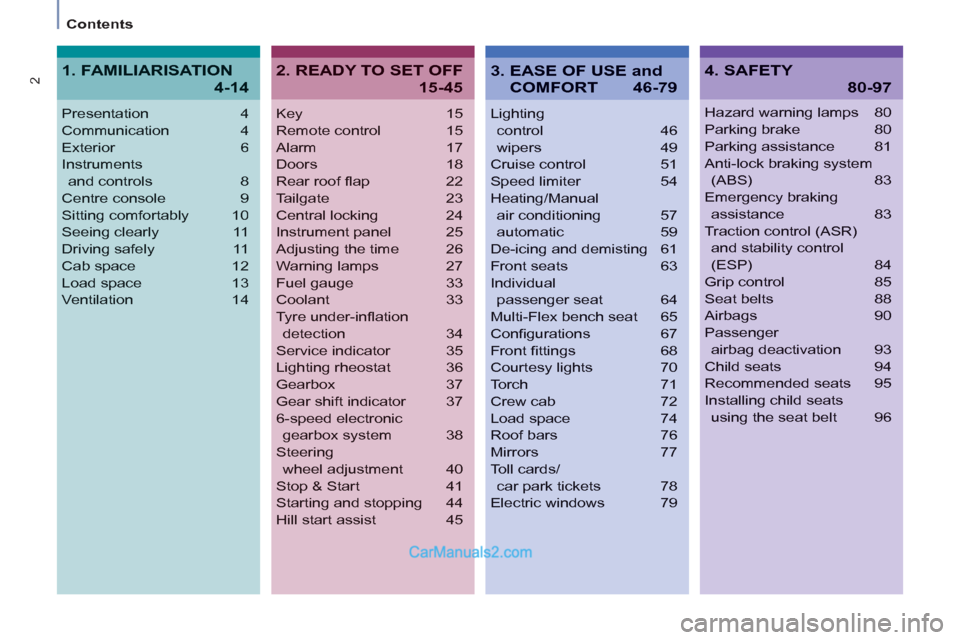
Key 15
Remote control 15
Alarm 17
Doors 18
Rear roof fl ap 22
Tailgate 23
Central locking 24
Instrument panel 25
Adjusting the time 26
Warning lamps 27
Fuel gauge 33
Coolant 33
Tyre under-infl ation
detection 34
Service indicator 35
Lighting rheostat 36
Gearbox 37
Gear shift indicator 37
6-speed electronic
gearbox system 38
Steering
wheel adjustment 40
Stop & Start 41
Starting and stopping 44
Hill start assist 45
Lighting
control 46
wipers 49
Cruise control 51
Speed limiter 54
Heating/Manual
air conditioning 57
automatic 59
De-icing and demisting 61
Front seats 63
Individual
passenger seat 64
Multi-Flex bench seat 65
Confi gurations 67
Front fi ttings 68
Courtesy lights 70
Torch 71
Crew cab 72
Load space 74
Roof bars 76
Mirrors 77
Toll cards/
car park tickets 78
Electric windows 79
Presentation4
Communication4
Exterior 6
Instruments
and controls8
Centre console9
Sitting comfortably 10
Seeing clearly 11
Driving safely 11
Cab space 12
Load space 13
Ventilation 14
Hazard warning lamps 80
Parking brake 80
Parking assistance 81
Anti-lock braking system
(ABS) 83
Emergency braking
assistance 83
Traction control (ASR)
and stability control
(ESP) 84
Grip control 85
Seat belts 88
Airbags 90
Passenger
airbag deactivation 93
Child seats 94
Recommended seats 95
Installing child seats
using the seat belt 96
2. READY TO SET OFF
15-45
4. SAFETY
80-97
1. FAMILIARISATION
4-14
3. EASE OF USE and
COMFORT 46-79
Page 16 of 200
33
4
4
3
14
Interior
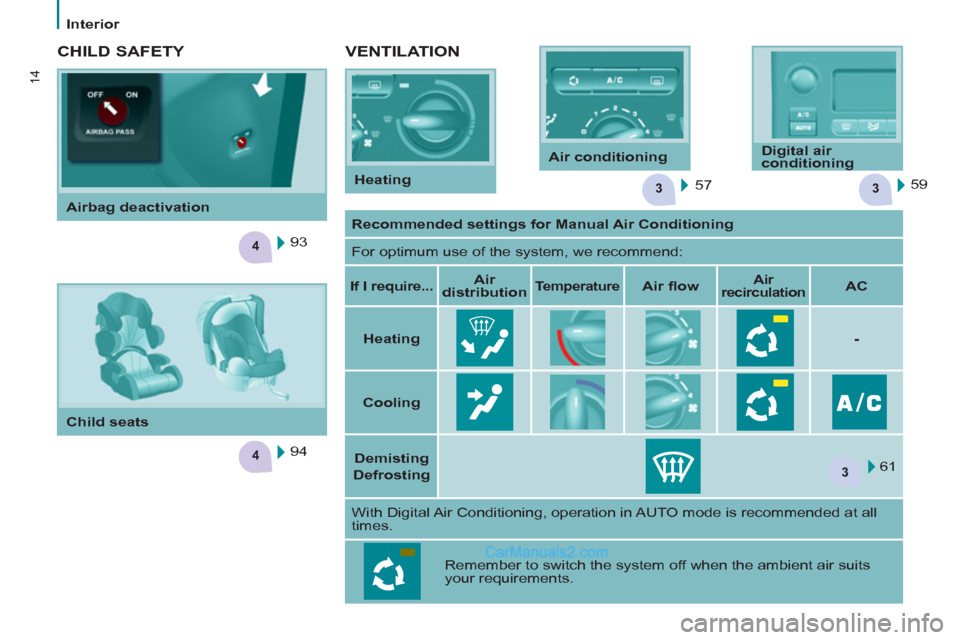
VENTILATION
57 59
CHILD SAFETY
94
93
Recommended settings for Manual Air Conditioning
For optimum use of the system, we recommend:
If I require...
Air
distribution
Temperature
Air fl ow
Air
recirculation
AC
Heating
-
Cooling
Demisting
Defrosting
61
With Digital Air Conditioning, operation in AUTO mode is recommended at all
times.
Remember to switch the system off when the ambient air suits
your requirements.
Airbag deactivation
Child seats
Heating Air conditioning
Digital air
conditioning
Page 31 of 200
29
READY TO SET OFF
22
Instruments and controls
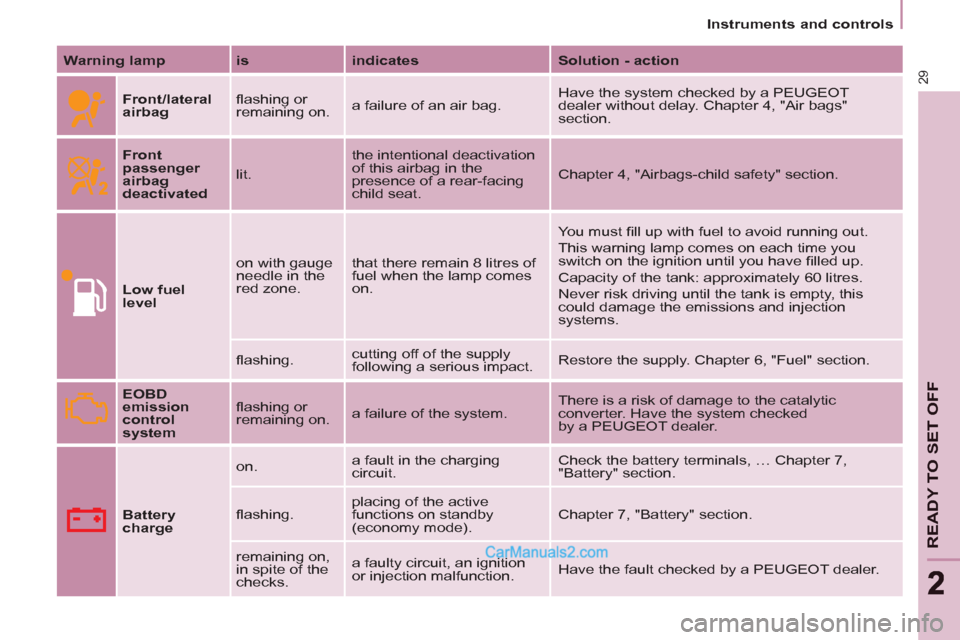
Warning lamp
is
indicates
Solution - action
Front/lateral
airbag
fl ashing or
remaining on. a failure of an air bag. Have the system checked by a PEUGEOT
dealer without delay. Chapter 4, "Air bags"
section.
Front
passenger
airbag
deactivated
lit. the intentional deactivation
of this airbag in the
presence of a rear-facing
child seat. Chapter 4, "Airbags-child safety" section.
Low fuel
level
on with gauge
needle in the
red zone. that there remain 8 litres of
fuel when the lamp comes
on. You must fi ll up with fuel to avoid running out.
This warning lamp comes on each time you
switch on the ignition until you have fi lled up.
Capacity of the tank: approximately 60 litres.
Never risk driving until the tank is empty, this
could damage the emissions and injection
systems.
fl ashing. cutting off of the supply
following a serious impact. Restore the supply. Chapter 6, "Fuel" section.
EOBD
emission
control
system
fl ashing or
remaining on. a failure of the system. There is a risk of damage to the catalytic
converter. Have the system checked
by a PEUGEOT dealer.
Battery
charge
on. a fault in the charging
circuit. Check the battery terminals, … Chapter 7,
"Battery" section.
fl ashing. placing of the active
functions on standby
(economy mode). Chapter 7, "Battery" section.
remaining on,
in spite of the
checks. a faulty circuit, an ignition
or injection malfunction. Have the fault checked by a PEUGEOT dealer.
Page 75 of 200
73
EASE OF USE and COMFOR
T
33
Practical information
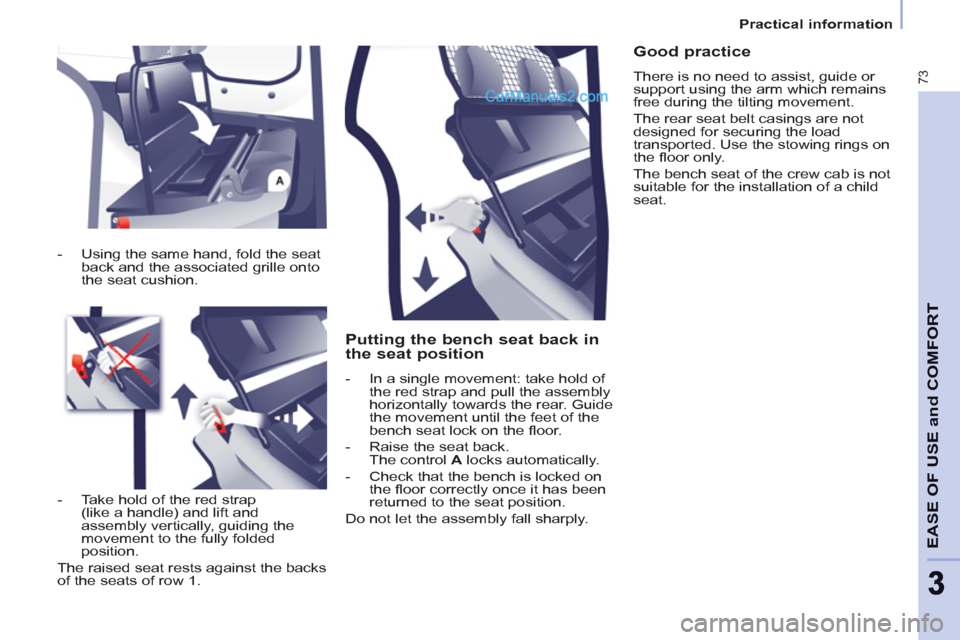
Putting the bench seat back in
the seat position
- In a single movement: take hold of
the red strap and pull the assembly
horizontally towards the rear. Guide
the movement until the feet of the
bench seat lock on the fl oor.
- Raise the seat back.
The control A
locks automatically.
- Check that the bench is locked on
the fl oor correctly once it has been
returned to the seat position.
Do not let the assembly fall sharply.
Good practice
There is no need to assist, guide or
support using the arm which remains
free during the tilting movement.
The rear seat belt casings are not
designed for securing the load
transported. Use the stowing rings on
the fl oor only.
The bench seat of the crew cab is not
suitable for the installation of a child
seat.
- Using the same hand, fold the seat
back and the associated grille onto
the seat cushion.
- Take hold of the red strap
(like a handle) and lift and
assembly vertically, guiding the
movement to the fully folded
position.
The raised seat rests against the backs
of the seats of row 1.
Page 91 of 200
Seat belts
89
SAFETY
4
The inertia reels are fi tted with a device
which automatically locks the strap in
the event of a collision or emergency
braking or if the vehicle rolls over.
You can unfasten the seat belt by
pressing the red button on the buckle.
Guide the seat belt after unfastening.
The airbag warning light comes on
if the pretensioners are triggered.
Consult a PEUGEOT dealer.
Recommendations for children:
- use a suitable child seat if the
passenger is less than 12 years old
or shorter than one metre fi fty,
- never allow a child to travel on
your lap, even with the seat belt
fastened.
For further information regarding
child seats, refer to the "Children
on board" section of chapter 4.
Clean the seat belt straps with
soapy water or a textile cleaning
product, sold by PEUGEOT
dealers.
In accordance with current safety
regulations, your PEUGEOT dealer
guarantees all work or any checks,
from testing to maintenance, on your
seat belt equipment.
Have the seat belts checked regularly
(even after a minor impact) by a
PEUGEOT dealer: they must not show
any signs of wear, cutting or fraying
and they must not be transformed or
modifi ed.
Front seat belts
The front seats are fi tted with
pretensioners and force limiters.
The seat belt associated with the centre
seat of the front bench does not have a
pretensioner.
In order to be effective, a seat belt
must:
- restrain one person only,
- must not be twisted, check by
pulling in front of you with an even
movement,
- be tightened as close to the body
as possible.
The upper part of the seat belt should
be positioned in the hollow of the
shoulder.
The lap part should be placed as low
as possible on the pelvis.
Do not invert the seat belt buckles as
they will not fulfi l their role completely.
If the seats are fi tted with armrests, the
lap part of the seat belt should always
pass under the armrest.
Check that the seat belt is fastened
correctly by pulling the strap fi rmly.
Page 93 of 200
Airbags
91
SAFETY
4
Good practice
Sit in a normal upright position.
Wear a correctly adjusted seat belt.
Do not leave anything between the
occupants and the airbags (a child,
pet, object...). This could hamper the
operation of the airbags or injure the
occupants.
After an accident or if the vehicle has
been stolen or broken into, have the
airbag systems checked.
All work on the airbag system is strictly
forbidden unless it is carried out by
qualifi ed personnel of the PEUGEOT
network.
Even if all of the precautions
mentioned are observed, a risk of
injury or of minor burns to the head,
chest or arms when an airbag is
triggered cannot be ruled out. In fact,
the bag infl ates almost instantly (within
a few milliseconds) then defl ates within
the same time discharging the hot gas
via openings provided for this purpose.
Side airbags
Only put recommended covers on the
seats. These will not hinder infl ation of
the side airbags. Consult a PEUGEOT
dealer.
Do not fi x or glue anything to the seat
backs. This could cause injury to the
chest or arms when the side airbag
infl ates.
Do not sit with the upper part of the
body any nearer to the door than
necessary.
Front airbags
Do not drive holding the steering wheel
by its spokes or resting your hands on
the centre part of the wheel.
Do not allow passengers to place their
feet on the fascia, they risk serious
injury if the airbag is triggered.
Smoke as little as possible as
deployment of the airbags can cause
burns or the risk of injury from a
cigarette or pipe.
Never remove or pierce the steering
wheel or hit it violently.
Airbags only operate when the
ignition is switched on.
This equipment only operates once.
If a second impact occurs (during the
same or a subsequent accident), the
airbag will not operate.
The triggering of an airbag or airbags
is accompanied by a slight discharge
of harmless smoke and a noise, due
to the activation of the pyrotechnic
cartridge incorporated in the system.
This smoke is not harmful, but
sensitive individuals may experience
some irritation.
The noise of the detonation may result
in a slight loss of hearing for a short
time.
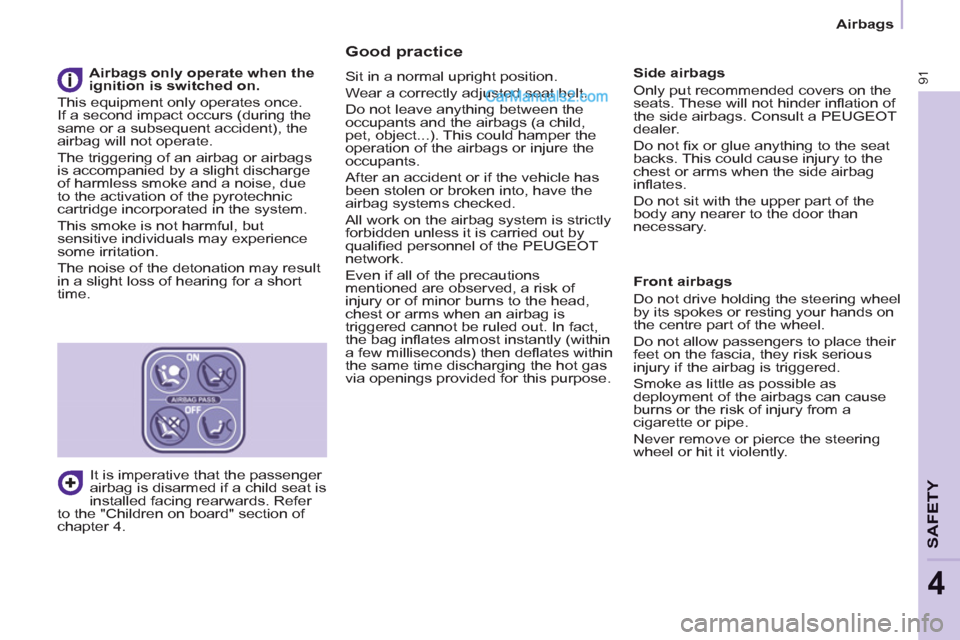
It is imperative that the passenger
airbag is disarmed if a child seat is
installed facing rearwards. Refer
to the "Children on board" section of
chapter 4.
Page 95 of 200
Airbags
93
SAFETY
4
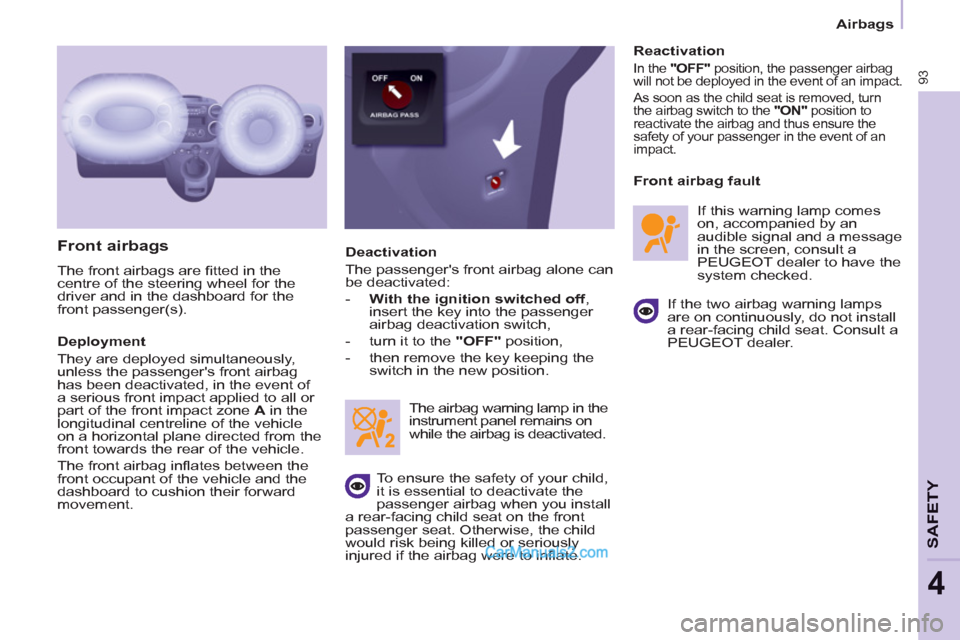
Front airbags
The front airbags are fi tted in the
centre of the steering wheel for the
driver and in the dashboard for the
front passenger(s).
Deployment
They are deployed simultaneously,
unless the passenger's front airbag
has been deactivated, in the event of
a serious front impact applied to all or
part of the front impact zone A
in the
longitudinal centreline of the vehicle
on a horizontal plane directed from the
front towards the rear of the vehicle.
The front airbag infl ates between the
front occupant of the vehicle and the
dashboard to cushion their forward
movement.
Deactivation
The passenger's front airbag alone can
be deactivated:
- With the ignition switched off
,
insert the key into the passenger
airbag deactivation switch,
- turn it to the "OFF"
position,
- then remove the key keeping the
switch in the new position.
The airbag warning lamp in the
instrument panel remains on
while the airbag is deactivated. If the two airbag warning lamps
are on continuously, do not install
a rear-facing child seat. Consult a
PEUGEOT dealer.
Front airbag fault
To ensure the safety of your child,
it is essential to deactivate the
passenger airbag when you install
a rear-facing child seat on the front
passenger seat. Otherwise, the child
would risk being killed or seriously
injured if the airbag were to infl ate.
Reactivation
In the "OFF"
position, the passenger airbag
will not be deployed in the event of an impact.
As soon as the child seat is removed, turn
the airbag switch to the "ON"
position to
reactivate the airbag and thus ensure the
safety of your passenger in the event of an
impact.
If this warning lamp comes
on, accompanied by an
audible signal and a message
in the screen, consult a
PEUGEOT dealer to have the
system checked.
Page 96 of 200
Child safety
94
GENERAL POINTS RELATING
TO CHILD SEATS
Although one of PEUGEOT’s main
criteria when designing your vehicle,
the safety of your children also
depends on you.
For maximum safety, please follow
these precautions:
- all children under the age of 12 or
less than one metre fi fty tall must
travel in approved child seats suited
to their weight, on seats fi tted with
a seat belt or ISOFIX mountings,
- statistically, the safest seats in your
vehicle for the transportation of
children are the rear seats,
- a child weighing less than 9 kg
must travel in the "rearwards-
facing" position both in the front
and in the rear,
- the passenger must not travel with
a child on his lap.
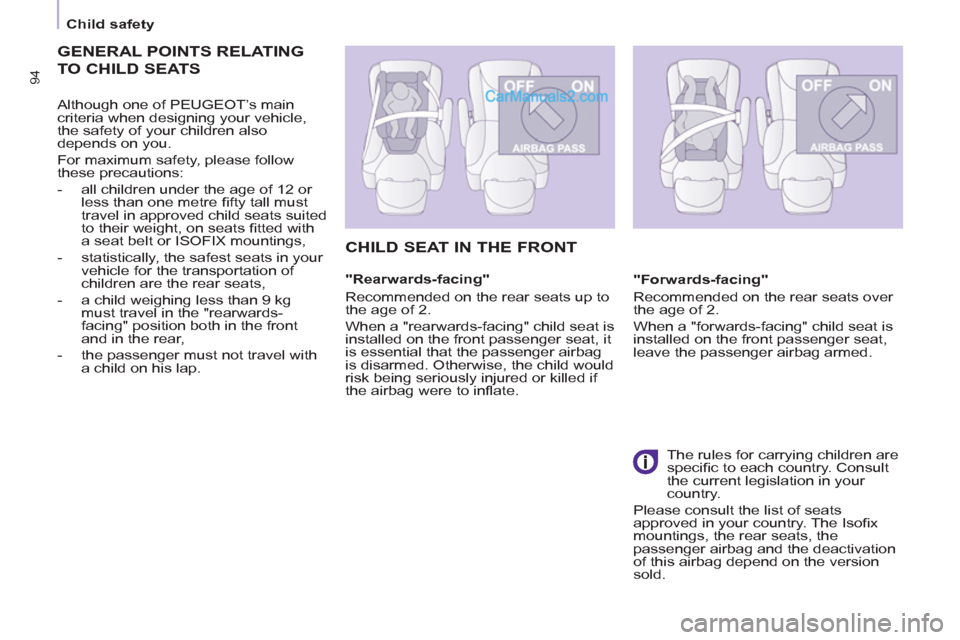
CHILD SEAT IN THE FRONT
"Rearwards-facing"
Recommended on the rear seats up to
the age of 2.
When a "rearwards-facing" child seat is
installed on the front passenger seat, it
is essential that the passenger airbag
is disarmed. Otherwise, the child would
risk being seriously injured or killed if
the airbag were to infl ate.
"Forwards-facing"
Recommended on the rear seats over
the age of 2.
When a "forwards-facing" child seat is
installed on the front passenger seat,
leave the passenger airbag armed.
The rules for carrying children are
specifi c to each country. Consult
the current legislation in your
country.
Please consult the list of seats
approved in your country. The Isofi x
mountings, the rear seats, the
passenger airbag and the deactivation
of this airbag depend on the version
sold.