Page 15 of 200
3
3
3
3
13
1
FAMILIARISATION
Interior
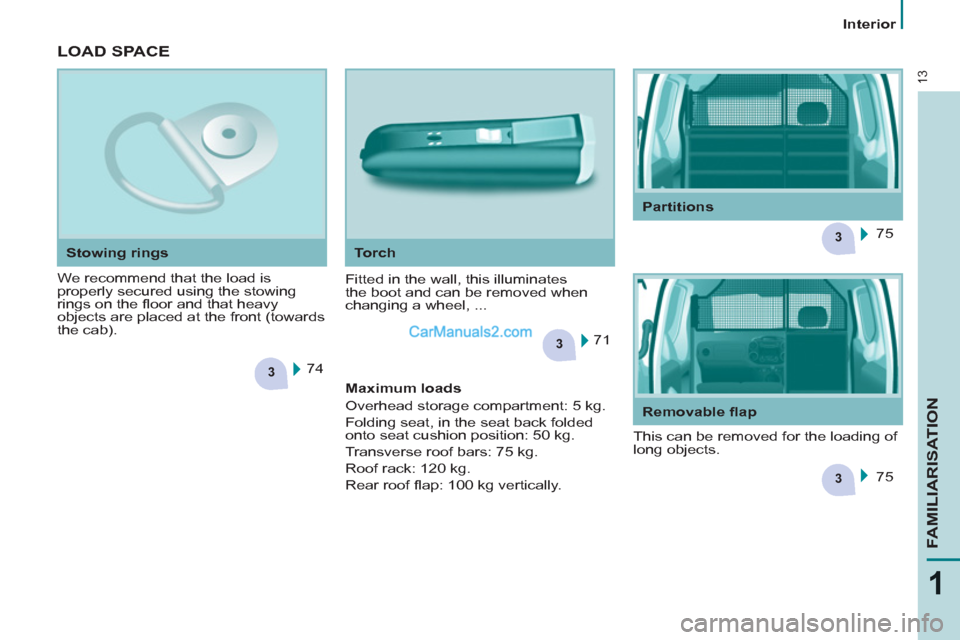
LOAD SPACE
We recommend that the load is
properly secured using the stowing
rings on the fl oor and that heavy
objects are placed at the front (towards
the cab). Fitted in the wall, this illuminates
the boot and can be removed when
changing a wheel, ...
74 71 75
Maximum loads
Overhead storage compartment: 5 kg.
Folding seat, in the seat back folded
onto seat cushion position: 50 kg.
Transverse roof bars: 75 kg.
Roof rack: 120 kg.
Rear roof fl ap: 100 kg vertically.
Partitions
Torch
Stowing rings
Removable fl ap
This can be removed for the loading of
long objects.
75
Page 84 of 200
82
Parking sensors
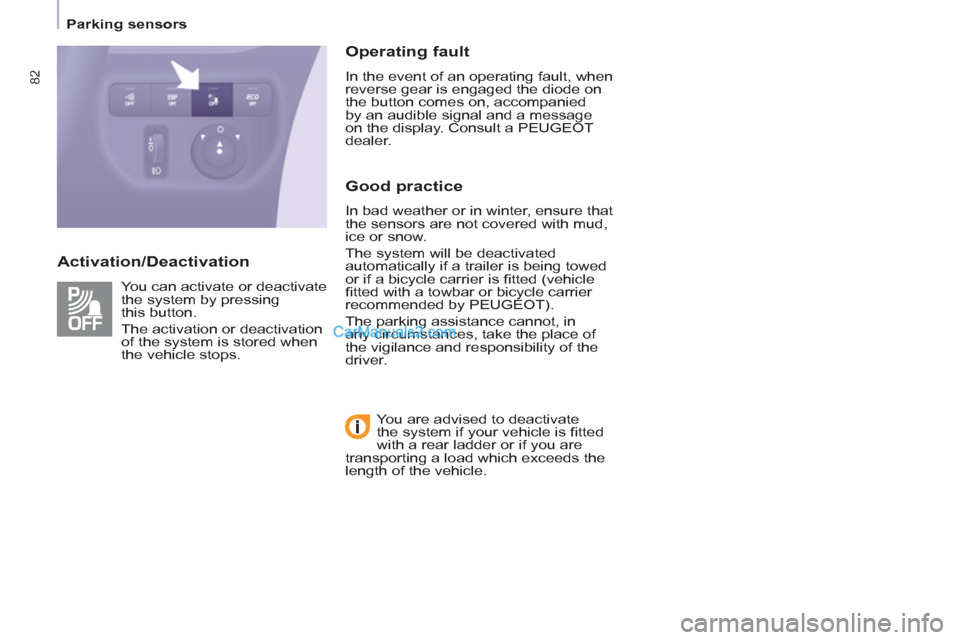
Activation/Deactivation
Operating fault
In the event of an operating fault, when
reverse gear is engaged the diode on
the button comes on, accompanied
by an audible signal and a message
on the display. Consult a PEUGEOT
dealer.
Good practice
In bad weather or in winter, ensure that
the sensors are not covered with mud,
ice or snow.
The system will be deactivated
automatically if a trailer is being towed
or if a bicycle carrier is fi tted (vehicle
fi tted with a towbar or bicycle carrier
recommended by PEUGEOT).
The parking assistance cannot, in
any circumstances, take the place of
the vigilance and responsibility of the
driver. You can activate or deactivate
the system by pressing
this button.
The activation or deactivation
of the system is stored when
the vehicle stops.
You are advised to deactivate
the system if your vehicle is fi tted
with a rear ladder or if you are
transporting a load which exceeds the
length of the vehicle.
Page 101 of 200
99
Towing a trailer
ACCESSORIE
S
5
Good Practice
In certain cases of particularly arduous
use (towing the maximum load up a
steep slope in high temperatures), the
engine automatically limits its power. In
this case, the automatic cutting off of
the air conditioning allows the engine
power to be recovered.
Tyres
Check the tyre pressures of the
towing vehicle (see the "Identifi cation
features" section of chapter 8) and of
the trailer, observing the recommended
pressure.
See the "Levels" section of chapter 6. If the coolant temperature
warning light comes on, stop
the vehicle and switch off the
engine as soon as possible.
Brakes
Towing increases the braking distance.
Drive at a moderate speed, change
down early and brake gradually.
Towbar
We recommend the use of original
PEUGEOT towbars and their
harnesses, which have been tested
and approved from the design stage of
your vehicle, and that you entrust the
fi tting of this equipment to a PEUGEOT
dealer.
If this equipment is not fi tted by a
PEUGEOT dealer, it is imperative that
it is fi tted using the electrical pre-
equipment installed at the rear of the
vehicle and in accordance with the
manufacturer's instructions.
In accordance with the general
instructions a reminder of which has
been given above, we draw your
attention to the risk linked with fi tting
a towbar or electrical accessory not
recommended by PEUGEOT. Fitting
such equipment could result in the
failure of your vehicle's electronic
system. Please contact a PEUGEOT
dealer for information before fi tting this
type of equipment.
OTHER ACCESSORIES
These accessories and parts, having been
tested and approved for reliability and
safety, are all adapted to your vehicle. A
wide range of recommended accessories
and genuine parts is available.
Range of trade equipment
The parts department publishes an
accessory catalogue offering various
equipment and fi ttings, such as:
Load retainers (all models).
Loading roller.
Towbar, towbar harness: trailer towbar
which must be fi tted by the PEUGEOT
network.
Separation partitions and grilles,
smooth, non-slip wooden protective
fl oor.
Protective grilles.
Side wind
Sensitivity to side wind is increased.
Drive smoothly and at a moderate
speed.
ABS/ESP
The ABS or ESP systems only control
the vehicle, not the trailer or caravan.
Rear parking assistance
The assistance does not function while
the vehicle is towing.
Another range is also available,
structured around comfort, leisure and
maintenance:
Page 114 of 200
11 2
Changing a wheel
1. PARKING THE VEHICLE
- Tthe occupants must get out of the
vehicle and wait in a safe location.
- If possible, park the vehicle on
level, stable and non-slippery
ground.
- Apply the parking brake, switch
off the ignition and engage fi rst or
reverse gear.
- If available, place a chock under
the wheel diagonally opposite the
one to be changed.
If the vehicle is fi tted with a towbar,
it is sometimes necessary to raise
the vehicle slightly to make it easier
to remove the spare wheel from its
carrier.
On certain types of ground and/or
if considerable loads are being
transported, call a PEUGEOT dealer.
CHANGING A WHEEL
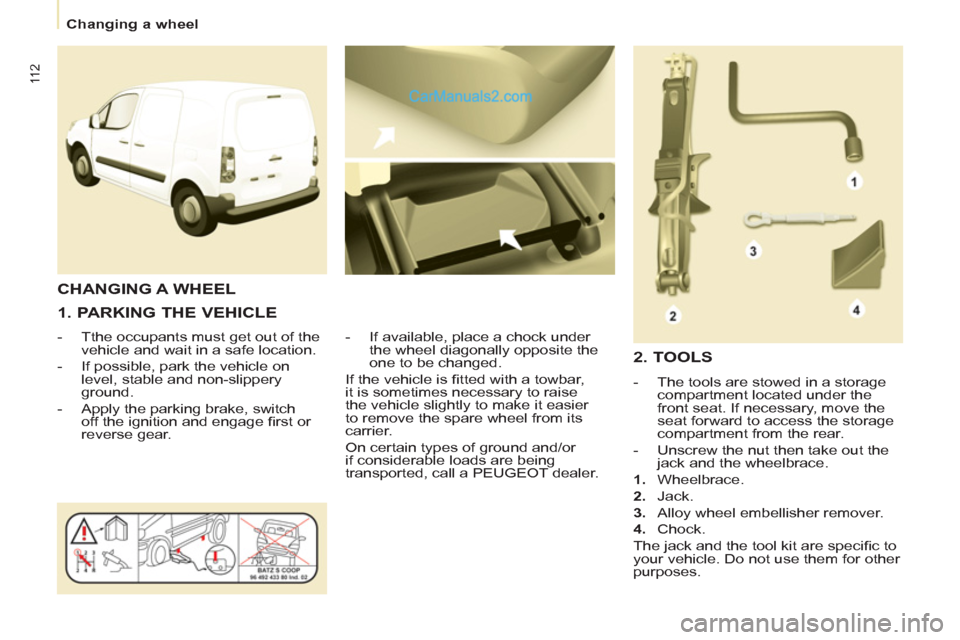
2. TOOLS
- The tools are stowed in a storage
compartment located under the
front seat. If necessary, move the
seat forward to access the storage
compartment from the rear.
- Unscrew the nut then take out the
jack and the wheelbrace.
1.
Wheelbrace.
2.
Jack.
3.
Alloy wheel embellisher remover.
4.
Chock.
The jack and the tool kit are specifi c to
your vehicle. Do not use them for other
purposes.
Page 124 of 200
122
Changing a fuse
CHANGING A FUSE
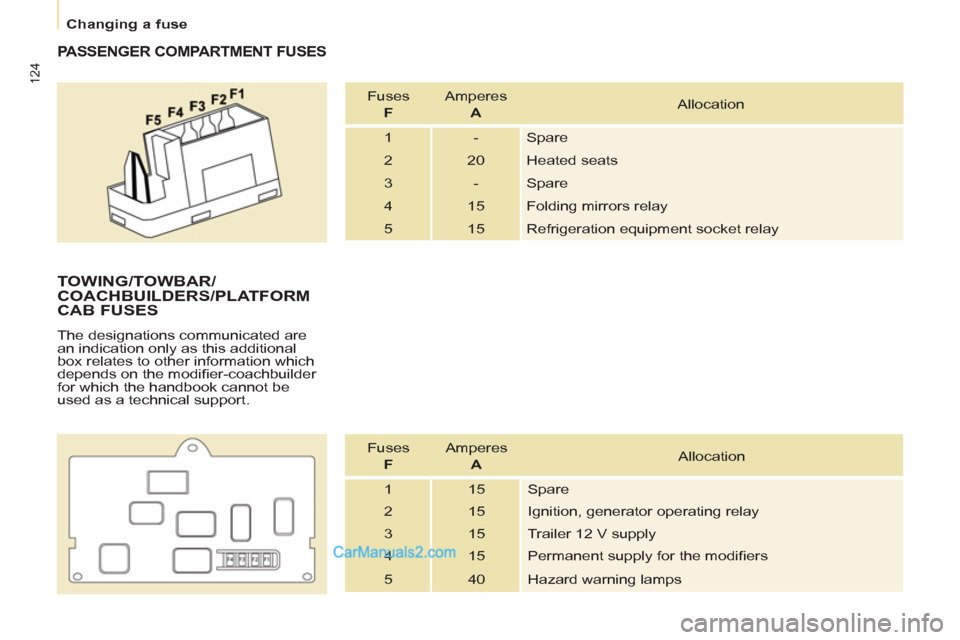
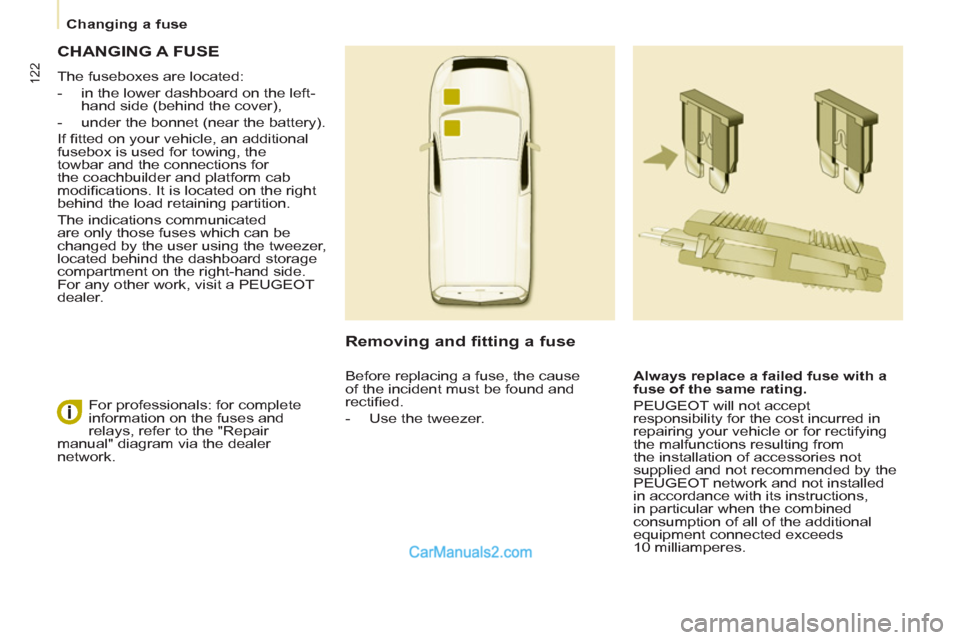
The fuseboxes are located:
- in the lower dashboard on the left-
hand side (behind the cover),
- under the bonnet (near the battery).
If fi tted on your vehicle, an additional
fusebox is used for towing, the
towbar and the connections for
the coachbuilder and platform cab
modifi cations. It is located on the right
behind the load retaining partition.
The indications communicated
are only those fuses which can be
changed by the user using the tweezer,
located behind the dashboard storage
compartment on the right-hand side.
For any other work, visit a PEUGEOT
dealer.
Removing and fitting a fuse
Always replace a failed fuse with a
fuse of the same rating.
PEUGEOT will not accept
responsibility for the cost incurred in
repairing your vehicle or for rectifying
the malfunctions resulting from
the installation of accessories not
supplied and not recommended by the
PEUGEOT network and not installed
in accordance with its instructions,
in particular when the combined
consumption of all of the additional
equipment connected exceeds
10 milliamperes. For professionals: for complete
information on the fuses and
relays, refer to the "Repair
manual" diagram via the dealer
network. Before replacing a fuse, the cause
of the incident must be found and
rectifi ed.
- Use the tweezer.
Page 126 of 200
124
Changing a fuse
PASSENGER COMPARTMENT FUSES
Fuses
F
Amperes
A
Allocation
1 - Spare
2 20 Heated seats
3 - Spare
4 15 Folding mirrors relay
5 15 Refrigeration equipment socket relay
TOWING/TOWBAR/
COACHBUILDERS/PLATFORM
CAB FUSES
The designations communicated are
an indication only as this additional
box relates to other information which
depends on the modifi er-coachbuilder
for which the handbook cannot be
used as a technical support.
Fuses
F
Amperes
A
Allocation
1 15 Spare
2 15 Ignition, generator operating relay
3 15 Trailer 12 V supply
4 15 Permanent supply for the modifi ers
5 40 Hazard warning lamps
Page 129 of 200
127
QUICK HELP
7
Having your vehicle towed
Without lifting
(4 wheels on the road)
You should always use a towbar.
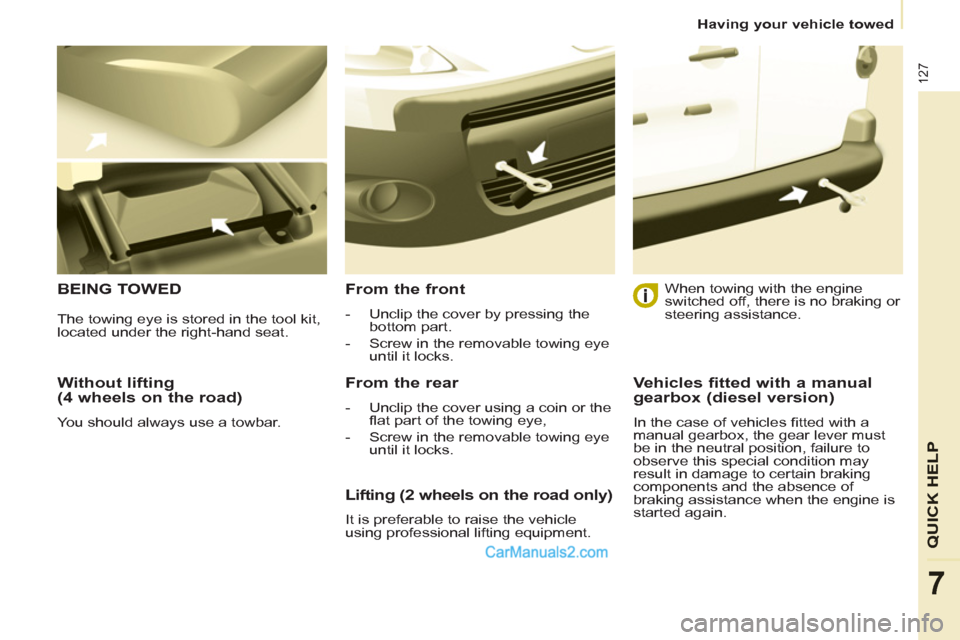
BEING TOWED
From the front
- Unclip the cover by pressing the
bottom part.
- Screw in the removable towing eye
until it locks.
From the rear
- Unclip the cover using a coin or the
fl at part of the towing eye,
- Screw in the removable towing eye
until it locks.
When towing with the engine
switched off, there is no braking or
steering assistance.
Lifting (2 wheels on the road only)
It is preferable to raise the vehicle
using professional lifting equipment. The towing eye is stored in the tool kit,
located under the right-hand seat.
Vehicles fitted with a manual
gearbox (diesel version)
In the case of vehicles fi tted with a
manual gearbox, the gear lever must
be in the neutral position, failure to
observe this special condition may
result in damage to certain braking
components and the absence of
braking assistance when the engine is
started again.
Page 193 of 200
135
Exterior
VISUAL SEARCH
10
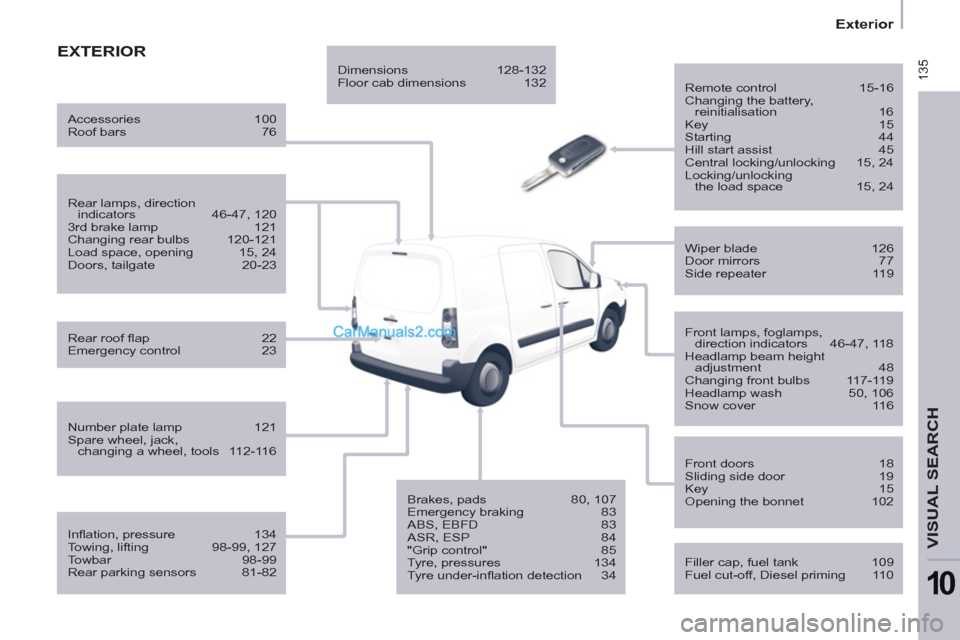
EXTERIOR
Remote control 15-16
Changing the battery,
reinitialisation 16
Key 15
Starting 44
Hill start assist 45
Central locking/unlocking 15, 24
Locking/unlocking
the load space 15, 24
Filler cap, fuel tank 109
Fuel cut-off, Diesel priming 110
Wiper blade 126
Door mirrors 77
Side repeater 119
Front lamps, foglamps,
direction indicators 46-47, 118
Headlamp beam height
adjustment 48
Changing front bulbs 117-119
Headlamp wash 50, 106
Snow cover 116
Front doors 18
Sliding side door 19
Key 15
Opening the bonnet 102
Infl ation, pressure 134
Towing, lifting 98-99, 127
Towbar 98-99
Rear parking sensors 81-82
Number plate lamp 121
Spare wheel, jack,
changing a wheel, tools 112-116
Rear lamps, direction
indicators 46-47, 120
3rd brake lamp 121
Changing rear bulbs 120-121
Load space, opening 15, 24
Doors, tailgate 20-23
Accessories 100
Roof bars 76
Rear roof fl ap 22
Emergency control 23
Dimensions 128-132
Floor cab dimensions 132
Brakes, pads 80, 107
Emergency braking 83
ABS, EBFD 83
ASR, ESP 84
"Grip control" 85
Tyre, pressures 134
Tyre under-infl ation detection 34