2011 CHEVROLET AVEO engine
[x] Cancel search: enginePage 215 of 328
Black plate (13,1)Chevrolet Aveo Owner Manual - 2011
Vehicle Care 10-13
must be reset. Your dealer has
trained service people who will
perform this work and reset the
system. It is also important to check
the oil regularly over the course of
an oil drain interval and keep it at
the proper level.
If the system is ever reset
accidentally, the oil must be
changed at 5 000 km (3,000 miles)
since the last oil change.
Remember to reset the oil life
system whenever the oil is changed.
How to Reset the Engine Oil
Life System
Reset the system whenever the
engine oil is changed so that the
system can calculate the next
engine oil change. To reset the
system:
1. Turn the ignition to ON/RUN,with the engine off.
2. Fully press and release the accelerator pedal three times
within five seconds.
3. Turn the key to LOCK/OFF. If the change engine oil light comes
back on when the vehicle is started,
the engine oil life system has not
reset. Repeat the procedure.
Automatic Transmission
Fluid
When to Check Automatic
Transmission Fluid
Check the automatic transmission
fluid level at least twice a year. Add
fluid if needed. See
Scheduled
Maintenance on page 11‑2.
How to Check Automatic
Transmission Fluid
Because this operation can be a
little difficult, it may be decided to
have this done at the dealer service
department.
If not taken to the dealer, be sure to
follow all the instructions here, or a
false reading on the dipstick could
result. Notice:
Too much or too little
fluid can damage the
transmission. Too much can
mean that some of the fluid could
come out and fall on hot engine
parts or exhaust system parts,
starting a fire. Too little fluid
could cause the transmission to
overheat. Be sure to get an
accurate reading if checking the
transmission fluid.
Wait at least 30 minutes before
checking the transmission fluid level
if the vehicle has been driven:
.When outside temperatures are
above 32°C (90°F).
.At high speed for quite a while.
.In heavy traffic —especially in
hot weather.
To get the right reading, the fluid
should be at normal operating
temperature, which is 70°C to 80°C
(158°F to 176°F).
Page 216 of 328
Black plate (14,1)Chevrolet Aveo Owner Manual - 2011
10-14 Vehicle Care
Get the vehicle warmed up by
driving about 24 km (15 miles) when
outside temperatures are above
10°C (50°F). If it is colder than
10°C (50°F), you may have to
drive longer.
Checking the Fluid Level
Prepare the vehicle as follows:
1. Park the vehicle on a levelplace. Keep the engine running.
2. With the parking brake applied, place the shift lever in P (Park).
3. With your foot on the brake pedal, move the shift lever
through each gear range,
pausing for about three seconds
in each range. Then, position the
shift lever in P (Park).
4. Let the engine run at idle for three to five minutes. Then, without shutting off the
engine, follow these steps:
1. Locate the automatic
transmission dipstick which is
located toward the front of the
engine compartment, near the
power steering fluid reservoir.
See Engine Compartment
Overview on page 10‑8 for more
information on location.
2. Pull out the dipstick and wipe it with a clean rag or paper towel.
3. Push the dipstick back in all the way, wait three seconds, and
then pull it back out again.
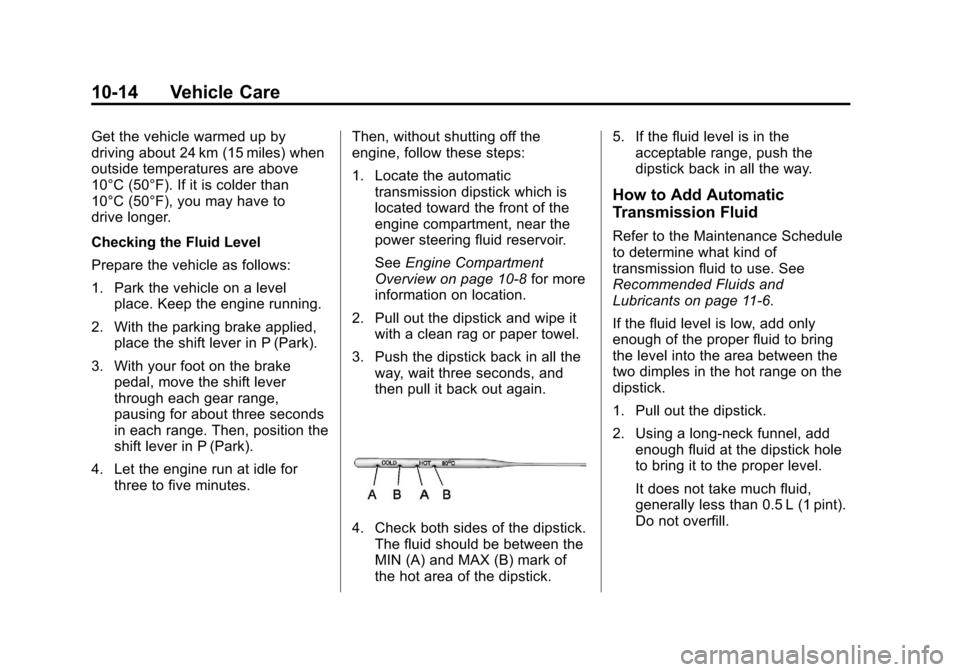
4. Check both sides of the dipstick.The fluid should be between the
MIN (A) and MAX (B) mark of
the hot area of the dipstick. 5. If the fluid level is in the
acceptable range, push the
dipstick back in all the way.
How to Add Automatic
Transmission Fluid
Refer to the Maintenance Schedule
to determine what kind of
transmission fluid to use. See
Recommended Fluids and
Lubricants on page 11‑6.
If the fluid level is low, add only
enough of the proper fluid to bring
the level into the area between the
two dimples in the hot range on the
dipstick.
1. Pull out the dipstick.
2. Using a long-neck funnel, add
enough fluid at the dipstick hole
to bring it to the proper level.
It does not take much fluid,
generally less than 0.5 L (1 pint).
Do not overfill.
Page 217 of 328
Black plate (15,1)Chevrolet Aveo Owner Manual - 2011
Vehicle Care 10-15
Notice:Use of the incorrect
automatic transmission fluid may
damage the vehicle, and the
damages may not be covered by
the vehicle warranty. Always use
the automatic transmission fluid
listed in Recommended Fluids
and Lubricants on page 11‑6.
3. After adding fluid, recheck the fluid level as described under
“How to Check Automatic
Transmission Fluid” earlier in
this section.
4. When the correct fluid level is obtained, push the dipstick back
in all the way.
Manual Transmission
Fluid
It is not necessary to check the
manual transmission fluid level.
A transmission fluid leak is the
only reason for fluid loss. If a leak
occurs, take the vehicle to the
dealer service department and have
it repaired as soon as possible. See Recommended Fluids and
Lubricants on page 11‑6
for the
proper fluid to use.
Hydraulic Clutch
There is one reservoir for both the
brake and the hydraulic clutch fluid.
See Brakes on page 10‑24 for more
information.
The hydraulic clutch linkage in the
vehicle is self-adjusting. The master
cylinder reservoir is filled with
hydraulic fluid.
A fluid loss in this system could
indicate a problem. Have the
system inspected and repaired.
When to Check and What
to Use
Refer to the Maintenance Schedule
to determine how often to check the
fluid level in the master cylinder
reservoir and for the proper fluid.
See Scheduled Maintenance on
page 11‑2 andRecommended
Fluids and Lubricants on page 11‑6.
How to Check and Add Fluid
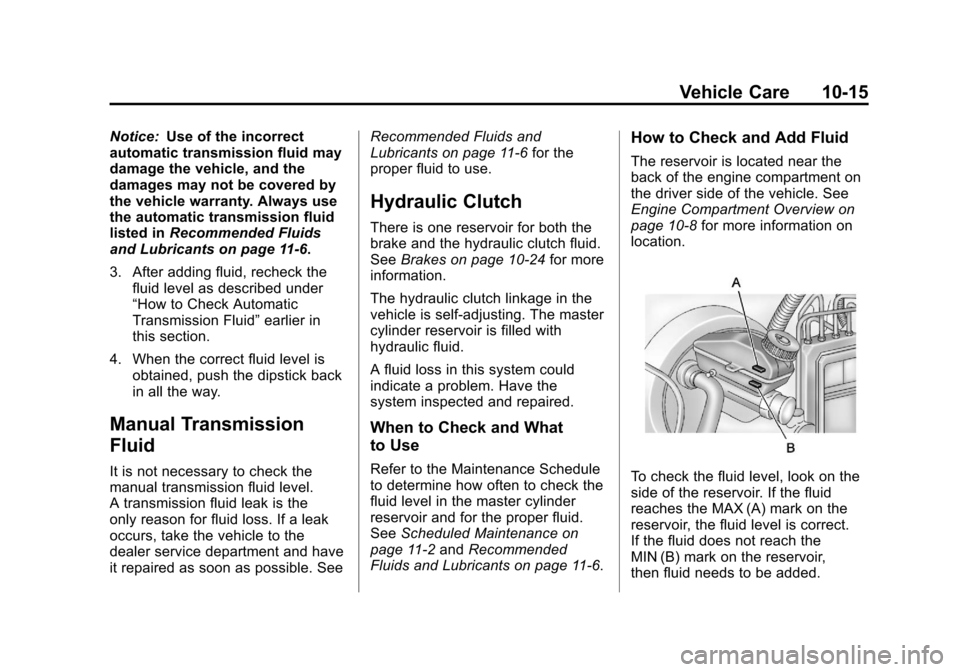
The reservoir is located near the
back of the engine compartment on
the driver side of the vehicle. See
Engine Compartment Overview on
page 10‑8 for more information on
location.
To check the fluid level, look on the
side of the reservoir. If the fluid
reaches the MAX (A) mark on the
reservoir, the fluid level is correct.
If the fluid does not reach the
MIN (B) mark on the reservoir,
then fluid needs to be added.
Page 218 of 328
Black plate (16,1)Chevrolet Aveo Owner Manual - 2011
10-16 Vehicle Care
Engine Air Cleaner/Filter
The engine air cleaner/filter is
located in the engine compartment
on the passenger side of the
vehicle. SeeEngine Compartment
Overview on page 10‑8 for more
information on location.
When to Inspect the Engine
Air Cleaner/Filter
Inspect the air cleaner/filter at the
scheduled maintenance intervals
and replace it at the first oil change
after each 80 000 km (50,000 mi)
interval. See Scheduled
Maintenance on page 11‑2 for more
information. If you are driving in
dusty/dirty conditions, inspect the
filter at each engine oil change.
How to Inspect the Engine
Air Cleaner/Filter
To inspect the engine air cleaner/
filter, remove the filter from the
vehicle and lightly shake the filter to release loose dust and dirt. If the
filter remains covered with dirt, a
new filter is required.
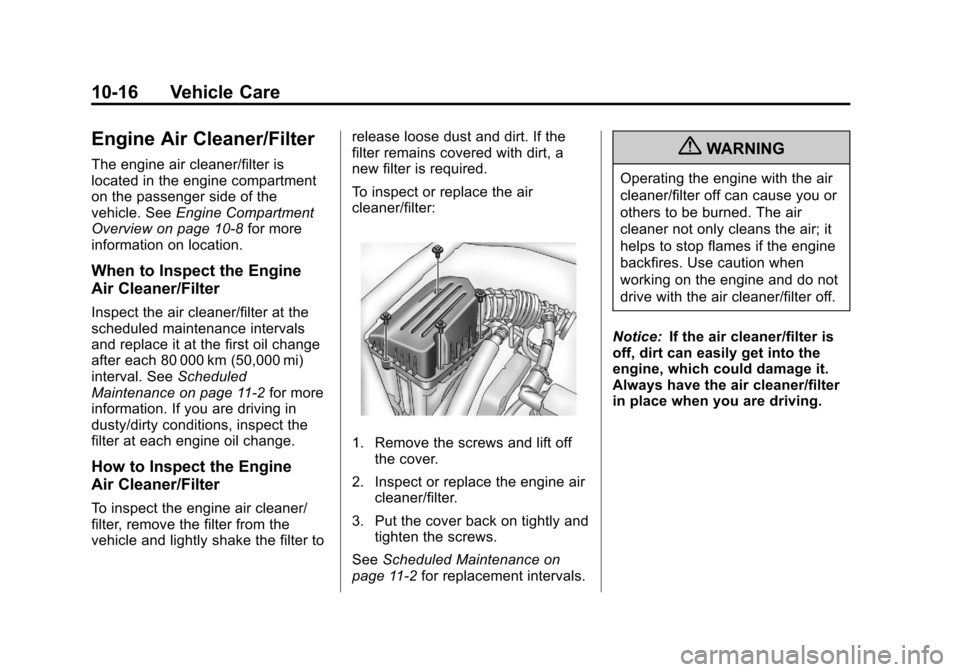
To inspect or replace the air
cleaner/filter:
1. Remove the screws and lift off
the cover.
2. Inspect or replace the engine air cleaner/filter.
3. Put the cover back on tightly and tighten the screws.
See Scheduled Maintenance on
page 11‑2 for replacement intervals.
{WARNING
Operating the engine with the air
cleaner/filter off can cause you or
others to be burned. The air
cleaner not only cleans the air; it
helps to stop flames if the engine
backfires. Use caution when
working on the engine and do not
drive with the air cleaner/filter off.
Notice: If the air cleaner/filter is
off, dirt can easily get into the
engine, which could damage it.
Always have the air cleaner/filter
in place when you are driving.
Page 219 of 328

Black plate (17,1)Chevrolet Aveo Owner Manual - 2011
Vehicle Care 10-17
Cooling System
The cooling system allows the
engine to maintain the correct
working temperature.
A. Electric Engine Cooling Fan(Out of View)
B. Coolant Surge Tank with Pressure Cap
{WARNING
An electric engine cooling fan
under the hood can start up even
when the engine is not running
and can cause injury. Keep
hands, clothing, and tools away
from any underhood electric fan.
{WARNING
Heater and radiator hoses, and
other engine parts, can be very
hot. Do not touch them. If you do,
you can be burned.
Do not run the engine if there is a
leak. If you run the engine, it
could lose all coolant. That could
cause an engine fire, and you
could be burned. Get any leak
fixed before you drive the vehicle. Notice:
Using coolant other than
DEX‐COOL
®can cause premature
engine, heater core, or radiator
corrosion. In addition, the engine
coolant may require changing
sooner, at the first maintenance
service after each 30,000 miles
(50 000 km) or 24 months,
whichever occurs first. Any
repairs would not be covered by
the vehicle warranty. Always use
DEX‐COOL
®(silicate‐free) coolant
in the vehicle.
Page 220 of 328

Black plate (18,1)Chevrolet Aveo Owner Manual - 2011
10-18 Vehicle Care
Engine Coolant
The cooling system in the vehicle
is filled with DEX-COOL®engine
coolant. This coolant is designed to
remain in the vehicle for 5 years or
240 000 km (150,000 mi), whichever
occurs first.
The following explains the cooling
system and how to check and add
coolant when it is low. If there is a
problem with engine overheating,
see Engine Overheating on
page 10‑21.
What to Use
{WARNING
Adding only plain water or some
other liquid to the cooling system
can be dangerous. Plain water
and other liquids, can boil before
the proper coolant mixture will.
The coolant warning system is
set for the proper coolant mixture.
With plain water or the wrong
mixture, the engine could get too
hot but you would not get the
overheat warning. The engine
could catch fire and you or
others could be burned. Use a
50/50 mixture of clean, drinkable
water and DEX-COOL coolant. Use a 50/50 mixture of clean,
drinkable water and DEX-COOL
coolant. If using this mixture,
nothing else needs to be added.
This mixture:.Gives freezing protection down
to
−37°C (−34°F), outside
temperature.
.Gives boiling protection up to
129°C (265°F), engine
temperature.
.Protects against rust and
corrosion.
.Will not damage aluminum parts.
.Helps keep the proper engine
temperature.
Notice: If an improper coolant
mixture is used, the engine could
overheat and be badly damaged.
The repair cost would not be
covered by the vehicle warranty.
Too much water in the mixture
can freeze and crack the engine,
radiator, heater core, and other
parts.
Page 221 of 328

Black plate (19,1)Chevrolet Aveo Owner Manual - 2011
Vehicle Care 10-19
Notice:If extra inhibitors and/or
additives are used in the vehicle
cooling system, the vehicle
could be damaged. Use only the
proper mixture of the engine
coolant listed in this manual for
the cooling system. See
Recommended Fluids and
Lubricants on page 11‑6 for
more information.
Checking Coolant
The vehicle must be on a level
surface when checking the coolant
level.
Check to see if coolant is visible in
the coolant surge tank. If the coolant
inside the coolant surge tank is
boiling, do not do anything else until
it cools down. If coolant is visible
but the coolant level is not between
the Minimum and Maximum marks,
add a 50/50 mixture of clean,
drinkable water and DEX-COOL
coolant at the coolant surge tank, but be sure the cooling system is
cool before this is done. See
Engine
Coolant on page 10‑18 for more
information.
The engine coolant surge tank is
located in the rear of the engine
compartment on the driver side
of the vehicle. See Engine
Compartment Overview on
page 10‑8 for more information on
location.
{WARNING
Turning the surge tank pressure
cap when the engine and radiator
are hot can allow steam and
scalding liquids to blow out and
burn you badly. Never turn the
surge tank pressure cap —even a
little —when the engine and
radiator are hot.
When the engine is cold, the coolant
level should be between the
Maximum (A) and Minimum (B)
marks on the coolant surge tank.
The level rises at engine operation
temperature and drops again when
the engine cools down.
The coolant should be between the
Maximum (A) and Minimum (B)
marks, when the engine is cold. If it
is not, there could be a leak in the
cooling system.
Page 222 of 328
Black plate (20,1)Chevrolet Aveo Owner Manual - 2011
10-20 Vehicle Care
How to Add Coolant to the
Coolant Surge Tank
{WARNING
You can be burned if you spill
coolant on hot engine parts.
Coolant contains ethylene glycol
and it will burn if the engine parts
are hot enough. Do not spill
coolant on a hot engine.
Notice: This vehicle has a
specific coolant fill procedure.
Failure to follow this procedure
could cause the engine to
overheat and be severely
damaged.
{WARNING
An electric engine cooling fan
under the hood can start up even
when the engine is not running
and can cause injury. Keep
hands, clothing, and tools away
from any underhood electric fan.
{WARNING
Steam and scalding liquids from a
hot cooling system can blow out
and burn you badly. They are
under pressure, and if you turn
the surge tank pressure
cap —even a little —they can
come out at high speed. Never
turn the cap when the cooling
system, including the surge tank
pressure cap, is hot. Wait for the
cooling system and surge tank
pressure cap to cool if you ever
have to turn the pressure cap.
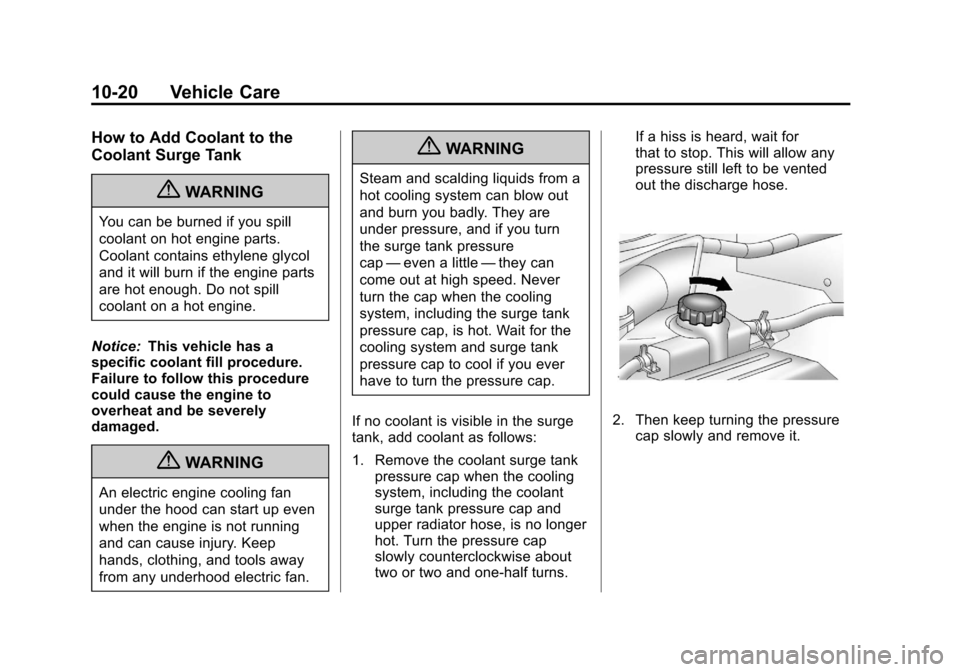
If no coolant is visible in the surge
tank, add coolant as follows:
1. Remove the coolant surge tank pressure cap when the cooling
system, including the coolant
surge tank pressure cap and
upper radiator hose, is no longer
hot. Turn the pressure cap
slowly counterclockwise about
two or two and one-half turns. If a hiss is heard, wait for
that to stop. This will allow any
pressure still left to be vented
out the discharge hose.
2. Then keep turning the pressure
cap slowly and remove it.