2011 CHEVROLET AVEO tire size
[x] Cancel search: tire sizePage 29 of 328
Black plate (23,1)Chevrolet Aveo Owner Manual - 2011
In Brief 1-23
.Always follow posted speed
limits or drive more slowly when
conditions require.
.Keep vehicle tires properly
inflated.
.Combine several trips into a
single trip.
.Replace the vehicle's tires with
the same TPC Spec number
molded into the tire's sidewall
near the size.
.Follow recommended scheduled
maintenance.
Roadside Assistance
Program
U.S.:1-800-243-8872
TTY Users: 1-888-889-2438
Canada: 1-800-268-6800
As the owner of a new Chevrolet,
you are automatically enrolled in the
Roadside Assistance program.
See Roadside Assistance Program
on page 13‑6 for more information.
Roadside Assistance and OnStar
If you have an active OnStar
subscription, press the
Qbutton
and the current GPS location will be
sent to an OnStar advisor who will
assess your problem, contact
Roadside Assistance, and relay
your exact location to get the help
you need. Online Owner Center
The Online Owner Center is a
complimentary service that includes
online service reminders, vehicle
maintenance tips, online owner
manual, special privileges,
and more.
Sign up today at:
www.chevyownercenter.com
(U.S.) or
www.gm.ca (Canada).
Page 175 of 328
Black plate (13,1)Chevrolet Aveo Owner Manual - 2011
Driving and Operating 9-13
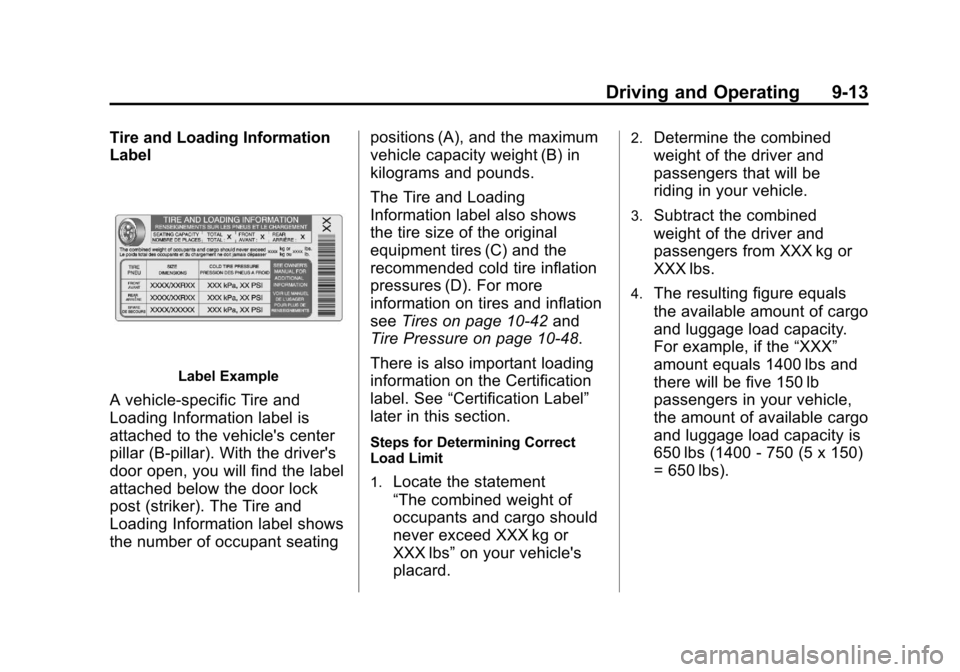
Tire and Loading Information
Label
Label Example
A vehicle-specific Tire and
Loading Information label is
attached to the vehicle's center
pillar (B‐pillar). With the driver's
door open, you will find the label
attached below the door lock
post (striker). The Tire and
Loading Information label shows
the number of occupant seatingpositions (A), and the maximum
vehicle capacity weight (B) in
kilograms and pounds.
The Tire and Loading
Information label also shows
the tire size of the original
equipment tires (C) and the
recommended cold tire inflation
pressures (D). For more
information on tires and inflation
see
Tires on page 10‑42 and
Tire Pressure on page 10‑48.
There is also important loading
information on the Certification
label. See “Certification Label”
later in this section.
Steps for Determining Correct
Load Limit
1.
Locate the statement
“The combined weight of
occupants and cargo should
never exceed XXX kg or
XXX lbs” on your vehicle's
placard.
2.Determine the combined
weight of the driver and
passengers that will be
riding in your vehicle.
3.Subtract the combined
weight of the driver and
passengers from XXX kg or
XXX lbs.
4.The resulting figure equals
the available amount of cargo
and luggage load capacity.
For example, if the “XXX”
amount equals 1400 lbs and
there will be five 150 lb
passengers in your vehicle,
the amount of available cargo
and luggage load capacity is
650 lbs (1400 ‐750 (5 x 150)
= 650 lbs).
Page 204 of 328

Black plate (2,1)Chevrolet Aveo Owner Manual - 2011
10-2 Vehicle Care
Tire Pressure MonitorSystem . . . . . . . . . . . . . . . . . . . 10-50
Tire Pressure Monitor Operation . . . . . . . . . . . . . . . . . 10-51
Tire Inspection . . . . . . . . . . . . . . 10-53
Tire Rotation . . . . . . . . . . . . . . . 10-54
When It Is Time for New
Tires . . . . . . . . . . . . . . . . . . . . . . 10-55
Buying New Tires . . . . . . . . . . . 10-56
Different Size Tires and Wheels . . . . . . . . . . . . . . . . . . . 10-57
Uniform Tire Quality Grading . . . . . . . . . . . . . . . . . . . 10-57
Wheel Alignment and Tire Balance . . . . . . . . . . . . . . . . . . . 10-59
Wheel Replacement . . . . . . . . 10-60
Tire Chains . . . . . . . . . . . . . . . . . 10-61
If a Tire Goes Flat . . . . . . . . . . 10-61
Tire Changing . . . . . . . . . . . . . . 10-64
Compact Spare Tire . . . . . . . . 10-69Jump Starting
Jump Starting . . . . . . . . . . . . . . 10-70
Towing
Towing the Vehicle . . . . . . . . . 10-74
Recreational Vehicle Towing . . . . . . . . . . . . . . . . . . . . 10-74
Appearance Care
Exterior Care . . . . . . . . . . . . . . . 10-76
Interior Care . . . . . . . . . . . . . . . . 10-80
Floor Mats . . . . . . . . . . . . . . . . . . 10-83
Page 245 of 328
Black plate (43,1)Chevrolet Aveo Owner Manual - 2011
Vehicle Care 10-43
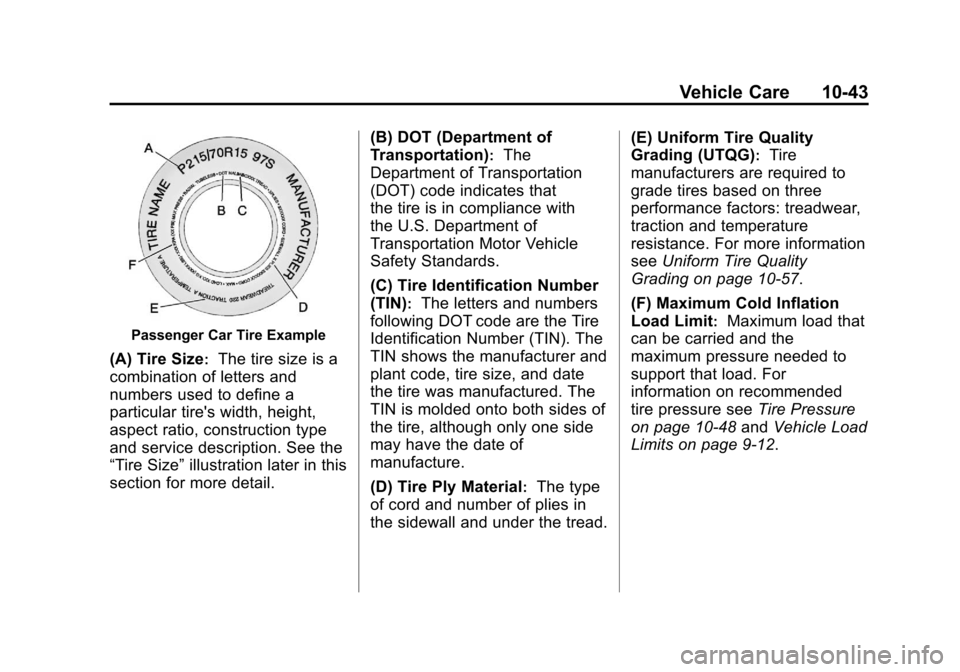
Passenger Car Tire Example
(A) Tire Size:The tire size is a
combination of letters and
numbers used to define a
particular tire's width, height,
aspect ratio, construction type
and service description. See the
“Tire Size” illustration later in this
section for more detail. (B) DOT (Department of
Transportation)
:The
Department of Transportation
(DOT) code indicates that
the tire is in compliance with
the U.S. Department of
Transportation Motor Vehicle
Safety Standards.
(C) Tire Identification Number
(TIN)
:The letters and numbers
following DOT code are the Tire
Identification Number (TIN). The
TIN shows the manufacturer and
plant code, tire size, and date
the tire was manufactured. The
TIN is molded onto both sides of
the tire, although only one side
may have the date of
manufacture.
(D) Tire Ply Material
:The type
of cord and number of plies in
the sidewall and under the tread. (E) Uniform Tire Quality
Grading (UTQG)
:Tire
manufacturers are required to
grade tires based on three
performance factors: treadwear,
traction and temperature
resistance. For more information
see Uniform Tire Quality
Grading on page 10‑57.
(F) Maximum Cold Inflation
Load Limit
:Maximum load that
can be carried and the
maximum pressure needed to
support that load. For
information on recommended
tire pressure see Tire Pressure
on page 10‑48 andVehicle Load
Limits on page 9‑12.
Page 246 of 328
Black plate (44,1)Chevrolet Aveo Owner Manual - 2011
10-44 Vehicle Care
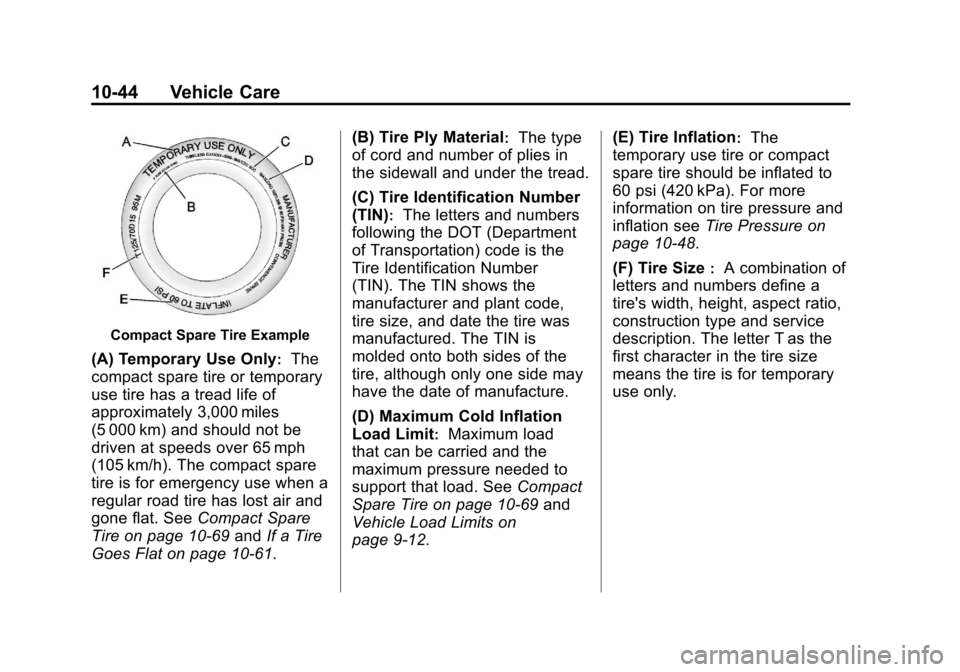
Compact Spare Tire Example
(A) Temporary Use Only:The
compact spare tire or temporary
use tire has a tread life of
approximately 3,000 miles
(5 000 km) and should not be
driven at speeds over 65 mph
(105 km/h). The compact spare
tire is for emergency use when a
regular road tire has lost air and
gone flat. See Compact Spare
Tire on page 10‑69 andIf a Tire
Goes Flat on page 10‑61. (B) Tire Ply Material
:The type
of cord and number of plies in
the sidewall and under the tread.
(C) Tire Identification Number
(TIN)
:The letters and numbers
following the DOT (Department
of Transportation) code is the
Tire Identification Number
(TIN). The TIN shows the
manufacturer and plant code,
tire size, and date the tire was
manufactured. The TIN is
molded onto both sides of the
tire, although only one side may
have the date of manufacture.
(D) Maximum Cold Inflation
Load Limit
:Maximum load
that can be carried and the
maximum pressure needed to
support that load. See Compact
Spare Tire on page 10‑69 and
Vehicle Load Limits on
page 9‑12. (E) Tire Inflation
:The
temporary use tire or compact
spare tire should be inflated to
60 psi (420 kPa). For more
information on tire pressure and
inflation see Tire Pressure on
page 10‑48.
(F) Tire Size
:A combination of
letters and numbers define a
tire's width, height, aspect ratio,
construction type and service
description. The letter T as the
first character in the tire size
means the tire is for temporary
use only.
Page 247 of 328
Black plate (45,1)Chevrolet Aveo Owner Manual - 2011
Vehicle Care 10-45
Tire Designations
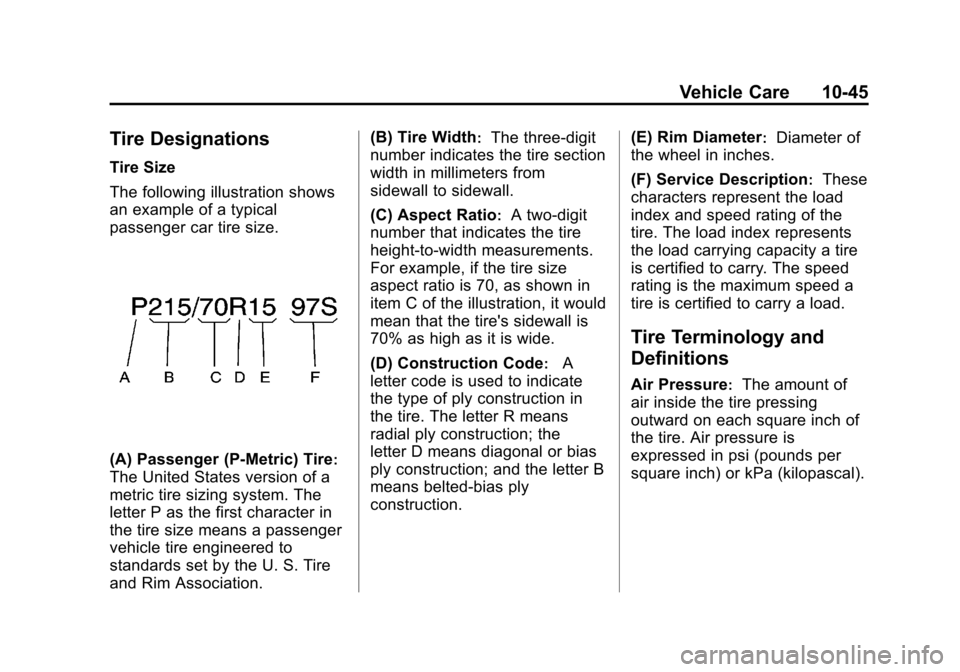
Tire Size
The following illustration shows
an example of a typical
passenger car tire size.
(A) Passenger (P‐Metric) Tire:
The United States version of a
metric tire sizing system. The
letter P as the first character in
the tire size means a passenger
vehicle tire engineered to
standards set by the U. S. Tire
and Rim Association.(B) Tire Width
:The three‐digit
number indicates the tire section
width in millimeters from
sidewall to sidewall.
(C) Aspect Ratio
:A two‐digit
number that indicates the tire
height‐to‐width measurements.
For example, if the tire size
aspect ratio is 70, as shown in
item C of the illustration, it would
mean that the tire's sidewall is
70% as high as it is wide.
(D) Construction Code
:A
letter code is used to indicate
the type of ply construction in
the tire. The letter R means
radial ply construction; the
letter D means diagonal or bias
ply construction; and the letter B
means belted‐bias ply
construction. (E) Rim Diameter
:Diameter of
the wheel in inches.
(F) Service Description
:These
characters represent the load
index and speed rating of the
tire. The load index represents
the load carrying capacity a tire
is certified to carry. The speed
rating is the maximum speed a
tire is certified to carry a load.
Tire Terminology and
Definitions
Air Pressure:The amount of
air inside the tire pressing
outward on each square inch of
the tire. Air pressure is
expressed in psi (pounds per
square inch) or kPa (kilopascal).
Page 250 of 328
Black plate (48,1)Chevrolet Aveo Owner Manual - 2011
10-48 Vehicle Care
Traction:The friction between
the tire and the road surface.
The amount of grip provided.
Tread
:The portion of a tire that
comes into contact with
the road.
Treadwear Indicators
:Narrow
bands, sometimes called wear
bars, that show across the tread
of a tire when only 1.6 mm
(1/16 in) of tread remains. See
When It Is Time for New Tires
on page 10‑55.
UTQGS (Uniform Tire Quality
Grading Standards)
:A tire
information system that
provides consumers with
ratings for a tire's traction,
temperature, and treadwear.
Ratings are determined by
tire manufacturers using
government testing procedures. The ratings are molded into the
sidewall of the tire. See
Uniform
Tire Quality Grading on
page 10‑57.
Vehicle Capacity Weight
:
The number of designated
seating positions multiplied by
68 kg (150 lbs) plus the rated
cargo load. See Vehicle Load
Limits on page 9‑12.
Vehicle Maximum Load on the
Tire
:Load on an individual tire
due to curb weight, accessory
weight, occupant weight, and
cargo weight.
Vehicle Placard
:A label
permanently attached to a
vehicle showing the vehicle
capacity weight and the
original equipment tire size
and recommended inflation
pressure. See “Tire and Loading
Information Label” underVehicle
Load Limits on page 9‑12.
Tire Pressure
Tires need the correct amount
of air pressure to operate
effectively.
Notice: Neither tire
underinflation or overinflation
are good. Underinflated tires,
or tires that do not have
enough air, can result in:
.Tire overloading and
over-heating which could
lead to a blowout.
.Premature or
irregular wear.
.Poor handling.
.Reduced fuel economy.
Page 252 of 328
Black plate (50,1)Chevrolet Aveo Owner Manual - 2011
10-50 Vehicle Care
Remove the valve cap from the
tire valve stem. Press the tire
gauge firmly onto the valve to
get a pressure measurement.
If the cold tire inflation pressure
matches the recommended
pressure on the Tire and
Loading Information label, no
further adjustment is necessary.
If the inflation pressure is low,
add air until you reach the
recommended amount.
If you overfill the tire, release
air by pushing on the metal stem
in the center of the tire valve.
Re‐check the tire pressure with
the tire gauge.
Be sure to put the valve caps
back on the valve stems. They
help prevent leaks by keeping
out dirt and moisture.Tire Pressure Monitor
System
The Tire Pressure Monitor System
(TPMS) uses radio and sensor
technology to check tire pressure
levels. The TPMS sensors monitor
the air pressure in your tires and
transmit tire pressure readings to a
receiver located in the vehicle.
Each tire, including the spare
(if provided), should be checked
monthly when cold and inflated to
the inflation pressure recommended
by the vehicle manufacturer on the
vehicle placard or tire inflation
pressure label. (If your vehicle has
tires of a different size than the size
indicated on the vehicle placard or
tire inflation pressure label, you
should determine the proper tire
inflation pressure for those tires.)
As an added safety feature, your
vehicle has been equipped with a
tire pressure monitoring system
(TPMS) that illuminates a low tirepressure telltale when one or
more of your tires is significantly
under‐inflated.
Accordingly, when the low tire
pressure telltale illuminates, you
should stop and check your tires as
soon as possible, and inflate them
to the proper pressure. Driving on
a significantly under‐inflated tire
causes the tire to overheat and can
lead to tire failure. Under‐inflation
also reduces fuel efficiency and tire
tread life, and may affect the
vehicle's handling and stopping
ability.
Please note that the TPMS is
not a substitute for proper tire
maintenance, and it is the driver's
responsibility to maintain correct tire
pressure, even if under‐inflation has
not reached the level to trigger
illumination of the TPMS low tire
pressure telltale.
Your vehicle has also been
equipped with a TPMS malfunction
indicator to indicate when the
system is not operating properly.