2011 CHEVROLET AVEO engine
[x] Cancel search: enginePage 187 of 328
Black plate (25,1)Chevrolet Aveo Owner Manual - 2011
Driving and Operating 9-25
Running the Vehicle
While Parked
It is better not to park with the
engine running. But if you ever have
to, here are some things to know.
{WARNING
Idling a vehicle in an enclosed
area with poor ventilation is
dangerous. Engine exhaust may
enter the vehicle. Engine exhaust
contains Carbon Monoxide (CO)
which cannot be seen or smelled.
It can cause unconsciousness
and even death. Never run the
engine in an enclosed area that
has no fresh air ventilation. For
more information, seeEngine
Exhaust on page 9‑24.
{WARNING
It can be dangerous to get out of
the vehicle if the automatic
transmission shift lever is not fully
in P (Park) with the parking brake
firmly set. The vehicle can roll. Do
not leave the vehicle when the
engine is running unless you
have to. If you have left the
engine running, the vehicle can
move suddenly. You or others
could be injured. To be sure the
vehicle will not move, even when
it is on fairly level ground, always
set the parking brake and move
the automatic transmission shift
lever to P (Park), or the manual
transmission shift lever to Neutral.
Follow the proper steps to be sure
the vehicle will not move. If the
vehicle has an automatic
transmission, see Shifting Into Park
(Automatic Transmission) on
page 9‑21.
Automatic
Transmission
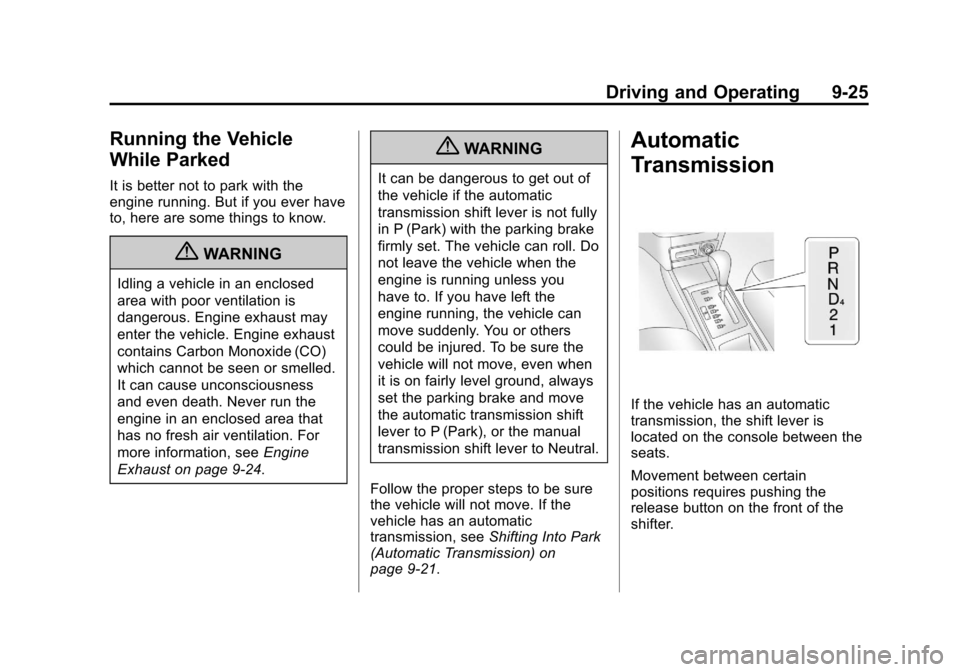
If the vehicle has an automatic
transmission, the shift lever is
located on the console between the
seats.
Movement between certain
positions requires pushing the
release button on the front of the
shifter.
Page 188 of 328
Black plate (26,1)Chevrolet Aveo Owner Manual - 2011
9-26 Driving and Operating
P (Park):This position locks the
front wheels. It is the best position
to use when you start the engine
because the vehicle cannot move
easily.
{WARNING
It is dangerous to get out of the
vehicle if the shift lever is not fully
in P (Park) with the parking brake
firmly set. The vehicle can roll.
Do not leave the vehicle when the
engine is running unless you
have to. If you have left the
engine running, the vehicle can
move suddenly. You or others
could be injured. To be sure the
vehicle will not move, even when
you are on fairly level ground,
always set the parking brake and
move the shift lever to P (Park).
See Shifting Into Park (Automatic
Transmission) on page 9‑21. Ensure that the shift lever is fully in
P (Park) before starting the engine.
The vehicle has an automatic
transmission shift lock control
system. You have to apply the brake
pedal before you can shift from
P (Park) when the key is in ON/
RUN. If you cannot shift out of
P (Park) while holding the brake
pedal down, see
Shifting Out of
Park on page 9‑23.
R (Reverse): Use this gear to
back up.
When shifting from N (Neutral) to
R (Reverse), you need to apply the
brake pedal and push the release
button on the front of the shifter.
Notice: Shifting to R (Reverse)
while the vehicle is moving
forward could damage the
transmission. The repairs would
not be covered by the vehicle
warranty. Shift to R (Reverse) only
after the vehicle is stopped. To rock the vehicle back and forth to
get out of snow, ice or sand without
damaging the transmission, see
If
the Vehicle is Stuck on page 9‑11.
N (Neutral): In this position, the
engine does not connect with the
wheels. To restart the engine while
the vehicle is already moving,
use N (Neutral) only. Also, use
N (Neutral) when the vehicle is
being towed.
{WARNING
Shifting into a drive gear while the
engine is running at high speed is
dangerous. Unless your foot is
firmly on the brake pedal, the
vehicle could move very rapidly.
You could lose control and hit
people or objects. Do not shift
into a drive gear while the engine
is running at high speed.
Page 189 of 328
Black plate (27,1)Chevrolet Aveo Owner Manual - 2011
Driving and Operating 9-27
Notice:Shifting out of P (Park)
or N (Neutral) with the engine
running at high speed may
damage the transmission. The
repairs would not be covered by
the vehicle warranty. Be sure the
engine is not running at high
speed when shifting the vehicle.
D4 (Automatic Overdrive): This
position is for normal driving.
When operating the vehicle in
severe cold conditions, the
transmission may be prevented
from shifting into D4 gear until the
transmission fluid has warmed up to
its operational temperature.
Notice: If the vehicle seems to
start up rather slowly or not shift
gears when you go faster, and
you continue to drive the vehicle
that way, you could damage the
transmission. Have the vehicle
serviced right away. You can
drive in 2 (Second) when you are
driving less than 55 km/h (35 mph)
and D4 (Automatic Overdrive) for
higher speeds until then. 2 (Second):
This position gives you
more power but lower fuel economy.
You can use 2 (Second) on hills.
It can help control vehicle speed as
you go down steep mountain roads,
while using the brakes off and on.
Notice: Do not drive in
2 (Second) at speeds over
105 km/h (65 mph), or you can
damage the transmission. Use
D4 (Automatic Overdrive) as
much as possible. Do not shift
into 2 (Second) unless you are
going slower than 105 km/h
(65 mph) or you can damage the
engine.
1 (First): This position gives you
even more power but lower fuel
economy than 2 (Second). You can
use it on very steep hills, or in deep
snow or mud. If the shift lever is put
in 1 (First), the transmission will not
shift into first gear until the vehicle is
going slowly enough. Notice:
Spinning the tires
or holding the vehicle in one
place on a hill using only the
accelerator pedal may damage
the transmission. The repair will
not be covered by the vehicle
warranty. If you are stuck, do not
spin the tires. When stopping on
a hill, use the brakes to hold the
vehicle in place.
If there is a malfunction with
the automatic transmission, the
malfunction indicator lamp or the
HOLD indicator light will turn on or
flash. See Malfunction Indicator
Lamp on page 5‑14.
Have the vehicle fixed as soon as
possible.
Page 190 of 328
Black plate (28,1)Chevrolet Aveo Owner Manual - 2011
9-28 Driving and Operating
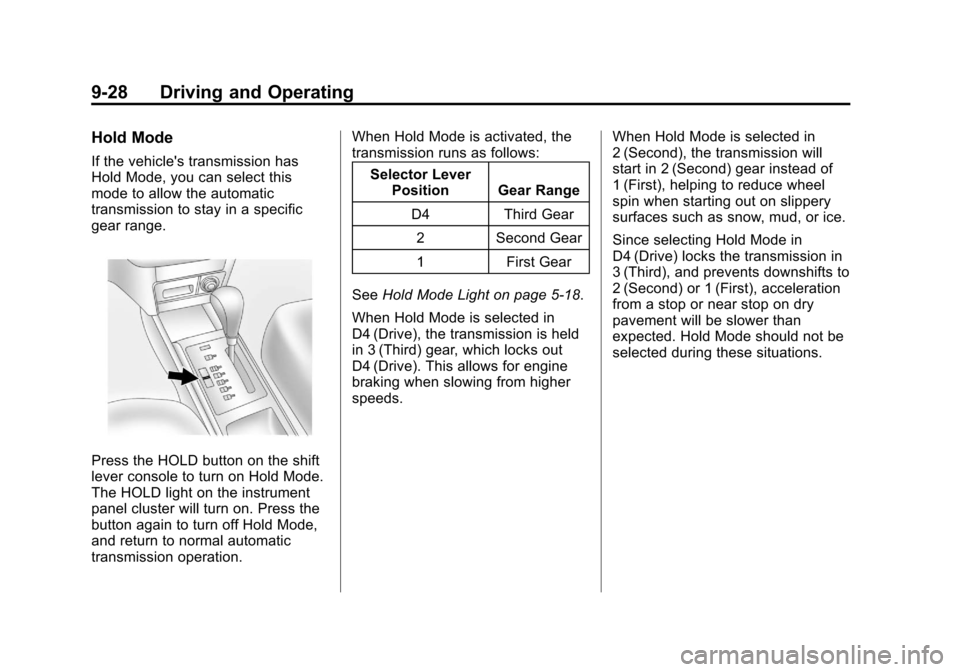
Hold Mode
If the vehicle's transmission has
Hold Mode, you can select this
mode to allow the automatic
transmission to stay in a specific
gear range.
Press the HOLD button on the shift
lever console to turn on Hold Mode.
The HOLD light on the instrument
panel cluster will turn on. Press the
button again to turn off Hold Mode,
and return to normal automatic
transmission operation.When Hold Mode is activated, the
transmission runs as follows:
Selector Lever Position Gear Range
D4 Third Gear2 Second Gear
1 First Gear
See Hold Mode Light on page 5‑18.
When Hold Mode is selected in
D4 (Drive), the transmission is held
in 3 (Third) gear, which locks out
D4 (Drive). This allows for engine
braking when slowing from higher
speeds. When Hold Mode is selected in
2 (Second), the transmission will
start in 2 (Second) gear instead of
1 (First), helping to reduce wheel
spin when starting out on slippery
surfaces such as snow, mud, or ice.
Since selecting Hold Mode in
D4 (Drive) locks the transmission in
3 (Third), and prevents downshifts to
2 (Second) or 1 (First), acceleration
from a stop or near stop on dry
pavement will be slower than
expected. Hold Mode should not be
selected during these situations.
Page 191 of 328
Black plate (29,1)Chevrolet Aveo Owner Manual - 2011
Driving and Operating 9-29
Manual Transmission
Five-Speed
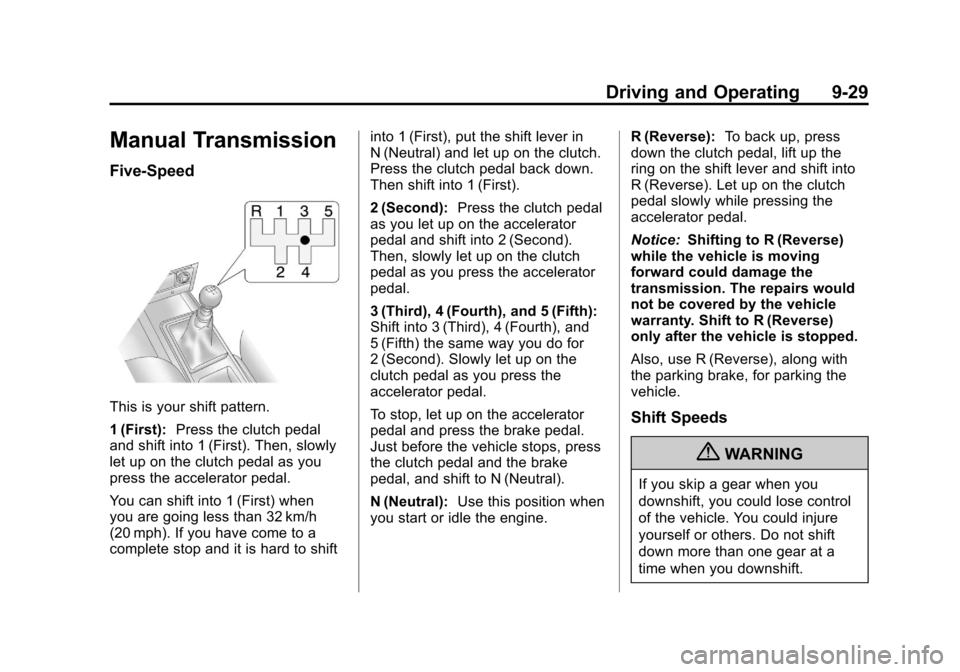
This is your shift pattern.
1 (First):Press the clutch pedal
and shift into 1 (First). Then, slowly
let up on the clutch pedal as you
press the accelerator pedal.
You can shift into 1 (First) when
you are going less than 32 km/h
(20 mph). If you have come to a
complete stop and it is hard to shift into 1 (First), put the shift lever in
N (Neutral) and let up on the clutch.
Press the clutch pedal back down.
Then shift into 1 (First).
2 (Second):
Press the clutch pedal
as you let up on the accelerator
pedal and shift into 2 (Second).
Then, slowly let up on the clutch
pedal as you press the accelerator
pedal.
3 (Third), 4 (Fourth), and 5 (Fifth):
Shift into 3 (Third), 4 (Fourth), and
5 (Fifth) the same way you do for
2 (Second). Slowly let up on the
clutch pedal as you press the
accelerator pedal.
To stop, let up on the accelerator
pedal and press the brake pedal.
Just before the vehicle stops, press
the clutch pedal and the brake
pedal, and shift to N (Neutral).
N (Neutral): Use this position when
you start or idle the engine. R (Reverse):
To back up, press
down the clutch pedal, lift up the
ring on the shift lever and shift into
R (Reverse). Let up on the clutch
pedal slowly while pressing the
accelerator pedal.
Notice: Shifting to R (Reverse)
while the vehicle is moving
forward could damage the
transmission. The repairs would
not be covered by the vehicle
warranty. Shift to R (Reverse)
only after the vehicle is stopped.
Also, use R (Reverse), along with
the parking brake, for parking the
vehicle.Shift Speeds
{WARNING
If you skip a gear when you
downshift, you could lose control
of the vehicle. You could injure
yourself or others. Do not shift
down more than one gear at a
time when you downshift.
Page 196 of 328
Black plate (34,1)Chevrolet Aveo Owner Manual - 2011
9-34 Driving and Operating
Reducing Speed While Using
Cruise Control
If the cruise control system is
already activated,
.Press the SET−button until the
lower speed desired is reached,
then release it.
.To slow down in small amounts,
briefly press the SET− button.
Each time this is done, the
vehicle goes about 1.6 km/h
(1 mph) slower.
Passing Another Vehicle While
Using Cruise Control
Use the accelerator pedal to
increase the vehicle speed. When
you take your foot off the pedal,
the vehicle will slow down to the
previous set cruise speed.
Using Cruise Control on Hills
How well the cruise control works
on hills depends upon the vehicle
speed, load, and the steepness of
the hills. When going up steep hills, you might have to step on the
accelerator pedal to maintain
the vehicle speed. When going
downhill, you might have to brake
or shift to a lower gear to keep the
vehicle speed down. When the
brakes are applied the cruise control
turns off.
Ending Cruise Control
There are two ways to end cruise
control:
.Step lightly on the brake pedal,
or press the clutch pedal, if you
have a manual transmission.
.PressI/Oon the cruise
control pad.
Erasing Speed Memory
The cruise control set speed is
erased from memory by pressing
the
I/Obutton or if the ignition is
turned off.
Fuel
Use of the recommended fuel
is an important part of the proper
maintenance of this vehicle. To help
keep the engine clean and maintain
optimum vehicle performance, we
recommend the use of gasoline
advertised as TOP TIER Detergent
Gasoline.
Look for the TOP TIER label on the
fuel pump to ensure gasoline meets
enhanced detergency standards
developed by auto companies. A list
of marketers providing TOP TIER
Detergent Gasoline can be found at
www.toptiergas.com.
Page 197 of 328
Black plate (35,1)Chevrolet Aveo Owner Manual - 2011
Driving and Operating 9-35
Recommended Fuel
Use regular unleaded gasoline with
a posted octane rating of 87 or
higher. If the octane rating is less
than 87, an audible knocking noise,
commonly referred to as spark
knock, might be heard when driving.If this occurs, use a gasoline rated
at 87 octane or higher as soon as
possible. If heavy knocking is
heard when using gasoline rated
at 87 octane or higher, the engine
needs service.
Gasoline Specifications
(U.S. and Canada Only)
At a minimum, gasoline
should meet ASTM specification
D 4814 in the United States or
CAN/CGSB‐3.5 or 3.511 in Canada.
Some gasolines contain an
octane-enhancing additive called
methylcyclopentadienyl manganese
tricarbonyl (MMT). We recommend
against the use of gasolines
containing MMT. See
Fuel Additives
on page 9‑36 for additional
information.
California Fuel
Requirements
If the vehicle is certified to meet
California Emissions Standards, it is
designed to operate on fuels that
meet California specifications. See
the underhood emission control
label. If this fuel is not available in
states adopting California Emissions
Standards, the vehicle will operate
satisfactorily on fuels meeting
federal specifications, but emission
control system performance might
be affected. The malfunction
indicator lamp could turn on and the
vehicle might fail a smog‐check test.
See Malfunction Indicator Lamp on
page 5‑14. If this occurs, return to
your authorized dealer for diagnosis.
If it is determined that the condition
is caused by the type of fuel used,
repairs might not be covered by the
vehicle warranty.
Page 198 of 328
Black plate (36,1)Chevrolet Aveo Owner Manual - 2011
9-36 Driving and Operating
Fuels in Foreign
Countries
Never use leaded gasoline or any
other fuel not recommended in the
previous text on fuel. Costly repairs
caused by use of improper fuel
would not be covered by the vehicle
warranty.
To check the fuel availability, ask an
auto club, or contact a major oil
company that does business in the
country where you will be driving.
Fuel Additives
To provide cleaner air, all gasolines
in the United States are now
required to contain additives that
help prevent engine and fuel system
deposits from forming, allowing the
emission control system to work
properly. In most cases, nothing
should have to be added to the fuel.
However, some gasolines contain
only the minimum amount of
additive required to meet U.S.
Environmental Protection Agency
regulations. To help keep fuel
injectors and intake valves clean
and avoid problems due to dirty
injectors or valves, look for gasoline
that is advertised as TOP TIER
Detergent Gasoline. Look for the
TOP TIER label on the fuel pump to
ensure gasoline meets enhanced
detergency standards developed by
the auto companies. A list of
marketers providing TOP TIER
Detergent Gasoline can be found at
www.toptiergas.com.For customers who do not use TOP
TIER Detergent Gasoline regularly,
one bottle of GM Fuel System
Treatment PLUS, added to the fuel
tank at every engine oil change, can
help clean deposits from fuel
injectors and intake valves. GM Fuel
System Treatment PLUS is the only
gasoline additive recommended by
General Motors. It is available at
your dealer.
Gasolines containing oxygenates,
such as ethers and ethanol, and
reformulated gasolines might be
available in your area. We
recommend that you use these
gasolines, if they comply with the
specifications described earlier.
However, E85 (85% ethanol) and
other fuels containing more than
10% ethanol must not be used in
vehicles that were not designed for
those fuels.