2011 CHEVROLET AVEO steering
[x] Cancel search: steeringPage 194 of 328
Black plate (32,1)Chevrolet Aveo Owner Manual - 2011
9-32 Driving and Operating
To release the parking brake, hold
the brake pedal down. Pull the
parking brake lever up until you can
press the release button. Hold the
release button in as you move the
brake lever all the way down.
Notice:Driving with the parking
brake on can overheat the brake
system and cause premature
wear or damage to brake system
parts. Make sure that the parking
brake is fully released and the
brake warning light is off before
driving.Cruise Control
For vehicles with cruise control, a
speed of about 39 km/h (24 mph)
or more can be maintained
without keeping your foot on the
accelerator. Cruise control does not
work at speeds below 39 km/h
(24 mph).
When the brakes are applied, or the
clutch pedal if you have a manual
transmission, the cruise control
turns off.
{WARNING
Cruise control can be dangerous
where you cannot drive safely at
a steady speed. So, do not use
the cruise control on winding
roads or in heavy traffic.
Cruise control can be dangerous
on slippery roads. On such roads,
fast changes in tire traction can
cause excessive wheel slip, and
you could lose control. Do not use
cruise control on slippery roads.
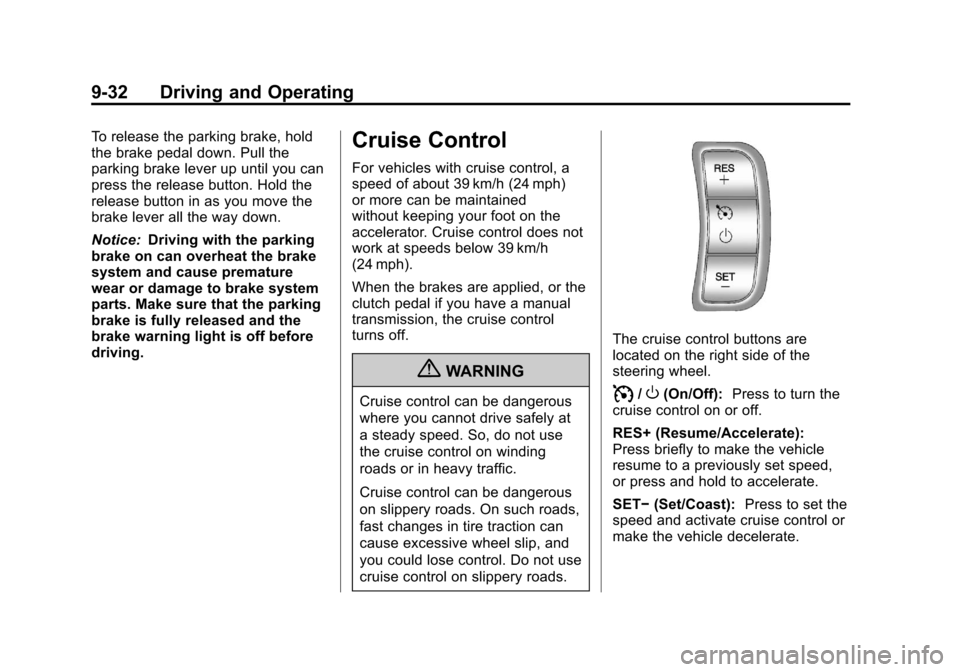
The cruise control buttons are
located on the right side of the
steering wheel.
I/O(On/Off): Press to turn the
cruise control on or off.
RES+ (Resume/Accelerate):
Press briefly to make the vehicle
resume to a previously set speed,
or press and hold to accelerate.
SET− (Set/Coast): Press to set the
speed and activate cruise control or
make the vehicle decelerate.
Page 195 of 328
Black plate (33,1)Chevrolet Aveo Owner Manual - 2011
Driving and Operating 9-33
Setting Cruise Control
If the cruise button is on when not in
use, it could get bumped and go into
cruise when not desired. Keep the
cruise control switch off when cruise
is not being used.
The cruise control light on the
instrument panel cluster will come
on after the cruise control has been
set to the desired speed.
1. Press
I/Oto turn cruise
control on.
2. Accelerate to the speed desired.
3. Press the SET− button and
release it.
4. Take your foot off the accelerate pedal. Resuming a Set Speed
If the cruise control is set at a
desired speed and then the brakes
are applied, or the clutch pedal if
you have a manual transmission,
the cruise control is disengaged
without erasing the set speed from
memory.
Once the vehicle speed reaches
about 39 km/h (24 mph) or more,
press the RES+ button on the
steering wheel. The vehicle returns
to the previous set speed and stays
there.
If the RES+ button is held, the
vehicle speed will continue to
increase until the button is released
or the brake pedal is applied. Do not
hold in the RES+ button, unless you
want the vehicle to go faster. Increasing Speed While Using
Cruise Control
If the cruise control system is
already activated,
.Press and hold the RES+ button
on the steering wheel until the
desired speed is reached, then
release it.
.To increase the vehicle speed in
small amounts, press the RES+
button. Each time this is done,
the vehicle goes about 1.6 km/h
(1 mph) faster.
The accelerate feature only works
after the cruise control is turned on
by pressing the SET− button.
Page 203 of 328

Black plate (1,1)Chevrolet Aveo Owner Manual - 2011
Vehicle Care 10-1
Vehicle Care
General Information
General Information . . . . . . . . . . 10-3
California Proposition65 Warning . . . . . . . . . . . . . . . . . 10-3
California Perchlorate Materials Requirements . . . . 10-3
Accessories and Modifications . . . . . . . . . . . . . . . 10-4
Vehicle Checks
Doing Your OwnService Work . . . . . . . . . . . . . . . 10-5
Hood . . . . . . . . . . . . . . . . . . . . . . . . 10-6
Engine Compartment Overview . . . . . . . . . . . . . . . . . . . 10-8
Engine Oil . . . . . . . . . . . . . . . . . . . 10-9
Engine Oil Life System . . . . . 10-12
Automatic Transmission Fluid . . . . . . . . . . . . . . . . . . . . . . 10-13
Manual Transmission Fluid . . . . . . . . . . . . . . . . . . . . . . 10-15
Hydraulic Clutch . . . . . . . . . . . . 10-15
Engine Air Cleaner/Filter . . . . 10-16
Cooling System . . . . . . . . . . . . 10-17 Engine Coolant . . . . . . . . . . . . . 10-18
Engine Overheating . . . . . . . . 10-21
Power Steering Fluid . . . . . . . 10-23
Washer Fluid . . . . . . . . . . . . . . . 10-24
Brakes . . . . . . . . . . . . . . . . . . . . . 10-24
Brake Fluid . . . . . . . . . . . . . . . . . 10-26
Battery . . . . . . . . . . . . . . . . . . . . . 10-27
Starter Switch Check . . . . . . . 10-28
Automatic Transmission Shift
Lock Control Function
Check . . . . . . . . . . . . . . . . . . . . . 10-28
Ignition Transmission Lock Check . . . . . . . . . . . . . . . . . . . . . 10-29
Park Brake and P (Park) Mechanism Check . . . . . . . . 10-29
Wiper Blade Replacement . . . . . . . . . . . . . . 10-30
Headlamp Aiming
Headlamp Aiming . . . . . . . . . . 10-30
Bulb Replacement
Bulb Replacement . . . . . . . . . . 10-31
Halogen Bulbs . . . . . . . . . . . . . . 10-31
Headlamps . . . . . . . . . . . . . . . . . 10-31
Front Turn Signal,Sidemarker, and Parking
Lamps . . . . . . . . . . . . . . . . . . . . 10-32 Taillamps, Turn Signal,
Sidemarker, Stoplamps,
and Back-Up Lamps . . . . . . 10-33
Center High-Mounted Stoplamp (CHMSL)
(Hatchback) . . . . . . . . . . . . . . . 10-34
Center High-Mounted Stoplamp (CHMSL)
(Sedan) . . . . . . . . . . . . . . . . . . . 10-34
License Plate Lamp . . . . . . . . 10-35
Replacement Bulbs . . . . . . . . . 10-35
Electrical System
Electrical System Overload . . . . . . . . . . . . . . . . . . 10-36
Fuses and Circuit Breakers . . . . . . . . . . . . . . . . . . 10-36
Engine Compartment Fuse Block . . . . . . . . . . . . . . . . . . . . . 10-37
Instrument Panel Fuse Block . . . . . . . . . . . . . . . . . . . . . 10-40
Wheels and Tires
Tires . . . . . . . . . . . . . . . . . . . . . . . . 10-42
Tire Sidewall Labeling . . . . . . 10-42
Tire Designations . . . . . . . . . . . 10-45
Tire Terminology andDefinitions . . . . . . . . . . . . . . . . 10-45
Tire Pressure . . . . . . . . . . . . . . . 10-48
Page 211 of 328

Black plate (9,1)Chevrolet Aveo Owner Manual - 2011
Vehicle Care 10-9
A.Engine Air Cleaner/Filter on
page 10‑16.
B. Engine Oil Fill Cap. See “When
to Add Engine Oil” under
Engine Oil on page 10‑9.
C. Brake/Clutch Fluid Reservoir. See “Brake Fluid” underBrakes
on page 10‑24 andHydraulic
Clutch on page 10‑15.
D. Engine Coolant Surge Tank. See Cooling System on
page 10‑17.
E. Engine Compartment Fuse
Block on page 10‑37.
F. Battery on page 10‑27.
G. Windshield Washer Fluid Reservoir. See “Adding Washer
Fluid” under Washer Fluid on
page 10‑24. H. Engine Oil Dipstick. See
“Checking Engine Oil” under
Engine Oil on page 10‑9.
I. Automatic Transmission Dipstick. See Automatic
Transmission Fluid on
page 10‑13.
J. Power Steering Fluid Reservoir. See Power Steering Fluid on
page 10‑23.
Engine Oil
To ensure proper engine
performance and long life, careful
attention must be paid to engine oil.
Following these simple, but
important steps will help protect
your investment:
.Always use engine oil approved
to the proper specification and of
the proper viscosity grade. See
“Selecting the Right Engine Oil”
in this section.
.Check the engine oil level
regularly and maintain the
proper oil level. See “Checking
Engine Oil” and“When to Add
Engine Oil” in this section.
.Change the engine oil at the
appropriate time. See Engine Oil
Life System on page 10‑12.
.Always dispose of engine oil
properly. See “What to Do with
Used Oil” in this section.
If the engine oil pressure light
comes on, check the engine oil level
right away. The oil pressure light is
on the instrument panel cluster. See
Engine Oil Pressure Light on
page 5‑18. Check the engine oil
level regularly; this is an added
reminder.
Page 216 of 328
Black plate (14,1)Chevrolet Aveo Owner Manual - 2011
10-14 Vehicle Care
Get the vehicle warmed up by
driving about 24 km (15 miles) when
outside temperatures are above
10°C (50°F). If it is colder than
10°C (50°F), you may have to
drive longer.
Checking the Fluid Level
Prepare the vehicle as follows:
1. Park the vehicle on a levelplace. Keep the engine running.
2. With the parking brake applied, place the shift lever in P (Park).
3. With your foot on the brake pedal, move the shift lever
through each gear range,
pausing for about three seconds
in each range. Then, position the
shift lever in P (Park).
4. Let the engine run at idle for three to five minutes. Then, without shutting off the
engine, follow these steps:
1. Locate the automatic
transmission dipstick which is
located toward the front of the
engine compartment, near the
power steering fluid reservoir.
See Engine Compartment
Overview on page 10‑8 for more
information on location.
2. Pull out the dipstick and wipe it with a clean rag or paper towel.
3. Push the dipstick back in all the way, wait three seconds, and
then pull it back out again.
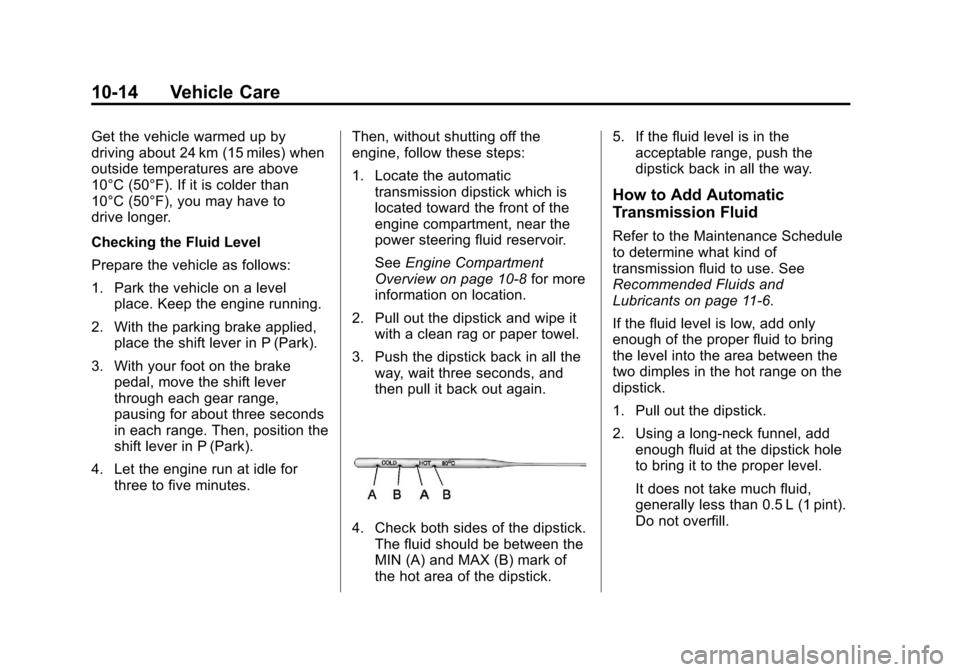
4. Check both sides of the dipstick.The fluid should be between the
MIN (A) and MAX (B) mark of
the hot area of the dipstick. 5. If the fluid level is in the
acceptable range, push the
dipstick back in all the way.
How to Add Automatic
Transmission Fluid
Refer to the Maintenance Schedule
to determine what kind of
transmission fluid to use. See
Recommended Fluids and
Lubricants on page 11‑6.
If the fluid level is low, add only
enough of the proper fluid to bring
the level into the area between the
two dimples in the hot range on the
dipstick.
1. Pull out the dipstick.
2. Using a long-neck funnel, add
enough fluid at the dipstick hole
to bring it to the proper level.
It does not take much fluid,
generally less than 0.5 L (1 pint).
Do not overfill.
Page 225 of 328
Black plate (23,1)Chevrolet Aveo Owner Manual - 2011
Vehicle Care 10-23
If the temperature overheat gauge
is no longer in the overheat zone
or an overheat warning no longer
displays, the vehicle can be driven.
Continue to drive the vehicle slowly
for about 10 minutes. Keep a safe
vehicle distance from the vehicle in
front. If the warning does not come
back on, continue to drive normally.
If the warning continues, pull over,
stop, and park the vehicle
right away.
If there is no sign of steam, idle the
engine for three minutes while
parked. If the warning is still
displayed, turn off the engine
until it cools down.Power Steering Fluid
When to Check Power
Steering Fluid
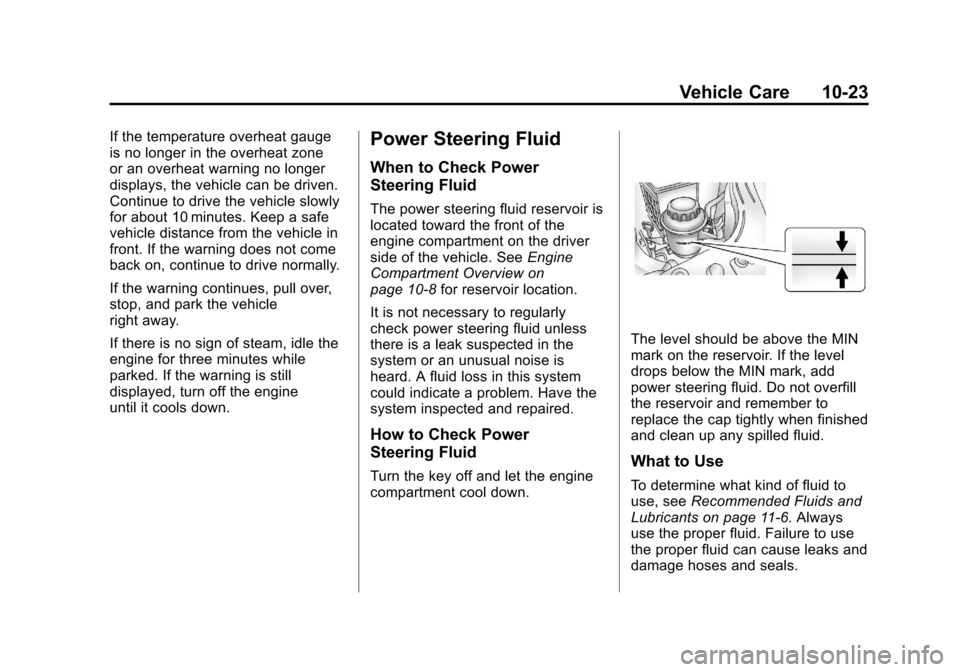
The power steering fluid reservoir is
located toward the front of the
engine compartment on the driver
side of the vehicle. SeeEngine
Compartment Overview on
page 10‑8 for reservoir location.
It is not necessary to regularly
check power steering fluid unless
there is a leak suspected in the
system or an unusual noise is
heard. A fluid loss in this system
could indicate a problem. Have the
system inspected and repaired.
How to Check Power
Steering Fluid
Turn the key off and let the engine
compartment cool down.
The level should be above the MIN
mark on the reservoir. If the level
drops below the MIN mark, add
power steering fluid. Do not overfill
the reservoir and remember to
replace the cap tightly when finished
and clean up any spilled fluid.
What to Use
To determine what kind of fluid to
use, see Recommended Fluids and
Lubricants on page 11‑6. Always
use the proper fluid. Failure to use
the proper fluid can cause leaks and
damage hoses and seals.
Page 248 of 328

Black plate (46,1)Chevrolet Aveo Owner Manual - 2011
10-46 Vehicle Care
Accessory Weight:This
means the combined weight
of optional accessories.
Some examples of optional
accessories are, automatic
transmission, power steering,
power brakes, power windows,
power seats, and air
conditioning.
Aspect Ratio
:The relationship
of a tire's height to its width.
Belt
:A rubber coated layer of
cords that is located between
the plies and the tread. Cords
may be made from steel or other
reinforcing materials.
Bead
:The tire bead contains
steel wires wrapped by steel
cords that hold the tire onto
the rim. Bias Ply Tire
:A pneumatic tire
in which the plies are laid at
alternate angles less than
90 degrees to the centerline of
the tread.
Cold Tire Pressure
:The
amount of air pressure in a tire,
measured in kPa (kilopascal)
or psi (pounds per square inch)
before a tire has built up heat
from driving. See Tire Pressure
on page 10‑48.
Curb Weight
:The weight of a
motor vehicle with standard and
optional equipment including the
maximum capacity of fuel, oil,
and coolant, but without
passengers and cargo.
DOT Markings
:A code molded
into the sidewall of a tire
signifying that the tire is in
compliance with the U.S.
Department of Transportation
(DOT) motor vehicle safety
standards. The DOT code includes the Tire Identification
Number (TIN), an alphanumeric
designator which can also
identify the tire manufacturer,
production plant, brand, and
date of production.
GVWR
:Gross Vehicle Weight
Rating. See Vehicle Load Limits
on page 9‑12.
GAWR FRT
:Gross Axle Weight
Rating for the front axle. See
Vehicle Load Limits on
page 9‑12.
GAWR RR
:Gross Axle Weight
Rating for the rear axle. See
Vehicle Load Limits on
page 9‑12.
Intended Outboard Sidewall
:
The side of an asymmetrical tire,
that must always face outward
when mounted on a vehicle.
Kilopascal (kPa)
:The metric
unit for air pressure.
Page 263 of 328
Black plate (61,1)Chevrolet Aveo Owner Manual - 2011
Vehicle Care 10-61
Used Replacement Wheels
{WARNING
Replacing a wheel with a used
one is dangerous. How it has
been used or how far it has been
driven may be unknown. It could
fail suddenly and cause a crash.
When replacing wheels, use a
new GM original equipment
wheel.
Tire Chains
Notice:Use tire chains only
where legal and only when you
must. Use only SAE Class“S”
type chains that are the proper
size for your tires. Install them on
the front tires and tighten them
as tightly as possible with the
ends securely fastened. Drive
slowly and follow the chain
manufacturer's instructions.
If you can hear the chains
contacting your vehicle, stop
and retighten them. If the
contact continues, slow down
until it stops. Driving too fast or
spinning the wheels with chains
on will damage your vehicle.
If a Tire Goes Flat
It is unusual for a tire to blowout
while you are driving, especially if
you maintain the vehicle's tires
properly. If air goes out of a tire, it is
much more likely to leak out slowly.
But if you should ever have a
blowout, here are a few tips about
what to expect and what to do:
If a front tire fails, the flat tire
creates a drag that pulls the vehicle
toward that side. Take your foot off
the accelerator pedal and grip the
steering wheel firmly. Steer to
maintain lane position, and then
gently brake to a stop, well off the
road, if possible.