2011 AUDI A5 COUPE lock
[x] Cancel search: lockPage 224 of 362
-Child Safety Pll:f __ .,.___ ____________ _
Convertible child safety seats
Properly used convertible child safety seats can help
protect toddlers and children over age one who weigh between 20 and 40 lbs. (9 and 18 kg)in a crash.
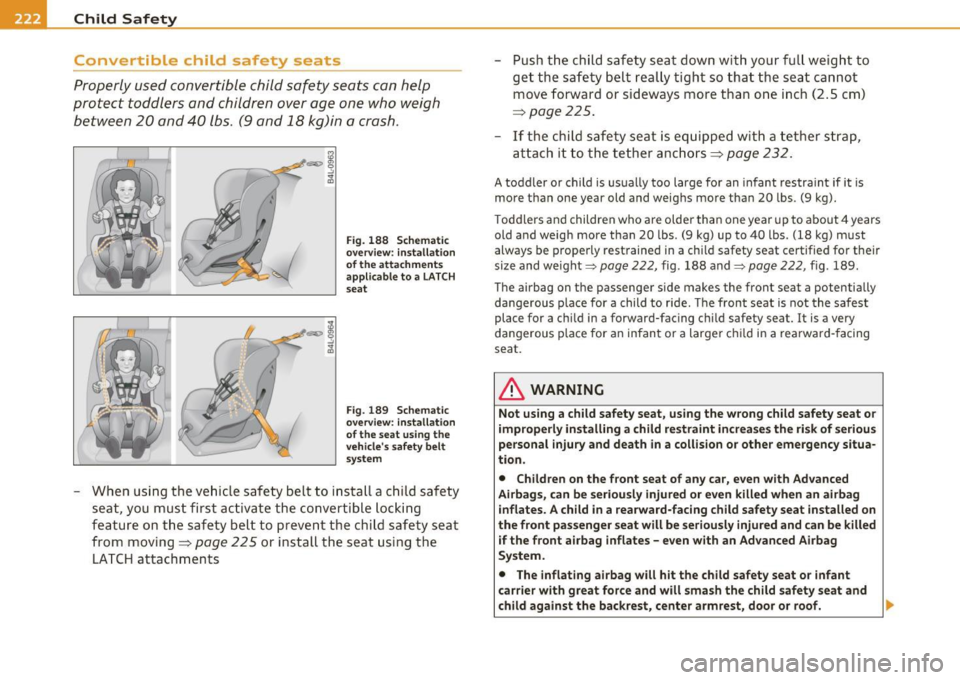
Fig. 188 Schematic
overview: installation
of the attachments
applicable to a LATCH
seat
Fig. 189 Schematic
overview: installation
of the seat using the
vehicle's safety belt
system
- When using the vehicle safety belt to install a child safety
seat, you must first activate the convertible locking
feature on the safety belt to prevent the child safety seat
from moving=>
page 225 or install the seat using the
LATCH attachments - Push the child safety seat down with your full weight to
get the safety belt really tight so that the seat cannot
move forward or sideways more than one inch (2.5 cm)
=>
page 225.
- If the child safety seat is equipped with a tether strap,
attach it to the tether anchors =>
page 232.
A toddler or child is usually too large for an infant restraint if it is
more than one year old and weighs more than 20 lbs . (9 kg).
Toddlers and children who are older than one year up to about 4 years
old and weigh more than 20 lbs. (9 kg) up to 40 lbs. (18 kg) must
always be properly restrained in a child safety seat certified for their
size and weight=>
page 222, fig. 188 and=> page 222, fig. 189.
The airbag on the passenger side makes the front seat a potentially dangerous place for a child to ride. The front seat is not the safest
place for a child in a forward-facing child safety seat. It is a very
dangerous place for an infant or a larger child in a rearward-facing
sea t.
& WARNING
Not using a child safety seat, using the wrong child safety seat or
improperly installing a child restraint increases the risk of serious
personal injury and death in a collision or other emergency situa
tion.
• Children on the front seat of any car, even with Advanced
Airbags, can be seriously injured or even killed when an airbag
inflates. A child in a rearward-facing child safety seat installed on
the front passenger seat will be seriously injured and can be killed
if the front airbag inflates -even with an Advanced Airbag
System.
• The inflating airbag will hit the child safety seat or infant
carrier with great force and will smash the child safety seat and
child against the backrest, center armrest, door or roof. ..,
Page 226 of 362

-L~C:_.!:h~ i~ld ~ S~ a:!: f~ e~ t~ y ~ ------------------------------------------
- Do not use the convertible locking retractor when using
the vehicle's safety belt to restrain a child on a booster
seat.
- Always position the shoulder portion of the safety belt midway over the child's shoulder . If you must transport an
older child in a booster seat on the front passenger seat,
you can use the safety belt height adjustment to help
adjust the shoulder port ion properly .
- Always make s ure that the shoulder por tion of the safety
belt never rests against or across the child's neck .
- Always make sure that the child can properly wear the lap portion of the belt low across the thighs or pelvis and
never over the stomach or abdomen .
Children up to about 40 lbs. (18 kg) are best protected in child safety
seats designed for their age and weight. Experts say that the skeletal
st ruct ure, particularly the pelv is, of these chi ldren is not fully deve l
oped, and they must not use the vehicle safety belts without a suit
able child rest raint .
Children who are at least 4 ft. 9 in . (57 inches/1.45 meters) tall can
generally use the vehicle's three point lap and shoulder belts . Never
use the lap belt port ion of the vehicle's safety belt alone to restra in
any child, regard less of how big the child is. Always remember that
childre n do not have the pronounced pelvic structure required for the
proper function of lap belt portion of the vehicle's three point lap and
shoulder belts. The ch ild's safety absolutely requires that a lap belt
portion of the safety belt be fastened snugly and as low as possible
around the pelvis. Neve r let the lap belt po rtion of the safety bel t
pass over the child's stomach or abdomen.
It is usua lly best to p ut these ch ildren in appropriate booster seats.
Be sure the booster seat meets all appl icable safety standards .
Booster seats raise the seating position of the child and reposition
both the lap and shoulder parts of the safety belt so that they pass across the child
's body in the right places . The rout ing of the belt over
t he c hild's body is very impo rtan t for the chi ld's p ro tect io n, whether
or not a booster seat is used. Children age 12 and under must always
ride in the rear seat .
In a crash, airbags m ust inflate with in a blink of an eye and with
considerable force. In order to do its job, the airbag needs room to
infl ate so that it w ill be t he re to protect t he oc cupan t as the occupant
moves forward into the a irbag.
A vehicle occupant who is out of position and too close to the airbag gets in the way of an inflating a irbag . When a n occupant is too close,
he or she will be struck violently and will receive serious or possibly
even fatal injury.
In order for the airbag to offer protection, it is important that all
veh icle occupants , espec ia lly any ch ild ren, who must be in the front
seat because of exceptional c ircumstances, be properly restra ined
and as far away from the airbag as possib le . By keeping room
between the child's body and the front of the passenger compart
ment, the airbag can inflate completely and provide supplemental
protection in certa in frontal collisions.
& WARNING
Not using a booste r sea t, using th e boo ste r seat improp erl y, inc or
rectl y installing a boo ste r seat or u sing the vehicle saf ety b elt
i mp roperly increa se s the risk of serio us per sonal injur y and death
i n a colli sion or oth er emergenc y situatio n. To he lp red uce the ri sk
of s eriou s pers onal injury and /or d eath:
• Alway s make su re to po sition the shoulder portion of the three
point b elt ove r the middl e of child' s sho ulder.
• Never l et the shoulder p orti on of the b elt re st again st or acro ss
th e neck, fa ce, chin , or thro at of the ch ild.
• Alwa ys make sure the lap belt portion of th e thr ee -point belt i s
worn snug and pa sses as low a s pos sible across the ch ild 's pel vis.
N ever le t th e be lt pa ss over the soft abdomen .
liJ>
Page 227 of 362

__________________________________________ ___:C~ h~il ~d ~ S~a ~f ~e ~t z._y __ _
& WARNING (c on tinued )
• Failure to properly route safety belt s ov e r a child' s body will
cause severe injurie s in an accident or oth er emergency situation
~ page 181 .
• The r ear side of the booster seat should be positioned as clo se
as possible to the backrest on the vehicle seat. Adjust o r remove
the rear seat head restraint if it is difficult to install the child seat
with the head restraint in place~
page 81. Install the head
restraint again immediatel y once the child seat is removed .
Driving without head restraints or with head restraints that are
not properly adju sted increases the risk of seriou s or fatal neck
injury dramat ically.
• Children on the front seat of any car, even with Advanced
Airbags , can be seriously injured or even killed when an airbag
inflates.
• Never let a child stand or kneel on any se at.
• Never let a child ride in the cargo area of your vehicle. • Alway s remember that a child leaning forward , sitting side
ways or out of position in any way during an accident can be struck by a deploying airbag. This will result in se rious personal injury or
death .
• If you must install a booster seat on the front passenger seat
because of e xceptional circumstances the PASSENGER AIR BAG
OFF light must come on and stay on, whenever the ignition is
switched on.
• If the PASSENGER AIR BAG OFF light does not come on and
stay on, perform the checks described
~ page 201, " Monitoring
the Advanced Airbag System ".
• Take the child restraint off the front passenger seat and install
it properly at one of the rear seat positions if the PASSENGER AIR BAG OFF light does not stay on whenever the ignition is sw itched
on.
• Always read and heed all WARNINGS whenever using a child
restrained in a vehicle is being used
~ page 181 , "Safety belts",
Controls and equip ment Safety first Vehicle operation
& WARNING
(co ntinued )
~ page 190, "Airbag system " and ~ page 215, "Important
things to know ".•
Installing a child safety seat
Securing a child safety seat using a safety
belt
Sa fety belts for the r ear seats and th e front passenger 's
seat c an be locked with the convertible locking retractor
t o pr operly secu re c hild safety se ats.
Th e safety bel ts emergency lock ing re trac to rs for the rear seats
safety belts and for the front passenger's seat safety belt have a
c onve rtible locking retractor for child res traints. The saf ety belt m ust
be locked so that belt webbing cannot un reel. The retractor can be
act ivate d to loc k the safety belt and prevent the safety belt webb ing
from loosening up during normal dr iv ing. A child safety seat can on ly
be pro pe rly in stall ed when the sa fety belt is locke d so th at th e child
and child safety seat will stay in place.
Always remembe r: E ven tho ugh yo ur vehicle is equippe d with an
Advanced Airbag system, all ch ild ren, espec ially those 12 yea rs and
younger, should a lways ride in t he back seat properly restrained for
their age and we ight.
& WARNING
Improperly installed child safety seats increase the risk of serious
personal injury and death in a collision.
• Always make sure that the safety belt retractor is locked when
installing a child safety seat . An unlocked safety belt retractor
cannot hold the child safety seat in place during normal driving or
in a cra sh. .,,
Vehicle care Do-it-yourself service Technical data
Page 229 of 362

Child Safety --------------------"'----
& WARNING (continued)
• Always move the passenger seat into its rearmost position in
the seat's fore and aft adjustment range, as far away from the airbag as possible before installing the forward-facing child
restraint. The backrest must be adjusted to an upright position.
• Make sure that the PASSENGER AIR BAG OFF light comes on
and stays on all the time whenever the ignition is switched on.
& WARNING
Rearward-facing child restraints:
• A child in a rearward-facing child safety seat installed on the
front passenger seat will be seriously injured and can be killed if
the front airbag inflates -even with an Advanced Airbag System.
• The inflating airbag will hit the child safety seat or infant
carrier with great force and will smash the child safety seat and
child against the backrest, center armrest, door or roof.
• Always be especially careful if you must install a rearward
facing child safety seat on the front passenger seat in exceptional
circumstances.
• A tight tether strap on a rearward-facing child restraint
attached to the front passenger seat can put too much pressure on
the weight-mat in the seat and register a heavier weight in the
Advanced Airbag System. The heavier weight registered can make
the system work as though an adult were on the seat and deploy the Advanced Airbag when it must be suppressed causing serious
or even fatal injury to the child.
• Make sure that the PASSENGER AIR BAG OFF light comes on
and stays on all the time whenever the ignition is switched on.
• If the PASSENGER AIR BAG OFF light does not come on and
stay on, immediately install the rearward-facing child safety seat
in a rear seating position and have the airbag system inspected by
your authorized Audi dealer. •
Controls and equip ment Safety first Vehicle operation
Activating the convertible Locking retractor
Use the convertible locking retractor to secure
a child
restraint.
Always heed the child safety seat manufacturer's instruc
tions when installing a child restraint in your vehicle. To acti
vate the convertible locking retractor:
- Place the child restraint on a seat, preferably on the rear
seat .
- Slowly pull the belt
all the way out.
- Route it around or through the child restraint belt path
::::>& .
- Push the child safety seat down with your full weight to
get the safety belt really tight.
- Insert the belt tongue into the buckle for that seating
position.
- Guide the safety belt back into the retractor until the belt
lies flat and snug on the child safety seat .
- You should hear a "clicking" noise as the belt winds back
into the inertia reel. Test the convertible locking retractor
by pulling on the belt. You should no longer be able to pull
the belt out of the retractor. The convertible locking
retractor is now activated.
- Make sure that the red release button is facing away from
the child restraint so that it can be unbuckled quickly.
- Pull on the belt to make sure the safety belt is properly
tight and fastened so that the seat cannot move forward
or sideways more than one inch (2.5 cm) . .,
Vehicle care Do-it-yourself service Technical data
Page 230 of 362

-Child Safety ---------' ~-------------------------------------
in. WARNING
Us ing the wrong child restraint or an improperly in stalled child
re straint can cause seri ou s personal injury or death in a cra sh.
• Always make su re that the safety belt ret racto r is locked when
installing a child safety sea t. An unlock ed safety belt retractor
cannot hold the child saf ety seat in place during normal driving or
in a cra sh .
• Always bu ckle the ch ild safety seat firmly in place even if a
c hild i s not sitting in it . A loose child safety se at can fly around
during a sudden stop or in a crash.
• Alway s make sure the seat backre st to whi ch the child re straint
is installed is in an upright posit ion and securely latched into place
and cannot fold forward. Otherwise , the seatba ck with the child
safety seat atta ched to it could fly forward in the event of an acci
dent or other emergen cy situation.
• Always read and heed all WARNINGS wheneve r us ing a child
re strained in a vehicle is being used=>
page 215. Special precau
tions apply when installing a chi ld safety seat on the front
pa ssenger seat=>
page 192, "Child restraints on the front seat -
some important things to know ".•
Deactivating the convertible Locking
retractor
The c onver tible l ockin g retract or fo r child res traints will
b e deacti vated a uto matically when the belt is wound all
t h e way back into the retractor .
-Press the red butto n on the safety belt buckle. T he belt
to ng ue will pop out o f the buckle.
- Guide the safety belt alt the way back into its stowed posi
t ion.
Always let the safety belt retract completely into its stowed position .
Th e sa fety bel t can now be used as an ordinary sa fety belt withou t the
convertib le locking retractor for ch ild restraints.
If the convertib le locking retractor should be activated inadvertently,
th e safe ty be lt must be unfas tene d and guided comple tely ba ck in to
its stowed position to deactivate this feature. I f the convertib le
lo ck in g re tra ctor is not deact ivate d, the safety be lt w ill gr adu ally
become tighter and uncomfortable to wear.
in. WARNING
Improperly installed child safety seats increase the r isk of serious
per sonal injury and death in a collision .
• Never unfasten the safety belt to deactivate the convertible
locking retractor for child restraints while the vehicle is moving .
You would not be restrained and could be seriously injured in an
accident.
• Always read and heed all WARNINGS whenever using a child
restrained in a vehicle is being us ed => page 215. Special precau
tions apply when installing a child safety seat on the front
pa ssenger seat=>
page 192, "Child re straints on the front seat -
some impo rtant things to know". •
Page 233 of 362

Child Safety -
-------------------"'---
& WARNING (continued)
• Always carefully follow the child restraints manufacturer's
instructions for proper installation of the child restraint and
proper use of the lower anchorages or safety belts in your vehicle.
• Never secure or attach any luggage or other items to the
LATCH
lower anchorages.
• Always read and heed the important information about child
restraints in this chapter and WARNINGS~ page
215, "Child
Safety ".•
Installing a child restraint with LATCH
Lower anchorages
Whenever you install a child restraint always follow the
child restraint manufacturer's instructions.
Mounting
Fig. 194 Lower
anchorages : proper
mounting
- Make sure the seatback of the rear seat bench is in the
upright position and securely latched in place.
Controls and equip
ment Safety first Vehicle operation
-
Attach both hook-on connectors with the spring catch
release on the child safety seat onto the LATCH lower
anchorage so that the connectors lock into place
=> fig. 194.
-Pull on the connector attachments to make sure they are
properly attached to the LATCH lower anchorage.
- Pull straps tight following the child restraint manufac
turer's instructions .
Releasing
-Loosen the tension on the straps following the child
restraint manufacturer's instructions.
- Depress the spring catches to release the anchorage hooks
from the lower anchorages.
Remember: Use tether straps to help keep the child restraint firmly
in place.
& WARNING
Improper use of the LATCH system can increase the risk of serious
personal injury and death in an accident.
• These anchors were developed only for child safety seats using
the "LATCH" system.
• Never attach other child safety seats, belts or other objects to
these anchors.
• Always make sure that you hear a click when latching the seat
in place. If you do not hear a click the seat is not secure and could
fly forward and hit the interior of the vehicle, or be ejected from
the vehicle.
l)l,
Vehicle care Do-it-yourself service Technical data
Page 239 of 362

Intelligent technology
--------------------------------------------------' "---.L==--
The system operates across the entire speed range in combination
w ith the ABS sys tem. If the A nti-L o ck Brak e System (A BS) mal fun c
tions, the ESP will also shut down.
How the system works
The Anti-Lock Brake System (ABS), Elect ronic D ifferential Lock (EDL)
and the Anti-Slip Regul ation System (AS R) are in teg rated in the e lec
tronic stab ilizat ion program . In addition to the data prov ided by
th ese fun ctions, the ESP control unit re quires addi tional meas ure
ment data provided by hig h pe rformance senso rs . The ro tat ional
speed of the vehicle about its vertical axis, veh icle acceleration in the
fore-and-a ft and lateral d irect ions, the brake pressure , a nd the
steerin g ang le are all measured .
Th e d irec tion in whi ch the driver w ishes to tra ve l is d ete rm ined wi th
the a id of the steering a ngle and ve hicle speed and is con tinually
c omp ared wi th the a ctu al b ehavior o f the ve hicl e. If t he two do no t
match, for example, when the vehicle starts hydroplani ng on a wet
roa d, E SP w ill automatica lly bra ke the approp riate whee l to correct
the problem.
Th e ve hicle is t hen stab ilized by the fo rces acting on the whee l during
bra king .
If the ve hicl e is oversteering (the vehicle tu rns too s harp ly
and the rear whee ls slide toward the outside of a curve), the brakes
a re mainly a pplied on the whee l tha t is o n the o uts ide of t he curve. In
the case of a vehicle that is
understeering (the vehicle does not turn
shar ply enough and push es out o f a curve), the b rakes are ap plied as
needed on the whee l th at is on the inside of the curve or additionally
on the ot her wheels . An acoustic s ignal indicates w hen ESP bra ke
applica tion cuts in=> &.
T he system operates across the entire speed range in combination
w ith the A BS system =>
page 241. If the A nti-Lo ck Br ake Sys tem
(ABS) ma lfunctions, the ESP w ill be o ut of act ion as we ll.
Activating
When you turn on the engine, ESP wi ll automatica lly be activated and
w ill pe rfor m a self- tes t. As soo n as t he tes t is co mplete d, th e sys tem
is in normal operating mo de.
Controls and equip
ment Safety first Vehicle operation
Yo
u can activate a deactivated ESP or deactivated ESP/ ASR if required
b y pressi ng the =>
page 236, fi g. 1 9 8 => page 236, fig . 19 7 bu tton.
Wh en they are activated, the message
Stabilisation program on
appears briefly in t he di sp lay .
Deactivating
The ES P shoul d no rma lly be acti va te d a ll the tim e. I f necess ary, y ou
can deact ivate A nti-Slip Reg ulat io n (ASR) or th e Electro nic Sta biliza
t ion Progr am ( ES P) by p ress ing the button =>
page 23 6, fig. 198.
• Deactivating ASR: Tap th e button . In cer tain exceptional s itua
t ions (e.g. driving with tire chains), the Anti -Slip Reg ulation (ASR) can
be dea ct iva te d =>
page 238. The m ess age ASR off Caution! Limited
driving stability
a pp ears in the d isp lay as well.
• Deactivating ESP/ASR Press the but ton for mor e tha n 3 seconds .
With the ESP/ ASR deactivated, the indicator light comes on, see
=>
p age 15. The m ess age Warning! Restri cted stability ap pears in
the display as we ll.
& WARNING
The Electronic Stabilization Program is nevertheless subje ct to the
laws of physics . It is particularly important to pay attention to
this fact on wet and slippery roads. It is therefore important that
you always adapt your driving to the condition of the road and
traffic conditions . Do not allow the increased safety provided by
the Electronic Stabilization Program system to lull you into accepting additional safety risks .
u
Vehicle care Do-it-yourself service Technical data
Page 240 of 362

Intelligent t echnology
'-----------------------------------------------
Electronic differential lock (EDL)
The elec tronic differen tial lock monitors the rotational
speed of the drive wheels.
G en era l not es
The electronic differentia l lock (EDL) helps the ca r to sta rt moving,
accelerate and climb a gradient on surfaces provid ing poor or almost
no grip . W ithout ED L, this would be d iff icu lt, if not impossible.
How the sy stem works
The EDL operates automatically. It mo nitors the rota tional speed of
wheels with the help of the ABS sensors~
page 241. If a not iceab le
slip is detected at the wheels (e.g . on slippery g round on one side),
the spinn ing wheels are braked and power is transferred to the other
wheels . This is done up to a speed of about 60 mph (100 km/h).
No ises from the brake system signal that wheel sp in is being
controlled.
Driv ing off
When d riving off, always be s ure to keep road conditions in mind as
you accelerate. If one drive wheel spins because it is on a surface with
less grip, apply
plenty of throttle until the car starts to move.
O verheating of bra kes
To prevent the disc b rake of the bra ked wheel from ove rhea ting if
subjected to excessive loads on this wheel, the EDL cuts out tempo
ra rily. The vehicle remains operat io nal and be haves in the same way
as a veh icle without EDL.
As soon as the brake has coo led down, EDL switches on again auto
matically.
& WARNING
• When ac ce le rating on s lippery surfa ce s, su ch as on ic e or snow,
alwa ys be ca reful when depre ssing the accele rator pedal. Even
& W ARNING (continue d)
with the EDL working , the dri ve wheels c an spin and reduce your
ability to contr ol your car . Ri sk of cra sh!
• The inc reased s afety afforded by E DL does not me an that you
can take safety ri sks. Alwa ys adapt your d rivin g style to the r oad
conditions and t raffic situation .
[ i ] Tips
If a fau lt occurs in the ABS, the EDL is also not funct ion ing. This is
ind ic a ted by the ABS warn ing light ~
page 17. •
Anti-Slip Regulation System (ASR)
The Anti-Slip Regulation System prevents the driven
wheels from spinning when the car is accelerating.
General notes
The Anti-Sl ip Regu lation System (ASR) is integrated in the electronic
stabiliza tion prog ram ( ESP) . When the ve hicle s tarts up and acceler
ates, the wheels are prevented from sp inning by adjusting the engine
powe r to match the amount of g rip available from the road surface .
How the system works
ASR performs au toma tic a lly, i.e. witho ut the dr ive r's intervent ion.
With the aid of the ABS sensors~
page 241, ASR monitors the speed
of the driven wheels. If the whee ls start to spi n, eng ine torq ue is
reduced automatically unti l the tires find enough grip to lock onto
t he road s urface . The system is active across the en tire spee d range.
Th e ASR works in con ju nction with the ABS .
If a malfunction shou ld
occur in the ABS, the ASR wi ll also be out of action.
Act ivating
T he ESP is automatica lly activated when the engine is started and it
performs a self-test . You can act ivate a deact ivated ASR if required by _,,