2011 AUDI A5 COUPE lock
[x] Cancel search: lockPage 310 of 362

IIIL-_T.:..:..: ir:....:e~ s=---= a~ n:..:..: d:......: w..:....:.. h:....:e~ e= ls=--------------------------------------------------
& WA RNING (conti nu ed )
• Winter t ires have ma ximum speed rating that may be lower
than your vehicle' s maximum speed .
• Never drive faster than the speed for which the winter or other
tires installed on your vehicle are rated .
& WARNING
Always adjust your driving to the road and t raffic conditions.
Never let the good ac celeration of the winter tire s and all-wheel
drive tempt you into taking extra risks . Always remember:
• Wh en braking, an alt-wheel drive vehicle handle s in the same
way as a front drive vehicle.
• Drive carefully and reduce your speed on icy and slippery roads,
even w inter tires cannot help under black ice conditions.
~ For the sake of the environment
Use summe r tires when weather condit ions permit. They are quieter,
do not wea r as quickly and redu ce fuel consumpt io n.•
Snow chains
Snow c hains may be fitted only to the front wheels, and only to
certain tire sizes. Ask your authorized Audi dealer on which tire sizes
snow chains c an be u sed.
T he snow cha ins must have low-profile links and m ust not be thicker
t han 0 .53 in ch ( 13 .5 mm), incl uding the lock .
Remove wheel center covers and t rim discs befor e put ting snow
chains on your vehicle=:,
0. For safety reasons cover caps must then
be fi tted ove r th e wheel bo lts. These a re available from auth orized
Audi dealers.
& WARNING
Using the wrong snow chains for your veh icle or installing them
in correctly can incre ase the risk of loss of control le ading to
serious personal injury.
• Snow chains are available in different size s. Always make sure
to follow the instructions provided by the snow chain manufac
turer .
• When driving with snow chains never dri ve faster than the
s peed permitted for your specific snow chain s.
• Always observe local regulations.
0 Note
• Remove snow chains before d riving on roads not covered with
s now to avoid d am ag ing t ires and wear ing t he snow chains dow n
unnecessarily.
• Snow chains, which come into direct contact with the wheel rim,
can scratch o r damage it. Therefo re, make sure that the snow chains
are sui tably cove red. C heck t he pos it ion of the snow cha in s a ft e r
dr iving a few yards and correct if necessary . Fo llow the instruct ions
from t he snow ch ain man ufactur er when doing so.
[ i ] Tips
Whe re snow chains are mandatory on certain roads, t his normally
also app lies to ve hicles with all wheel drive. •
Wheel bolts
Wheel bolts must al ways be tightened to the c orrect
torque .
The desig n of wheel bo lts is matched to the factory installed rims. If
differen t rims a re fitted, the co rrect wheel bolts wi th the r ig ht length
and correctly shaped bolt heads must be used. This e nsures that ..,_
Page 317 of 362

What do I do now? -________________ PfWII
Removing the spare tire
- Lift th e carg o floo r by the plas tic h andle ~ page 314,
fig . 2 20.
- H ook the hand le into t he luggage compa rtment weathe r
stri p.
- Tur n th e la rge screw~
page 314 , fig . 220 cou nter -clock-
w ise .
- Ta ke out the sp are t ire.
- U nho ok the c arg o flo or b efo re clos ing th e rear lid .
Securing the replaced tire
- Pla ce the w heel w it h t ire in t he spa re wheel we ll and
secu re t he wheel wit h the large sc rew.
- Unhook the c arg o floor before closing the re ar lid.
Using the spare tire (compact spare tire)
T he compact s pare tire is only inte nded for em er gen cie s until you can
reac h a repa ir sh op. R epl ace it as quickly as poss ible wit h a standar d
w he el a nd t ire.
Th ere are some rest rict io ns o n th e use of the compact s pare tire . The
compa ct spar e tir e has b een d esign ed spe cific ally f or your t ype of
vehicle. It must n ot be swa pped with a compact spare tire from
an other ty p e of vehi cle.
Snow chains
Fo r te chni cal re ason s, the use of snow ch ain s on th e compact s par e
t ire is not permitted .
I f y ou do h ave to dr ive wi th sno w chains an d a
front t ire fails, mount
t he spare wh eel w it h t ire instead of a rear tire. Ins tall the s now chai ns
on t he rear tire and use it to repla ce the defective fro nt tire .
Safety first
& WARNING
• Never use the spare tire if it is damaged or if it is worn down to
the tread wear indicators.
• If the spare tire is more than 6 years old, use it only in an emer
gency and with extreme caution and careful driving.
• The spare tire is intended only for temporary and short-term
use. It should be replaced as soon as possible with the normal
wheel and tire .
• After mounting the compact spare tire, the tire pressure must
be checked as soon as possible. The tire pressure of the compact
spare tire must be 4.2 bar; otherwise, you risk having an accident.
• Do not drive faster than 50 mph (80 km/h) . You risk having an
accident.
• Avoid full-throttle acceleration, heavy braking, and fast
cornering. You risk having an accident.
• Never drive using more than one spare wheel and tire. You risk
having an accident.
• Normal summer or winter tires must not be mounted on the
compact spare wheel rim.
• For technical reasons, the use of tire chains on the spare tire is
not permitted. If it is necessary to drive with tire chains, the spare
wheel must be mounted on the front axle in the event of a flat in
a rear tire. The newly available front wheel must then be installed
in place of the rear wheel with the flat tire . Installing the tire
chain before mounting the wheel and tire is recommended.
• Loose items in the passenger compartment can cause serious
personal injury during hard braking or in an accident.
- Never store the inflatable spare tire or jack and tool s in the
passenger compartment.
- Always store all jacking equipment, tools, and the inflatable spare tire in the luggage compartment.
- Tighten the knurled retaining screw for the inflatable spare
tire securely. •
Vehicle care Do-it-yourself service Technical data
Page 318 of 362

lffll.___W __ h_a_ t_ d_ o_ I_ d_o_ n_ o_w _ ? _____________________________________________ _
Changing a wheel
Before changing a wheel
Observe the following precautions for your own and your
passenger's safety when changing a wheel.
- After you experience a tire failure, pull the car well away
from moving traffic and try to reach
level ground before
you stop
~ & .
- All passengers should
leave the car and move to a safe
location (for instance, behind the guardrail)~& .
- Engage the
parking brake to prevent your vehicle from
rolling unintentionally~ &.
- Shift into
1st gear on vehicles with manual transmission,
or move the
selector lever to the P position on vehicles
with automatic transmission*.
- If you are towing a trailer: unhitch the trailer from your vehicle.
- Take the
jack~ page 314 and the spare tire~ page 314
out of the luggage compartment.
& WARNING
You or your passengers could be injured while changing a wheel if
you do not follow these safety precautions:
• If you have a flat tire, move a safe distance off the road. Turn
off the engine, turn the emergency flashers on and use other
warning devices to alert other motorists.
• Make sure that passengers wait in a safe place away from the
vehicle and well away from the road and traffic.
& WARNING (continued)
• To help prevent the vehicle from moving suddenly and possibly
slipping off the jack, always fully set the parking brake and block
the wheel diagonally opposite the wheel being changed with the
folding chocks or other objects. When one front wheel is lifted off
the ground, placing the Automatic Transmission in "P" (Park) will
not prevent the vehicle from moving.
• Before you change a wheel, be sure the ground is level and
firm. If necessary, use a sturdy board under the jack.
• After installing the inflatable spare tire, make sure that you
replace the flat tire/wheel in its storage area properly and tighten
the knurled retaining screw securely.
0 Note
If you are changing the wheel on a steep incline, use a rock or simila r
object to block the opposite wheel to prevent the vehicle from
moving.
[ i] Tips
Obey all laws. •
Changing a wheel
When you change a wheel, follow the sequence described
below step-by-step and in exactly that order.
1. Remove the decorative wheel cover* or the wheel bolt
caps* .
For more details see also~ page 317, "Decorative
wheel covers" or~
page 318, "Wheels with wheel bolt
caps".
2. Loosen the
wheel bolts~ page 318. .,_
Page 320 of 362
-L--....:..:W:..:..; h:..:.:: a:..:t :... d.:.:..: o:.:...:. I..;d:.:...:. o....:..: n:..:o :...w:..:..:. ? ___________________________________________ _
Applies to veh icles : w ith wheel bolts w ith caps
Wheels with wheel bolt caps
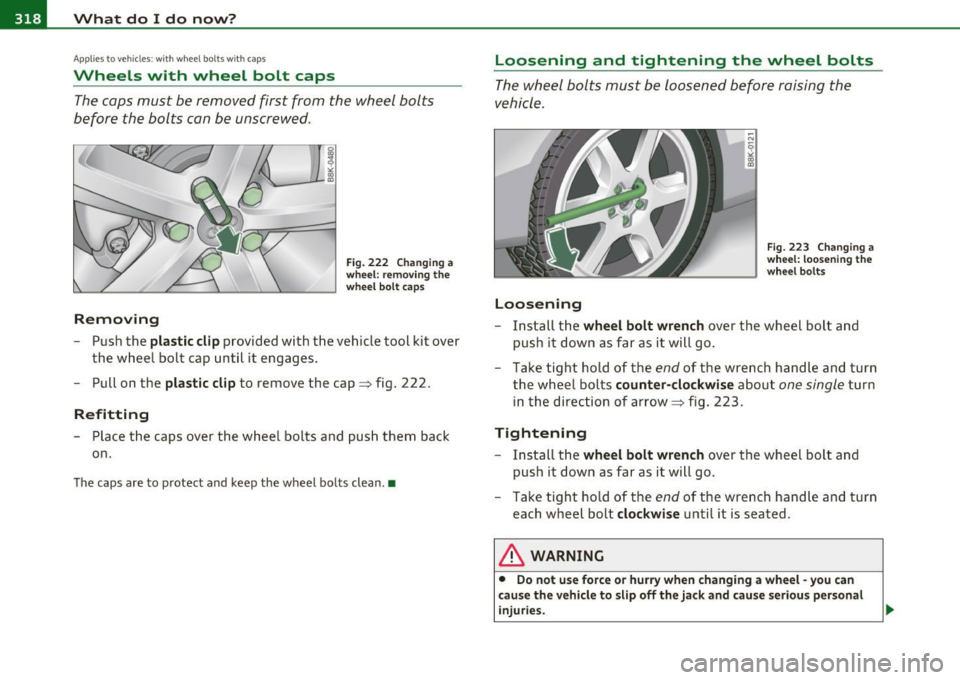
The caps must be removed first from the wheel bolts
before the bolts can be unscrewed .
Removing
Fig. 222 Changing a
wheel: removing the
wheel bolt caps
-Push the plastic clip provided with the vehicle tool kit over
the wheel bolt cap until it engages.
- Pull on the
plastic clip to remove the cap~ fig. 222 .
Refitting
-Place the caps over the wheel bolts and push them back
on.
The caps are to protect and keep the wheel bo lts clean. •
Loosening and tightening the wheel bolts
The wheel bolts must be loosened before raising the
vehicle .
Loosening
Fig. 223 Changing a
wheel: loosening the
wheel bo lts
- Install the wheel bolt wrench over the wheel bolt and
push it down as far as it will go .
- Take tight hold of the
end of the wrench handle and turn
the wheel bolts
counter-clockwise about one single turn
in the direction of arrow~ fig. 223.
Tightening
-Install the wheel bolt wrench over the wheel bolt and
push it down as far as it will go.
- Take tight hold of the
end of the wrench handle and turn
each wheel bolt
clockwise until it is seated .
& WARNING
• Do not use force or hurry when changing a wheel -you can
cause the vehicle to slip off the jack and cause seriou s personal
inju ries.
Page 323 of 362

What do I do now? Ill
----------------
- Screw the threaded end of the alignment pin from the
tool kit hand-tight into the empty bo lt hole~
page 320 ,
fig. 227.
- Then re m ove the o ther wheel bolts as described above.
- Take off t he w heel leaving the alignment pin i n the bolt
hole~ 0-
Putting on the inflatable spare tire
- Push t he spare tire over the a lignmen t pin.
- Screw on th e whe el bo lts and t ight en them
slightly using
the hexagonal soc ket .
- Remove the alignment pin and insert and tighten the
remaini ng whee l bol t slig htly like the rest .
- Turn the jack handle counter-clockwise to lower t he
vehicle unt il the jack is fully released.
- Use the wheel bolt wrench to t ighten a ll whee l bolts firmly
~ page 318 . Tighte n th em in a crisscross pattern, from
one bolt to the (approx imately) opposite one , to keep the
wheel centered.
- Perform the steps required after changing the wheel
~ page 317, "After c hanging a wheel".
T he hexagona l socket makes it easier to remove the whee l bolts from
the rim. Care should be take n when remov ing the reve rsib le blade .
0 Note
When removing or installing the wheel, the r im could hit the brake
rotor and damage the rotor . Work caref ully and have a second person
to he lp you.
Safety first
(I] Tips
• Whe n mounting tires with unidirection al tread de sign make sure
the tread pattern is pointed the rig ht way~
page 321.
• T he wheel bolts should be clea n and easy to turn. Check for dirt
and corrosion on the mating surfaces of both the whee l and the hub .
Remove all d irt from these surfaces before remounting the whee l.
• Do not use the hexagonal socket in the screwdriver hand le to
loose n or tig hten the wheel bolts .•
Tires with unidirectional tread design
Tires with unidirectional tread design mus t be mounte d
with their tread pattern pointed in the right direc tio n .
Using a spare tire with a tread pattern intended for
use in a specific direction
Whe n using a spare tire with a tread patte rn intended fo r use in a
specific direction, p lease note the fo llow ing:
• T he direction of ro ta t ion is ma rked by an
arrow on th e side of the
t ir e.
• If the spare tire has to be installed in the incorrect d irect ion, use
the spare t ire only temporar ily since the tire w ill not be ab le to
achieve its optimum pe rformance characterist ics with rega rd to
aquaplaning, noise and wear.
• We recommend tha t you pay particular attent ion to th is fact
dur ing wet weather and that you adjust your speed to match road
condi tions.
• Replace the flat ti re with a new one and have it installed on your
veh icle as soon as possible to restore the handling adva ntages of a
unidirect ional tire. •
Vehicle care Do-it-yourself service Technical data
Page 327 of 362

Fuses and bulbs -----------------------=---==-=-=--=.:..:..:::...:....:.:..:....-EWII
No. Consumer Amps
8 Vehicle electrical system control module 1
30
--
9 sunroof 20
10 Vehicle electrical system control module 1 30
11 sunroof shade (Avant)
20
12 Convenience electronics 5
•
Fuse Location, Instrument Panel right
Fig. 230 Right cockpit:
f use panel with plastic
clip
Vehicle OP-eration
No. Consumer Amps
Fuse panel @ (black)
5 Steering column switch module
5
6 Electronic Stabilization Program
5
7 Terminal 15 diagnostic connector 5
8 Gateway (Databus diagnostic interface)
5
Fuse panel @ (brown)
1 CD-/DVD player
5
2 Audi drive select switch module 5
3 MMI/Radio 5/20
4 Instrument cluster 5
5 Gateway (instrument cluster control module)
5
6 Ignition lock 5
7 Rotary light switch 5
8 Climate control system blower 40
9 Steering column lock
5
10 Climate control 10
11 Terminal 30 d
iagnostic connector
10
12 Steering column switch module 5
•
Vehicle care Do-it-yourself service iTechnical data
Page 332 of 362

lffl!I.___E_ m_ e_r -=g =- e_ n_c -=y ;..._ s_i_t _u _a _ t_ i_ o _ n_ s ____________________________________________ _
Connect POSITIVE(+) to POSITIVE(+) (red)
- Remove the cover above the jump start connection .
- Open t he red cover on the positive pole~
page 329,
fig. 232.
1. Connect one end of the positive cable (red) on the
jump
start bolt~
page 329, fig. 233 (D (Bolts under red cover
= "positive") of the vehicle to be started @.
2. Connect the other end to the positive terminal @of the
booster battery ®·
Connect NEGATIVE(-) to NEGATIVE(-)
(black)
3. Connect one end to the negative terminal ® of the
booster battery @.
4. Connect the other end of the negative cable (black) to the
jump start bolt© (Bolts with hex head = "negative") of
the vehicle to be started @.
Starting the engine
- Start the engine of the vehicle with the booster battery.
Run the engine at a moderate speed.
- Start engine with discharged vehicle battery in the usual
manner.
- If the engine fails to start: do not keep the starter cranking for longer than 10 seconds. Wait for about
30 seconds and then try again.
- With engine running, remove jumper cables from both
vehicles in the exact
reverse order .
- Close the red cover on the positive pole.
The battery is vented to the outside to prevent gases from entering
the vehicle interior . Make sure that the jumper clamps are well
connected with their
metal parts in full contact with the battery
terminals.
& WARNING
To avoid serious personal injury and damage to the vehicle, heed
all warnings and instructions of the jumper cable manufacturer. If
in doubt, call for road service.
• Jumper cables must be long enough so that the vehicles do not
touch.
• When connecting jumper cables, make sure that they cannot
get caught in any moving parts in the engine compartment.
• Do not bend over the batteries· danger of chemical burns!
• The battery cell locking screws must be tightened securely.
• Before you check anything in the engine compartment, always
read and heed all WARNINGS~
page 267, ''Engine compart
ment".
0 Note
Improper hook-up of jumper cables can ruin the generator.
• Always connect POSITIVE(+) to POSITIVE(+), and NEGATIVE( -)
to NEGATIVE(-) ground post of the battery manager control unit.
• Check that all screw plugs on the battery cells are screwed in
firmly . If not, tighten plugs prior to connecting clamp on negative
battery terminal.
• Please note that the procedure for connecting a jumper cable as
described
above app lies specifically to the case of your vehicle be ing
jump started. When you are giving a jump start to another vehicle, do
not connect the negative (-) cab le to the negative(-) terminal on the
discharged battery©~
page 329, fig. 233. Instead, securely
connect the negative(-) cable to either a solid metal component that
is firmly bolted to the engine block or to the engine block itself.
If the _,,,
Page 336 of 362

lffll.___E_ m_ e_ r-' g=- e_n_ c=-y _ s_it _ u _ a_t_ i_ o _ n_ s ______________________________________________ _
in. WARNING
• To reduce the risk of serious injury and vehicle damage.
-Always lift the vehicle only at the special workshop hoist and
floor jack lift points illustrated
=> page 333, fig. 238 and
=> page 333, fig. 239.
- Failure to lift the vehicle at these points could cause the
vehicle to tilt or fall from a lift if there is a change in vehicle
weight distribution and balance. This might happen, for
example, when heavy components such as the engine block or
transmission are removed.
• When removing heavy components like these, anchor vehicle
to hoist or add corresponding weights to maintain the center of
gravity. Otherwise, the vehicle might tilt or slip off the hoist,
causing serious personal injury.
0 Note
• Be aware of the following points before lifting the vehicle :
-The vehicle should never be lifted or jacked up from under
neath the engine oil pan, the transmission housing, the front or
rear axle or the body side members. This could lead to serious
damage.
- To avoid damage to the underbody or chassis frame, a rubber
pad must be inserted between the floor jack and the lift points.
- Before driving over a workshop hoist, check that the vehicle
weight does not exceed the permissible lifting capacity of the hoist.
- Before driving over a workshop hoist, ensure that there is sufficient clearance between the hoist and low parts of the
vehicle. •