2010 SUZUKI SX4 seat belts
[x] Cancel search: seat beltsPage 73 of 297

2-56
BEFORE DRIVING
80J23-03E
How the System WorksIn a frontal collision, the crash sensors will
detect rapid deceleration and send a signal
to the controller. If the controller judges
that the deceleration represents a severe
frontal crash, the controller will trigger the
inflators. The controller also judges:
Whether the front air bags should deploy
at reduced power or at full power accord-
ing to crash severity.
Whether the air bags should deploy at
reduced power or at full power according
to crash severity, driver’s seat fore/aft
position and whether or not the front
passenger’s seat belt is fastened.
Whether the front passenger’s front air
bag should deploy or not based on clas-
sification of the occupant of the front
passenger’s seat.
Since your vehicle is equipped with side air
bags, and side curtain air bags, crash sen-
sors will detect a side collision, and if the
controller judges that the side collision is
severe enough, it will trigger the side air
bag and side curtain air bag inflators.
The inflators inflate the appropriate air
bags with nitrogen or argon gas. The
inflated air bags provide a cushion for your
head (front air bags and side curtain air
bags only) and upper body. The air bag
inflates and deflates so quickly that you
may not even realize that it has activated.
The air bag will neither hinder your view
nor make it harder to exit the vehicle.Air bags must inflate quickly and forcefully
in order to reduce the chance of serious or
fatal injuries. However, an unavoidable
consequence of the quick inflation is that
the air bag may irritate bare skin, such as
the facial area against a front air bag. Also,
upon inflation, a loud noise will occur and
some powder and smoke will be released.
These conditions are not harmful and do
not indicate a fire in the car. Be aware,
however, that some air bag components
may be hot for a while after inflation.
A seat belt helps keep you in the proper
position for maximum protection when an
air bag inflates. Adjust your seat as far
back as possible while still maintaining
control of the vehicle. Sit fully back in your
seat; sit up straight; do not lean over the
steering wheel or dashboard. Front occu-
pants should not lean on or sleep against
the door. Please refer to the “Seat Adjust-
ment” section and the “Seat Belts and
Child Restraint Systems” section in the
“BEFORE DRIVING” section for details on
proper seat and seat belt adjustments.
WARNING
Do not spill any liquids on the seat.
Liquids can damage the sensors
under the front seat.
Have the driver’s seat position sen-
sor and the front passenger’s sen-
sor mat inspected by your dealer
after a collision.
Do not replace the front seats. If
you replace them, the air bags and
front passenger sensing system
may not work properly.
Do not use a seat cover. If you use
a seat cover, the front passenger
sensing system may not work prop-
erly.
Page 74 of 297

2-57BEFORE DRIVING
80J23-03E
65D610
54G582
Note that even though your vehicle may be
moderately damaged in a collision, the col-
lision may not have been severe enough to
trigger the front, side, or side curtain air
bags to inflate. If your car sustains ANY
front-end or side damage, have the air bag
system inspected by an authorized
SUZUKI dealer to ensure it is in proper
working order.
Your vehicle is equipped with a diagnostic
module which records information about
the air bag system if the air bags deploy in
a crash. The module records information
about overall system status, which sensors
activated the deployment, and whether the
front seat belts were in use.
WARNING
The driver should not lean over the
steering wheel. The front passen-
ger should not rest his or her body
against the dashboard, or other-
wise get too close to the dash-
board. For vehicles with side air
bags and side curtain air bags,
occupants should not lean on or
sleep against the door. In these sit-
uations, the out-of-position occu-
pant would be too close to an
inflating air bag, and may suffer
severe injury.
Do not attach any objects to, or
place any objects over, the steering
wheel or dashboard. Do not place
any objects between the air bag
and the driver or front passenger.
These objects may interfere with air
bag operation or may be propelled
by the air bag in the event of a
crash. Either of these conditions
may cause severe injury.
For vehicles with side air bags, do
not place seat covers on the front
seats, because seat covers could
restrict the air bag’s inflation. Also,
do not place any cup holders or
other objects on the door, as these
objects could be propelled by the
air bag in the event of a crash.
Either of these conditions may
cause severe injury.
Page 81 of 297
2-64
BEFORE DRIVING
80J23-03E
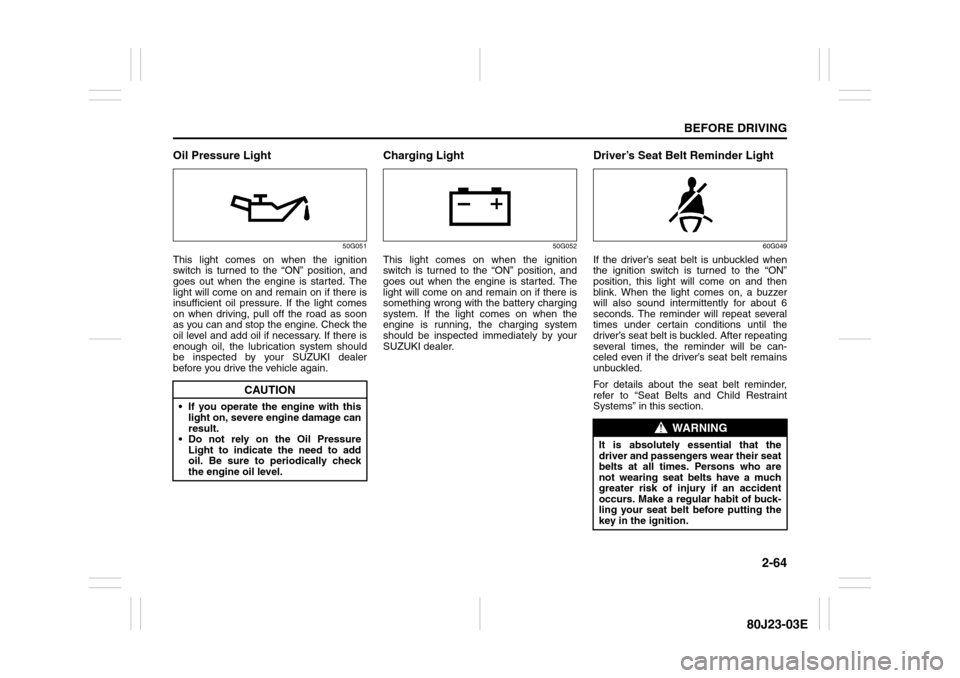
Oil Pressure Light
50G051
This light comes on when the ignition
switch is turned to the “ON” position, and
goes out when the engine is started. The
light will come on and remain on if there is
insufficient oil pressure. If the light comes
on when driving, pull off the road as soon
as you can and stop the engine. Check the
oil level and add oil if necessary. If there is
enough oil, the lubrication system should
be inspected by your SUZUKI dealer
before you drive the vehicle again.
Charging Light
50G052
This light comes on when the ignition
switch is turned to the “ON” position, and
goes out when the engine is started. The
light will come on and remain on if there is
something wrong with the battery charging
system. If the light comes on when the
engine is running, the charging system
should be inspected immediately by your
SUZUKI dealer.
Driver’s Seat Belt Reminder Light
60G049
If the driver’s seat belt is unbuckled when
the ignition switch is turned to the “ON”
position, this light will come on and then
blink. When the light comes on, a buzzer
will also sound intermittently for about 6
seconds. The reminder will repeat several
times under certain conditions until the
driver’s seat belt is buckled. After repeating
several times, the reminder will be can-
celed even if the driver’s seat belt remains
unbuckled.
For details about the seat belt reminder,
refer to “Seat Belts and Child Restraint
Systems” in this section.
CAUTION
If you operate the engine with this
light on, severe engine damage can
result.
Do not rely on the Oil Pressure
Light to indicate the need to add
oil. Be sure to periodically check
the engine oil level.
WARNING
It is absolutely essential that the
driver and passengers wear their seat
belts at all times. Persons who are
not wearing seat belts have a much
greater risk of injury if an accident
occurs. Make a regular habit of buck-
ling your seat belt before putting the
key in the ignition.
Page 102 of 297
3-1OPERATING YOUR VEHICLE
80J23-03E
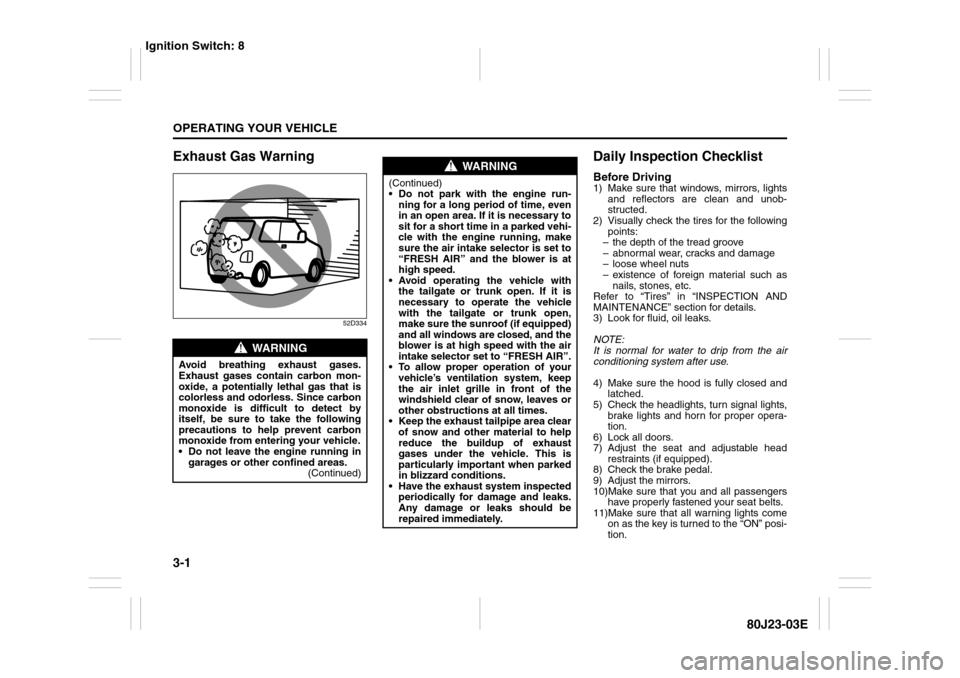
Exhaust Gas Warning
52D334
Daily Inspection ChecklistBefore Driving1) Make sure that windows, mirrors, lights
and reflectors are clean and unob-
structed.
2) Visually check the tires for the following
points:
– the depth of the tread groove
– abnormal wear, cracks and damage
– loose wheel nuts
– existence of foreign material such as
nails, stones, etc.
Refer to “Tires” in “INSPECTION AND
MAINTENANCE” section for details.
3) Look for fluid, oil leaks.
NOTE:
It is normal for water to drip from the air
conditioning system after use.
4) Make sure the hood is fully closed and
latched.
5) Check the headlights, turn signal lights,
brake lights and horn for proper opera-
tion.
6) Lock all doors.
7) Adjust the seat and adjustable head
restraints (if equipped).
8) Check the brake pedal.
9) Adjust the mirrors.
10)Make sure that you and all passengers
have properly fastened your seat belts.
11)Make sure that all warning lights come
on as the key is turned to the “ON” posi-
tion.
WARNING
Avoid breathing exhaust gases.
Exhaust gases contain carbon mon-
oxide, a potentially lethal gas that is
colorless and odorless. Since carbon
monoxide is difficult to detect by
itself, be sure to take the following
precautions to help prevent carbon
monoxide from entering your vehicle.
Do not leave the engine running in
garages or other confined areas.
(Continued)
WARNING
(Continued)
Do not park with the engine run-
ning for a long period of time, even
in an open area. If it is necessary to
sit for a short time in a parked vehi-
cle with the engine running, make
sure the air intake selector is set to
“FRESH AIR” and the blower is at
high speed.
Avoid operating the vehicle with
the tailgate or trunk open. If it is
necessary to operate the vehicle
with the tailgate or trunk open,
make sure the sunroof (if equipped)
and all windows are closed, and the
blower is at high speed with the air
intake selector set to “FRESH AIR”.
To allow proper operation of your
vehicle’s ventilation system, keep
the air inlet grille in front of the
windshield clear of snow, leaves or
other obstructions at all times.
Keep the exhaust tailpipe area clear
of snow and other material to help
reduce the buildup of exhaust
gases under the vehicle. This is
particularly important when parked
in blizzard conditions.
Have the exhaust system inspected
periodically for damage and leaks.
Any damage or leaks should be
repaired immediately.
Ignition Switch: 8
Page 134 of 297
4-1DRIVING TIPS
80J23-03E
52D078S
Break-In Catalytic Converter
68KM085
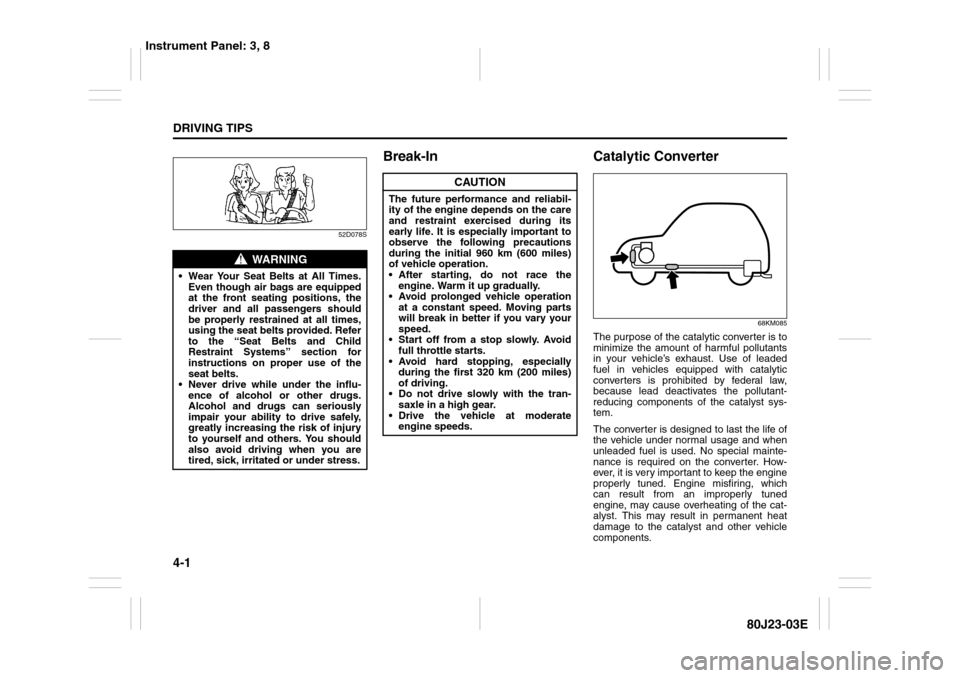
The purpose of the catalytic converter is to
minimize the amount of harmful pollutants
in your vehicle’s exhaust. Use of leaded
fuel in vehicles equipped with catalytic
converters is prohibited by federal law,
because lead deactivates the pollutant-
reducing components of the catalyst sys-
tem.
The converter is designed to last the life of
the vehicle under normal usage and when
unleaded fuel is used. No special mainte-
nance is required on the converter. How-
ever, it is very important to keep the engine
properly tuned. Engine misfiring, which
can result from an improperly tuned
engine, may cause overheating of the cat-
alyst. This may result in permanent heat
damage to the catalyst and other vehicle
components.
WARNING
Wear Your Seat Belts at All Times.
Even though air bags are equipped
at the front seating positions, the
driver and all passengers should
be properly restrained at all times,
using the seat belts provided. Refer
to the “Seat Belts and Child
Restraint Systems” section for
instructions on proper use of the
seat belts.
Never drive while under the influ-
ence of alcohol or other drugs.
Alcohol and drugs can seriously
impair your ability to drive safely,
greatly increasing the risk of injury
to yourself and others. You should
also avoid driving when you are
tired, sick, irritated or under stress.
CAUTION
The future performance and reliabil-
ity of the engine depends on the care
and restraint exercised during its
early life. It is especially important to
observe the following precautions
during the initial 960 km (600 miles)
of vehicle operation.
After starting, do not race the
engine. Warm it up gradually.
Avoid prolonged vehicle operation
at a constant speed. Moving parts
will break in better if you vary your
speed.
Start off from a stop slowly. Avoid
full throttle starts.
Avoid hard stopping, especially
during the first 320 km (200 miles)
of driving.
Do not drive slowly with the tran-
saxle in a high gear.
Drive the vehicle at moderate
engine speeds.
Instrument Panel: 3, 8
Page 270 of 297
9-3APPEARANCE CARE
80J23-03E
Vehicle Cleaning
76G044S
Cleaning InteriorVinyl upholstery
Prepare a solution of soap or mild deter-
gent mixed with warm water. Apply the
solution to the vinyl with a sponge or soft
cloth and let it soak for a few minutes to
loosen dirt. Rub the surface with a clean,damp cloth to remove dirt and the soap
solution. If some dirt still remains on the
surface, repeat this procedure.
Fabric upholstery
Remove loose dirt with a vacuum cleaner.
Using a mild soap solution, rub stained
areas with a clean damp cloth. To remove
soap, rub the areas again with a cloth
dampened with water. Repeat this until the
stain is removed, or use a commercial fab-
ric cleaner for tougher stains. If you use a
fabric cleaner, carefully follow the manu-
facturer’s instructions and precautions.
Leather upholstery
Remove loose dirt with a vacuum cleaner.
Using a mild soap or saddle soap solution,
wipe dirt off with a clean damp soft cloth.
To remove soap, wipe the areas again with
a soft cloth dampened with water. Wipe the
areas dry with a soft dry cloth. Repeat this
until the dirt or stain is removed, or use a
commercial leather cleaner for tougher dirt
or stains. If you use a leather cleaner, care-
fully follow the manufacture’s instructions
and precautions. Do not use solvent type
cleaners or abrasive cleaners.
Seat belts
Clean seat belts with a mild soap and
water. Do not use bleach or dye on the
belts. They may weaken the fabric in the
belts.Vinyl floor mats
Ordinary dirt can be removed from vinyl
with water or mild soap. Use a brush to
help loosen dirt. After dirt is loosened,
rinse the mat thoroughly with water and
dry it in the shade.
Carpets
Remove dirt and soil as much as possible
with a vacuum cleaner. Using a mild soap
solution, rub stained areas with a clean
damp cloth. To remove soap, rub the areas
again with a cloth dampened with water.
Repeat this until the stain is removed, or
use a commercial carpet cleaner for
tougher stains. If you use a carpet cleaner,
carefully follow the manufacturer’s instruc-
tions and precautions.
Cleaning the Exterior
WARNING
When cleaning the interior or exterior
of the vehicle, NEVER USE flammable
solvents such lacquer thinners, gas-
oline, benzene or cleaning materials
such as bleaches and strong house-
hold detergents. The materials could
cause personal injury or damage to
the vehicle.
CAUTION
It is important that your vehicle be
kept clean and free from dirt. Failure
to keep your vehicle clean may result
in fading of the paint or corrosion to
various parts of the vehicle body.
Periodic Maintenance Schedule: 1, 2, 3, 4, 5, 6, 9, 10
Page 291 of 297
13-1
INDEX
13
80J23-03E
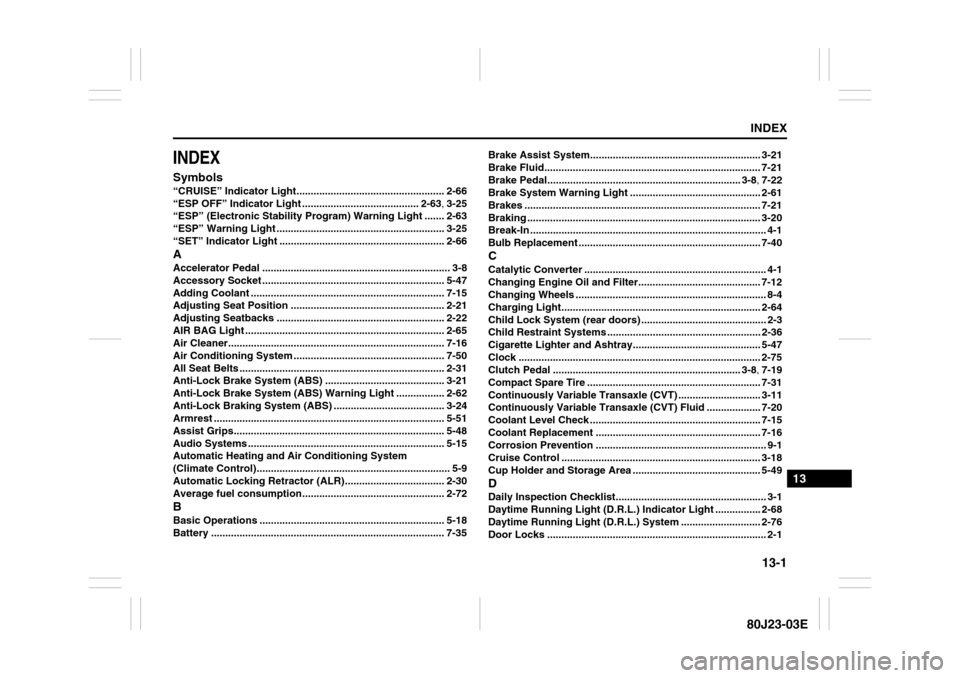
INDEXSymbols“CRUISE” Indicator Light.................................................... 2-66
“ESP OFF” Indicator Light ......................................... 2-63, 3-25
“ESP” (Electronic Stability Program) Warning Light ....... 2-63
“ESP” Warning Light ........................................................... 3-25
“SET” Indicator Light .......................................................... 2-66AAccelerator Pedal .................................................................. 3-8
Accessory Socket ................................................................ 5-47
Adding Coolant .................................................................... 7-15
Adjusting Seat Position ...................................................... 2-21
Adjusting Seatbacks ........................................................... 2-22
AIR BAG Light ...................................................................... 2-65
Air Cleaner............................................................................ 7-16
Air Conditioning System ..................................................... 7-50
All Seat Belts ........................................................................ 2-31
Anti-Lock Brake System (ABS) .......................................... 3-21
Anti-Lock Brake System (ABS) Warning Light ................. 2-62
Anti-Lock Braking System (ABS) ....................................... 3-24
Armrest ................................................................................. 5-51
Assist Grips.......................................................................... 5-48
Audio Systems ..................................................................... 5-15
Automatic Heating and Air Conditioning System
(Climate Control).................................................................... 5-9
Automatic Locking Retractor (ALR)................................... 2-30
Average fuel consumption.................................................. 2-72BBasic Operations ................................................................. 5-18
Battery .................................................................................. 7-35Brake Assist System............................................................ 3-21
Brake Fluid............................................................................ 7-21
Brake Pedal.................................................................... 3-8, 7-22
Brake System Warning Light .............................................. 2-61
Brakes ................................................................................... 7-21
Braking .................................................................................. 3-20
Break-In ................................................................................... 4-1
Bulb Replacement ................................................................ 7-40
CCatalytic Converter ................................................................ 4-1
Changing Engine Oil and Filter........................................... 7-12
Changing Wheels ................................................................... 8-4
Charging Light...................................................................... 2-64
Child Lock System (rear doors) ............................................ 2-3
Child Restraint Systems ...................................................... 2-36
Cigarette Lighter and Ashtray............................................. 5-47
Clock ..................................................................................... 2-75
Clutch Pedal .................................................................. 3-8, 7-19
Compact Spare Tire ............................................................. 7-31
Continuously Variable Transaxle (CVT) ............................. 3-11
Continuously Variable Transaxle (CVT) Fluid ................... 7-20
Coolant Level Check ............................................................ 7-15
Coolant Replacement .......................................................... 7-16
Corrosion Prevention ............................................................ 9-1
Cruise Control ...................................................................... 3-18
Cup Holder and Storage Area ............................................. 5-49DDaily Inspection Checklist..................................................... 3-1
Daytime Running Light (D.R.L.) Indicator Light ................ 2-68
Daytime Running Light (D.R.L.) System ............................ 2-76
Door Locks ............................................................................. 2-1
Page 293 of 297
13-3
INDEX80J23-03E
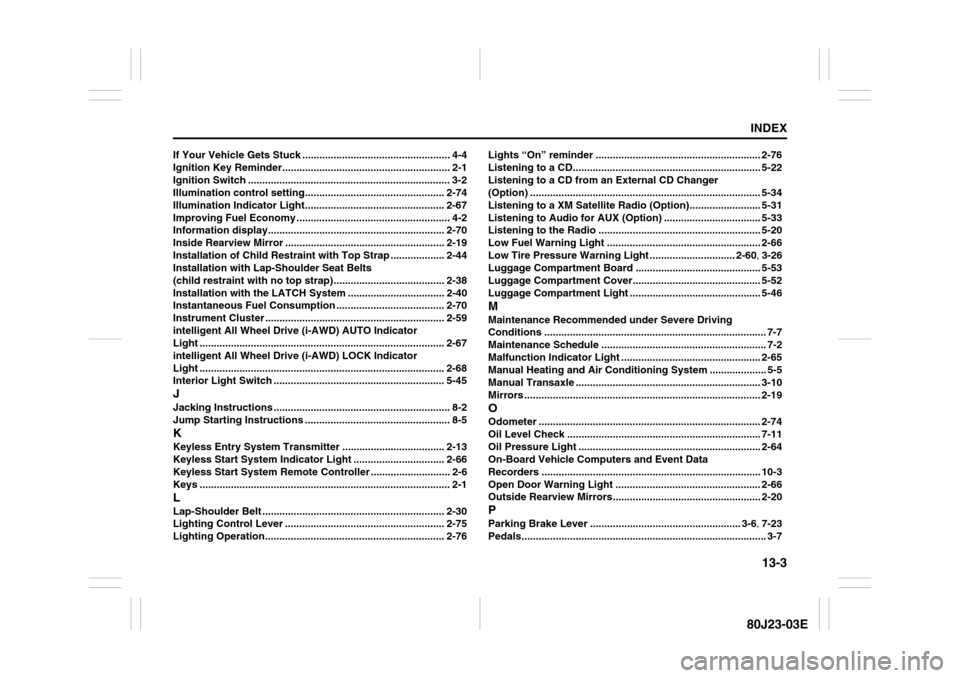
If Your Vehicle Gets Stuck .................................................... 4-4
Ignition Key Reminder........................................................... 2-1
Ignition Switch ....................................................................... 3-2
Illumination control setting................................................. 2-74
Illumination Indicator Light................................................. 2-67
Improving Fuel Economy ...................................................... 4-2
Information display.............................................................. 2-70
Inside Rearview Mirror ........................................................ 2-19
Installation of Child Restraint with Top Strap ................... 2-44
Installation with Lap-Shoulder Seat Belts
(child restraint with no top strap)....................................... 2-38
Installation with the LATCH System .................................. 2-40
Instantaneous Fuel Consumption ...................................... 2-70
Instrument Cluster ............................................................... 2-59
intelligent All Wheel Drive (i-AWD) AUTO Indicator
Light ...................................................................................... 2-67
intelligent All Wheel Drive (i-AWD) LOCK Indicator
Light ...................................................................................... 2-68
Interior Light Switch ............................................................ 5-45JJacking Instructions .............................................................. 8-2
Jump Starting Instructions ................................................... 8-5KKeyless Entry System Transmitter .................................... 2-13
Keyless Start System Indicator Light ................................ 2-66
Keyless Start System Remote Controller ............................ 2-6
Keys ........................................................................................ 2-1LLap-Shoulder Belt ................................................................ 2-30
Lighting Control Lever ........................................................ 2-75
Lighting Operation............................................................... 2-76Lights “On” reminder .......................................................... 2-76
Listening to a CD.................................................................. 5-22
Listening to a CD from an External CD Changer
(Option) ................................................................................. 5-34
Listening to a XM Satellite Radio (Option)......................... 5-31
Listening to Audio for AUX (Option) .................................. 5-33
Listening to the Radio ......................................................... 5-20
Low Fuel Warning Light ...................................................... 2-66
Low Tire Pressure Warning Light .............................. 2-60, 3-26
Luggage Compartment Board ............................................ 5-53
Luggage Compartment Cover............................................. 5-52
Luggage Compartment Light .............................................. 5-46
MMaintenance Recommended under Severe Driving
Conditions .............................................................................. 7-7
Maintenance Schedule .......................................................... 7-2
Malfunction Indicator Light ................................................. 2-65
Manual Heating and Air Conditioning System .................... 5-5
Manual Transaxle ................................................................. 3-10
Mirrors ................................................................................... 2-19OOdometer .............................................................................. 2-74
Oil Level Check .................................................................... 7-11
Oil Pressure Light................................................................ 2-64
On-Board Vehicle Computers and Event Data
Recorders ............................................................................. 10-3
Open Door Warning Light ................................................... 2-66
Outside Rearview Mirrors.................................................... 2-20PParking Brake Lever ..................................................... 3-6, 7-23
Pedals...................................................................................... 3-7