Page 77 of 658
2-44 Seat and restraint systems
2
WA R N I N G
! Do not allow rear-seat occupants to grasp the front
passenger’s seatback or put their arms around it.
When attaching a child restraint system in the rear
seat, make sure it does not interfere with the front
seat.
WA R N I N G
!�
If the vehicle is involved in a severe impact, have the
SRS sensors inspected by an authorized Mitsubishi
Motors dealer as soon as possible.
BK0103001US.book 44 ページ 2009年8月20日 木曜日 午前10時45分
Page 78 of 658
Seat and restraint systems
2-45
2
Passenger’s airbag off indicator
N00418100251
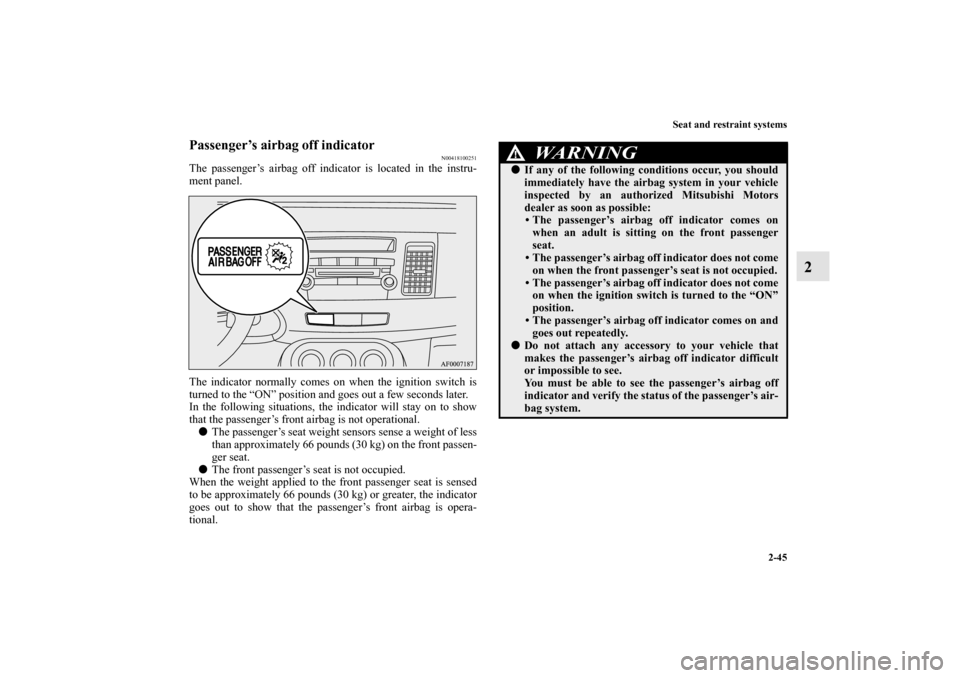
The passenger’s airbag off indicator is located in the instru-
ment panel.
The indicator normally comes on when the ignition switch is
turned to the “ON” position and goes out a few seconds later.
In the following situations, the indicator will stay on to show
that the passenger’s front airbag is not operational.�
The passenger’s seat weight sensors sense a weight of less
than approximately 66 pounds (30 kg) on the front passen-
ger seat.
�
The front passenger’s seat is not occupied.
When the weight applied to the front passenger seat is sensed
to be approximately 66 pounds (30 kg) or greater, the indicator
goes out to show that the passenger’s front airbag is opera-
tional.
WA R N I N G
!�
If any of the following conditions occur, you should
immediately have the airbag system in your vehicle
inspected by an authorized Mitsubishi Motors
dealer as soon as possible: The passenger’s airbag off indicator comes on
when an adult is sitting on the front passenger
seat.
The passenger’s airbag off indicator does not come
on when the front passenger’s seat is not occupied.
The passenger’s airbag off indicator does not come
on when the ignition switch is turned to the “ON”
position.
The passenger’s airbag off indicator comes on and
goes out repeatedly.
�
Do not attach any accessory to your vehicle that
makes the passenger’s airbag off indicator difficult
or impossible to see.
You must be able to see the passenger’s airbag off
indicator and verify the status of the passenger’s air-
bag system.
BK0103001US.book 45 ページ 2009年8月20日 木曜日 午前10時45分
Page 80 of 658
Seat and restraint systems
2-47
2
Driver’s and passenger’s front airbag system
N00407900275
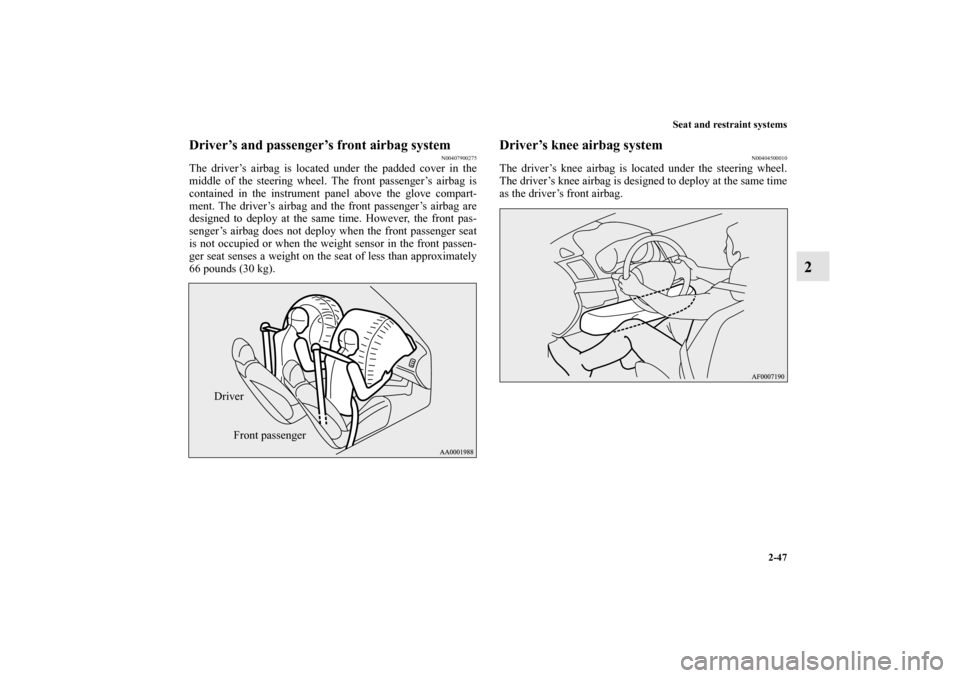
The driver’s airbag is located under the padded cover in the
middle of the steering wheel. The front passenger’s airbag is
contained in the instrument panel above the glove compart-
ment. The driver’s airbag and the front passenger’s airbag are
designed to deploy at the same time. However, the front pas-
senger’s airbag does not deploy when the front passenger seat
is not occupied or when the weight sensor in the front passen-
ger seat senses a weight on the seat of less than approximately
66 pounds (30 kg).
Driver’s knee airbag system
N00404500010
The driver’s knee airbag is located under the steering wheel.
The driver’s knee airbag is designed to deploy at the same time
as the driver’s front airbag.
Driver
Front passenger
BK0103001US.book 47 ページ 2009年8月20日 木曜日 午前10時45分
Page 118 of 658
Features and controls
3-23
3
�
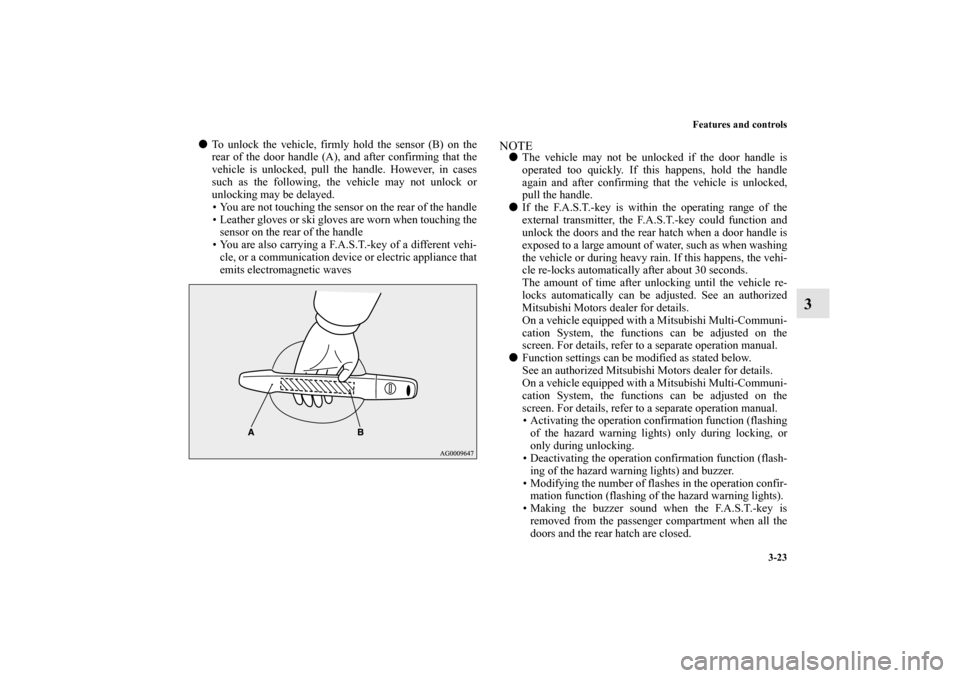
To unlock the vehicle, firmly hold the sensor (B) on the
rear of the door handle (A), and after confirming that the
vehicle is unlocked, pull the handle. However, in cases
such as the following, the vehicle may not unlock or
unlocking may be delayed.
You are not touching the sensor on the rear of the handle
Leather gloves or ski gloves are worn when touching the
sensor on the rear of the handle
You are also carrying a F.A.S.T.-key of a different vehi-
cle, or a communication device or electric appliance that
emits electromagnetic waves
NOTE�
The vehicle may not be unlocked if the door handle is
operated too quickly. If this happens, hold the handle
again and after confirming that the vehicle is unlocked,
pull the handle.
�
If the F.A.S.T.-key is within the operating range of the
external transmitter, the F.A.S.T.-key could function and
unlock the doors and the rear hatch when a door handle is
exposed to a large amount of water, such as when washing
the vehicle or during heavy rain. If this happens, the vehi-
cle re-locks automatically after about 30 seconds.
The amount of time after unlocking until the vehicle re-
locks automatically can be adjusted. See an authorized
Mitsubishi Motors dealer for details.
On a vehicle equipped with a Mitsubishi Multi-Communi-
cation System, the functions can be adjusted on the
screen. For details, refer to a separate operation manual.
�
Function settings can be modified as stated below.
See an authorized Mitsubishi Motors dealer for details.
On a vehicle equipped with a Mitsubishi Multi-Communi-
cation System, the functions can be adjusted on the
screen. For details, refer to a separate operation manual.
Activating the operation confirmation function (flashing
of the hazard warning lights) only during locking, or
only during unlocking.
Deactivating the operation confirmation function (flash-
ing of the hazard warning lights) and buzzer.
Modifying the number of flashes in the operation confir-
mation function (flashing of the hazard warning lights).
Making the buzzer sound when the F.A.S.T.-key is
removed from the passenger compartment when all the
doors and the rear hatch are closed.
BK0103001US.book 23 ページ 2009年8月20日 木曜日 午前10時45分
Page 233 of 658
3-138 Features and controls
3
After driving on icy roads
N00529200051
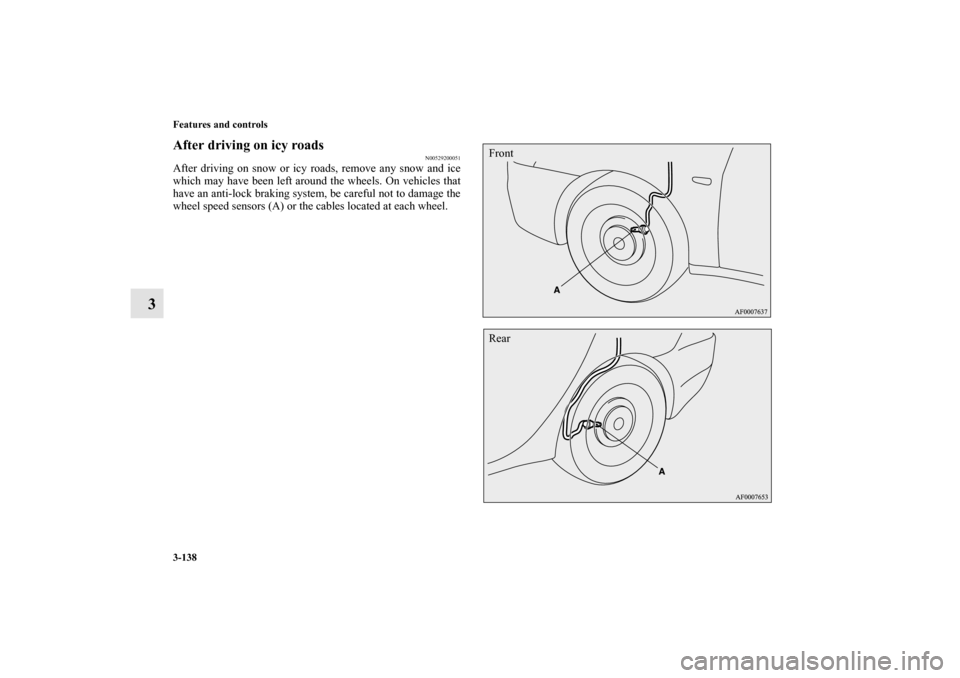
After driving on snow or icy roads, remove any snow and ice
which may have been left around the wheels. On vehicles that
have an anti-lock braking system, be careful not to damage the
wheel speed sensors (A) or the cables located at each wheel.
FrontRear
BK0103001US.book 138 ページ 2009年8月20日 木曜日 午前10時45分
Page 248 of 658
Features and controls
3-153
3
Under either of the following conditions, however, using the
switch does not allow you to resume the previously set speed.
In these situations, repeat the speed setting procedure:�
The “ON OFF” switch is pressed.
�
The ignition switch is turned OFF.
�
“CRUISE” indicator light is turned OFF.
Tire pressure monitoring system
N00530200309
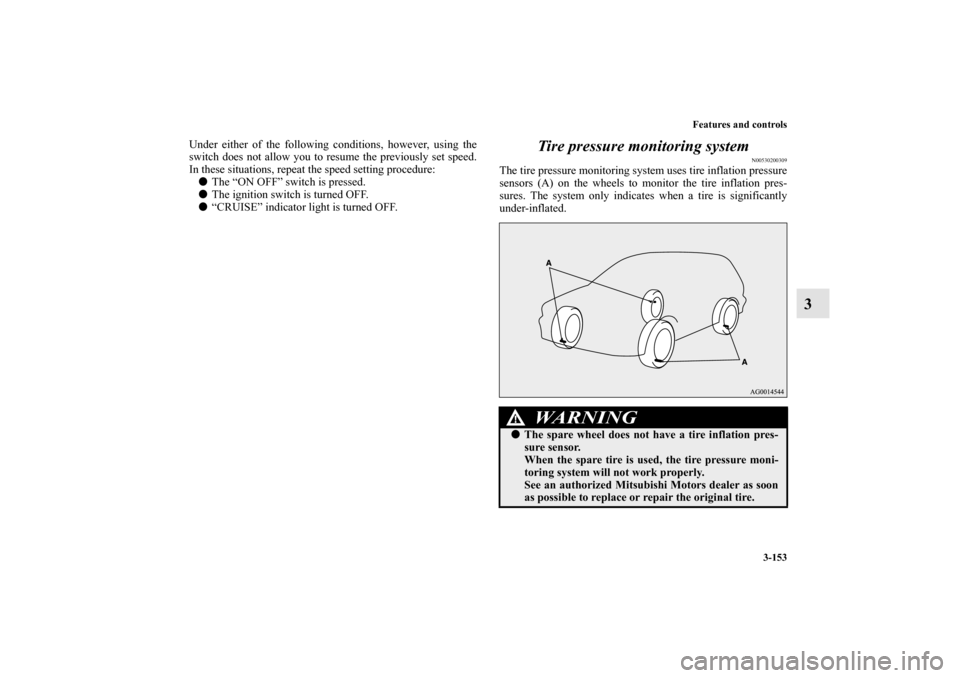
The tire pressure monitoring system uses tire inflation pressure
sensors (A) on the wheels to monitor the tire inflation pres-
sures. The system only indicates when a tire is significantly
under-inflated.
WA R N I N G
!�
The spare wheel does not have a tire inflation pres-
sure sensor.
When the spare tire is used, the tire pressure moni-
toring system will not work properly.
See an authorized Mitsubishi Motors dealer as soon
as possible to replace or repair the original tire.
BK0103001US.book 153 ページ 2009年8月20日 木曜日 午前10時45分
Page 249 of 658
3-154 Features and controls
3
NOTE�
The tire pressure monitoring system is not a substitute for
regularly checking tire inflation pressures.
Be sure to check the tire inflation pressures as described in
“Tires” on page 7-29.
�
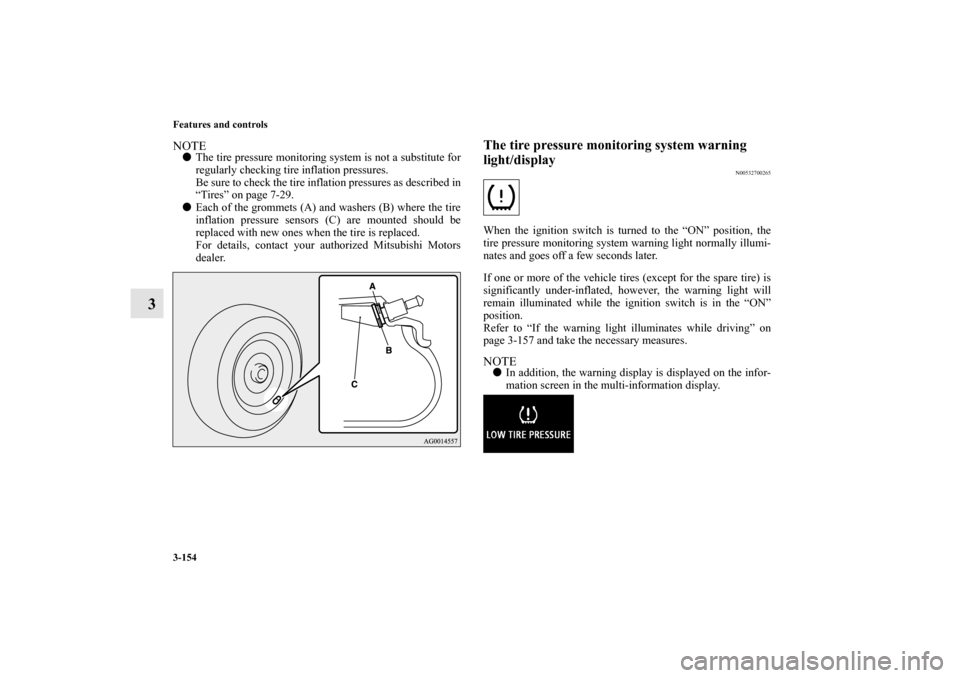
Each of the grommets (A) and washers (B) where the tire
inflation pressure sensors (C) are mounted should be
replaced with new ones when the tire is replaced.
For details, contact your authorized Mitsubishi Motors
dealer.
The tire pressure monitoring system warning
light/display
N00532700265
When the ignition switch is turned to the “ON” position, the
tire pressure monitoring system warning light normally illumi-
nates and goes off a few seconds later.
If one or more of the vehicle tires (except for the spare tire) is
significantly under-inflated, however, the warning light will
remain illuminated while the ignition switch is in the “ON”
position.
Refer to “If the warning light illuminates while driving” on
page 3-157 and take the necessary measures.NOTE�
In addition, the warning display is displayed on the infor-
mation screen in the multi-information display.
BK0103001US.book 154 ページ 2009年8月20日 木曜日 午前10時45分
Page 252 of 658
Features and controls
3-157
3
If the warning light illuminates while driving
N00532800309
1. If the tire pressure monitoring system warning light illu-
minates, avoid hard braking, sharp steering maneuvers
and high speeds. You should stop and adjust the tires to
the proper inflation pressure as soon as possible. Adjust
the spare tire at the same time. Refer to “Tires” on page 7-
29.NOTE�
In addition, the warning display is displayed on the infor-
mation screen in the multi-information display.
�
Once adjustments have been made, the warning light will
go off after a few minutes of driving.
2. If the tire pressure monitoring system warning light
remains illuminated after you have been driving for about
20 minutes after you adjust the tire inflation pressure, one
or more of the tires may have a puncture. Inspect the tire
and if it has a puncture, have it repaired by an authorized
Mitsubishi Motors dealer as soon as possible.
NOTE�
To avoid the risk of damage to the tire inflation pressure
sensors, have any punctured tire repaired by an authorized
Mitsubishi Motors dealer. If the tire repair is not done by
an authorized Mitsubishi Motors dealer, it is not covered
by your warranty.
�
Do not use an aerosol puncture-repair product on any tire,
as it could damage the tire inflation pressure sensors.
Have any puncture repaired by an authorized Mitsubishi
Motors dealer.
WA R N I N G
!�
If the warning light/display illuminates while you
are driving, avoid hard braking, sharp steering
maneuvers and high speeds. Driving with an under-
inflated tire adversely affects vehicle performance
and can result in an accident.
CAUTION
!�
If a tire has a puncture, replace that tire with the
spare tire. Driving on a punctured tire could lead to
an accident.
�
The warning light/display may not illuminate imme-
diately in the event of a tire blowout or rapid leak.
BK0103001US.book 157 ページ 2009年8月20日 木曜日 午前10時45分