2010 KIA Sportage tow
[x] Cancel search: towPage 299 of 371
615
In case of an emergency
1
2
3
4
5
6
7
8
9
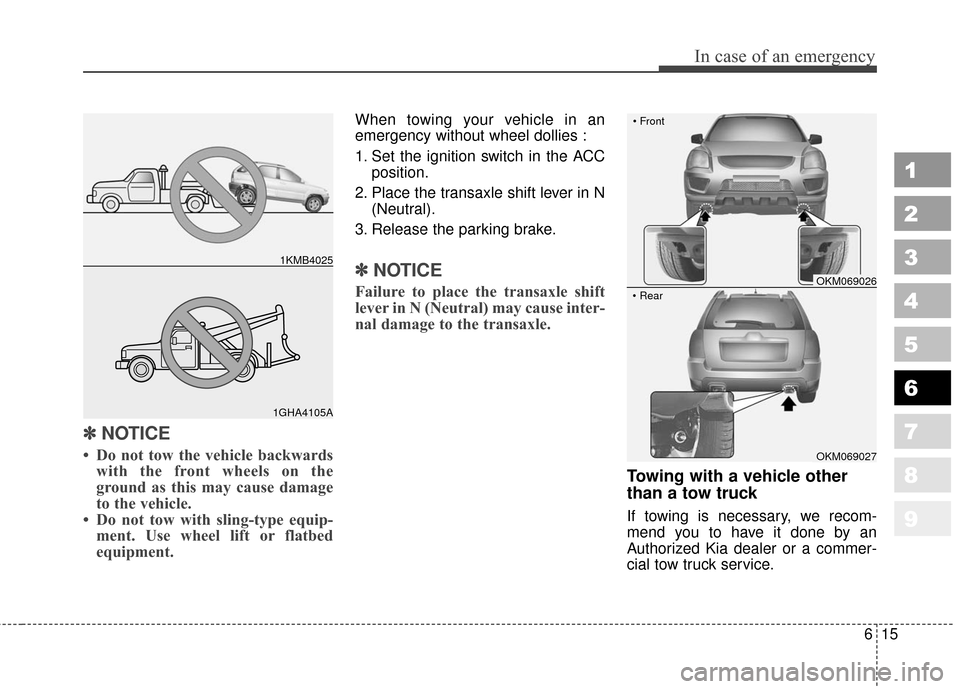
✽ ✽NOTICE
• Do not tow the vehicle backwards
with the front wheels on the
ground as this may cause damage
to the vehicle.
• Do not tow with sling-type equip- ment. Use wheel lift or flatbed
equipment.
When towing your vehicle in an
emergency without wheel dollies :
1. Set the ignition switch in the ACC
position.
2. Place the transaxle shift lever in N (Neutral).
3. Release the parking brake.
✽ ✽ NOTICE
Failure to place the transaxle shift
lever in N (Neutral) may cause inter-
nal damage to the transaxle.
Towing with a vehicle other
than a tow truck
If towing is necessary, we recom-
mend you to have it done by an
Authorized Kia dealer or a commer-
cial tow truck service.
1GHA4105A1KMB4025
OKM069026
OKM069027
Page 300 of 371

In case of an emergency
16
6
1
2
3
4
5
6
7
8
9
If towing service is not available in an
emergency, your vehicle may be
temporarily towed using a cable or
chain secured to the emergency tow-
ing hook under the front or rear of the
vehicle. Use extreme caution when
towing the vehicle. A driver must be
in the vehicle to steer it and operate
the brakes. Towing in this manner may be done
only on hard-surfaced roads for a
short distance and at low speeds.
Also, the wheels, axles, power train,
steering and brakes must all be in
good condition.
Do not use the tow hooks to pull a
vehicle out of mud, sand or other
conditions from which the vehicle
cannot be driven out under its own
power.
Avoid towing a vehicle heavier than the vehicle doing the towing.✽ ✽ NOTICE
• Attach a towing strap to the tow
hook.
• Using a portion of the vehicle other than the tow hooks for tow-
ing may damage the body of your
vehicle.
• Use only a cable or chain specifi- cally intended for use in towing
vehicles. Securely fasten the cable
or chain to the towing hook pro-
vided.
Page 301 of 371

617
In case of an emergency
1
2
3
4
5
6
7
8
9
Before emergency towing, checkthat the hook is not broken or dam-
aged.
Fasten the towing cable or chain securely to the hook.
Do not jerk the hook. Apply steady and even force.
To avoid damaging the hook, do not pull from the side or at a verti-
cal angle. Always pull straight
ahead.
Use a towing strap less than 5 m(16 feet) long. Attach a white or red
cloth (about 30 cm (12 inches)
wide) in the middle of the strap for
easy visibility.
Drive carefully so that the towing strap is not loosened during tow-
ing.CAUTION
Use extreme caution when tow-ing the vehicle.
driving maneuvers whichwould place excessive stresson the emergency towinghook and towing cable orchain. The hook and towingcable or chain may break andcause serious injury or dam-age.
If the towing vehicle can hard- ly move, do not forcibly con-tinue the towing. Contact anAuthorized Kia dealer or acommercial tow truck servicefor assistance.
Tow the vehicle as straight ahead as possible.
Keep away from the vehicle during towing.
1KMA4028
Page 302 of 371

In case of an emergency
18
6
1
2
3
4
5
6
7
8
9
When your vehicle is being
towed by another vehicle
other than a tow truck (in case
of an emergency)
Turn the ignition switch to ACC so
the steering wheel isn’t locked.
Place the transaxle shift lever in N (Neutral).
Release the parking bake.
Vehicles equipped with automatic transaxles should not exceed 45
km/h (28 mph) and should not be
towed more than 80 km (50 miles).
Vehicles equipped with manual transaxle should not be towed in
excess of 88 km/h (55 mph) and
should not be towed more than
645 km (400 miles). Press the brake pedal with more
force than normal since you will
have reduced brake performance.
More steering effort will be required because the power steer-
ing system will be disabled.
If you are driving down a long hill, the brakes may overheat and brake
performance will be reduced. Stop
often and let the brakes cool off.
✽ ✽ NOTICE
To prevent internal damage to the
transaxle, never tow your vehicle
from the rear (backwards) with all
four tires in contact with the sur-
face.
Tips for towing a stuck vehicle
The following methods are effective
when your vehicle is stuck in mud,
sand or similar substances that pre-
vent the vehicle from being driven
out under its own power.
Remove the soil and sand, etc.
from the front and the back of the
tires.
Place a stone or wood under the tires.
Page 305 of 371

621
In case of an emergency
1
2
3
4
5
6
7
8
9
Changing tires
Jacking instructions
The jack is provided for emergency
tire changing only.
Follow jacking instructions to reduce
the possibility of personal injury.
WARNING- Changingtires
Never attempt vehicle repairs in the traffic lanes of a public
road or highway.
Always move the vehicle com- pletely off the road and onto
the shoulder before trying to
change a tire. The jack should
be used on level firm ground.
If you cannot find a firm, level
place off the road, call a tow-
ing service company for
assistance.
Be sure to use the correct front and rear jacking posi-
tions on the vehicle; never use
the bumpers or any other part
of the vehicle for jack support.
(Continued)(Continued)
The vehicle can easily roll offthe jack causing serious
injury or death. No person
should place any portion of
their body under a vehicle that
is supported only by a jack ;
use vehicle support stands.
Do not start or run the engine while the vehicle is on the
jack.
Do not allow anyone to remain in the vehicle while it is on the
jack.
Make sure any children pre- sent are in a secure place
away from the road and from
the vehicle to be raised with
the jack.
1KMA4013
Page 328 of 371

719
Maintenance
1
2
3
4
5
6
7
8
9
ENGINE COOLING SYSTEM
The high-pressure cooling system
has a reservoir filled with year-round
antifreeze coolant. The reservoir is
filled at the factory.
Check the antifreeze protection and
coolant level at least once a year, at
the beginning of the winter season,
and before traveling to a colder cli-
mate.Checking the coolant level
WARNING- Removingradiator cap
Never attempt to remove the radiator cap while the engine
is operating or hot. Doing so
might lead to cooling system
and engine damage and could
result in serious personal
injury from escaping hot
coolant or steam.
Turn the engine off and wait until it cools down. Use
extreme care when removing
the radiator cap. Wrap a thick
towel around it, and turn it
counterclockwise slowly to
the first stop. Step back while
the pressure is released from
the cooling system. When you
are sure all the pressure has
been released, press down on
the cap, using a thick towel,
and continue turning counter-
clockwise to remove it.
(Continued)
(Continued)
Even if the engine is not oper-ating, do not remove the radi-
ator cap or the drain plug
while the engine and radiator
are hot. Hot coolant and steam
may still blow out under pres-
sure, causing serious injury.
Page 370 of 371

93
1
2
3
4
5
6
7
8
9
Index
Instrument panel overview . . . . . . . . . . . . . . . . . . . . . 2-3
Interior care . . . . . . . . . . . . . . . . . . . . . . . . . . . . . . . . 7-53
Interior features . . . . . . . . . . . . . . . . . . . . . . . . . . . . . 3-92
Interior lights . . . . . . . . . . . . . . . . . . . . . . . . . . . . . . . 3-88
Interior overview . . . . . . . . . . . . . . . . . . . . . . . . . . . . . 2-2
Keys . . . . . . . . . . . . . . . . . . . . . . . . . . . . . . . . . . . . \
. . . . 3-2
Label information. . . . . . . . . . . . . . . . . . . . . . . . . . . . 5-51
Lighting . . . . . . . . . . . . . . . . . . . . . . . . . . . . . . . . . . . . \
4-54
Lubricant specifications. . . . . . . . . . . . . . . . . . . . . . . 7-48
Luggage center box . . . . . . . . . . . . . . . . . . . . . . . . . 3-103
Luggage net . . . . . . . . . . . . . . . . . . . . . . . . . . . . . . . . 3-101
Maintenance schedule . . . . . . . . . . . . . . . . . . . . . . . . . 7-4
Maintenance services . . . . . . . . . . . . . . . . . . . . . . . . . . 7-3
Manual climate control system . . . . . . . . . . . . . . . . . 4-63
Manual transaxle . . . . . . . . . . . . . . . . . . . . . . . . . . . . . 4-5
Mirrors . . . . . . . . . . . . . . . . . . . . . . . . . . . . . . . . . . . . \
3-84
Overheating. . . . . . . . . . . . . . . . . . . . . . . . . . . . . . . . . . 6-3
Overloading. . . . . . . . . . . . . . . . . . . . . . . . . . . . . . . . . 5-40
Owner maintenance . . . . . . . . . . . . . . . . . . . . . . . . . . 7-12Parking brake . . . . . . . . . . . . . . . . . . . . . . . . . . . . . . . 7-23
Power steering . . . . . . . . . . . . . . . . . . . . . . . . . . . . . . 7-24
Rear differential (4WD). . . . . . . . . . . . . . . . . . . . . . . 7-27
Rear parking assist system . . . . . . . . . . . . . . . . . . . . 4-48
Remote keyless entry . . . . . . . . . . . . . . . . . . . . . . . . . . 3-3
Road warning . . . . . . . . . . . . . . . . . . . . . . . . . . . . . . . . 6-2
Roof rack . . . . . . . . . . . . . . . . . . . . . . . . . . . . . . . . . . 3-10\
4
Safety belts . . . . . . . . . . . . . . . . . . . . . . . . . . . . . . . . . 3-31
Seat. . . . . . . . . . . . . . . . . . . . . . . . . . . . . . . . . . \
. . . . . . 3-19
Special driving conditions . . . . . . . . . . . . . . . . . . . . . . 5-8
Specifications . . . . . . . . . . . . . . . . . . . . . . . . . . . . . . . . 8-2
Starting the engine . . . . . . . . . . . . . . . . . . . . . . . . . . . . 4-4
Steering wheel . . . . . . . . . . . . . . . . . . . . . . . . . . . . . . . 4-24
Storage compartment. . . . . . . . . . . . . . . . . . . . . . . . . 3-89
Suggestions for economical operation . . . . . . . . . . . . 5-6
Sunroof . . . . . . . . . . . . . . . . . . . . . . . . . . . . . . . . . . . . \
3-97
Theft-alarm system . . . . . . . . . . . . . . . . . . . . . . . . . . . 3-5
Tires and wheels . . . . . . . . . . . . . . . . . . . . . . . . . . . . . 7-36
Tonneau cover . . . . . . . . . . . . . . . . . . . . . . . . . . . . . . 3-101
Towing . . . . . . . . . . . . . . . . . . . . . . . . . . . . . . . . . . . . \
. 6-14
K
L
M
O
P
R
S
T
Page 371 of 371

Index
49
1
2
3
4
5
6
7
8
9
Trailer towing . . . . . . . . . . . . . . . . . . . . . . . . . . . . . . . 5-33
Transfer case (4WD) . . . . . . . . . . . . . . . . . . . . . . . . . 7-27
Using four-wheel drive . . . . . . . . . . . . . . . . . . . . . . . . 5-14
Vehicle break-in process . . . . . . . . . . . . . . . . . . . . . . . 1-3
Vehicle handling instructions . . . . . . . . . . . . . . . . . . . 1-3
Vehicle load limit . . . . . . . . . . . . . . . . . . . . . . . . . . . . 5-41
Warnings and indicators . . . . . . . . . . . . . . . . . . . . . . 4-39
Weight of the vehicle . . . . . . . . . . . . . . . . . . . . . . . . . 5-32
Window . . . . . . . . . . . . . . . . . . . . . . . . . . . . . . . . . . . . \
3-16
Windshield defrosting and defogging . . . . . . . . . . . . 4-81
Wiper blades . . . . . . . . . . . . . . . . . . . . . . . . . . . . . . . . 7-31
Wipers and washers . . . . . . . . . . . . . . . . . . . . . . . . . . 4-58
U
V
W