2010 JAGUAR XFR fuel pump
[x] Cancel search: fuel pumpPage 1342 of 3039
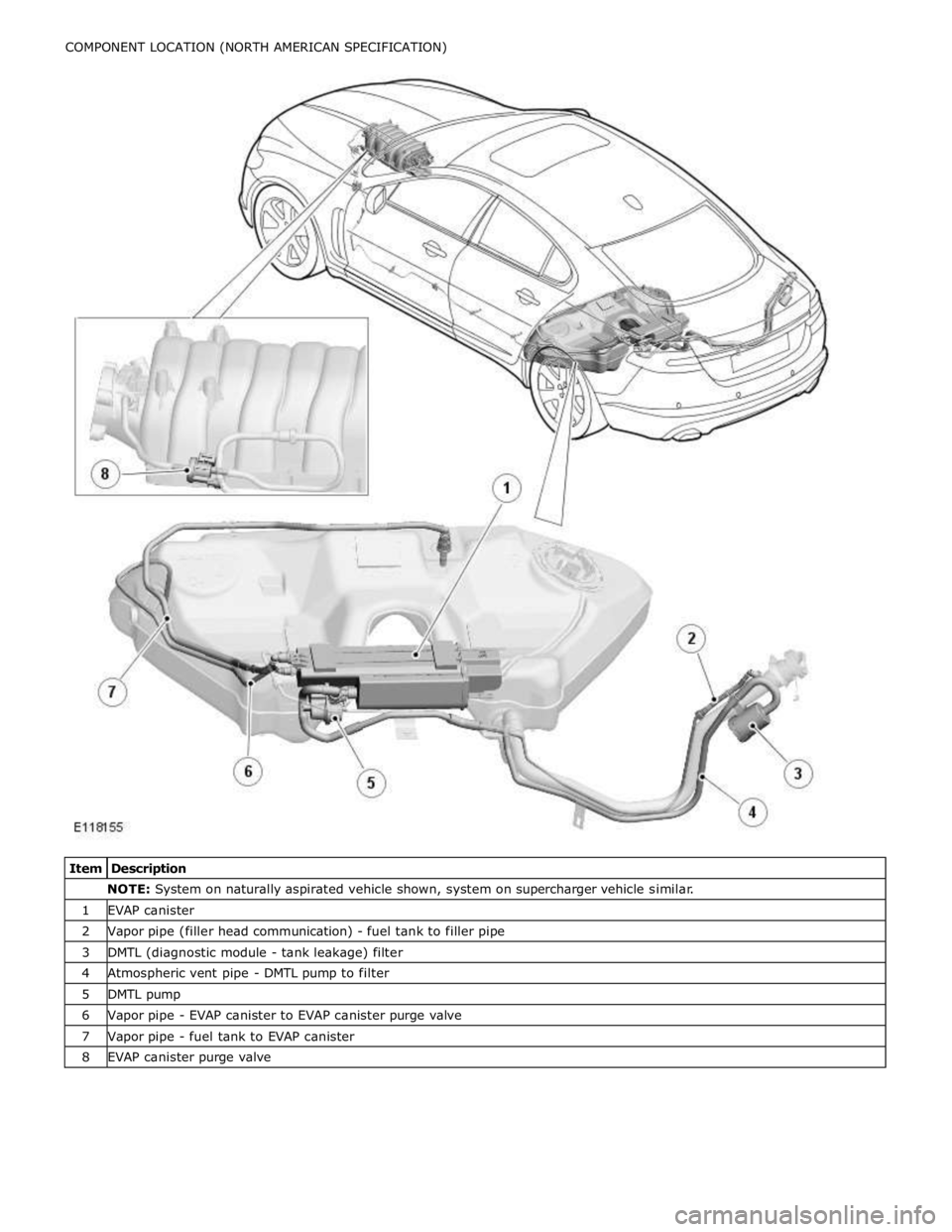
NOTE: System on naturally aspirated vehicle shown, system on supercharger vehicle similar. 1 EVAP canister 2 Vapor pipe (filler head communication) - fuel tank to filler pipe 3 DMTL (diagnostic module - tank leakage) filter 4 Atmospheric vent pipe - DMTL pump to filter 5 DMTL pump 6 Vapor pipe - EVAP canister to EVAP canister purge valve 7 Vapor pipe - fuel tank to EVAP canister 8 EVAP canister purge valve
Page 1343 of 3039

vehicles, a DMTL pump and filter. The vapor pipes are connected to the system components using quick release connectors.
Fuel vapor is generated by the fuel in the tank and the amount of vapor produced increases as the fuel heats up. Fuel vapor
can flow freely to the EVAP canister via the tank venting system. On NAS vehicles the vapor generated in the fuel tank during refueling flows without restriction to the EVAP canister.
On all vehicles except NAS, the vapor is restricted in its path to the EVAP canister, but can flow freely during the refueling operation to atmosphere via the fuel filler pipe opening.
The vapor passes into the EVAP canister where it is absorbed and stored by the charcoal. Because there is a limit to the amount of vapor the canister can contain, the fuel vapor is purged from the canister when the engine is running and burned in
the engine.
Page 1344 of 3039
Published: 11-May-2011
Evaporative Emissions - V8 5.0L Petrol/V8 S/C 5.0L Petrol - Evaporative Emissions - System Operation and Component Description
Description and Operation
System Operation DIAGNOSTIC MODULE - TANK LEAKAGE PUMP (NAS ONLY)
To check the fuel tank and the EVAP (evaporative emission) system for leaks, the ECM (engine control module) operates the
DMTL pump and monitors the current draw. Initially, the ECM establishes a reference current by pumping air through the reference orifice and back to atmosphere. Once the reference current is determined, the ECM closes the change-over valve, which seals the EVAP system. The EVAP canister purge valve remains de-energized and is therefore closed. The output from the air pump is diverted from the reference orifice and into the EVAP system.
When the change-over valve is closed, the load on the air pump falls to zero. Providing there are no leaks, the air pump will
begin to pressurize the EVAP system and the load and current draw in the pump increases. By monitoring the rate and level of the current increase, the ECM can determine if there is a leak in the EVAP system.
During normal vehicle operation, 15 seconds after the engine has started, the ECM energizes the heating element in the pump to prevent condensation formation and possible incorrect readings. The heater remains energized until either the engine and
ignition are off (if no DMTL test is running) or until after the DMTL test is completed.
Leaks are classified as:
Minor - equivalent to a hole diameter of 0.5 to 1.0 mm (0.02 to 0.04 in.).
Major - equivalent to a hole diameter of 1.0 mm (0.04 in.) or greater.
The ECM performs a check for major leaks each time the ignition is switched off, providing the following conditions are met: The vehicle speed is zero.
The engine speed is zero.
The atmospheric pressure is above 70 kPa (10.15 lbf/in2
), i.e. the altitude is less than approximately 3047 m (10000
feet).
The ambient temperature is between 0 and 40 °C (32 and 104 °F).
The EVAP canister vapor concentration factor is 5 or less (where 0 is no fuel vapor, 1 is stoichiometric fuel vapor and greater than 1 is rich fuel vapor).
The fuel tank level is valid and between 15 and 85% of nominal capacity.
The engine running time during the previous cycle was more than 10 minutes.
The battery voltage is between 10 and 15 volts.
The last engine off time was more than 180 minutes.
No errors are detected with the EVAP components, the ambient air temperature and the fuel level.
NOTE: A leak test can be performed using a Jaguar recognized diagnostic tool. This overrides the above conditions and is
useful for checking correct system and component operation.
The ECM performs a check for minor leaks after every 2nd major leak check.
When the leak check is complete, the ECM stops the DMTL pump and opens (de-energizes) the change-over valve.
If the fuel filler cap is opened or refueling is detected during the leak check, by a sudden drop in the current draw or a rise in
the fuel level, the ECM aborts the leak check.
If a leak is detected during the check, the ECM stores an appropriate fault code in its memory. If a leak is detected on two consecutive checks, the ECM illuminates the MIL (malfunction indicator lamp) in the instrument cluster on the next drive cycle. The duration of a leak check can be between 60 and 900 seconds depending on the results and fuel tank level.
EVAP CANISTER PURGE VALVE
The ECM waits until the engine is running above 55 °C (131 °F) coolant temperature with closed loop fuel operational before the purging process is activated. Under these conditions the engine should be running smoothly with no warm up enrichment.
The EVAP canister purge valve duty (and flow) is initially ramped slowly because the vapor concentration is unknown (a sudden increase in purge could cause unstable engine running or cause it to stall due to an extremely "rich" air/fuel mixture). The
concentration is then determined from the amount of adjustment that the closed loop fueling is required to make to achieve
the target AFR (air fuel ratio). Once the concentration has been determined, the purge flow can be increased rapidly and the
injected fuel can be pro-actively adjusted to compensate for the known purge vapor and the target AIR control is maintained.
When the purging process is active, fresh air is drawn into the EVAP canister via the DMTL filter and pump on NAS vehicles, or via the vent port on the EVAP canister of non NAS vehicles.
Page 1345 of 3039
Component Description DIAGNOSTIC MODULE - TANK LEAKAGE PUMP (NAS ONLY)
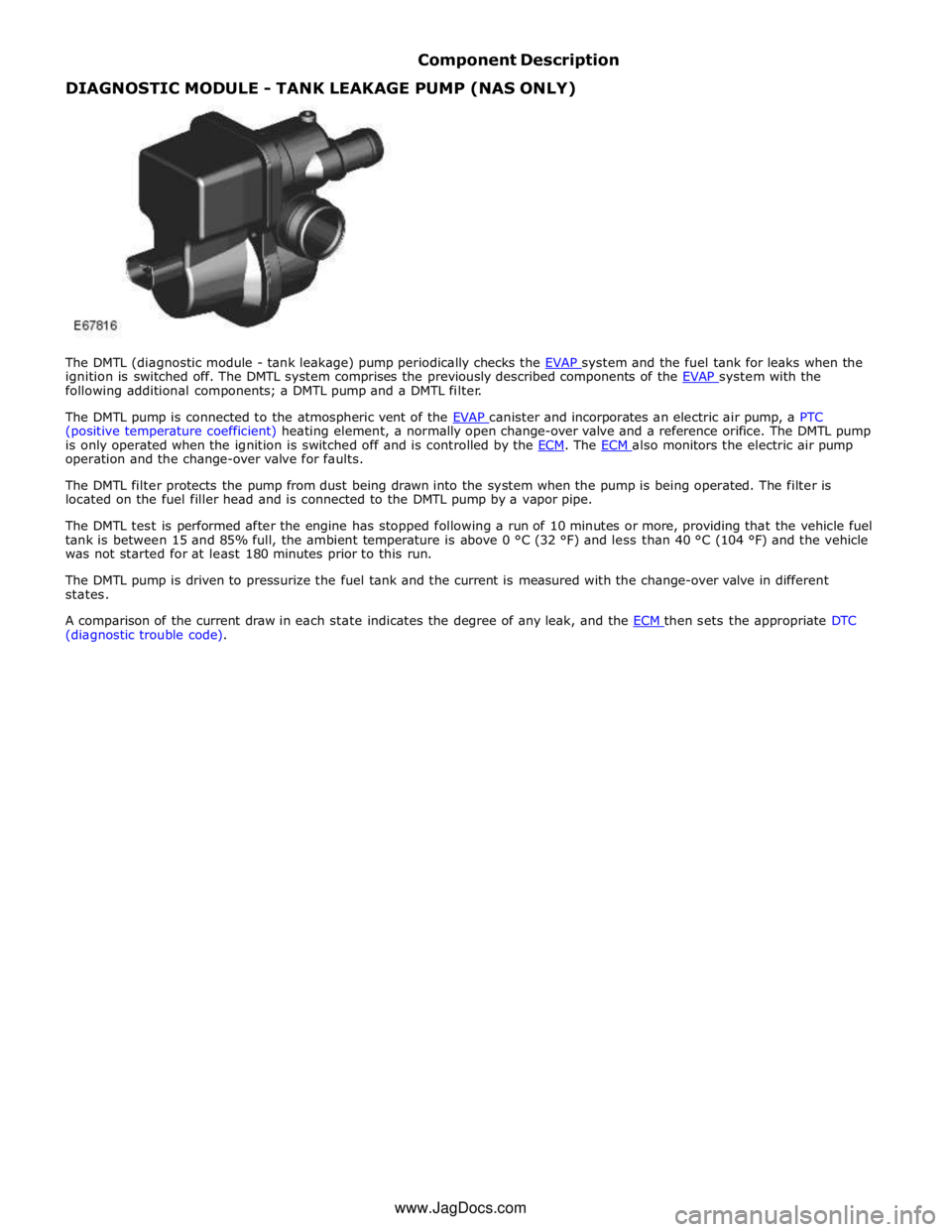
The DMTL (diagnostic module - tank leakage) pump periodically checks the EVAP system and the fuel tank for leaks when the ignition is switched off. The DMTL system comprises the previously described components of the EVAP system with the following additional components; a DMTL pump and a DMTL filter.
The DMTL pump is connected to the atmospheric vent of the EVAP canister and incorporates an electric air pump, a PTC (positive temperature coefficient) heating element, a normally open change-over valve and a reference orifice. The DMTL pump
is only operated when the ignition is switched off and is controlled by the ECM. The ECM also monitors the electric air pump operation and the change-over valve for faults.
The DMTL filter protects the pump from dust being drawn into the system when the pump is being operated. The filter is
located on the fuel filler head and is connected to the DMTL pump by a vapor pipe.
The DMTL test is performed after the engine has stopped following a run of 10 minutes or more, providing that the vehicle fuel
tank is between 15 and 85% full, the ambient temperature is above 0 °C (32 °F) and less than 40 °C (104 °F) and the vehicle
was not started for at least 180 minutes prior to this run.
The DMTL pump is driven to pressurize the fuel tank and the current is measured with the change-over valve in different
states.
A comparison of the current draw in each state indicates the degree of any leak, and the ECM then sets the appropriate DTC (diagnostic trouble code).
www.JagDocs.com
Page 1346 of 3039
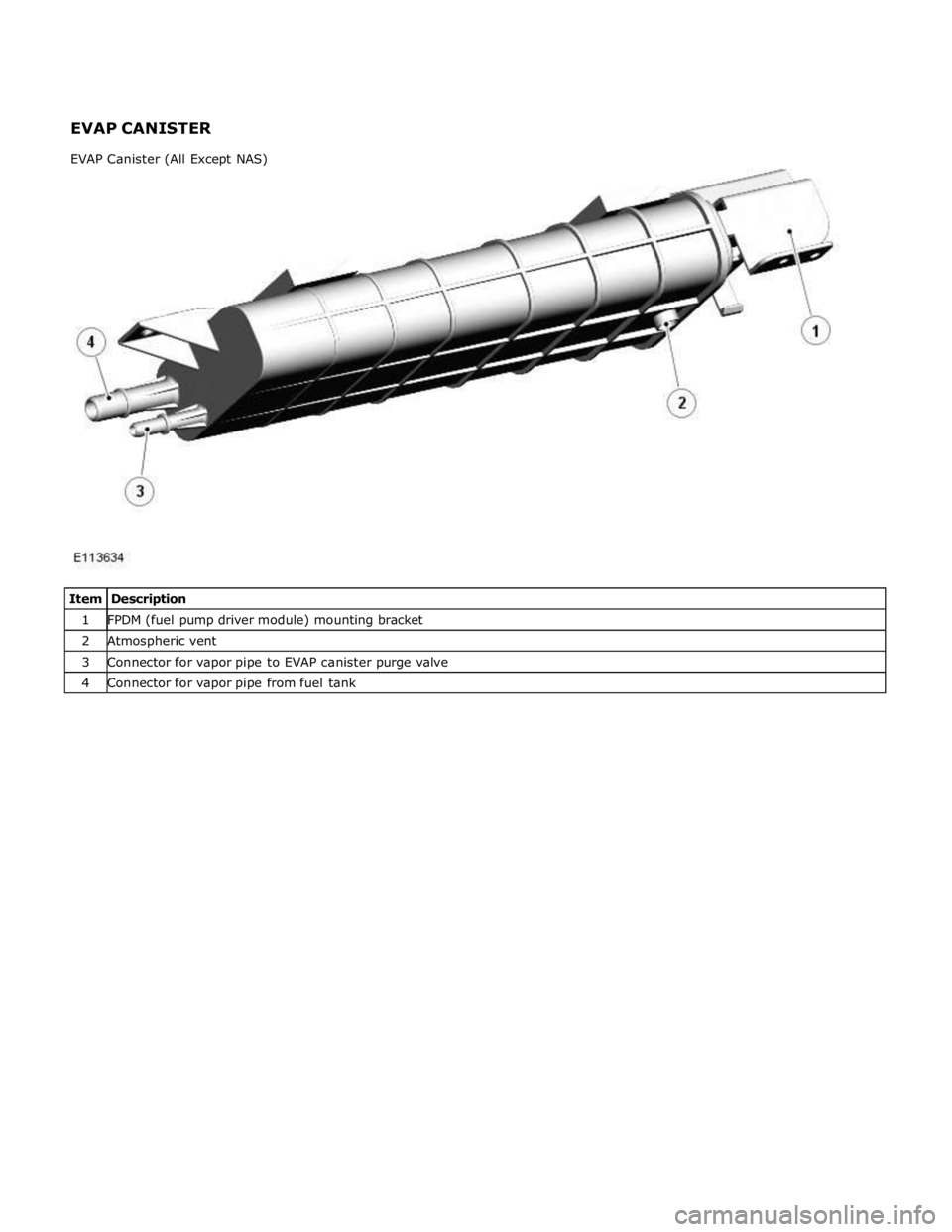
1 FPDM (fuel pump driver module) mounting bracket 2 Atmospheric vent 3 Connector for vapor pipe to EVAP canister purge valve 4 Connector for vapor pipe from fuel tank EVAP CANISTER
EVAP Canister (All Except NAS)
Page 1347 of 3039
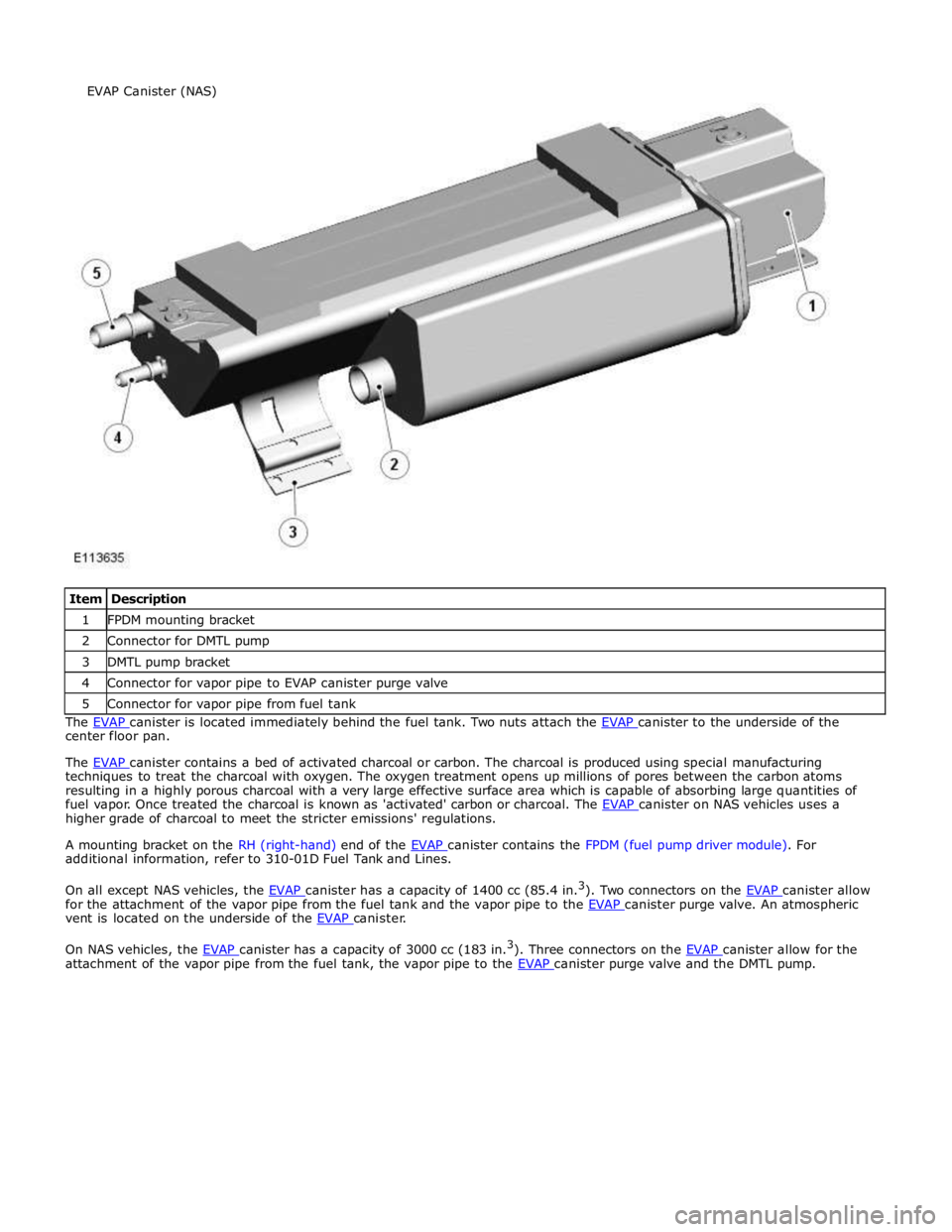
1 FPDM mounting bracket 2 Connector for DMTL pump 3 DMTL pump bracket 4 Connector for vapor pipe to EVAP canister purge valve 5 Connector for vapor pipe from fuel tank The EVAP canister is located immediately behind the fuel tank. Two nuts attach the EVAP canister to the underside of the center floor pan.
The EVAP canister contains a bed of activated charcoal or carbon. The charcoal is produced using special manufacturing techniques to treat the charcoal with oxygen. The oxygen treatment opens up millions of pores between the carbon atoms
resulting in a highly porous charcoal with a very large effective surface area which is capable of absorbing large quantities of
fuel vapor. Once treated the charcoal is known as 'activated' carbon or charcoal. The EVAP canister on NAS vehicles uses a higher grade of charcoal to meet the stricter emissions' regulations.
A mounting bracket on the RH (right-hand) end of the EVAP canister contains the FPDM (fuel pump driver module). For additional information, refer to 310-01D Fuel Tank and Lines.
On all except NAS vehicles, the EVAP canister has a capacity of 1400 cc (85.4 in.3
). Two connectors on the EVAP canister allow for the attachment of the vapor pipe from the fuel tank and the vapor pipe to the EVAP canister purge valve. An atmospheric vent is located on the underside of the EVAP canister.
On NAS vehicles, the EVAP canister has a capacity of 3000 cc (183 in.3
). Three connectors on the EVAP canister allow for the attachment of the vapor pipe from the fuel tank, the vapor pipe to the EVAP canister purge valve and the DMTL pump. EVAP Canister (NAS)
Page 1361 of 3039
DIAGNOSTICS
The ECM stores each fault as a DTC (diagnostic trouble code). The DTC and associated environmental and freeze frame data can be read using Jaguar approved diagnostic equipment, which can also read real time data from each sensor, the adaption
values currently being employed and the current fueling, ignition and idle speed settings.
ENGINE CONTROL MODULE Component Description
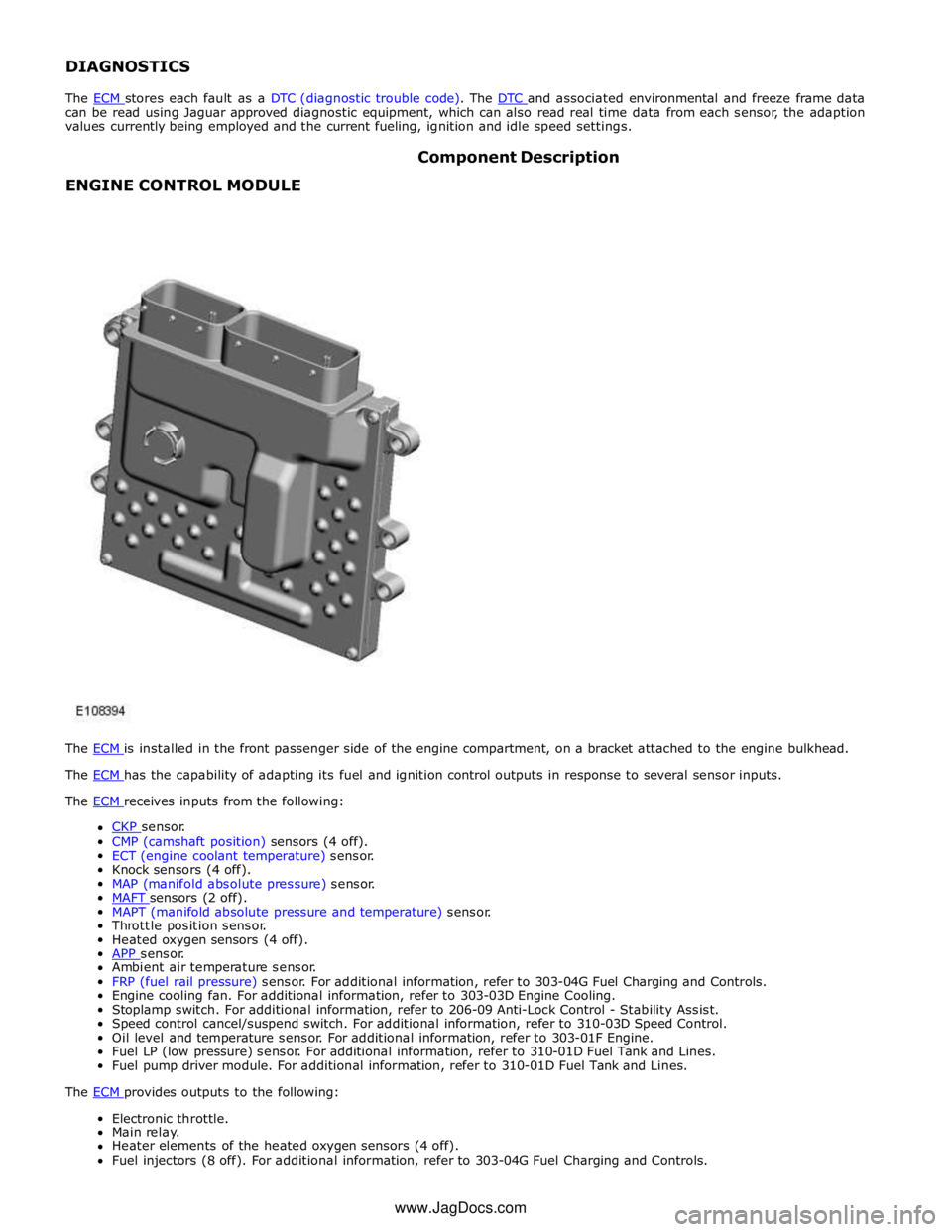
The ECM is installed in the front passenger side of the engine compartment, on a bracket attached to the engine bulkhead. The ECM has the capability of adapting its fuel and ignition control outputs in response to several sensor inputs. The ECM receives inputs from the following:
CKP sensor. CMP (camshaft position) sensors (4 off).
ECT (engine coolant temperature) sensor.
Knock sensors (4 off).
MAP (manifold absolute pressure) sensor.
MAFT sensors (2 off). MAPT (manifold absolute pressure and temperature) sensor.
Throttle position sensor.
Heated oxygen sensors (4 off).
APP sensor. Ambient air temperature sensor.
FRP (fuel rail pressure) sensor. For additional information, refer to 303-04G Fuel Charging and Controls.
Engine cooling fan. For additional information, refer to 303-03D Engine Cooling.
Stoplamp switch. For additional information, refer to 206-09 Anti-Lock Control - Stability Assist.
Speed control cancel/suspend switch. For additional information, refer to 310-03D Speed Control.
Oil level and temperature sensor. For additional information, refer to 303-01F Engine.
Fuel LP (low pressure) sensor. For additional information, refer to 310-01D Fuel Tank and Lines.
Fuel pump driver module. For additional information, refer to 310-01D Fuel Tank and Lines.
The ECM provides outputs to the following: Electronic throttle.
Main relay.
Heater elements of the heated oxygen sensors (4 off).
Fuel injectors (8 off). For additional information, refer to 303-04G Fuel Charging and Controls. www.JagDocs.com
Page 1369 of 3039

Published: 16-Sep-2013
Electronic Engine Controls - V8 S/C 5.0L Petrol - Electronic Engine Controls
Diagnosis and Testing
Principle of Operation
For a detailed description of electronic engine controls, refer to the relevant Description and Operation section of the workshop
manual. REFER to: (303-14D Electronic Engine Controls - V8 S/C 5.0L Petrol)
Electronic Engine Controls (Description and Operation), Electronic Engine Controls (Description and Operation), Electronic Engine Controls (Description and Operation).
Inspection and Verification
1. Verify the customer concern.
2. Visually inspect for obvious signs of damage and system integrity.
Visual Inspection
Mechanical Electrical
Engine oil level and condition
Cooling system coolant level
Fuel level
Fuel contamination/grade/quality
Throttle body
Front End Accessory Drive (FEAD) belt
Air cleaner condition
Fuses
Wiring harness
Electrical connector(s)
Sensor(s)
Engine Control Module
Transmission Control Module
3. If an obvious cause for an observed or reported concern is found, correct the cause (if possible) before proceeding to
the next step.
4. If the cause is not visually evident, verify the customer concern and refer to the Symptom Chart below, alternatively,
check for Diagnostic Trouble Codes (DTCs) and refer to the DTC Index.
Symptom Chart
Symptom Possible Cause Action Engine non-start Engine does not crank
Security system /Immobilizer
engaged
Engine in shut-down mode
ECM relay
Battery
Starting system
Engine seized
Check that the security system is disarmed
Read DTCs and refer to DTC Index in this
section for ECM relay tests
Ensure the battery is in fully charged and
serviceable condition
For starting system tests refer to the
relevant section of the workshop manual
For engine system tests refer to the relevant
section of the workshop manual Engine cranks, but does not fire
Engine breather system
disconnected/restricted
Ignition system
Fuel system
Electronic engine controls
Ensure the engine breather system is free
from restriction and is correctly installed
For ignition system tests refer to the
relevant section of the workshop manual
For fuel system tests refer to the relevant
section of the workshop manual
Read DTCs and refer to DTC Index in this
section for electronic engine control tests Engine cranks and fires, but will not
start
Evaporative emissions purge
valve
Fuel pump
Spark plugs
Ignition coil failure(s)
For purge valve tests refer to the relevant
section of the workshop manual
For fuel system tests refer to the relevant
section of the workshop manual
For ignition system tests refer to the
relevant section of the workshop manual Difficult to start Difficult cold start
Check engine coolant
level/anti-freeze content
Battery
Electronic engine controls
Exhaust gas recirculation
Check the engine coolant level and
condition. Refer to the relevant sections of
the workshop manual
Ensure the battery is in a fully charged and
serviceable condition. Refer to the battery