Page 897 of 3039
17.
18.
Press the cruise control cancel button twice within 2
seconds.
The message center display will revert to the normal
display in the trip computer.
Scroll through the trip menu to access the engine oil
level display.
Check that the oil level display shows an oil level
reading.
Only after having started and run the engine for 10
minutes (as indicated in Step 14), switch off the
engine, then stabilizing for 10 minutes, take a
reading from the oil level display and, if necessary
top up with engine oil.
19. NOTE: If instructed to follow Steps 15-19 in a previous step, return
to Step 14 and continue the procedure.
Turn the ignition off.
20. Allow 10 minutes for the engine oil level to stabilize if there has been
additional oil top up.
Page 903 of 3039

Installation
1. CAUTIONS:
Prior to installing the camshafts, position the
crankshaft 45 degrees ATDC cylinder 1A to prevent
valve/piston collision.
Make sure that the camshafts and camshaft bearing
caps are installed in their original locations.
Evenly and progressively install and tighten the
camshaft bearing caps.
NOTE: Lubricate the camshafts and the camshaft
bearing caps with EP90 oil (or 75/90 viscosity oil will
suffice) prior to installation.
Torque: 3 Nm
2. NOTE: Tighten the bolts in the indicated sequence.
Torque: 12 Nm
3. CAUTION: Only rotate the crankshaft clockwise.
Rotate the crankshaft untill the camshaft lobe on the valve being
checked is 180 degrees from the maximum opening position.
4. NOTE: If the valve clearance is incorrect, continue to the next step. If
the valve clearance is correct, continue to step 8.
Using feeler gauge check the gap between the tappet and the camshaft
lobe and check against specifications table.
5. CAUTIONS:
Do not use a magnet to remove the tappet.
Use the following formula to calculate the required bucket
thickness. Original thickness + measured clearance - desired clearance =
required bucket thickness.
Remove the tappet and measure the thickness.
Page 906 of 3039

Installation
1. CAUTIONS:
Prior to installing the camshafts, position the
crankshaft 45 degrees ATDC cylinder 1A to prevent
valve/piston collision.
Evenly and progressively install and tighten the
camshaft bearing caps.
Make sure that the camshafts and camshaft bearing
caps are installed in their original locations.
NOTE: Lubricate the camshafts and the camshaft
bearing caps with EP90 oil (or 75/90 viscosity oil will
suffice) prior to installation.
Torque: 3 Nm
2. NOTE: Tighten the bolts in the indicated sequence.
Torque: 12 Nm
3. CAUTION: Only rotate the crankshaft clockwise.
Rotate the crankshaft untill the camshaft lobe on the valve being
checked is 180 degrees from the maximum opening position.
4. NOTE: If the valve clearance is incorrect, continue to the next step. If
the valve clearance is correct, continue to step 8.
Using feeler gauge check the gap between the tappet and the camshaft
lobe and check against specifications table.
5. CAUTIONS:
Use the following formula to calculate the required bucket
thickness. Original thickness + measured clearance - desired clearance =
required bucket thickness.
Do not use a magnet to remove the tappet.
Remove the tappet and measure the thickness. www.JagDocs.com
Page 990 of 3039
3. Check and top-up the engine oil.
4. Start and run the engine.
5. Refer to: Engine Cover - V8 5.0L Petrol/V8 S/C 5.0L Petrol (501-05 Interior Trim and Ornamentation, Removal and Installation). Installation
Page 1081 of 3039
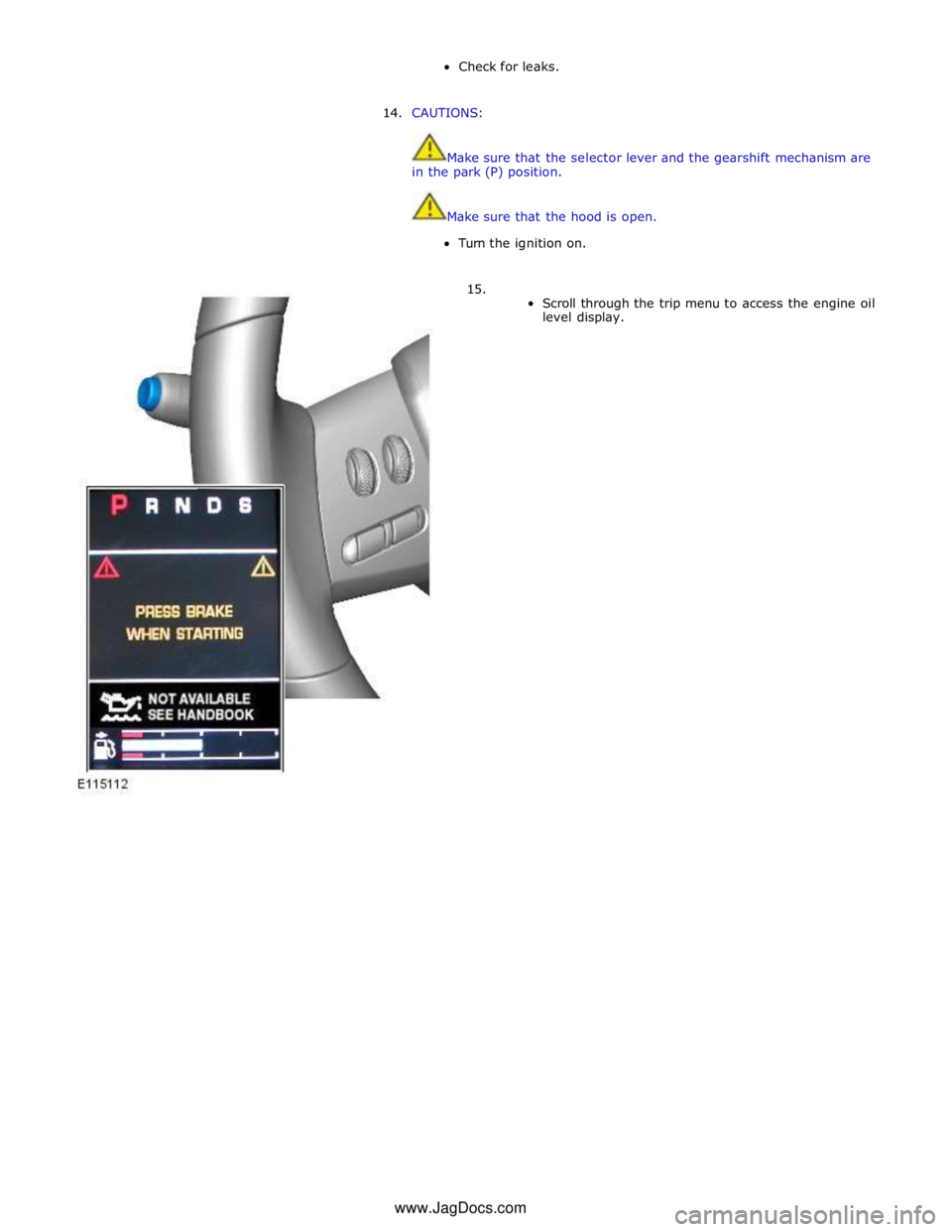
Check for leaks.
14. CAUTIONS:
Make sure that the selector lever and the gearshift mechanism are
in the park (P) position.
Make sure that the hood is open.
Turn the ignition on.
15.
Scroll through the trip menu to access the engine oil
level display. www.JagDocs.com
Page 1082 of 3039
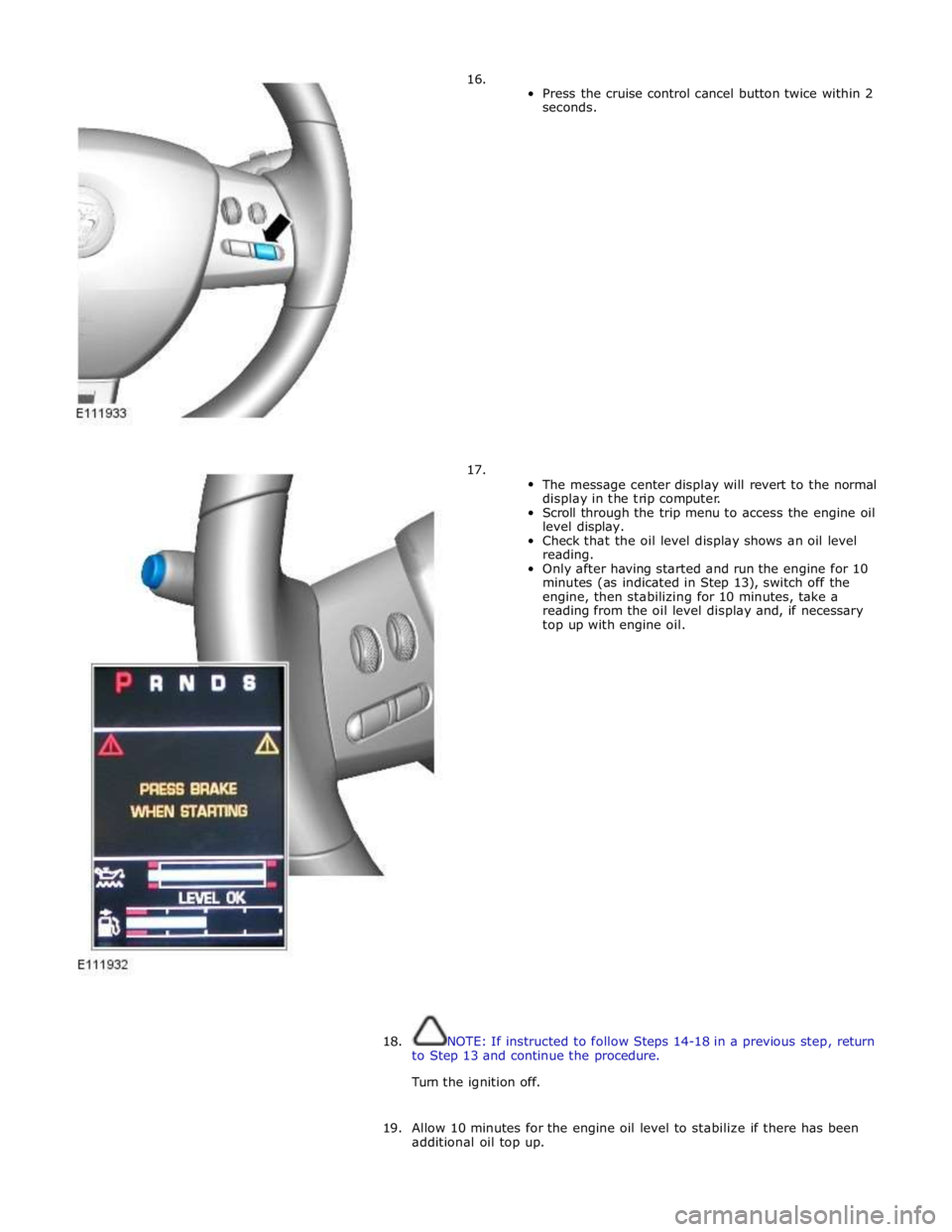
16.
17.
Press the cruise control cancel button twice within 2
seconds.
The message center display will revert to the normal
display in the trip computer.
Scroll through the trip menu to access the engine oil
level display.
Check that the oil level display shows an oil level
reading.
Only after having started and run the engine for 10
minutes (as indicated in Step 13), switch off the
engine, then stabilizing for 10 minutes, take a
reading from the oil level display and, if necessary
top up with engine oil.
18. NOTE: If instructed to follow Steps 14-18 in a previous step, return
to Step 13 and continue the procedure.
Turn the ignition off.
19. Allow 10 minutes for the engine oil level to stabilize if there has been
additional oil top up.
Page 1113 of 3039
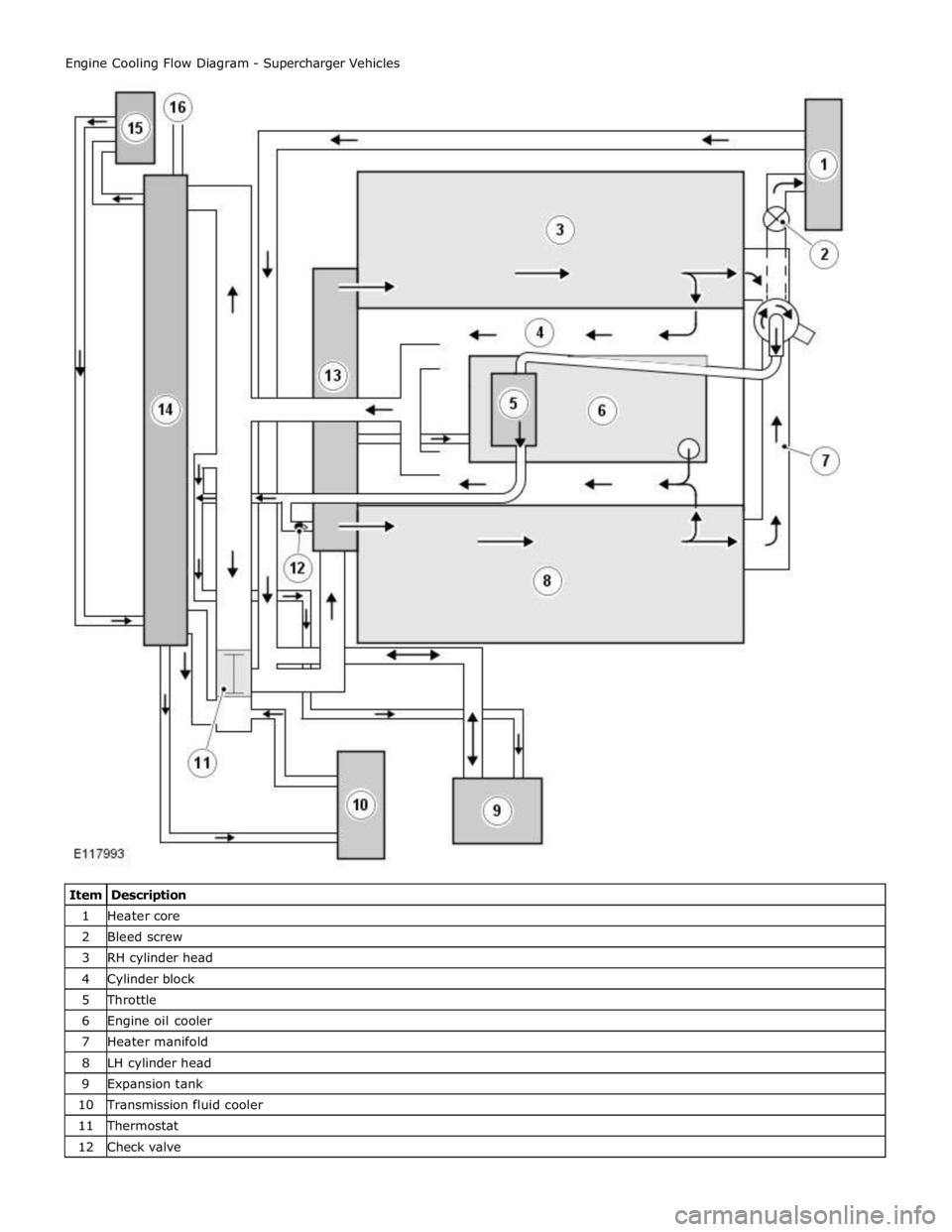
1 Heater core 2 Bleed screw 3 RH cylinder head 4 Cylinder block 5 Throttle 6 Engine oil cooler 7 Heater manifold 8 LH cylinder head 9 Expansion tank 10 Transmission fluid cooler 11 Thermostat 12 Check valve
Page 1115 of 3039
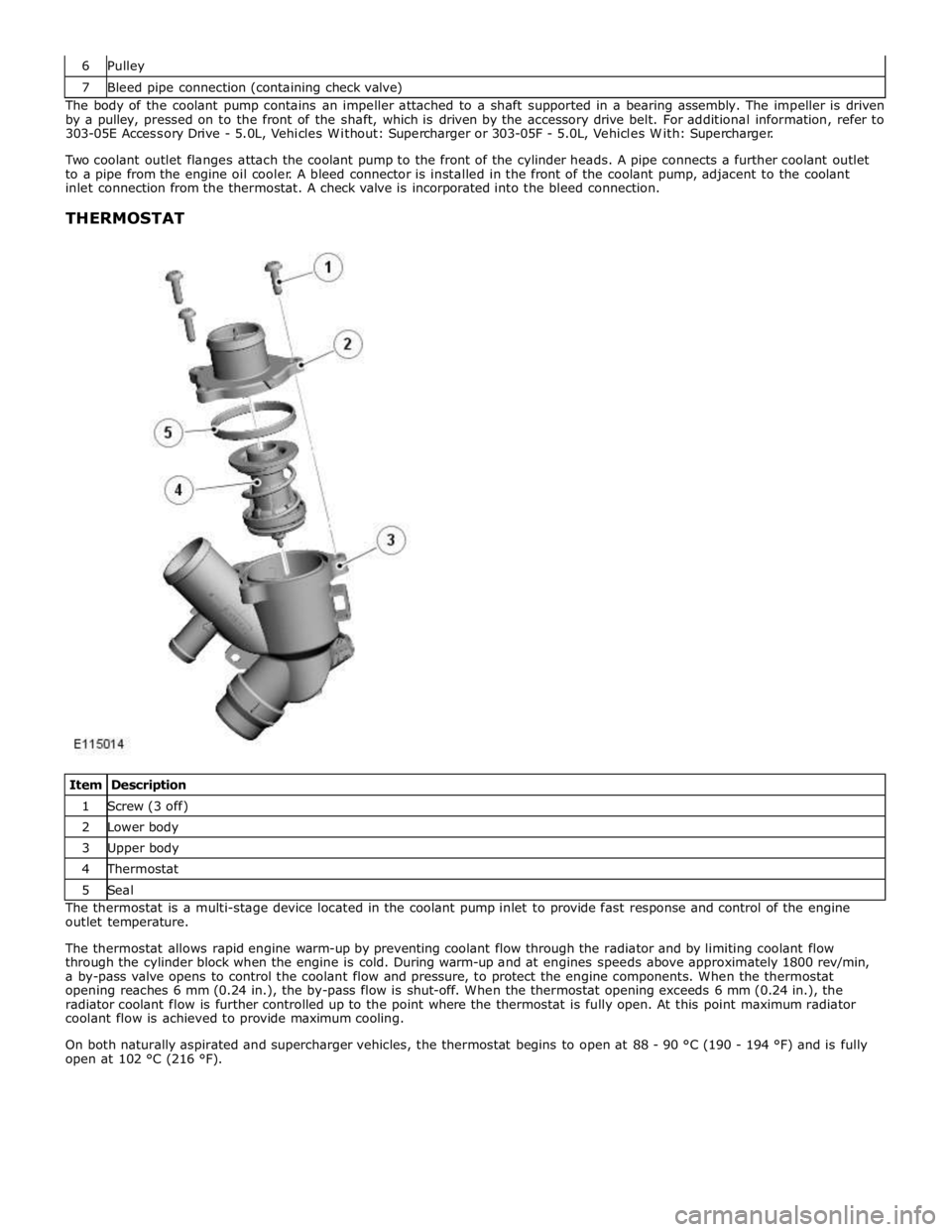
7 Bleed pipe connection (containing check valve) The body of the coolant pump contains an impeller attached to a shaft supported in a bearing assembly. The impeller is driven
by a pulley, pressed on to the front of the shaft, which is driven by the accessory drive belt. For additional information, refer to
303-05E Accessory Drive - 5.0L, Vehicles Without: Supercharger or 303-05F - 5.0L, Vehicles With: Supercharger.
Two coolant outlet flanges attach the coolant pump to the front of the cylinder heads. A pipe connects a further coolant outlet
to a pipe from the engine oil cooler. A bleed connector is installed in the front of the coolant pump, adjacent to the coolant
inlet connection from the thermostat. A check valve is incorporated into the bleed connection.
THERMOSTAT
Item Description 1 Screw (3 off) 2 Lower body 3 Upper body 4 Thermostat 5 Seal The thermostat is a multi-stage device located in the coolant pump inlet to provide fast response and control of the engine
outlet temperature.
The thermostat allows rapid engine warm-up by preventing coolant flow through the radiator and by limiting coolant flow
through the cylinder block when the engine is cold. During warm-up and at engines speeds above approximately 1800 rev/min,
a by-pass valve opens to control the coolant flow and pressure, to protect the engine components. When the thermostat
opening reaches 6 mm (0.24 in.), the by-pass flow is shut-off. When the thermostat opening exceeds 6 mm (0.24 in.), the
radiator coolant flow is further controlled up to the point where the thermostat is fully open. At this point maximum radiator
coolant flow is achieved to provide maximum cooling.
On both naturally aspirated and supercharger vehicles, the thermostat begins to open at 88 - 90 °C (190 - 194 °F) and is fully
open at 102 °C (216 °F).