Page 590 of 3039
Does the brake pedal return to its original position? Yes
No action required, vehicle is OK.
No
GO to K2. K2: CHECK FOR BRAKE PEDAL BINDING 1 Disconnect the brake booster from the brake pedal. Check the brake pedal to ensure free operation. Is the brake pedal operating freely? Yes
Install a new brake booster as required. REFER to:
Brake Booster (206-07 Power Brake Actuation, Removal and Installation), Brake Booster - RHD (206-07, Removal and Installation).
Re-test the system for normal operation.
No
Repair or install new brake pedal. Re-test the system for normal operation. Component Tests
Brake Booster
1. Check all hoses and connections. All unused vacuum connectors should be capped. Hoses and their connections should
be correctly secured and in good condition with no holes and no collapsed areas. Inspect the valve on the brake booster
for damage.
2. Check the hydraulic brake system for leaks or low fluid.
3. With the automatic transmission in PARK, stop the engine and apply the parking brake. Pump the brake pedal several
times to exhaust all vacuum in the system. With the engine switched off and all vacuum in the system exhausted,
apply the brake pedal and hold it down. Start the engine. If the vacuum system is operating, the brake pedal will tend
to move downward under constant foot pressure. If no motion is felt, the vacuum booster system is not functioning.
4. Remove the vacuum hose from the brake booster. Manifold vacuum should be available at the brake booster end of the
hose with the engine at idle speed and the automatic transmission in PARK. Make sure that all unused vacuum outlets
are correctly capped, hose connectors are correctly secured and vacuum hoses are in good condition. When it is
established that manifold vacuum is available to the brake booster, connect the vacuum hose to the brake booster and
repeat Step 3. If no downward movement of the brake pedal is felt, install a new brake booster.
5. Operate the engine for a minimum of 10 seconds at a fast idle. Stop the engine and allow the vehicle to stand for 10
minutes. Then, apply the brake pedal with approximately 89 N (20lb) of force. The pedal feel (brake application) should
be the same as that noted with the engine running. If the brake pedal feels hard (no power assist), install a new valve
and then repeat the test. If the brake pedal still feels hard, install a new brake booster. If the brake pedal movement
feels spongy, bleed the brake system.
REFER to: Brake System Bleeding (206-00 Brake System - General Information, General Procedures). Brake Master Cylinder
Usually, the first and strongest indicator of anything wrong in the brake system is a feeling through the brake pedal. In
diagnosing the condition of the brake master cylinder, check pedal feel as evidence of a brake concern. Check for brake warning
lamp illumination and the brake fluid level in the brake master cylinder reservoir.
Normal Conditions
The following conditions are considered normal and are not indications that the brake master cylinder is in need of repair.
Modern brake systems are designed to produce a pedal effort that is not as hard as in the past. Complaints of light
pedal efforts should be compared to the pedal efforts of another vehicle of the same model and year.
The fluid level will fall with brake pad wear.
Abnormal Conditions
Changes in the brake pedal feel or brake pedal travel are indicators that something could be wrong in the brake system. The
diagnostic procedure and techniques use brake pedal feel, warning indicator illumination and low brake fluid level as indicators
to diagnosing brake system concerns. The following conditions are considered abnormal and indicate that the brake master
cylinder is in need of repair:
NOTE: Prior to carrying out any diagnosis, make sure the brake system warning indicator is functional.
Brake pedal goes down fast. This could be caused by an external or internal leak.
Brake pedal goes down slowly. This could be caused by an internal or external leak.
Brake pedal is low or feels spongy. This condition may be caused by no fluid in the brake master cylinder, reservoir cap
vent holes clogged or air in the hydraulic system.
Brake pedal effort is excessive. This may be caused by a bind or obstruction in the pedal/linkage, a faulty non-return
valve, booster or insufficient booster vacuum.
Rear brakes lock up during light pedal force. This may be caused by damaged brake pads, a partially applied parking
brake, a damaged ABS sensor or bearing failure.
Brake pedal effort erratic. This condition could be caused by the brake booster or incorrectly installed brake pads.
Brake warning indicator is on. This may be caused by low fluid level or float assembly damaged. www.JagDocs.com
Page 591 of 3039
Non Pressure Leaks
Any reduced fluid volume in the brake master cylinder reservoir may be caused by two types of none pressure external leaks.
Type 1: An external leak may occur at the brake master cylinder reservoir cap because of incorrect positioning of the gasket
and cap. Reposition cap and gasket.
Type 2: An external leak may occur at the brake master cylinder reservoir mounting seals. Repair such a leak by installing new
seals and make sure that the brake master cylinder reservoir retaining bolt is correctly installed.
Page 594 of 3039

Brake System - General Information - Brake System Bleeding
General Procedures
CAUTIONS:
The brake fluid reservoir must remain full with new, clean brake fluid at all times during bleeding. Published: 11-May-2011
Brake fluid will damage paint finished surfaces. If spilled, immediately remove the fluid and clean the area with water.
NOTE:
All vehicles
1. WARNING: Do not work on or under a vehicle supported only by a
jack. Always support the vehicle on safety stands.
Raise and support the vehicle.
2. Check that the brake fluid lines are secure and that there are no signs of
a brake fluid leak. If a brake fluid leak is detected, investigate and
rectify the cause of the leak before bleeding the brakes.
3. Remove the brake master cylinder cover.
Carefully release the clip.
4. WARNING: Do not allow dirt or foreign liquids to enter
the reservoir. Use only new brake fluid of the correct
specification from airtight containers. Do not mix brands of
brake fluid as they may not be compatible.
CAUTION: Brake fluid will damage paint finished
surfaces. If spilled, immediately remove the fluid and clean
the area with water.
Remove the brake fluid reservoir cap.
Page 595 of 3039

5.
All vehicles Fill the brake fluid reservoir to the MAX mark.
6. Install the bleed tube to the right hand rear brake caliper bleed screw
and immerse the free end of the bleed tube in a bleed jar, containing a
small quantity of approved brake fluid.
Remove the bleed screw caps.
7. Loosen the bleed screw by one-half to three-quarters of a
turn.
8. CAUTION: The brake fluid reservoir must remain full with new, clean
brake fluid at all times during bleeding.
NOTE: If the bleed tube used, does not have a one way valve the
bleed screw will need to be closed before the brake pedal is returned to
the rest position. Then opened again and the procedure repeated for
each pedal application.
With assistance, depress the brake pedal steadily through its full stroke
and allow it to return to the rest position. Repeat the procedure until
brake fluid, clean and air-free flows into the bleed jar.
9. CAUTION: Make sure the bleed screw cap is installed after
bleeding. This will prevent corrosion to the bleed screw.
With the brake pedal fully depressed, tighten the bleed screw.
Vehicles with standard brakes: Tighten the front caliper bleed
screw to 8 Nm.
Vehicles with high performance brakes: Tighten the front caliper
bleed screw to 14 Nm.
Tighten the rear bleed screw to 14 Nm.
10. Fill the brake fluid reservoir to the MAX mark. www.JagDocs.com
Page 596 of 3039
Left-hand drive vehicles
11.
WARNING: Braking efficiency may be seriously
impaired if an incorrect bleed sequence is used.
Repeat the brake bleeding procedure for each brake
caliper, following the above sequence.
Right-hand drive vehicles
All vehicles
12.
WARNING: Braking efficiency may be seriously
impaired if an incorrect bleed sequence is used.
Repeat the brake bleeding procedure for each brake
caliper, following the above sequence.
13. Fill the brake fluid reservoir to the MAX mark.
14. Apply the brakes and check for leaks.
15. Install the brake fluid reservoir cap.
16. Install the brake master cylinder cover.
Carefully secure the clip.
Page 611 of 3039
Published: 02-May-2013
Front Disc Brake - TDV6 3.0L Diesel /V8 5.0L Petrol/V8 S/C 5.0L Petrol - Brake Caliper Vehicles With: High Performance Brakes
Removal and Installation
Removal
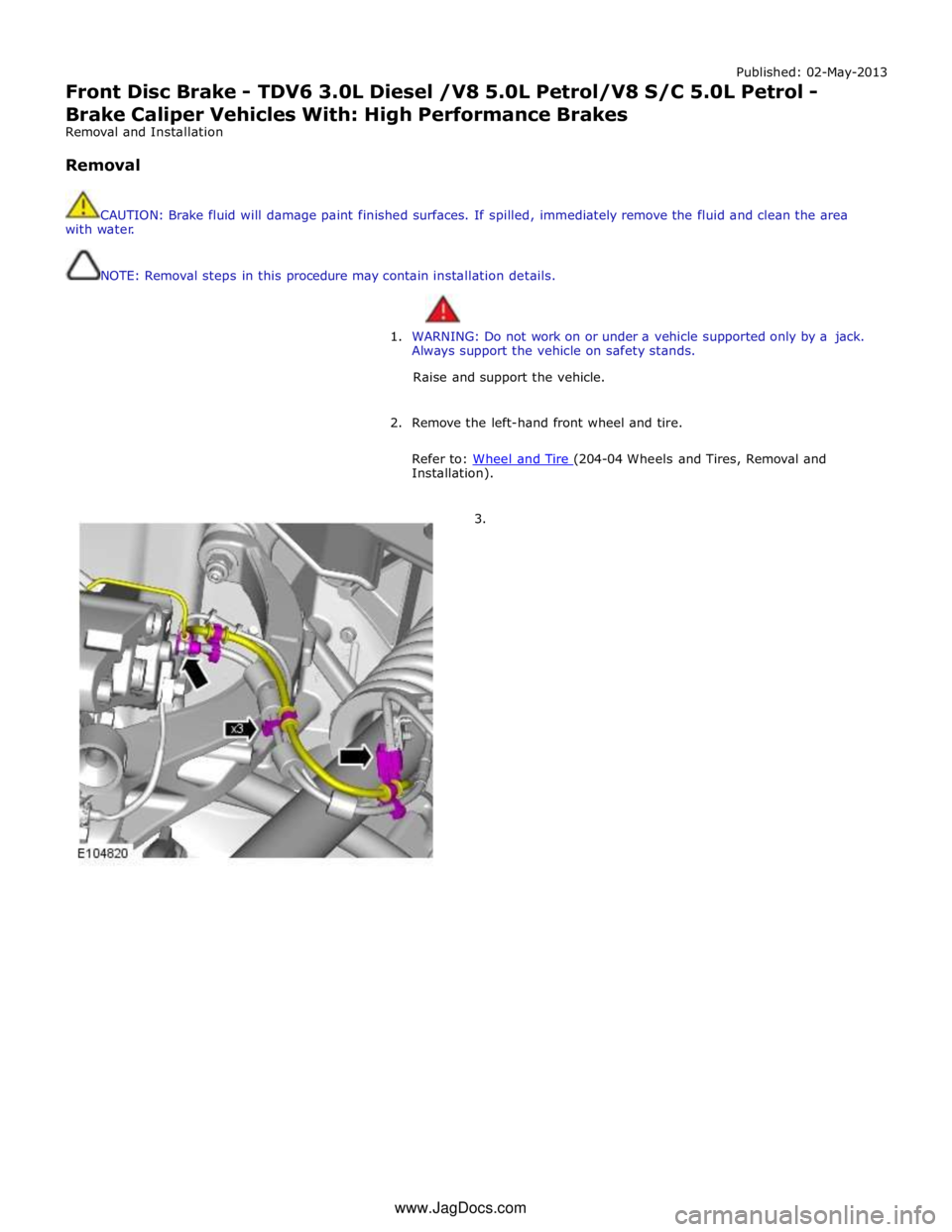
CAUTION: Brake fluid will damage paint finished surfaces. If spilled, immediately remove the fluid and clean the area
with water.
NOTE: Removal steps in this procedure may contain installation details.
1. WARNING: Do not work on or under a vehicle supported only by a jack.
Always support the vehicle on safety stands.
Raise and support the vehicle.
2. Remove the left-hand front wheel and tire.
Refer to: Wheel and Tire (204-04 Wheels and Tires, Removal and Installation).
3. www.JagDocs.com
Page 612 of 3039
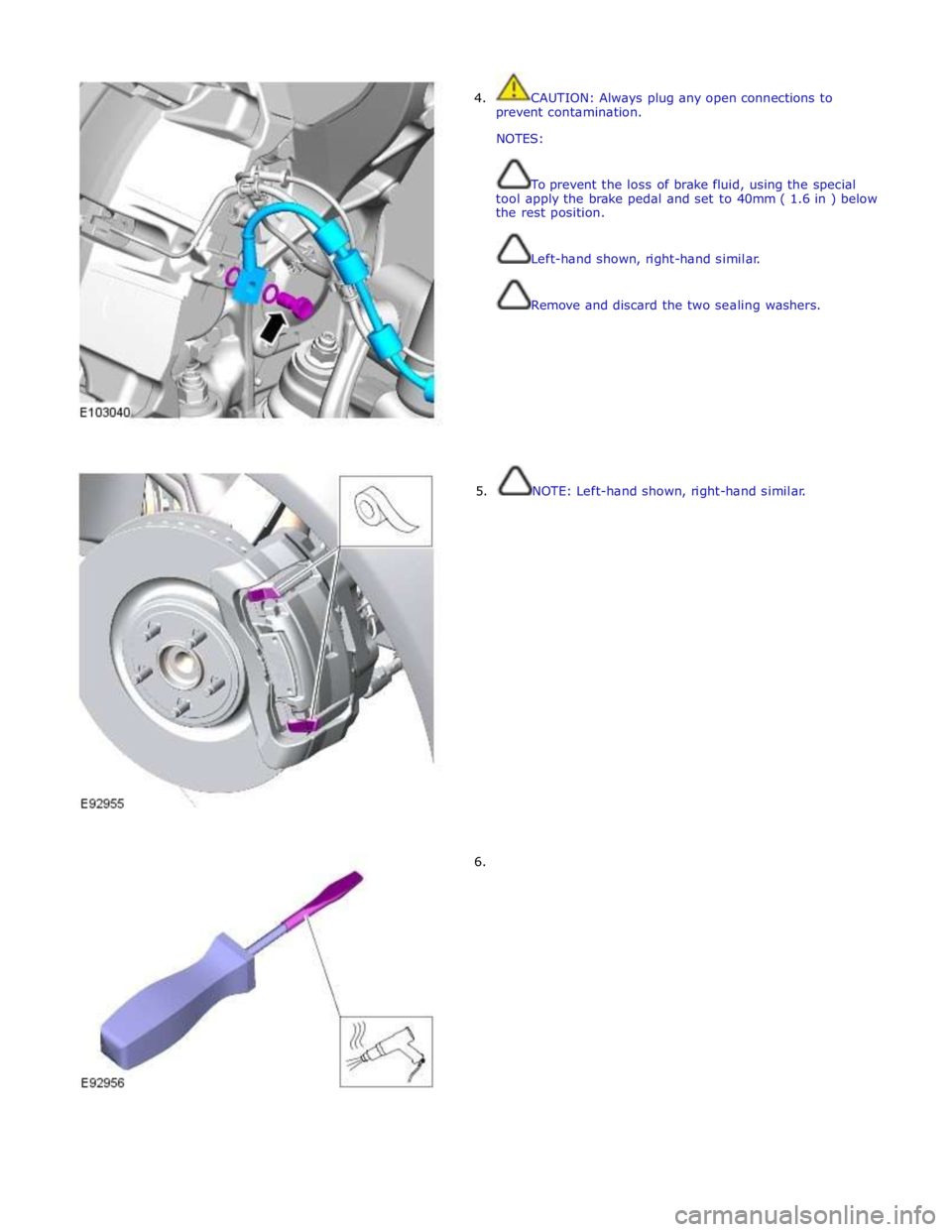
4. CAUTION: Always plug any open connections to
prevent contamination.
NOTES:
To prevent the loss of brake fluid, using the special
tool apply the brake pedal and set to 40mm ( 1.6 in ) below
the rest position.
Left-hand shown, right-hand similar.
Remove and discard the two sealing washers.
5. NOTE: Left-hand shown, right-hand similar.
6.
Page 614 of 3039
Installation
10.
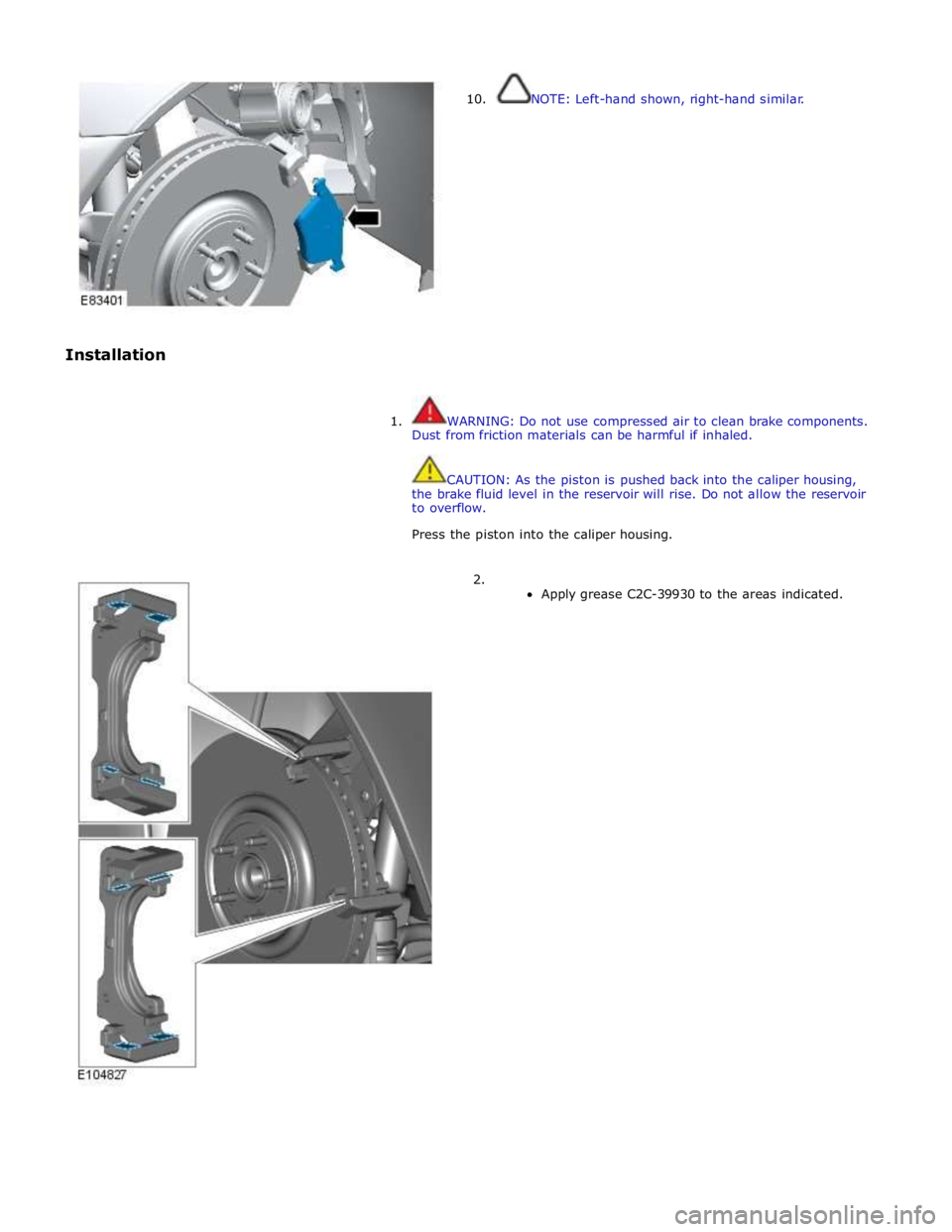
NOTE: Left-hand shown, right-hand similar.
1. WARNING: Do not use compressed air to clean brake components.
Dust from friction materials can be harmful if inhaled.
CAUTION: As the piston is pushed back into the caliper housing,
the brake fluid level in the reservoir will rise. Do not allow the reservoir
to overflow.
Press the piston into the caliper housing.
2.
Apply grease C2C-39930 to the areas indicated.