Page 355 of 450
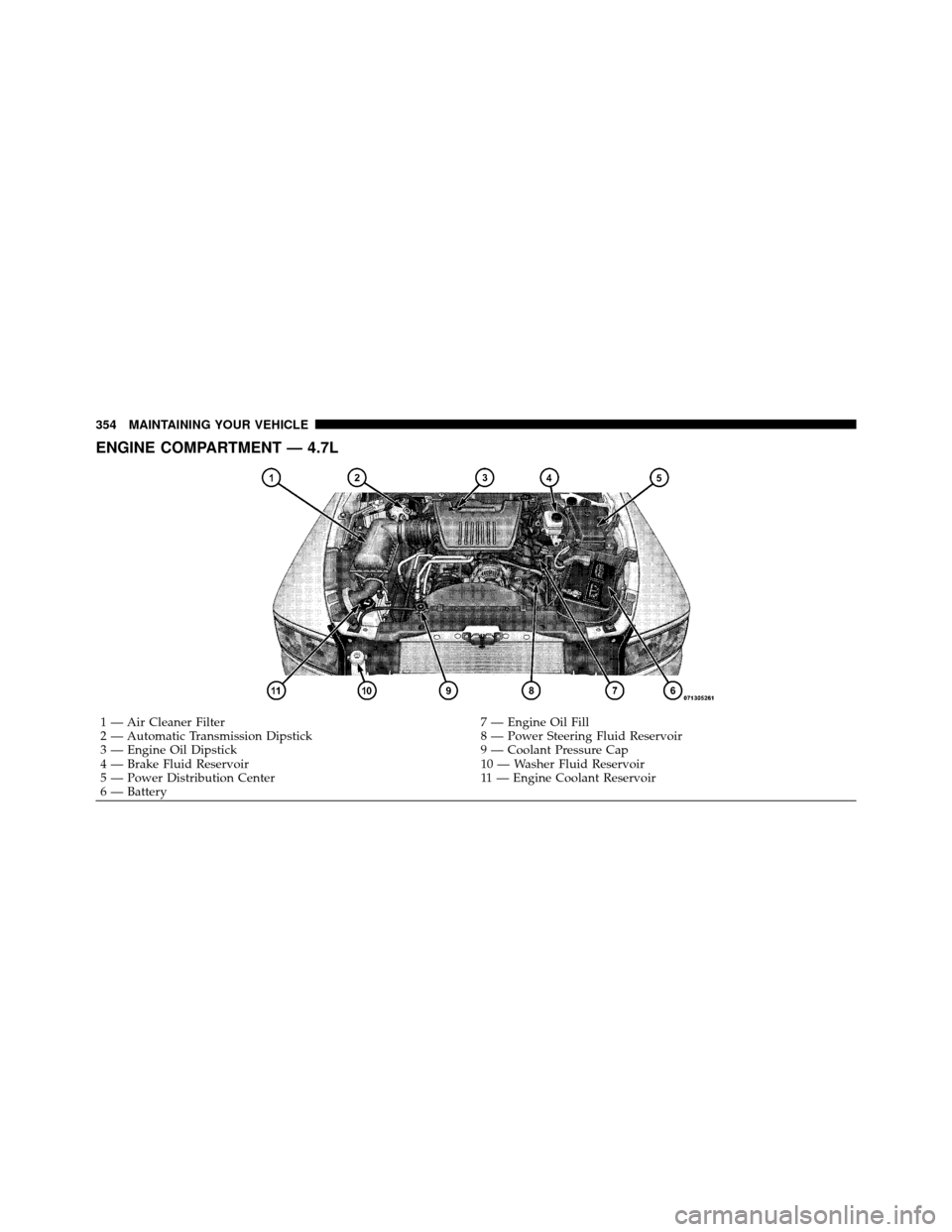
ENGINE COMPARTMENT — 4.7L
1 — Air Cleaner Filter7 — Engine Oil Fill
2 — Automatic Transmission Dipstick 8 — Power Steering Fluid Reservoir
3 — Engine Oil Dipstick 9 — Coolant Pressure Cap
4 — Brake Fluid Reservoir 10 — Washer Fluid Reservoir
5 — Power Distribution Center 11 — Engine Coolant Reservoir
6 — Battery
354 MAINTAINING YOUR VEHICLE
Page 357 of 450
the message will appear the next time the vehicle is
started. This might indicate a damaged cap. If the prob-
lem is detected twice in a row, the system will turn on the
MIL. Resolving the problem will turn the MIL off.
EMISSIONS INSPECTION AND MAINTENANCE
PROGRAMS
In some localities, it may be a legal requirement to pass
an inspection of your vehicle’s emissions control system.
Failure to pass could prevent vehicle registration.For states that require an Inspection and Mainte-
nance (I/M), this check verifies the “Malfunction
Indicator Light (MIL)” is functioning and is not
on when the engine is running, and that the OBD II
system is ready for testing.
Normally, the OBD II system will be ready. The OBD II
system may notbe ready if your vehicle was recently serviced, recently had a dead battery or a battery replace-
ment. If the OBD II system should be determined not
ready for the I/M test, your vehicle may fail the test.
Your vehicle has a simple ignition key-actuated test,
which you can use prior to going to the test station. To
check if your vehicle’s OBD II system is ready, you must
do the following:
1. Turn the ignition switch to the ON position, but do not
crank or start the engine.
2. If you crank or start the engine, you will have to start
this test over.
3. As soon as you turn the ignition switch to the ON
position, you will see the MIL symbol come on as part of
a normal bulb check.
356 MAINTAINING YOUR VEHICLE
Page 358 of 450

4. Approximately 15 seconds later, one of two things will
happen:a. The MIL will flash for about 10 seconds and then
return to being fully illuminated until you turn OFF
the ignition or start the engine. This means that your
vehicle’s OBD II system is not readyand you should
not proceed to the I/M station.
b. The MIL will not flash at all and will remain fully
illuminated until you turn OFF the ignition or start the
engine. This means that your vehicle’s OBD II system
is ready and you can proceed to the I/M station.
If your OBD II system is not ready,you should see your
authorized dealer or repair facility. If your vehicle was
recently serviced or had a battery failure or replacement,
you may need to do nothing more than drive your vehicle as you normally would in order for your OBD II
system to update. A recheck with the above test routine
may then indicate that the system is now ready.
Regardless of whether your vehicle’s OBD II system is
ready or not, if the MIL is illuminated during normal
vehicle operation you should have your vehicle serviced
before going to the I/M station. The I/M station can fail
your vehicle because the MIL is on with the engine running.
REPLACEMENT PARTS
Use of genuine MOPAR�
parts for normal/scheduled
maintenance and repairs is highly recommended to ensure
the designed performance. Damage or failures caused by
the use of non-MOPAR� parts for maintenance and repairs
will not be covered by the manufacturer’s warranty.
7
MAINTAINING YOUR VEHICLE 357
Page 363 of 450

Engine Air Cleaner Filter
Refer to “Maintenance Schedule” for further information.
WARNING!
The air cleaner can provide a measure of protection
in the case of engine backfire. Do not remove the air
cleaner unless such removal is necessary for repair or
maintenance. Make sure that no one is near the
engine compartment before starting the vehicle with
the air cleaner removed. Failure to do so can result in
serious personal injury.
Engine Air Cleaner Filter Selection
The quality of replacement engine air cleaner filters
varies considerably. Only high quality filters should be
used to assure most efficient service. MOPAR�engine air
cleaner filters are a high quality filter and are
recommended.
Maintenance-Free Battery
The top of the maintenance-free battery is permanently
sealed. You will never have to add water, nor is periodic
maintenance required.
WARNING!
•Battery fluid is a corrosive acid solution and can
burn or even blind you. Do not allow battery fluid
to contact your eyes, skin or clothing. Do not lean
over a battery when attaching clamps. If acid
splashes in eyes or on skin, flush the area imme-
diately with large amounts of water.
•Battery gas is flammable and explosive. Keep
flame or sparks away from the battery. Do not use
a booster battery or any other booster source with
an output greater than 12 volts. Do not allow cable
clamps to touch each other.
(Continued)
362 MAINTAINING YOUR VEHICLE
Page 364 of 450
WARNING! (Continued)
•Battery posts, terminals and related accessories
contain lead and lead compounds. Wash hands
after handling.
CAUTION!
•It is essential when replacing the cables on the
battery that the positive cable is attached to the
positive post, and the negative cable is attached to
the negative post. Battery posts are marked (+)
positive and (-) negative and are identified on the
battery case.
•If a “fast charger” is used while the battery is in
the vehicle, disconnect both vehicle battery cables
before connecting the charger to the battery. Do
not use a “fast charger” to provide starting voltage.
Air Conditioner Maintenance
For best possible performance, your air conditioner
should be checked and serviced by an authorized dealer
at the start of each warm season. This service should
include cleaning of the condenser fins and a performance
test. Drive belt tension should also be checked at this
time.
CAUTION!
Do not use chemical flushes in your air conditioning
system as the chemicals can damage your air condi-
tioning components. Such damage is not covered by
the New Vehicle Limited Warranty.
7
MAINTAINING YOUR VEHICLE 363
Page 391 of 450

VEHICLE STORAGE
If you are storing your vehicle for more than 21 days, we
recommend that you take the following steps to mini-
mize the drain on your vehicle’s battery:
•Disconnect the Ignition Off Draw (I.O.D.) fuses located
in the Power Distribution Center (PDC). The I.O.D.
cavity includes a snap-in retainer that allows the fuse
to be disconnected without removing it from the fuse
block.
•The transfer case should be placed in the 4HI mode
and kept in this position to minimize the battery drain.
•As an alternative to the above steps you may discon-
nect the negative cable from the battery.
REPLACEMENT BULBS
LIGHT BULBS – InteriorBulb No.
Dome Lamp ........................ WL212–2
Cargo Lamp ............................ 921
Overhead Console Lamps ................... 192
Reading Lamp ...................... WL212–2
LIGHT BULBS – Exterior Bulb No.
Headlamp ............................. H13
Front Park/Turn/Side Marker ............3157NA
Back-Up .............................. 3157
Center High Mounted Stop Lamp ............. 921
Fog Lamp ............................. 9145
License Plate Lamp ....................... 168
Rear Tail, Stop, Turn Signal .................3057
390 MAINTAINING YOUR VEHICLE
Page 406 of 450
•Change your engine oil more often if you drive your
vehicle off-road for an extended period of time.
•Under no circumstances should oil change intervals
exceed 6,000 miles (10,000 km) or six months, which-
ever comes first.
Your authorized dealer will reset the oil change indicator
message after completing the scheduled oil change. If a
scheduled oil change is performed by someone other
than your authorized dealer, the message can be reset by
referring to the steps described under “Electronic Vehicle
Information Center (EVIC)/Oil Change Required” in
“Understanding Your Instrument Panel” or under “In-
strument Cluster Description/Odometer/Trip Odom-
eter” in “Understanding Your Instrument Panel” for
further information. At Each Stop for Fuel
•Check the engine oil level about five minutes after a
fully warmed engine is shut off. Checking the oil level
while the vehicle is on level ground will improve the
accuracy of the oil level reading. Add oil only when
the level is at or below the ADD or MIN mark.
•Check the windshield washer solvent and add if
required.
Once a Month
•Check tire pressure and look for unusual wear or
damage.
•Inspect the battery, and clean and tighten the terminals
as required.
8
M A I
N T
E
N A
N CE
S
C
H E
D
U L
E
SMAINTENANCE SCHEDULES 405
Page 434 of 450

Special Additives...................... 378
Torque Converter ...................... 257
Axle Fluid ............................. 401
Axle Lubrication (Axle Fluid) ............... 379
Battery ............................... 362
Keyless Transmitter Replacement (RKE) ....... 25
Saving Feature (Protection) ............... 130
Belts, Seat ............................ 37,76
Body Mechanism Lubrication ............... 364
Box, Sound ............................ 229
B-Pillar Location ........................ 279
Brake Fluid ............................ 401
Brake System ........................ 270,374
Anti-Lock (ABS) .................... 270,271
Fluid Check .......................... 374
Master Cylinder ....................... 374
Parking ............................. 269
Warning Light ..................... 176,181Brake/Transmission Interlock
............... 253
Break-In Recommendations, New Vehicle ........ 74
Bulb Replacement ....................... 391
Bulbs, Light .......................... 77,390
Calibration, Compass ..................... 146
Camper ............................... 164
Capacities, Fluid ........................ 399
Caps, Filler Oil (Engine) .......................... 360
Power Steering ........................ 268
Radiator (Coolant Pressure) ............... 371
Car Washes ............................ 380
Carbon Monoxide Warning ............75,164,302
Cargo Light ............................ 133
Cargo (Vehicle Loading) ................... 309
Cellular Phone ........................ 86,237
Center High Mounted Stop Light ............ 395
Certification Label ....................... 309
10
INDEX 433