Page 396 of 530
Trailer and Trailer Tongue Weight
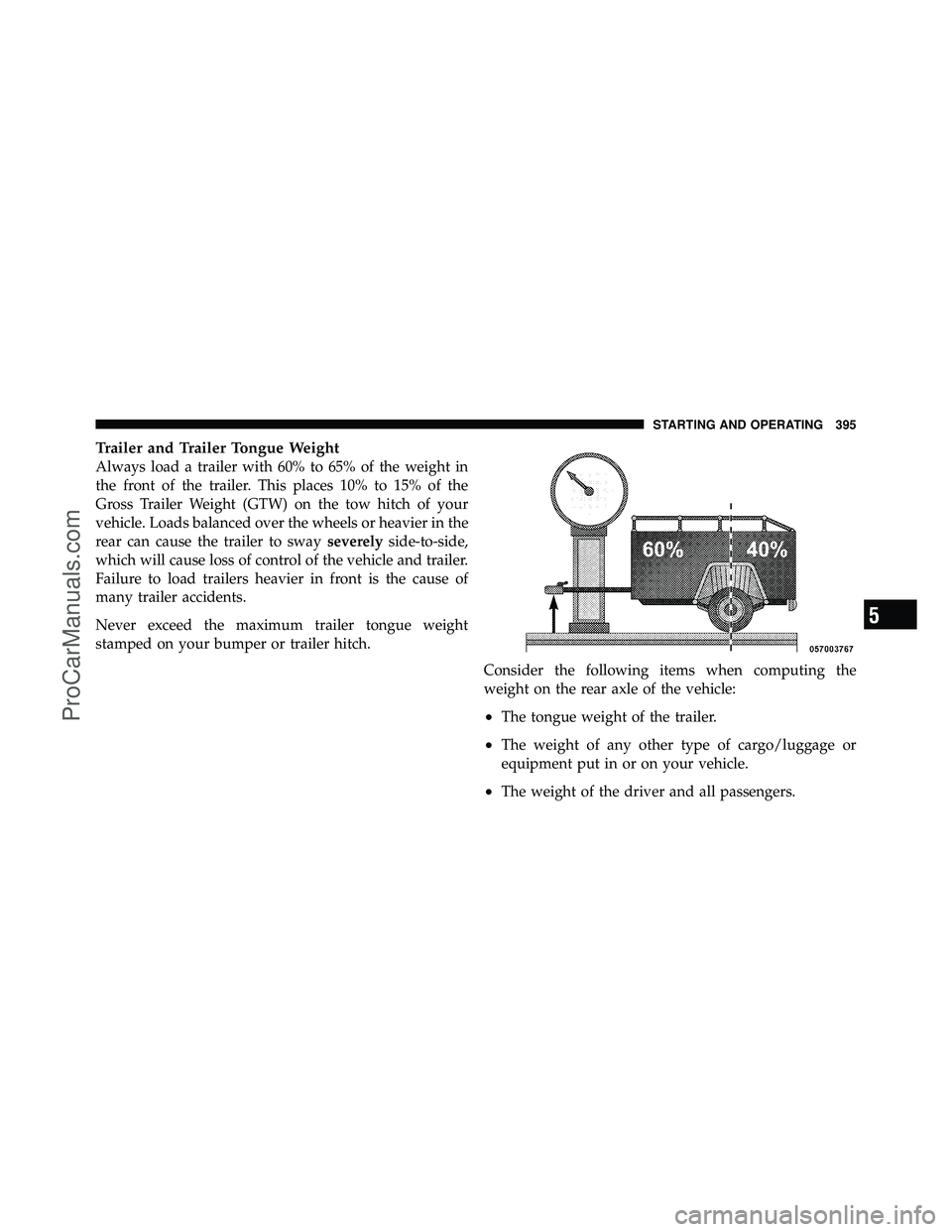
Always load a trailer with 60% to 65% of the weight in
the front of the trailer. This places 10% to 15% of the
Gross Trailer Weight (GTW) on the tow hitch of your
vehicle. Loads balanced over the wheels or heavier in the
rear can cause the trailer to swayseverelyside-to-side,
which will cause loss of control of the vehicle and trailer.
Failure to load trailers heavier in front is the cause of
many trailer accidents.
Never exceed the maximum trailer tongue weight
stamped on your bumper or trailer hitch.
Consider the following items when computing the
weight on the rear axle of the vehicle:
•The tongue weight of the trailer.
•The weight of any other type of cargo/luggage or
equipment put in or on your vehicle.
•The weight of the driver and all passengers.
5
STARTING AND OPERATING 395
ProCarManuals.com
Page 398 of 530
WARNING! (Continued)
•Make certain that the load is secured in the trailer
and will not shift during travel. When trailering
cargo that is not fully secured, dynamic load shifts
can occur that may be difficult for the driver to
control. You could lose control of your vehicle and
have an accident.
•When hauling cargo or towing a trailer, do not
overload your vehicle or trailer. Overloading can
cause a loss of control, poor performance or dam-
age to brakes, axle, engine, transmission, steering,
suspension, chassis structure or tires.
•Safety chains must always be used between your
vehicle and trailer. Always connect the chains to
the frame or hook retainers of the vehicle hitch.
Cross the chains under the trailer tongue and
allow enough slack for turning corners.(Continued)
WARNING! (Continued)
•Vehicles with trailers should not be parked on a
grade. When parking, apply the parking brake on
the tow vehicle. Put the tow vehicle automatic
transmission in PARK. Always, block or �chock�
the trailer wheels.
•GCWR must not be exceeded.
•Total weight must be distributed between the tow
vehicle and the trailer such that the following four
ratings are not exceeded:
1. GVWR
2. GTW
3. GAWR
(Continued)
5
STARTING AND OPERATING 397
ProCarManuals.com
Page 404 of 530
Cooling System
To reduce potential for engine and transmission over-
heating, take the following actions:
•City Driving
When stopped for short periods of time, shift the trans-
mission into NEUTRAL but do not increase engine idle
speed.
•Highway Driving
Reduce speed.
•Air Conditioning
Turn off temporarily.
RECREATIONAL TOWING
(BEHIND MOTORHOME, ETC.)
CAUTION!
Towing this vehicle behind another vehicle (flat-
towing with all four wheels on the ground) is not
recommended.
NOTE: If the vehicle requires towing, make sure all four
wheels are off the ground.
5
STARTING AND OPERATING 403
ProCarManuals.com
Page 406 of 530
WHAT TO DO IN EMERGENCIES
CONTENTS
�Hazard Warning Flasher ................ 406
� If Your Engine Overheats ................ 406
� Jacking And Tire Changing ............... 407
▫ Jack Location ....................... 408
▫ Spare Tire Removal ................... 409
▫ Preparations For Jacking ............... 410
▫ Jacking Instructions ................... 410
▫ Wheel Nuts ........................ 419 ▫
Secure The Spare Tire ................. 419
� Jump-Starting Procedure ................ 421
▫ Preparations For Jump-Start ............. 422
▫ Jump-Starting Procedure ............... 423
� Freeing A Stuck Vehicle ................. 425
� Towing A Disabled Vehicle ............... 426
▫ Towing With The Ignition Key ........... 426
6
ProCarManuals.com
Page 411 of 530
Preparations For Jacking
1. Park the vehicle on a firm, level surface. Avoid ice or
slippery areas.
WARNING!
Do not attempt to change a tire on the side of the
vehicle close to moving traffic. Pull far enough off
the road to avoid being hit when operating the jack
or changing the wheel.
2. Set the parking brake.
3. Place the shift lever into PARK.
4. Turn OFF the ignition.
5. Turn on the Hazard Warning flasher. 6. Block both the front and rear of the
wheel diagonally opposite the jacking
position. For example, if changing the
right front tire, block the left rear
wheel.
NOTE: Passengers should not remain in the vehicle
when the vehicle is being jacked.
Jacking Instructions
WARNING!
Carefully follow these tire changing warnings to help
prevent personal injury or damage to your vehicle:
•Always park on a firm, level surface as far from
the edge of the roadway as possible before raising
the vehicle.
(Continued)
410 WHAT TO DO IN EMERGENCIES
ProCarManuals.com
Page 412 of 530
WARNING! (Continued)
•Block the wheel diagonally opposite the wheel to
be raised.
•Set the parking brake firmly and set an automatic
transmission in PARK; a manual transmission in
REVERSE.
•Never start or run the engine with the vehicle on a
jack.
•Do not let anyone sit in the vehicle when it is on a
jack.
•Do not get under the vehicle when it is on a jack.
•Only use the jack in the positions indicated and
for lifting this vehicle during a tire change.
•If working on or near a roadway, be extremely
careful of motor traffic.(Continued)
WARNING! (Continued)
•To assure that spare tires, flat or inflated, are
securely stowed, spares must be stowed with the
valve stem facing the ground.
•Turn on the Hazard Warning flasher.
Jack Warning Label
6
WHAT TO DO IN EMERGENCIES 411
ProCarManuals.com
Page 413 of 530
1. Loosen (but do not remove) the wheel lug nuts by
turning them to the left one turn while the wheel is still
on the ground.
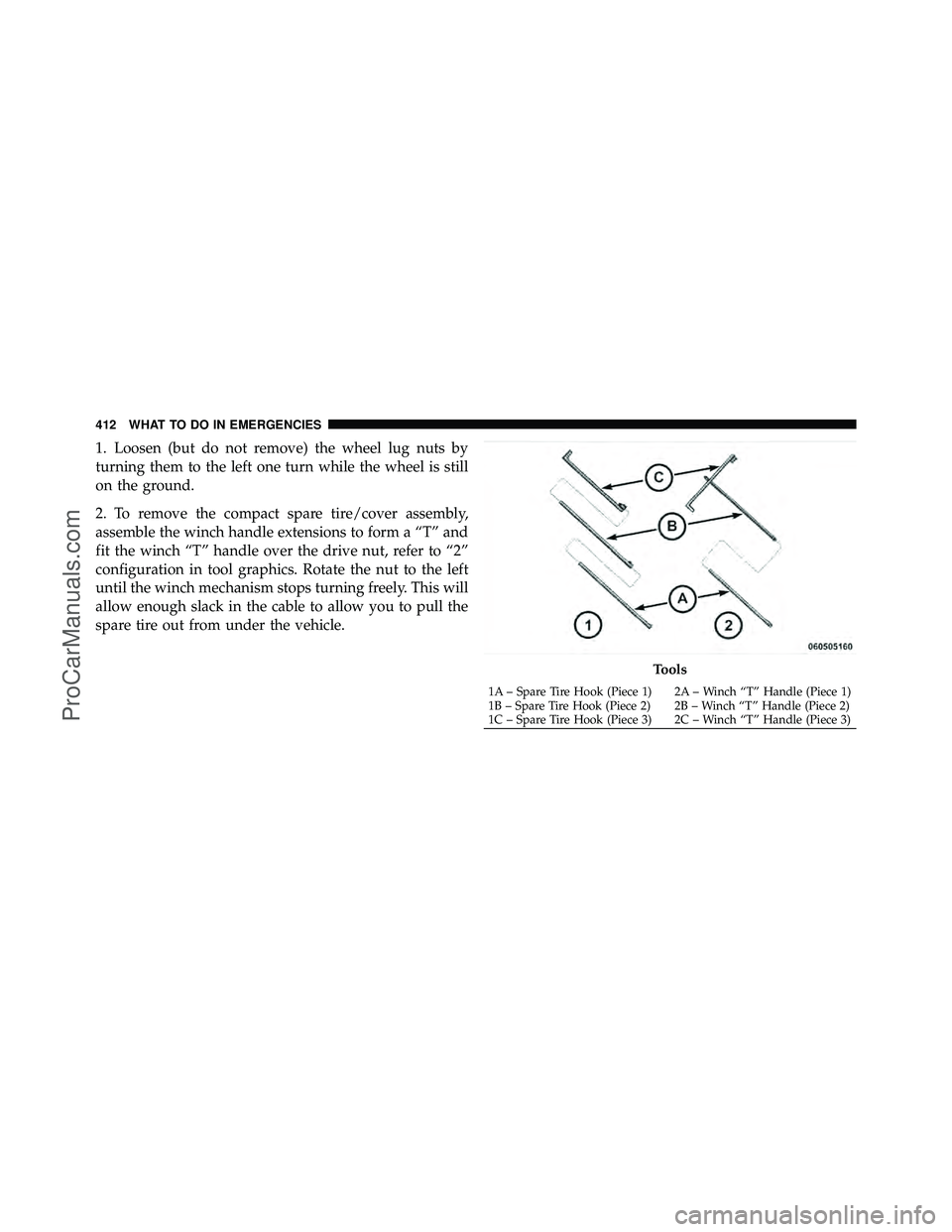
2. To remove the compact spare tire/cover assembly,
assemble the winch handle extensions to form a “T” and
fit the winch “T” handle over the drive nut, refer to “2”
configuration in tool graphics. Rotate the nut to the left
until the winch mechanism stops turning freely. This will
allow enough slack in the cable to allow you to pull the
spare tire out from under the vehicle.
Tools
1A – Spare Tire Hook (Piece 1) 2A – Winch “T” Handle (Piece 1)
1B – Spare Tire Hook (Piece 2) 2B – Winch “T” Handle (Piece 2)
1C – Spare Tire Hook (Piece 3) 2C – Winch “T” Handle (Piece 3)
412 WHAT TO DO IN EMERGENCIES
ProCarManuals.com
Page 415 of 530
WARNING!
Getting under a jacked-up vehicle is dangerous. The
vehicle could slip off the jack and fall on you. You
could be crushed. Never get any part of your body
under a vehicle that is on a jack. If you need to get
under a raised vehicle, take it to a service center
where it can be raised on a lift.
NOTE: If either front tire is flat, it may be necessary to
jack up the vehicle to remove the compact spare tire/
cover assembly from under the vehicle. Refer to jack
engagement locations in the following steps for proper
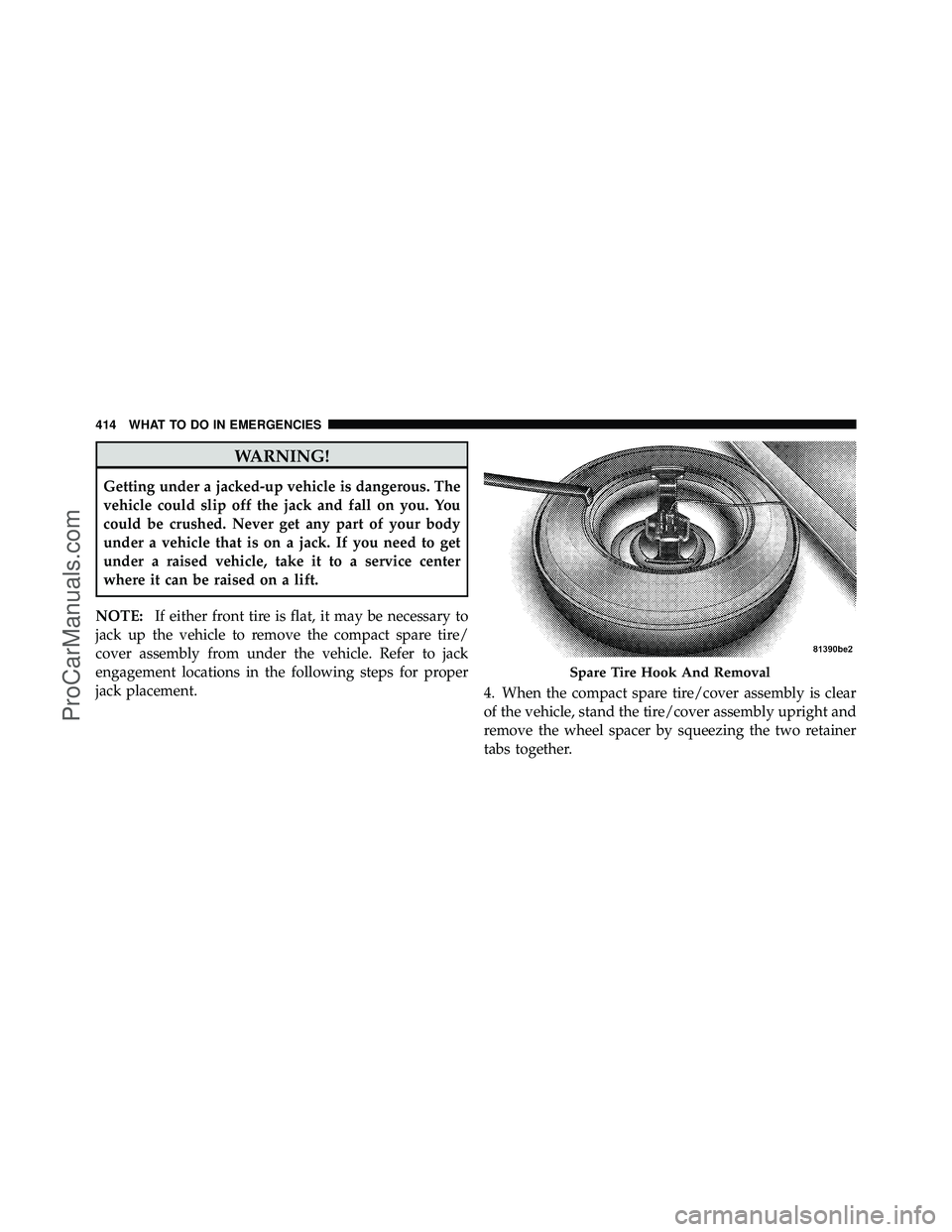
jack placement. 4. When the compact spare tire/cover assembly is clear
of the vehicle, stand the tire/cover assembly upright and
remove the wheel spacer by squeezing the two retainer
tabs together.
Spare Tire Hook And Removal
414 WHAT TO DO IN EMERGENCIES
ProCarManuals.com